


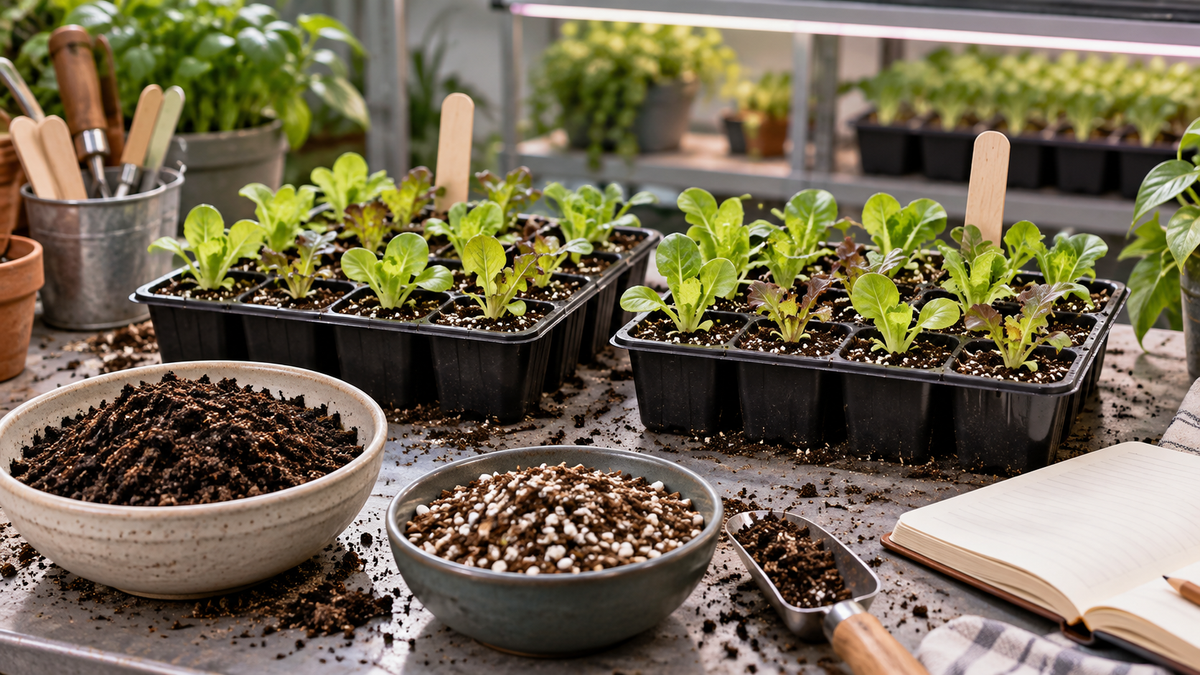
GEME Compost Base · Small-Batch Curing · Seedling Preparation
Prepare a small, screened batch with airflow and suitable moisture, then check the seedling mix you actually intend to use. That gives harvested GEME Compost Base a defined route from kitchen processing to a carefully observed garden trial.
GEME handles real microbial decomposition inside the appliance. Seedling preparation is a later task: the batch’s condition, the growing medium and the crop all matter. Keep the main sowing in a purpose-made seed-starting mix while you assess an amended trial.

Quick Answer: How Should You Prepare Compost Base for Seedlings?
- Harvest and screen: retain GEME’s active bed and return suitable unfinished pieces.
- Cure a separate batch: use a breathable container, maintain moisture and stop adding fresh inputs to that batch.
- Check its condition: look for continuing activity, poor odors, clumping or drying before considering a trial.
- Compare the intended growing mix with a control: observe emergence and early growth using the same seed lot.
GEME’s approximately 1:8 garden-soil blend is not a validated seed-starting recipe. Do not sow into pure Compost Base or assume one passing home comparison establishes suitability for every crop.
The GEME application guide advises particular care with seedlings. University of Minnesota Extension recommends purpose-made seed-starting media for germination. This guide adds a small-batch preparation and observation workflow between those two tasks.
1. Seed Starting and Garden-Soil Application Are Different Tasks
A germinating seed in a small cell has different needs from an established plant in a bed. Decide whether you are sowing seeds, growing on established seedlings or amending garden soil before choosing the material and application.
| Your task | Practical starting point |
|---|---|
| Sow seeds in cells or plugs | Use a reputable seed-starting medium for the main sowing. Assess any Compost Base amendment in a separate small trial. |
| Grow on established seedlings | Use a suitable transplant medium; evaluate the specific crop and proposed amendment before expanding use. |
| Amend a garden bed or established planting | Follow the GEME screening, soil-blending and protective-cap guidance for that application. |
The general GEME soil-use workflow uses approximately one part screened Compost Base to eight parts plain soil and cautions about sensitive plants. A recipe for a bed does not establish the drainage, salinity or suitability of a propagation medium.
Penn State Extension’s propagation guide identifies compost maturity and soluble salts as considerations for mixes used to raise seedlings. Time spent curing and the amount used in a mix are separate variables.

2. Prepare a Separate, Traceable Curing Batch
Take out only the amount you can manage and observe. Leave the active bed in GEME so the household’s suitable kitchen-scrap routine can continue.
Screen Before Storing
Use a clean garden sieve or careful hand sorting to separate larger unfinished organic pieces. Return suitable pieces to the appliance under GEME guidance. Remove any packaging fragments. Fine particle size helps prepare a consistent batch, but screening does not prove maturity.
Keep Air Available
Place the screened material loosely in a clean, breathable container, such as a vented container or woven sack, in a sheltered location. Protect it from heavy rain, contamination and extremes of drying. Keep it separate from food-preparation areas and use dedicated gardening tools.
Maintain Moisture Without Waterlogging
Check for uneven wet clumps or a completely dry crust. Gently loosen compacted material and maintain damp conditions rather than sealing a wet mass in an airtight bag. Cornell’s moisture guidance explains why both excessive water and drying can restrict the biological process.
Keep the Batch Closed to Fresh Inputs
Label the harvest date and do not keep topping up the curing container with new food scraps or newer output. A separate batch is easier to assess than a container whose contents keep changing. A weekly reminder can help you make consistent observations; it is a recordkeeping interval, not a maturity deadline.

How Long Should Curing Take?
There is no verified GEME-specific number of days that makes every batch suitable for seed starting. The EPA’s general home-composting guide describes further curing after active decomposition, while Cornell’s composting FAQ emphasizes that readiness depends on intended use. Track the batch’s condition and evaluate the actual growing mix rather than promising readiness on a fixed date.
3. Check the Batch Before Making a Seedling Trial
Use several observations together. A tiny batch can remain near room temperature because it cannot retain much heat; a dry batch may appear inactive because moisture is limiting activity.
On smaller screens, scroll horizontally to read all checks.
| Check | What to observe | What it means for the next step |
|---|---|---|
| Recognizable unfinished material | Fresh-looking food pieces or dense fibrous clumps. | Screen and separate unfinished pieces; do not put them into the trial mix. |
| Odor and aeration | Persistent sour or ammonia-like odor, or a compacted wet mass. | Hold seedling use and correct the storage conditions. Investigate persistent problems. |
| Moisture | Dry crusts, dusty pockets or soggy material. | Restore appropriate conditions before judging progress. |
| Continuing activity | Noticeable renewed warmth or material still changing rapidly after gentle mixing. | Allow more preparation time; cool temperature alone is not proof of maturity. |
| Salt and pH suitability | Cannot be established from appearance or smell. | Use a suitable media analysis when uncertain; interpret results for the crop and test method. |
Curing does not establish that soluble salts have fallen to a suitable level. If salinity is the concern, more waiting alone is not a reliable correction. Penn State describes testing a propagation medium for pH, electrical conductivity and nutrients. Ask the laboratory for an appropriate growing-media test; numbers from different extraction methods should not be compared as if they were equivalent.
For the broader distinction between an active amendment and a finished material, see GEME Compost Base vs finished compost and when compost is ready to use.

4. Compare the Actual Candidate Mix With a Control
Test the medium you propose to use, not pure Compost Base as a stand-in for that mixture. If you do not have a crop-appropriate formulation, use a purpose-made seed-starting mix and reserve the Compost Base for a supported later application.
The following is a practical home comparison adapted from the principles in Cornell’s plant-growth experiments: replicate treatments, hold growing conditions consistent and record emergence and growth. It is not a validated GEME germination protocol, a laboratory germination-index test or a completed product trial.
| Group | Growing medium | Record |
|---|---|---|
| Control | The chosen seed-starting medium without added Compost Base. | Seed lot, medium, cell size and sowing date. |
| Candidate | Your intended amended medium, with the exact ingredients and proportions written down. | Compost Base batch, preparation history and complete mix. |
| Both groups | Matching containers, seeds and growing conditions; more than one container per treatment. | Emergence, growth, watering and any unexpected symptoms. |
- Choose one seed lot. Use the same crop and packet for both groups; keep the main planting separate.
- Make repeat groups. For a manageable home layout, you could use two groups of ten cells per treatment, with one seed per cell. This is a sample layout, not a statistical certification standard.
- Label everything. Include batch ID, ingredients, proportions and sowing date.
- Use comparable conditions. Follow the seed packet for depth, temperature and timing; provide consistent light and appropriate moisture. Avoid grouping all controls in a warmer or brighter position.
- Count emerged seedlings. Check through the crop’s expected emergence window. Record the count for each repeat separately.
- Continue observing. Compare early leaf development, vigor and root development in spare test plugs. Record differences in moisture retention or damage.
Matching emergence counts do not settle every question. A mix may allow seeds to emerge but perform differently during early growth. Keep the observation period and crop in your interpretation.
5. Decide Whether to Continue Curing, Trial Carefully or Investigate
| Result | Next action | What the result does not establish |
|---|---|---|
| Batch remains wet, strongly odorous or visibly unfinished | Hold seedling use, improve preparation conditions and recheck. | A fixed waiting period cannot override the observed condition. |
| The control also performs poorly | Check seed quality, light, moisture, temperature and technique; repeat with a functioning control. | The Compost Base alone cannot be identified as the cause. |
| Candidate performs noticeably worse | Do not expand use. Review the formulation, maturity, salinity and physical properties; seek media testing where appropriate. | More curing is not automatically the right correction. |
| Both perform similarly with healthy early growth | Continue a limited, observed use of that crop and mix; retain the batch record. | The result does not certify other crops, new batches or freedom from contaminants. |
| Valuable planting or uncertain material | Use the purpose-made medium for the main planting and get appropriate advice or analysis before expanding the amended mix. | A handful of seedlings cannot replace the relevant material tests. |
A home comparison is most useful when it helps you make a smaller, better-informed next step. It should not become a reason to ignore a result that differs from what you hoped to see.
6. Keep a Small-Batch Record
Copy this log for each separately harvested batch. Repeating a successful recipe is easier when you know the material and conditions that produced the result.
| Field | What to record | Your notes |
|---|---|---|
| Batch identity | Harvest date, model, known input history and batch ID. | |
| Preparation | Screening, container, location, moisture and observation dates. | |
| Before trial | Odor, unfinished material, activity and any media analysis. | |
| Trial setup | Crop and seed lot; complete mix; control; repeats; sowing date. | |
| Observation | Emergence by repeat, early growth and watering differences. | |
| Decision | Hold, revise, investigate or continue a limited trial. |
For a sample sent to a laboratory, follow its collection and submission instructions. The garden soil testing guide explains the value of testing, but a seedling medium may require a different analysis from a garden-soil sample.
7. Keep the Kitchen-to-Garden Routine Going With GEME
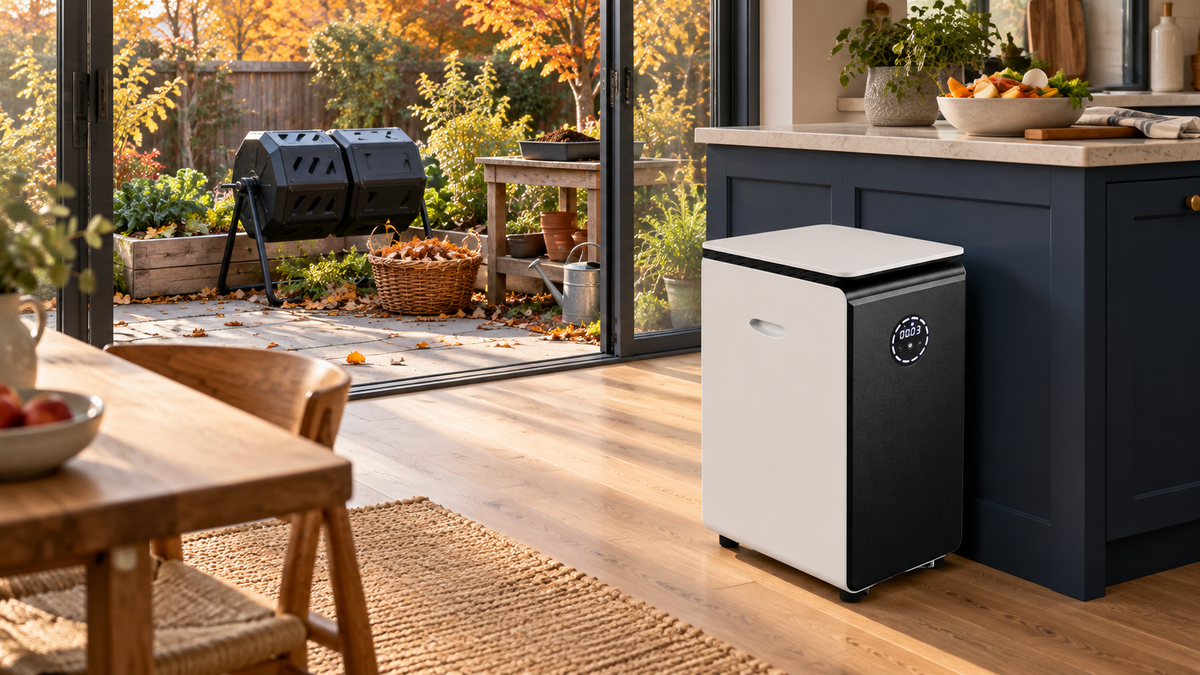
GEME’s advantage is that kitchen processing can continue while you prepare a harvested batch for a particular garden task. You keep the living bed in the chamber and manage the harvested material separately.
Terra 2 combines a 14 L microbial chamber, up to 2 kg/day of suitable input and GEMEBrain adaptive control. GEME Pro offers a 19 L chamber and up to 5 kg/day for heavier suitable daily loads. Both use continuous, divided additions and a maximum of 1 kg per addition in established operation.
Choose the machine by your kitchen workload. The larger Pro capacity does not mean its output automatically needs a different seedling recipe. Both models’ harvested Compost Base should be prepared and assessed for the intended use.

Use the official manual for appliance operation, the Compost Base application guide for supported soil uses and the Gardening Hub for the next planting task.
Real Microbial Composting · A Clear Garden Workflow
Turn Daily Kitchen Scraps Into a Garden Resource
Choose GEME for continuous microbial processing, then prepare each harvested batch for the plants you want to grow.
8. Frequently Asked Questions
Can I sow seeds directly into fresh GEME Compost Base?
Do not use pure Compost Base as a seed-starting medium. Keep the main sowing in a suitable purpose-made medium while you prepare and assess a separate amended trial.
How long should I cure Compost Base for seedlings?
There is no verified universal GEME seedling-curing duration. Keep a separate batch under suitable conditions, observe its progress and assess the actual intended growing mix. Do not use elapsed days as the only readiness test.
Is GEME’s 1:8 soil ratio a seed-starting recipe?
No. The approximately 1:8 plain-soil blend belongs to GEME’s general soil-application guidance. It does not establish that the same mixture is suitable for seed germination or every propagation container.
Does drying Compost Base make it mature?
Drying does not establish maturity. Lack of moisture can suppress biological activity, so a dry, inactive-looking batch still needs appropriate assessment.
Does more curing remove excess salts?
More time alone does not establish a suitable salt level. If salinity is a concern, have the intended growing medium tested and interpret the result for the crop and test method.
What should the home comparison measure?
Compare emergence and early growth in the intended candidate mix with an unamended control, using the same seed lot and comparable growing conditions. Keep repeat groups and record results separately.
Does a successful home trial prove the batch is safe for all seedlings?
No. It offers limited evidence about the tested crop, mix, batch and conditions. It does not certify other crops or provide a contaminant, pathogen or laboratory maturity result.
Does Terra 2 Compost Base need different checks from Pro output?
Use the same application-based questions for both models: batch condition, intended medium, crop and growing stage. Processing capacity alone does not establish a different seedling-use recipe.
9. Sources and Scope
Sources reviewed October 15, 2026. This guide provides a preparation and observation framework. It does not present measured seedling outcomes or a validated GEME propagation recipe.
- GEME Compost Base Application GuideScreening, separate output handling and caution with seedlings.
- GEME Official ManualRetaining the microbial bed, operation and harvesting.
- University of Minnesota Extension: Starting Seeds IndoorsSeed-starting media, containers and crop-specific growing conditions.
- Penn State Extension: Potting Media and Plant PropagationCompost quality, soluble salts and growing-media testing.
- Cornell Composting: Plant Growth ExperimentsReplicated comparisons and observation of germination and plant growth.
- Cornell Composting: Monitoring Compost MoistureWhy moisture and air affect biological activity.
- Cornell Composting: Frequently Asked QuestionsReadiness depends on the intended use of the compost.
- US EPA: Composting at HomeGeneral finishing and curing context, not a GEME-specific seedling protocol.


Leave a comment
All comments are moderated before being published.
This site is protected by hCaptcha and the hCaptcha Privacy Policy and Terms of Service apply.