


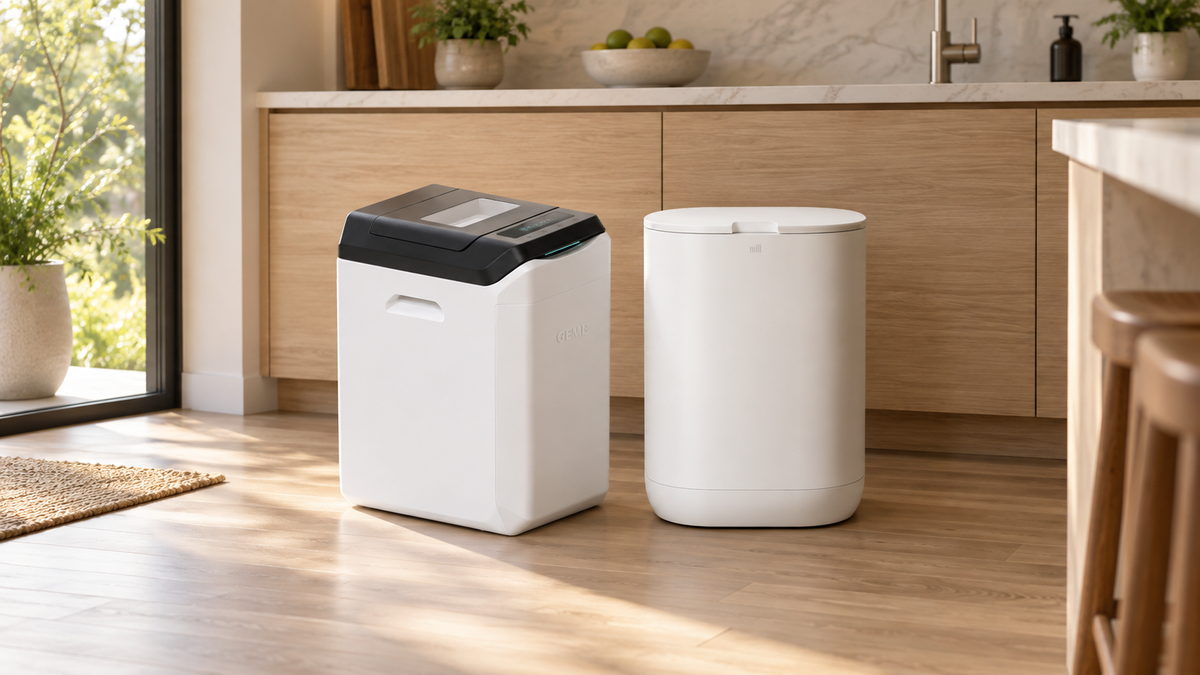
Mill Food Grounds · Microbial composting · 2026
Does Mill really compost? No. Mill dries and grinds food scraps into what it calls Food Grounds. Mill itself says those grounds are not compost.
Starting at $999, that’s an expensive way to produce dried food waste if what you actually want is compost for your garden. Here is what happens inside Mill, what you can do with the output, and why GEME Terra 2 takes a different approach.
By Matthew Moore · Prices checked November 6, 2026

Quick Answer
Mill is a food recycler: it heats, dries and grinds scraps into Food Grounds, which can then enter another composting or reuse pathway. GEME Terra 2 is designed for continuous microbial processing, producing a moist, biologically active Compost Base for soil blending.
For the complete shopping comparison, see our Mill Composter vs GEME Terra 2 buying and ownership guide.
In This Guide
Does Mill Really Compost?
No. Mill makes dried Food Grounds, not compost. That is not a fine-print technicality or a rival’s interpretation: Mill says so itself.
Composting is a biological process: microorganisms break down organic materials over time. Mill’s appliance primarily removes moisture and grinds food into smaller pieces. The grounds can be used or composted, but drying is not the same as microbial decomposition.
That difference should be front and center when a product costs four figures. If you buy a machine expecting it to compost indoors, discovering that you still need a plan for dried grounds is a pretty expensive surprise.
The “Electric Composter” Label Is Blurring the Market
Search for a Mill composter, and the name alone suggests a machine that composts. Yet Mill describes its product as a food recycler and says its Food Grounds are not compost. That disconnect is exactly why we think the way “electric composter” is used across this market needs a harder look.
Drying food, making a soil amendment, and biologically composting are not interchangeable outcomes. A premium appliance that takes food scraps and delivers dry material for later use offers a different process from a system built around ongoing microbial decomposition. Calling both simply “composters” without explaining the difference makes it far too easy for shoppers to assume they work the same way.
Mill is not the only reason shoppers encounter that blurred boundary. Lomi, Vego and Vitamix FoodCycler are also sold or discussed in the electric-composter conversation, but the details matter:
- Mill: dries and grinds scraps into Food Grounds. Mill says those grounds are not compost.
- Lomi: its food-recycler process includes heating, drying and grinding, while the company also describes mode-specific microbial and soil-use features. In a Saskatchewan Waste Reduction Council study, the Pela Lomi tested produced dried, pulverized food waste rather than mature compost; that test should not be treated as a test of every later Lomi model and mode.
- Vego Kitchen Composter: Vego describes its process in terms of heat, grinding and drying; it also says its Vego Mode uses moderate temperatures and is designed to preserve beneficial microorganisms. Those are specific claims about that mode, not proof that every output is real compost. See Vego’s mode and output guidance.
- Vitamix FoodCycler Eco 5: Vitamix says it grinds food waste into a fine, dry powder. That describes a food-recycling output, not evidence that real compost was made inside the cycle. See the Eco 5 product page.
Our view is blunt: if a machine’s core job is drying and grinding, “food recycler” tells shoppers far more than “composter.” A machine can still make waste easier to manage and create material for later use. But its purchase price should be judged against the work it actually does, not against the real compost a shopper might imagine from the name.
GEME Terra 2 takes a different route: its ongoing Kobold™ microbial process creates a moist, biologically active Compost Base for soil blending. The output is used according to its stage of breakdown; the appliance's name should never replace a clear explanation of the process and the result.

What Does Mill Actually Do?
Mill Food Recycler is designed to make kitchen waste drier, smaller and easier to store. Its scheduled Dry & Grind cycle heats and mixes the material, then grinds it into Food Grounds. According to Mill, a cycle generally lasts about three to eight hours, though the duration depends on what is inside.
- Collect: add suitable food scraps to the bucket.
- Dry and grind: the machine uses heat and mechanical processing to reduce moisture and particle size.
- Choose the next destination: keep the grounds for an appropriate use, compost them, use an accepted organics collection route, or consider Mill’s optional service.
There is value in cleaner, less bulky scraps. But let’s call the result what it is: a processed food-waste ingredient that still needs a next step. A polished bin does not turn a dehydration cycle into composting.
One detail often misstated in comparisons: Mill says you can add scraps during a running cycle; it may extend the cycle or leave grounds less dry. See Mill’s cycle guidance.
What Can You Do With Mill Food Grounds?
Mill gives owners several potential routes. You do not have to subscribe to its pickup service.
- Compost pile: use grounds as an input to a suitable composting system where microbes continue the work.
- Garden: follow Mill’s own guidance for applying grounds; they are dried food material, not a bag of mature compost.
- Municipal organics: use a collection route that accepts the material per local rules.
- Mill Pickups: an optional paid service for eligible addresses. Mill says the material it collects is processed into a chicken-feed ingredient for a farm partner.
Those choices are useful if they fit your routine. My criticism is the handoff: you pay a premium for the machine, yet the biological work happens somewhere else. If your goal is an at-home kitchen-to-garden cycle, that is a major compromise.
Mill lists pickup at $192 plus tax per year for eligible customers, billed annually. It is optional and separate from the machine price. See Mill’s Food Grounds options and pickup terms.
What Does GEME Terra 2 Do Differently?
GEME Terra 2 is built around a living microbial process. Add suitable everyday food scraps to the chamber and Kobold™ microbes work in a managed, warm, moist and oxygen-rich environment. GEMEBrain™ supports the chamber conditions and mixing.
The result is a real, moist, biologically active Compost Base intended for soil blending, not dry Food Grounds. It keeps more of the biological pathway in your home, making the food-to-soil routine a much more compelling reason to own a kitchen machine.
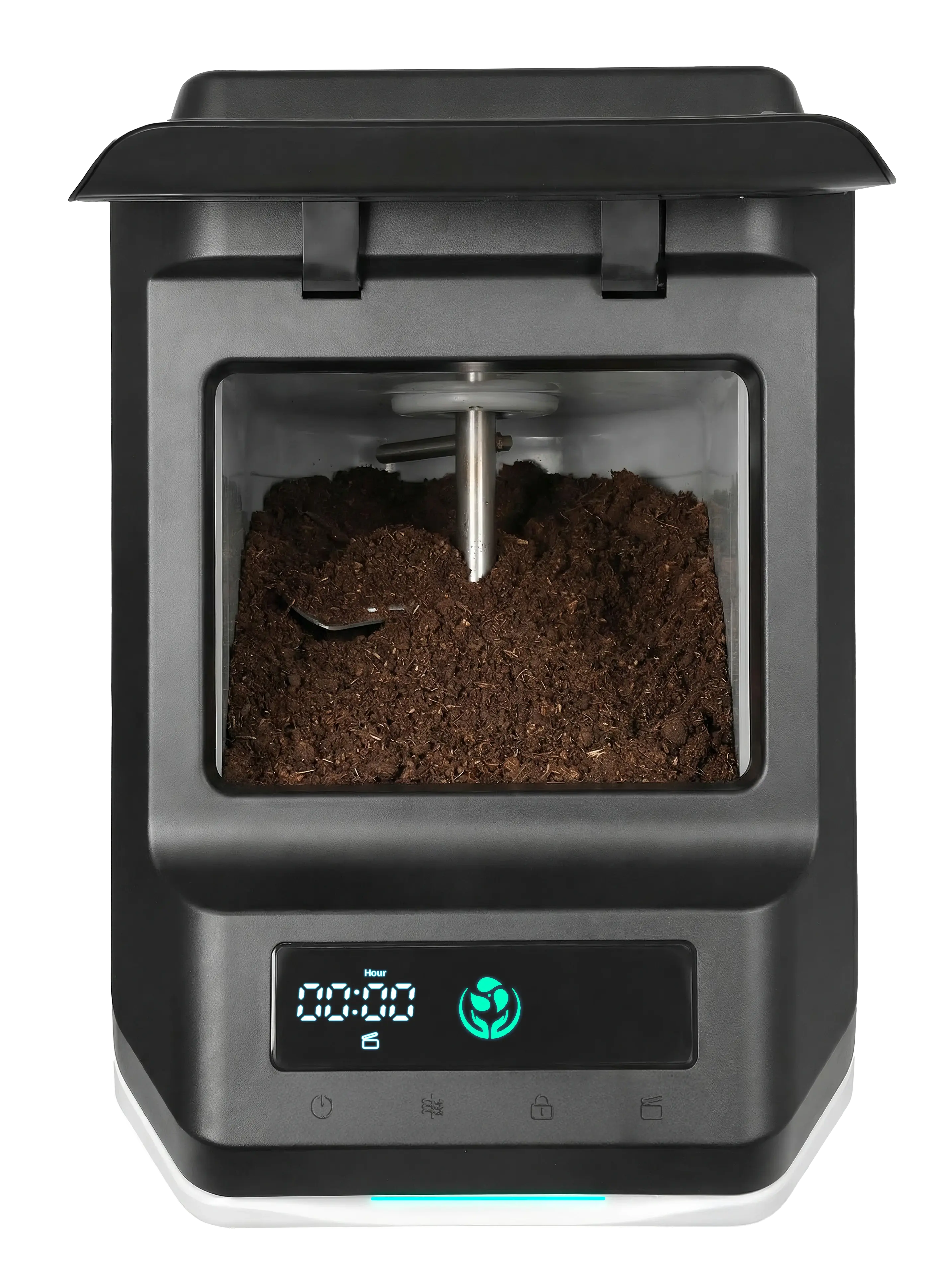
The chamber is continuous, so recently added material and older material can be at different stages. Screen larger unfinished pieces back into the machine and blend approximately one part Compost Base with eight parts plain soil. Read the GEME Compost Base application guide for the full method.
Mill vs GEME Terra 2: The Differences That Matter
| Question | Mill Essential / Plus | GEME Terra 2 |
|---|---|---|
| What happens inside? | Scheduled drying and grinding | Continuous microbial processing |
| What comes out? | Dry Food Grounds; Mill says they are not compost | Moist, biologically active Compost Base |
| Next step | Home use, further composting, organics collection or optional pickup | Screen and blend with soil for use |
| Chamber capacity | 6.5 L for both models | 14 L |
| Add scraps during operation? | Yes; adding during a cycle may extend it | Yes, according to product guidance |
| Odor filters | Replaceable carbon filters | No routine disposable odor-filter replacement |
| Pickup required? | Optional | No pickup service required for soil use |
For model features, daily routines and the full ownership comparison, read Mill Composter vs GEME Terra 2: Kitchen Composter Decision Guide.
Mill’s Price: A Premium Bill for Food Grounds
Here is the part that makes Mill hard to justify for a gardener: the Essential costs $999, while Plus starts at $1,149. The stainless-steel Plus is listed at $1,299. Those are substantial prices for a machine whose output Mill does not call compost.
| Model | US purchase price | Replacement carbon filter |
|---|---|---|
| Mill Essential | $999 | $59; typically up to 5–6 months |
| Mill Plus | From $1,149; stainless steel $1,299 | $114; typically up to 10–12 months |
| GEME Terra 2 | See current price and offers | No routine disposable odor-filter replacement |
Each purchased Mill includes its initial filter. Replacements add a repeat expense; Mill says an annual Plus filter is included with its rental plans. Prices, offers and lifetimes vary. A permanent odor-treatment system gives GEME owners one less consumable to keep buying.
Mill US prices and filter guidance checked November 6, 2026. Sources: Mill Essential pricing, Mill Plus pricing, and filter replacement guidance.
Our Verdict: Buy the Outcome You Actually Want
If you want a sleek way to dry and store food scraps, Mill offers that. But if you’re paying $999 or more because you think you’re buying a home composter, the distinction is impossible to ignore: Mill’s machine does not make compost. Add replacement-filter costs and an optional pickup service, and its premium is harder to defend for someone whose priority is feeding their soil.
GEME Terra 2 is our pick for a kitchen-to-garden routine. Its continuous microbial system and active Compost Base give gardeners a more direct, satisfying reason to keep food scraps in the cycle. For heavier daily loads, GEME Pro provides a larger chamber.
Editorial disclosure: The assessment above reflects our perspective; Mill specifications and prices are linked to Mill’s published information.
Frequently Asked Questions
Does the Mill composter really make compost?
No. Mill dries and grinds food scraps into Food Grounds, and Mill says those grounds are not compost. They can be composted later or used in other ways according to Mill’s guidance.
Can Mill Food Grounds go into a compost pile or garden?
Mill says Food Grounds can be added to a compost pile. Follow Mill’s application guidance; dried grounds are not the same as compost and still depend on biological activity after rewetting.
Do I have to send Food Grounds back to Mill?
No. Mill Pickups is an optional paid service for eligible addresses. Mill also describes home composting, garden use and municipal organics collection as potential options where accepted.
Is Mill more expensive than GEME Terra 2?
Mill lists Essential at $999 and Plus from $1,149 in the US, while GEME Terra 2 is listed at $599 during Black Friday. Mill’s purchased units also use replaceable carbon filters; GEME Terra 2 does not require routine disposable odor-filter replacements.
Can I add food scraps while Mill is running?
Yes. Mill says food scraps can be added during a Dry & Grind cycle, though this can extend the cycle and affect how dry the grounds are when it ends.
Does GEME Terra 2 make compost?
GEME Terra 2 uses a continuously managed microbial system to break down food scraps into a moist, biologically active Compost Base for soil blending. The chamber contains material at different stages; screen unfinished pieces and follow GEME’s soil-use instructions.
Can GEME Compost Base go straight into a plant pot?
Screen unfinished pieces and mix approximately one part GEME Compost Base with eight parts plain soil by volume before plant use. Follow the current application guidance for the plants and setting.
Does Mill require filter replacements?
Mill lists replacement carbon filters for purchased units at $59 for Essential and $114 for Plus, with typical lifetimes of up to 5–6 and 10–12 months, respectively. Plus rental plans include an annual filter under the stated terms.
Which is better for a kitchen-to-garden routine?
For readers who want microbial processing at home and Compost Base for soil blending, GEME Terra 2 is the best choice. Mill is designed for drying and storing scraps as Food Grounds for subsequent use or collection pathway.
Sources and Further Reading
Bring Microbial Composting Home
Put daily food scraps to work with GEME Terra 2, and bring your kitchen and garden closer together.
Explore GEME Terra 2


Leave a comment
All comments are moderated before being published.
This site is protected by hCaptcha and the hCaptcha Privacy Policy and Terms of Service apply.