


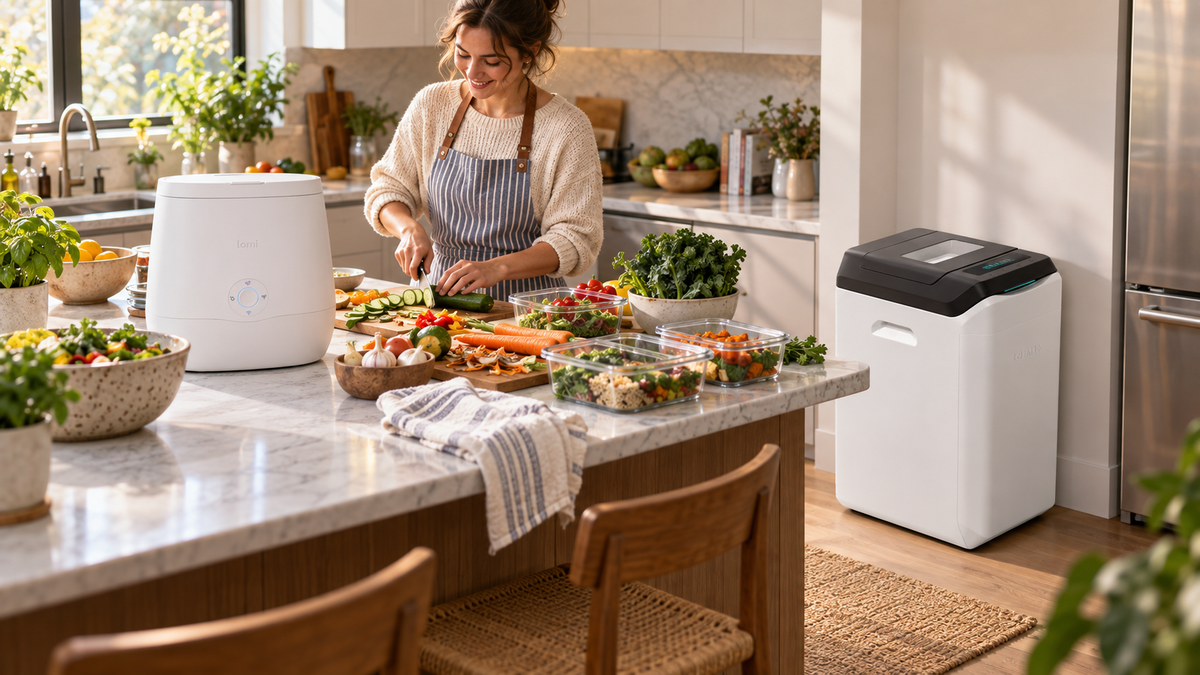
Lomi 3 vs GEME Terra 2 · Weekly Meal Prep Workflow
If you batch-cook several meals on Sunday, GEME Terra 2 is the easier food-waste workflow.
The reason is not that Lomi 3 cannot process meal-prep scraps. It can. The difference is when you are allowed to forget about the machine.
Lomi 3 is built around a 3 L removable bucket and timed processing cycles. Its current user guide lists Express at approximately 3–6 hours and Grow at approximately 11–17 hours.
GEME Terra 2 works differently. Its 14 L microbial chamber remains active continuously, so suitable scraps can be added as they appear during washing, chopping, batch cooking and cleanup, within its up-to-2-kg/day and per-addition limits.
Meal prep creates waste continuously. We think the composter should accept it continuously too.

Quick Answer: Which Is Better for Sunday Meal Prep?
For a household that produces food scraps in several waves during a long meal-prep session, we recommend GEME Terra 2.
With Terra 2, suitable scraps can go into the active chamber when they are created. There is no batch-start decision and no need to wait for one processing cycle to finish before the system is ready for the next normal addition.
Lomi 3 uses a 3 L bucket and scheduled cycles. The current Lomi 3 manual does allow food to be added during a cycle by pausing the machine, but it also states that adding food later in the cycle, or adding wetter material, may mean another cycle is required to achieve dry Lomi Earth.
That makes Lomi workable for meal prep, but it requires more awareness of bucket space, cycle timing and when additional scraps arrive.
For one neat batch, Lomi can work well. For scraps that keep appearing while you cook, GEME's continuous feeding is the more natural workflow.
This article is intentionally narrower than our full GEME vs Lomi comparison. Here, we are only asking what happens during one realistic weekly meal-prep day.
1. Why Weekly Meal Prep Exposes the Difference Between Lomi and GEME
A normal dinner may create one short burst of scraps.
Weekly meal prep is different.
A Sunday cooking session might involve:
- washing and trimming vegetables in the morning;
- cutting onions, peppers and herbs an hour later;
- preparing meat, grains and sauces around lunch;
- portioning fruit or snacks later in the afternoon;
- and then clearing leftovers and scraps at final cleanup.
That means food waste arrives across several hours.
This is where appliance architecture matters.
A Timed Processing Bucket
You fill a 3 L bucket, choose a mode and run a processing cycle.
The bucket and the cycle become part of your meal-prep schedule.
An Always-Available Active Chamber
Suitable scraps can join the existing microbial bed when they are generated.
The cooking schedule does not need to be reorganized around a processing cycle.
The Meal-Prep Question
Should your cooking schedule adapt to the food-waste machine, or should the food-waste machine adapt to your cooking schedule?
For us, that is the strongest reason Terra 2 wins this specific comparison.
2. What the Current Lomi 3 Manual Actually Says
Lomi's current model is Lomi 3, so this comparison uses its current user guide rather than older cycle numbers from previous models or archived marketing pages.
| Lomi 3 Item | Current Manual | Why It Matters During Meal Prep |
|---|---|---|
| Bucket capacity | 3 L / ¾ gallon | You have a defined batch volume and must stay below the fill line. |
| Express Mode | 3–6 hours | The shortest processing option still occupies part of a long meal-prep day. |
| Grow Mode | 11–17 hours | A Sunday-afternoon start can continue overnight or into Monday. |
| Cleaning Mode | About 1.5 hours | Used when deeper bucket cleaning is needed; separate from food processing. |
| Add food during a cycle? | Yes, by pausing Lomi. | Later or wetter additions may mean another cycle is needed. |
| Overfilling | Do not exceed the fill line or compact scraps. | Meal-prep volume has to be watched rather than pressed into the bucket. |
| Emptying | The Manual says up to 3 cycles may be run before emptying. | Lomi does not necessarily need emptying after every cycle, but it remains a cycle-managed bucket. |
| Carbon filter | Replacement indicator after approximately 45 cycles. | Cycle frequency contributes to filter-maintenance frequency. |
That gives Lomi more flexibility than an overly simplistic “you can never add food during a cycle” description would suggest.
But it does not turn Lomi into a continuous-feed system.
The user is still making decisions around a running batch: pause or wait, how full the bucket is, how wet the new material is, and whether another cycle may be needed afterward.
See the current Lomi 3 setup and operating guide.
3. One Sunday, Same Example Meal-Prep Load
To make this comparison practical, imagine a three-hour Sunday meal-prep session for a 1–3 person household.
The example creates approximately 1.5 kg of suitable food scraps across several stages:
- 08:30 — 0.4 kg: fruit peels, herb stems and vegetable trimming;
- 11:30 — 0.6 kg: onion skins, vegetable ends and other suitable prep waste;
- 15:30 — 0.5 kg: final trimming, plate scraps and cleanup waste.
The 1.5 kg total is intentionally below Terra 2's current up-to-2-kg/day guidance, and none of the individual additions exceeds 1 kg.
This is an illustrative workflow, not a claim that 1.5 kg automatically equals one Lomi batch.
Lomi's limit is a 3 L bucket volume, not a directly comparable kilogram-per-day rating. Bulky or high-moisture scraps can occupy that volume differently, so the actual number of Lomi cycles depends on what you prepared and whether the material stays below the fill line without compaction.
That difference in measurement is itself important: Terra 2 is designed around continuous household throughput, while Lomi is designed around what fits safely into each bucket cycle.
4. Hour-by-Hour: What Does the Same Sunday Feel Like?
GEME Terra 2 Workflow
First prep scraps appear
Add the first approximately 0.4 kg of suitable scraps to Terra 2.
Close the lid and continue cooking. The existing microbial system continues operating.
Second wave appears
Add the next approximately 0.6 kg.
There is no need to ask whether the morning batch has “finished,” because there is no isolated morning batch.
Final cleanup
Add the final approximately 0.5 kg of suitable scraps.
Daily illustrative total: approximately 1.5 kg.
Your meal-prep job is finished
There is no cycle to start and no processed bucket that must be removed before tomorrow's breakfast scraps can be added.
Lomi 3 Workflow: The Cleanest Batch Strategy
For Lomi, the simplest workflow is usually not to start too early.
Instead, collect meal-prep scraps separately until you know what the day's final batch actually looks like.
First scraps appear
Hold the scraps in a separate caddy or in the Lomi bucket before starting a cycle.
If you start immediately, later scraps will arrive while that cycle is still running.
More scraps arrive
Continue collecting them, provided the total material remains below Lomi's fill line and is not compacted.
Meal prep ends
Now you know the final bucket condition and can choose a processing mode.
Express Mode
Under the current Lomi 3 manual, Express takes approximately 3–6 hours.
A 15:30 start therefore finishes approximately between 18:30 and 21:30.
Grow Mode
The current manual lists Grow at approximately 11–17 hours.
A 15:30 Sunday start therefore runs roughly until 02:30–08:30 Monday.
The Workflow Difference
With GEME, the scraps leave your prep area when they are created.
With Lomi, the cleanest batch workflow usually means collecting until you are ready to commit the bucket to a cycle.

5. Waiting, Feeding and Emptying: The Task Table
| Meal-Prep Task | Lomi 3 | GEME Terra 2 |
|---|---|---|
| Scraps appear at 08:30 | Load bucket but delay cycle, or start and manage later additions. | Add immediately. |
| More scraps appear at 11:30 | If cycle is running, pause to add or keep scraps elsewhere. | Add immediately. |
| More scraps appear at 15:30 | Check fill line and current cycle status. | Add immediately. |
| Need to press Start? | Yes, choose and start a cycle. | No batch Start step. |
| Wait for a processing window? | Express: approximately 3–6 h; Grow: approximately 11–17 h. | No batch-cycle waiting before the next normal addition. |
| Add scraps during processing? | Possible by pausing, but the current manual says another cycle may be needed depending on timing and moisture. | Continuous feeding is the normal workflow. |
| Watch bucket capacity? | Yes. Stay below the 3 L fill line and do not compact. | Stay within daily and individual-addition limits. |
| Empty after every cycle? | No. Current manual allows up to 3 cycles before emptying. | No cycle-by-cycle bucket emptying. |
| Ready for tomorrow's scraps? | Depends on cycle and remaining bucket capacity. | Yes, the continuous system remains available. |
This is why we prefer Terra 2 for meal prep: the advantage is not one spectacular specification. It is the removal of multiple small timing decisions throughout the cooking day.
6. But Can't You Add Food to Lomi While It Is Running?
Yes.
This is an important correction to simplistic Lomi comparisons.
The current Lomi 3 manual explicitly says users may add food scraps to a running cycle by pausing Lomi with the Start button.
After closing the lid, the cycle can be resumed.
But the same instruction immediately adds an important qualification:
Depending on when in the cycle new scraps are added and how much moisture they contain, another cycle may be necessary to obtain dry Lomi Earth.
Pause-and-Add Is Possible. It Is Not the Same as Continuous Feeding.
Lomi gives you a way to interrupt a batch and add more material.
GEME is designed around new material joining an already active microbial chamber as part of normal operation.
That distinction is exactly why meal prep is such a useful comparison scenario.
If scraps arrive only once, a batch machine is easy.
If scraps arrive repeatedly, the architecture becomes visible.
7. Why GEME Terra 2 Fits Weekly Meal Prep Better
1. The Chamber Is Available When the Scraps Are
You do not have to decide whether this is the moment to “start the batch.”
Peels can go in after breakfast prep. Vegetable ends can go in at lunch. Cleanup scraps can go in later.
2. You Do Not Need a Holding Strategy for the Rest of the Day
With a batch system, starting too early can leave you deciding what to do with scraps generated during the next several hours.
You can pause Lomi or hold those scraps elsewhere, but both are additional workflow decisions.
Terra 2 removes that question.
3. The 14 L Chamber Gives the Biological System Working Volume
Terra 2 has a 14 L microbial chamber rather than a 3 L removable processing bucket.
Those liters do not represent directly equivalent “batch capacity,” because the systems use fundamentally different architectures.
But the larger active chamber is part of what makes continuous feeding possible.
4. Automated Mixing Continues in the Background
The user does not start a new grinding-and-drying cycle after every meal-prep wave.
GEMEBrain™ manages heat, airflow, moisture-related conditions and mixing around the active microbial system.
5. Monday Morning Does Not Begin With a Sunday Batch Decision
A continuous system does not become unavailable because yesterday's bucket is still in a 3–6 hour or 11–17 hour processing window.
That matters when Monday breakfast creates another set of scraps.
Why We Recommend Terra 2
Weekly meal prep is a flow problem, not a batch problem. Terra 2 is designed around flow.

8. When Lomi 3 Still Makes Sense for Meal Prep
Continuous feeding is not automatically the right answer for every kitchen.
Lomi 3 remains a reasonable choice when:
- your prep scraps comfortably fit within its 3 L bucket;
- you prefer a countertop appliance;
- you are happy to collect scraps and run one deliberate batch later;
- your main goal is fast volume reduction;
- you like choosing between Express and Grow processing modes;
- you do not mind managing a removable bucket and activated-carbon filter.
For that user, a batch can be perfectly logical:
prep everything → fill bucket → press Start → let Lomi run.
Our point is narrower.
If the household wants scraps to disappear from the cooking workflow as they are generated, GEME is the stronger architecture.
9. Terra 2 or GEME Pro for Weekly Meal Prep?
Terra 2 should be the starting point for most 1–3 person weekly meal-prep households.
| Meal-Prep Consideration | Terra 2 | GEME Pro |
|---|---|---|
| Typical household | 1–3 people | 4+ people / heavier cooking |
| Microbial chamber | 14 L | 19 L |
| Daily input | Up to 2 kg/day | Up to 5 kg/day |
| Maximum individual addition | Up to 1 kg | Up to 1 kg |
| Best meal-prep fit | Normal weekly prep for smaller households | Large-family prep, entertaining, heavier recurring loads |
Do not choose Pro only because Sunday is your busiest cooking day.
Choose it when your actual recurring daily waste load justifies the additional capacity.
For larger households, see Best Electric Composter for Large Families.
Meal Prep Is Continuous. Your Food-Waste Workflow Should Be Too.
Terra 2 lets suitable scraps leave your cutting board when they are created, not when a batch timer says the machine is ready. For most 1–3 person households that prep several meals at once, that is the simpler ownership experience.
Frequently Asked Questions
Which is better for weekly meal prep, Lomi or GEME?
For households that create food scraps in several waves during meal prep, we recommend GEME Terra 2 because continuous feeding lets suitable scraps enter the chamber as they are generated rather than organizing the day around a batch cycle.
How long does Lomi 3 take?
The current Lomi 3 User Guide lists Express Mode at approximately 3–6 hours and Grow Mode at approximately 11–17 hours. Cleaning Mode takes approximately 1.5 hours.
How large is the Lomi 3 bucket?
The current Lomi 3 specification lists a 3 L, or ¾-gallon, bucket. The manual instructs users not to fill above the internal fill line and not to press or compact scraps into the bucket.
Can I add more scraps to Lomi while a cycle is running?
Yes. The current Lomi 3 manual says you can pause a running cycle and add more food. It also says that depending on when those scraps are added and their moisture content, another cycle may be needed to achieve dry Lomi Earth.
Do I have to empty Lomi after every cycle?
No. The current Lomi 3 manual says you can run up to three cycles without emptying the bucket, provided you stay within the fill guidance. It recommends emptying after three cycles to avoid excessive strain on the grinder.
Can I keep adding food to GEME Terra 2 during the day?
Yes. Continuous feeding is part of Terra 2's normal operating model. Add suitable scraps progressively while staying within the current guidance of up to approximately 2 kg/day and no more than approximately 1 kg per individual addition.
Does Terra 2 run a 3-hour or 6-hour cycle?
No. Terra 2 is not designed around discrete user-started food-processing batches. It maintains an active microbial environment continuously, so new suitable scraps can join the chamber during normal use.
Which machine needs less timing during Sunday meal prep?
GEME Terra 2. You do not need to decide when to start a batch, whether to pause a running cycle for later scraps, or whether a late addition may require another cycle.
Is Lomi better if I only create one bucket of scraps at the end of meal prep?
It can be a good fit. If you naturally collect one batch, prefer a countertop appliance and are comfortable starting a timed processing cycle after cooking, Lomi's batch workflow can make sense.
Should I choose Terra 2 or GEME Pro for meal prep?
Choose based on recurring daily food-scrap volume rather than meal prep alone. Terra 2 is designed primarily for 1–3 person households and up to approximately 2 kg/day; GEME Pro provides up to approximately 5 kg/day for larger or heavier-use households.
Is this the same as the general GEME vs Lomi comparison?
No. The main GEME vs Lomi guide compares the two systems across process, output, maintenance and ownership. This article focuses specifically on what happens when food scraps arrive repeatedly during a weekly meal-prep session.
Sources and Related Guides
Lomi workflow details in this article use the current Lomi 3 User Guide rather than older Lomi models or archived cycle claims.
Current Product Sources
- Lomi — Lomi 3 Get Started Guide
- Lomi 3 User Guide — Cycle Timing, Capacity, Mid-Cycle Feeding, Cleaning and Filters
- Lomi — Current Lomi 3 FAQ
- GEME Terra 2 — Current Product Information
- GEME — Terra 2 vs GEME Pro Specifications


Leave a comment
All comments are moderated before being published.
This site is protected by hCaptcha and the hCaptcha Privacy Policy and Terms of Service apply.