


Complete Home Composting Reference
You can compost far more than banana peels and autumn leaves, but not every organic-looking material belongs in every composting system.
Fruit and vegetable scraps, coffee grounds, eggshells, grass clippings, healthy garden plants, dry leaves, straw and clean uncoated cardboard are suitable for most ordinary home compost piles.
Meat, dairy, oils, bones, pet waste, diseased plants and compostable packaging require more caution because backyard piles, worm bins, industrial facilities and managed microbial systems operate under different conditions.
Use this guide to identify the material first, then match it to the correct composting method.
The Four Main Material Groups
Fresh and nitrogen-rich
Kitchen organic material
Plants, leaves and prunings
Dry and carbon-rich
“Green” and “brown” describe composting function, not necessarily the material’s visible color.
Quick Answer: What Can You Compost at Home?
In an ordinary backyard compost pile, you can usually compost fruit and vegetable scraps, coffee grounds, paper coffee filters, loose tea leaves, crushed eggshells, untreated garden plants, grass clippings, dry leaves, straw, small twigs, shredded non-glossy paper and clean uncoated cardboard.
Mix nitrogen-rich “greens” with approximately two to three times their volume of carbon-rich “browns.” Bury food scraps and cover them with four to eight inches of dry leaves or similar material to support airflow and reduce pest attraction.
Keep meat, fish, dairy, grease, large bones, pet feces, cat litter, diseased plants, seed-bearing weeds, treated wood, plastics and chemically contaminated materials out of a conventional home pile.
Learn how to build and manage the pile in the Complete Home Composting Guide, and see why separation matters in What Happens to Food Waste?
One Material Can Have Four Different Answers
Backyard Pile
Best for plant-based kitchen scraps, garden waste, leaves and carbon-rich materials.
Worm Bin
Best for selected fruit and vegetable scraps, coffee grounds and soft plant material.
Municipal Facility
May accept meat, dairy, bones and certified packaging, but only when local rules allow them.
Managed Microbial System
May accept a broader kitchen-food range while still applying product-specific liquid, hardness and fibre limits.
Table of Contents
- Choose the Composting System First
- Green Waste List
- Food Scraps List
- Garden Waste List
- Brown and Carbon-Rich Materials
- Compostable but Slow Materials
- Conditional Materials
- What Not to Compost
- How to Prepare Materials
- How to Balance Greens and Browns
- Prevent Food Waste First
- What Terra II Can Compost
- Frequently Asked Questions
- Summary Checklist
- Authoritative Sources
- Related Guides
Choose the Composting System Before the Material
A material can be biologically degradable and still be unsuitable for a particular home system. The practical answer depends on temperature, oxygen, moisture, pest control, mixing and residence time.
| Composting Method | Usually Suitable | Usually Avoided or Restricted | Best Use |
|---|---|---|---|
| Open backyard pile | Fruit and vegetable scraps, coffee grounds, eggshells, leaves, grass, garden plants, straw and cardboard. | Meat, dairy, oils, pet waste, diseased plants and seeded weeds. | Mixed kitchen and garden plant materials. |
| Enclosed bin or tumbler | Similar materials to a backyard pile, with improved pest protection. | Large quantities of wet food, grease, large branches and hazardous materials. | Smaller gardens and more controlled household use. |
| Worm bin | Most fruit and vegetable scraps, coffee grounds, crushed eggshells and paper bedding. | Meat, dairy, grease, bones, pet waste and large amounts of citrus, onion or garlic. | Indoor composting of soft plant-based food scraps. |
| Municipal or industrial facility | Potentially food scraps, meat, dairy, bones, yard waste and approved compostable packaging. | Anything not specifically accepted by the local program. | Higher-volume organics processing under controlled conditions. |
| Managed microbial appliance | Product-approved kitchen scraps, potentially including cooked food, meat, dairy and small bones. | Packaging, large hard objects, excessive free liquid, long fibres and unapproved garden waste. | Continuous processing of everyday household kitchen organics. |
The Compost at Home Hub compares piles, tumblers, worm bins and managed indoor systems in more detail.
Green Waste: Nitrogen-Rich Materials You Can Compost
In composting, “green waste” usually means relatively fresh, moist and nitrogen-rich organic material. A material does not need to be visibly green: coffee grounds and fruit scraps are also classified as greens.
| Green Material | Status | Preparation | Important Notes |
|---|---|---|---|
| Fresh grass clippings | Usually suitable | Mix with dry leaves or shredded cardboard. | Do not add in a thick wet mat; compacted grass restricts oxygen. |
| Fresh non-seeding weeds | Usually suitable | Chop or wilt before adding. | Exclude weeds that already carry mature seed. |
| Soft green prunings | Usually suitable | Cut into short pieces. | Avoid long vines that may tangle or form dense mats. |
| Fresh leaves | Usually suitable | Shred and mix with drier material. | Young leaves contain more nitrogen than dry autumn leaves. |
| Vegetable plant trimmings | Usually suitable | Remove ties, labels and plastic clips. | Use only healthy, non-diseased material in an ordinary home pile. |
| Fresh flower stems and leaves | Usually suitable | Cut into smaller pieces. | Remove florist wire, foam, ribbon and plastic wrapping. |
| Spent cut flowers | Check first | Remove all non-plant components. | Use cautiously if the flowers were treated with persistent chemicals. |
| Coffee grounds | Usually suitable | Spread through the pile instead of adding one dense layer. | Paper filters can be composted when they contain no plastic. |
| Loose tea leaves | Usually suitable | Add directly or mix through the pile. | Tea bags require separate material verification. |
| Fruit and vegetable scraps | Usually suitable | Cut large pieces and bury under browns. | Remove produce stickers, packaging and rubber bands. |
| Fresh herb trimmings | Usually suitable | Chop long stems. | Strong aroma does not prevent ordinary aerobic decomposition. |
| Lake or pond plants | Check first | Drain and mix with dry carbon material. | Confirm local rules and exclude invasive aquatic plants. |
| Herbivore manure | Hot pile only | Mix with bedding and carbon-rich material. | Requires careful pathogen, nutrient and temperature management. |
| Spent brewery grains | Small amounts | Mix immediately with abundant browns. | Dense wet grains can turn anaerobic quickly. |
| Plant-based juicing pulp | Usually suitable | Mix with shredded leaves or cardboard. | High moisture and fine texture can reduce airflow when added alone. |
Food Scraps: Complete Home-Composting List
Plant-based kitchen scraps are the safest starting point for an ordinary home pile. Cooked foods and animal products require more careful system selection.
| Food Material | Ordinary Home Pile | Preparation | Important Notes |
|---|---|---|---|
| Apple cores and peels | Yes | Remove stickers and chop large cores. | Seeds do not usually create a practical problem, but woody stems decompose slowly. |
| Banana peels | Yes | Cut into shorter pieces. | Remove produce stickers before adding. |
| Citrus peels | Yes | Chop and mix with varied materials. | Suitable for ordinary piles; use more sparingly in worm bins. |
| Melon rinds | Yes | Cut thick rinds into smaller pieces. | Large rinds contain substantial moisture and may attract pests if exposed. |
| Pineapple skins and crowns | Slow | Cut into small pieces. | Tough fibres require more time than soft fruit. |
| Avocado skins | Yes | Cut into pieces. | The skin decomposes faster than the pit. |
| Avocado pits | Very slow | Split only when it can be done safely. | Expect to screen and return intact pits to a new pile. |
| Vegetable peelings | Yes | Cut long peelings to prevent matting. | Potato, carrot, cucumber and similar peels break down readily. |
| Vegetable stems and cores | Yes | Chop dense stems and cabbage cores. | Woody brassica stems require more time. |
| Onion and garlic scraps | Yes | Chop and disperse. | Suitable for ordinary piles but commonly limited in worm bins. |
| Corn husks | Slow | Cut across the fibres. | Long strips can form mats or wrap around mechanical equipment. |
| Corn cobs | Very slow | Split or chop when practical. | Often need to be screened back into the active pile. |
| Overripe fruit | Yes | Bury under four to eight inches of browns. | Covering limits flies, rodents and odor. |
| Moldy fruit and vegetables | Usually | Remove packaging and bury promptly. | Ordinary spoiled plant food can enter the pile when it is safe to handle. |
| Moldy bread | Small amounts | Tear up and bury deeply. | Bread is compostable but may attract pests when left exposed. |
| Stale bread and crackers | Small amounts | Break into pieces and mix with moist greens. | Prioritize human consumption when still safe and edible. |
| Plain cereal and oats | Small amounts | Mix through the pile. | Avoid adding a thick dry layer. |
| Flour | Small amounts | Moisten and disperse. | Dry flour can clump or become airborne. |
| Plain cooked rice | Conditional | Add a small amount and bury deeply. | Moist starch can compact and attract pests. |
| Plain cooked pasta | Conditional | Cut long pasta and bury. | Avoid oily sauces in an ordinary pile. |
| Coffee grounds | Yes | Mix with other materials. | Coffee grounds are considered a nitrogen-rich green. |
| Paper coffee filters | Yes | Tear when thick. | Exclude plastic mesh or synthetic filters. |
| Loose tea leaves | Yes | Add directly. | Suitable for backyard piles and worm bins. |
| Tea bags | Verify bag | Remove staples, labels and synthetic string. | Compost the bag only when it is confirmed paper and plastic-free. |
| Eggshells | Yes | Crush before adding. | They decompose slowly and may remain visible after screening. |
| Whole raw eggs | Avoid | Use another approved disposal route. | Odor and animal attraction make them unsuitable for ordinary piles. |
| Nutshells | Slow | Crush where practical. | Hard shells may remain through several composting cycles. |
| Herbs and spices | Yes | Mix into the pile. | Avoid dumping large amounts of salt-containing seasoning. |
| Plant-based leftovers | Conditional | Use small amounts; bury and balance with browns. | Oil, sauces, salt and high moisture increase management difficulty. |
| Meat and fish scraps | Not ordinary piles | Use an approved municipal or managed system. | They can create odor and attract rodents and other animals. |
| Dairy products | Not ordinary piles | Use an approved managed pathway. | Milk, cheese, yogurt and butter create pest and odor risks. |
| Bones | Not ordinary piles | Use an approved facility or product-specific system. | Large dense bones decompose extremely slowly. |
| Cooking oil and grease | Avoid | Use local oil-recycling or waste guidance. | Free oil coats particles, restricts airflow and attracts pests. |
| Pickle brine, soup and free liquid | Do not pour in | Drain solids before composting. | Excess liquid can waterlog the pile; salty liquids may disrupt the process. |
For ordinary spoiled food, see Can You Compost Moldy Bread? and Can You Compost Moldy Grapes?
The wider Food Storage & Waste Reduction Hub explains how to keep edible food from reaching the compost bin prematurely.
Garden Waste: What Can Go Into a Home Compost Pile?
| Garden Material | Status | Preparation | Important Notes |
|---|---|---|---|
| Dry autumn leaves | Excellent brown | Shred for faster breakdown. | Store dry leaves for covering food scraps throughout the year. |
| Fresh leaves | Suitable green | Mix with dry materials. | Fresh leaves contain more moisture and nitrogen. |
| Grass clippings | Suitable green | Add thin layers and mix well. | Thick layers compact, overheat locally and restrict airflow. |
| Healthy spent annual plants | Yes | Remove soil clumps, labels and support ties. | Chop thick stems. |
| Healthy vegetable plants | Yes | Cut roots and stems into shorter pieces. | Exclude plants showing serious disease or insect infestation. |
| Faded flowers | Yes | Remove plastic tags and wire. | Seed heads may need removal. |
| Nonwoody hedge trimmings | Yes | Chop into short pieces. | Mix dense evergreen foliage with other materials. |
| Small twigs under ¼ inch | Yes, slowly | Cut or shred. | Useful for structure and airflow but slower than leaves. |
| Wood chips | Small amounts | Use untreated chips. | Excellent for structure but high carbon content slows breakdown. |
| Untreated sawdust | Small amounts | Mix thoroughly with nitrogen-rich greens. | Dense sawdust can compact and immobilize available nitrogen. |
| Straw | Excellent brown | Cut long straw where possible. | Provides carbon and pore structure. |
| Hay | Check seeds | Use seed-free or well-managed material. | Hay may introduce weed seeds into an insufficiently hot pile. |
| Pine needles | Small amounts | Chop or mix with varied materials. | Waxy needles decompose slowly and can mat together. |
| Pine cones | Very slow | Crush or shred when practical. | Better used as a structural material than rapid feedstock. |
| Acorns | Slow | Crush where practical. | Whole acorns may remain after screening. |
| Fallen fruit | Yes | Chop and bury beneath browns. | Do not leave exposed where it can attract animals. |
| Weeds without seeds | Usually | Wilt or dry before adding. | Exclude invasive plants that readily regrow from roots or stems. |
| Seed-bearing weeds | Avoid ordinary piles | Use an approved hot or municipal process. | An ordinary pile may not expose every seed to lethal conditions. |
| Invasive rhizomes and roots | Avoid | Follow local invasive-species disposal guidance. | Some species can survive and regrow from fragments. |
| Diseased plants | Avoid ordinary piles | Use local disease-management guidance. | Home piles may not reliably destroy plant pathogens. |
| Insect-infested plants | Avoid ordinary piles | Bag or process according to local advice. | Insects or eggs may survive and return to the garden. |
| Chemically treated clippings | Check product label | Follow pesticide or herbicide restrictions. | Some treatments may harm compost organisms or persist in finished material. |
| Large branches and logs | Not practical whole | Chip, shred or use as woody mulch. | Whole wood decomposes too slowly for most household piles. |
Brown Materials: Carbon-Rich Inputs for Home Compost
Browns provide carbon, absorb excess moisture and help create air spaces. A pile with food scraps but insufficient browns commonly becomes wet, compacted and odorous.
| Brown Material | Status | Preparation | Important Notes |
|---|---|---|---|
| Dry leaves | Excellent | Shred when possible. | One of the most useful year-round household carbon sources. |
| Straw | Excellent | Cut long stems. | Adds carbon and structure. |
| Shredded cardboard | Usually suitable | Remove tape, labels, staples and plastic film. | Use plain, uncoated cardboard. |
| Corrugated cardboard | Usually suitable | Tear into small pieces and moisten. | Avoid waxed, plastic-coated or heavily printed sections. |
| Paper egg cartons | Yes | Tear apart. | Do not include plastic or foam cartons. |
| Toilet-paper and paper-towel tubes | Yes | Flatten and tear. | Useful as a dry carbon source. |
| Non-glossy newspaper | Yes | Shred and mix through the pile. | Avoid adding thick compressed layers. |
| Plain office paper | Small amounts | Shred and remove plastic windows or adhesive. | Prioritize paper recycling when clean and recyclable. |
| Brown paper grocery bags | Usually suitable | Remove handles, tape and labels; shred. | Exclude laminated or water-resistant bags. |
| Plain paper napkins | Small amounts | Tear up. | Avoid napkins contaminated with cleaning chemicals or heavy grease. |
| Plain paper towels | Small amounts | Tear or shred. | Do not compost towels used with disinfectants, solvents or synthetic chemicals. |
| Untreated sawdust | Small amounts | Mix with moist nitrogen-rich material. | Never use sawdust from painted, pressure-treated or composite wood. |
| Untreated wood shavings | Small amounts | Mix thoroughly. | Large volumes can create a severe carbon imbalance. |
| Natural cork | Very slow | Cut into small pieces. | Confirm that it is natural cork rather than synthetic plastic. |
| Hair and untreated fur | Small amounts | Disperse through the pile. | Dense clumps break down slowly. |
| 100% natural cotton or wool | Only when verified | Cut into very small pieces. | Avoid synthetic blends, coatings, elastic, thread and chemical treatments. |
| Wood fireplace ash | Very small amounts | Use only fully cooled ash from clean, untreated wood. | Ash raises alkalinity and excessive amounts can increase nitrogen loss. |
Compostable but Slow: Do Not Mistake Slow Breakdown for Failure
The following materials are biologically compostable but may remain visible when softer food scraps have already disappeared:
Dense fibres require cutting, moisture and time.
May pass through one or more screening cycles.
Crushing increases surface area but does not make them disappear instantly.
Hard structures often remain in screened compost.
Waxy surfaces slow water entry and microbial access.
Useful for structure even when they require multiple cycles.
Skins break down sooner; pits can remain for a long time.
Compostable but highly resistant when left whole.
Screen these materials from mature compost and return them to the active pile. Each additional cycle exposes more surface area and advances decomposition.
Materials That Are Compostable Only Under Certain Conditions
| Material | Ordinary Backyard Pile | Where It May Be Accepted | Decision Rule |
|---|---|---|---|
| Meat and fish | Generally avoid. | Approved industrial or managed microbial systems. | Follow the exact facility or appliance input rules. |
| Dairy products | Generally avoid. | Some industrial and managed systems. | Ordinary piles lack reliable pest and odor controls. |
| Small bones | Generally avoid. | Selected industrial or product-approved systems. | Do not assume that all mechanical or biological systems accept them. |
| Cooked mixed leftovers | Limited, especially when oily or salty. | Municipal programs and approved managed systems. | Drain free liquid and avoid large single-food loads. |
| Certified compostable bags | Only when explicitly home-compostable. | Accepting industrial facilities. | “Compostable” alone usually does not mean suitable for a backyard pile. |
| Compostable cups and cutlery | Usually no. | Specific industrial facilities. | Check local acceptance before placing them in any organics bin. |
| Tea bags | Only when paper and plastic-free. | Programs that accept the certified material. | Open uncertain bags and compost only the tea leaves. |
| Pizza boxes | Clean, uncoated portions only. | Some municipal programs accept food-soiled paper. | Remove plastic liners, stickers and heavily coated sections. |
| Herbivore manure | Only with careful hot-compost management. | Agricultural or regulated compost systems. | Do not confuse aged manure with validated composted manure. |
| Wood ash | Very small quantities only. | Soil or compost use when chemistry is appropriate. | Never use coal, charcoal-briquette, painted-wood or treated-wood ash. |
| Diseased plants | Generally no. | Validated high-temperature or municipal systems. | Ordinary household piles may not treat every piece sufficiently. |
| Seed-bearing weeds | Generally no. | Validated hot-compost systems. | Use only when time and temperature control are reliable. |
What Should Never Go Into an Ordinary Home Compost Pile?
Plastics and Packaging
- Conventional plastic bags
- Produce stickers
- Plastic tea bags
- Coffee pods
- Plastic-coated paper
- Foam food containers
- Rubber bands and twist ties
Hazardous or Contaminated Material
- Painted or pressure-treated wood
- Composite-board sawdust
- Solvents and cleaning chemicals
- Motor oil or petroleum products
- Coal and charcoal-briquette ash
- Medical or sanitary waste
Human and Pet Waste
- Dog feces
- Cat feces
- Soiled cat litter
- Human feces
- Diapers
- Sanitary products
Problem Garden Material
- Severely diseased plants
- Insect-infested plants
- Mature seed-bearing weeds
- Invasive roots and rhizomes
- Recently treated plant material when the label prohibits composting
Non-Compostable Household Materials
- Glass
- Metal
- Ceramics
- Thermal receipts
- Glossy laminated paper
- Synthetic fabrics
- Mixed-fibre dryer lint
Ordinary-Pile Food Exclusions
- Meat and fish
- Dairy products
- Large bones
- Free cooking oil
- Grease and lard
- Large volumes of salty liquid
Some food exclusions may be processed in a municipal facility or product-approved microbial system. “Not for a backyard pile” does not necessarily mean that the material is incapable of biological decomposition.
How to Prepare Compostable Materials
-
Remove contamination.
Take off stickers, elastic bands, twist ties, staples, plastic windows, foil and packaging. -
Reduce particle size.
Chop dense stems, peels, corn cobs and thick rinds to expose more surface area. -
Shorten long fibres.
Cut vines, corn husks, paper strips and long stems so they do not form mats or tangles. -
Drain free liquid.
Compost moist solids rather than pouring soup, brine or oil into the pile. -
Break up dense clumps.
Disperse coffee grounds, flour, cooked rice and grass clippings instead of adding solid layers. -
Cover kitchen scraps.
Bury food under approximately four to eight inches of dry leaves or other browns. -
Mix fast and slow materials.
Combine soft scraps with leaves, shredded cardboard, small twigs and other structural material. -
Screen the finished material.
Return pits, shells, cobs and woody pieces to the next active cycle.
How to Balance Greens and Browns
For a conventional backyard pile, EPA recommends adding at least two to three times the volume of browns to the volume of greens.
Greens
- Food scraps
- Coffee grounds
- Fresh grass
- Fresh weeds
- Soft green prunings
- Fresh plant material
Browns
- Dry leaves
- Straw
- Shredded cardboard
- Non-glossy paper
- Small twigs
- Untreated wood chips
Practical Backyard Formula
2–3 Containers of Browns
+
1 Container of Greens
+
Enough Water for a Wrung-Out-Sponge Feel
+
Airflow and Occasional Turning
The biological explanation is covered in How Does Composting Work?
Compostable Does Not Mean It Should Be Wasted
Edible bread, fruit, vegetables, grains and leftovers may be compostable, but composting does not recover the grocery value or the water, land, energy and labor used to produce them.
Use safe edible food first. Freeze it, repurpose it, share it or move it into an “Eat First” area. Compost peels, cores, shells, trimmings and food that can no longer serve its original purpose.
Build the prevention step with How to Reduce Food Waste at Home.
What Can GEME Terra II Compost?
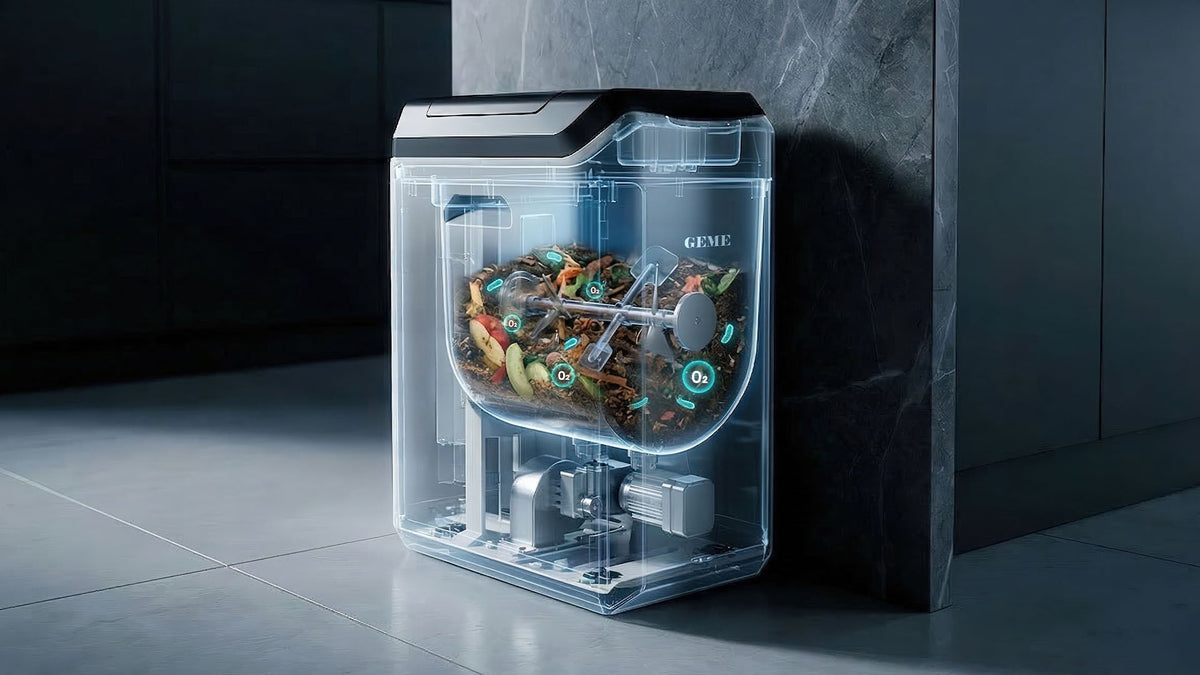
Terra II is designed for everyday kitchen bio-waste rather than bulk garden waste. It maintains a warm, moist and oxygen-rich microbial chamber and accepts a broader range of food than a conventional backyard pile.
| Material Group | Terra II Guidance | Boundary |
|---|---|---|
| Fruit and vegetable scraps | Suitable for normal feeding. | Cut dense, fibrous or oversized pieces. |
| Cooked grains and leftovers | Suitable as part of a varied input mix. | Drain free liquid and avoid one large dense starch load. |
| Meat and fish | Accepted in normal household quantities. | Large bones and oversized hard pieces remain unsuitable. |
| Dairy products | Accepted as part of mixed kitchen input. | Avoid a large single load of liquid dairy. |
| Small chicken and fish bones | Accepted according to current product guidance. | Do not add large dense bones. |
| Oily or salty leftovers | Ordinary food residue may be included modestly. | Do not pour in free oil, concentrated brine or excessive salty liquid. |
| Coffee grounds and eggshells | Suitable for normal mixed feeding. | Disperse dense coffee grounds and expect shells to remain longer. |
| Paper towels and cardboard | Small amounts of approved uncoated material can provide carbon. | Shred into small square pieces; never add long strips or whole sheets. |
| Grass, leaves and garden trimmings | Not the machine’s primary feedstock. | Use a backyard or municipal garden-waste route instead. |
| Packaging and non-food objects | Not accepted. | Remove plastic, metal, glass, stickers, strings and rubber bands. |
GEMEBrain™ adjusts heat, airflow, moisture and mixing automatically, reducing the manual balancing associated with a traditional pile. Automation does not make every organic object suitable.
Review the complete product-specific boundaries in What Can You Put in an Electric Composter? and Electric Composter Salt & Oil Boundaries.

A managed microbial system for everyday household food scraps.
Compost More of the Food Your Backyard Pile Cannot Handle
Terra II combines Kobold™ living microbes, continuous feeding and GEMEBrain™ adaptive control to process everyday kitchen organics, including suitable mixed leftovers, meat, dairy and small bones.
Terra II is designed for kitchen bio-waste, not bulk yard debris or unrestricted garbage disposal.
Frequently Asked Questions
What can you compost at home?
Most home piles can compost fruit and vegetable scraps, coffee grounds, paper coffee filters, crushed eggshells, healthy garden plants, grass clippings, dry leaves, straw, small twigs and shredded uncoated cardboard.
What food scraps can be composted?
Fruit peels, vegetable trimmings, cores, coffee grounds, loose tea leaves, eggshells, small amounts of bread, plain grains and plant-based leftovers can be composted. Bury food scraps under dry carbon material.
Can you compost cooked food?
Small amounts of plain plant-based cooked food can enter a well-managed enclosed pile. Oily, salty, meat-containing or dairy-containing leftovers are better suited to an accepting municipal or managed microbial system.
Can you compost meat?
Avoid meat in an ordinary backyard pile because it can create odor and attract animals. Meat may be accepted by selected industrial facilities and product-approved managed microbial systems such as Terra II.
Can you compost dairy?
Dairy is not recommended for ordinary home piles. Some municipal facilities and managed systems accept it under controlled conditions.
Can you compost bread?
Yes. Tear bread into smaller pieces, add only modest amounts and bury it beneath dry leaves or other browns to reduce pest attraction.
Can you compost citrus peels?
Citrus peels can be composted in an ordinary backyard pile. Chop thick peels and mix them with varied materials. Limit large citrus loads in a worm bin.
Can you compost onions and garlic?
Yes, in a normal aerobic pile. Chop and mix them through the material. Worm-bin guidance commonly recommends limiting strongly aromatic foods such as onion and garlic.
Can you compost eggshells?
Yes. Crushing eggshells increases surface area, but visible shell fragments may remain in the finished compost and can be screened back into the active pile.
Can you compost coffee grounds?
Yes. Coffee grounds are treated as nitrogen-rich green material. Disperse them through the pile rather than creating one dense layer.
Can you compost tea bags?
Compost loose tea leaves freely. Compost the bag only when it is verified as paper and plastic-free, and remove staples, labels and synthetic string.
Can you compost grass clippings?
Yes, but mix them with dry leaves, straw or cardboard. Thick layers of fresh grass compact easily and restrict oxygen.
Can you compost weeds?
Compost young weeds before they produce seed. Keep seeded weeds, invasive roots and plants capable of regrowing from fragments out of an ordinary home pile.
Can you compost diseased plants?
Diseased plants should generally stay out of ordinary household piles because all material may not reach conditions sufficient to control the pathogen.
Can you compost cardboard?
Plain uncoated cardboard can be shredded and composted. Remove tape, labels, staples, plastic windows and waxed or laminated sections.
Can you compost compostable plastic at home?
Only when the product explicitly states that it is suitable for home composting. Most items labeled simply “compostable” are intended for industrial facilities.
Can dog or cat waste be composted?
Do not place dog feces, cat feces or soiled cat litter in compost intended for food gardens. They may contain parasites and human pathogens.
What can Terra II compost?
Terra II accepts everyday kitchen organics including fruits, vegetables, grains, ordinary leftovers, meat, dairy and suitable small bones. Packaging, excessive free liquid, large hard bones, long stringy materials and bulk garden waste remain outside its normal input range.
Summary Checklist
Usually Compost
- Fruit and vegetable scraps
- Coffee grounds and paper filters
- Loose tea leaves
- Crushed eggshells
- Healthy garden plants
- Grass clippings mixed with browns
- Dry leaves and straw
- Small untreated twigs
- Shredded plain cardboard
- Non-glossy paper
Compost With Care
- Bread, rice and pasta
- Oily or salty cooked foods
- Tea bags
- Fruit pits and corn cobs
- Wood ash
- Sawdust and wood chips
- Herbivore manure
- Seed-bearing weeds
- Certified compostable packaging
- Meat and dairy in approved systems
Keep Out
- Plastic and produce stickers
- Glass, metal and ceramics
- Pet and human waste
- Diseased plants
- Invasive roots and rhizomes
- Treated wood and sawdust
- Coal or charcoal ash
- Cleaning chemicals and solvents
- Synthetic fabric and mixed lint
- Free oil and concentrated brine
Authoritative Sources
- U.S. EPA — Composting at Home
- U.S. EPA — Approaches to Composting
- U.S. EPA — Compostable Plastics and Home Composting
- University of Minnesota Extension — Composting in Home Gardens
- Oregon State University Extension — Composting Yard Debris
- U.S. EPA — Preventing Wasted Food at Home
- GEME — Terra II Product and Input Guidance
- GEME — Electric Composter Food Input Guide
- GEME — Salt, Oil and Liquid Input Boundaries
Guidance reviewed July 30, 2026. Municipal acceptance rules and product-specific input limits vary. Always verify local collection guidance and the instructions for the composting system being used.
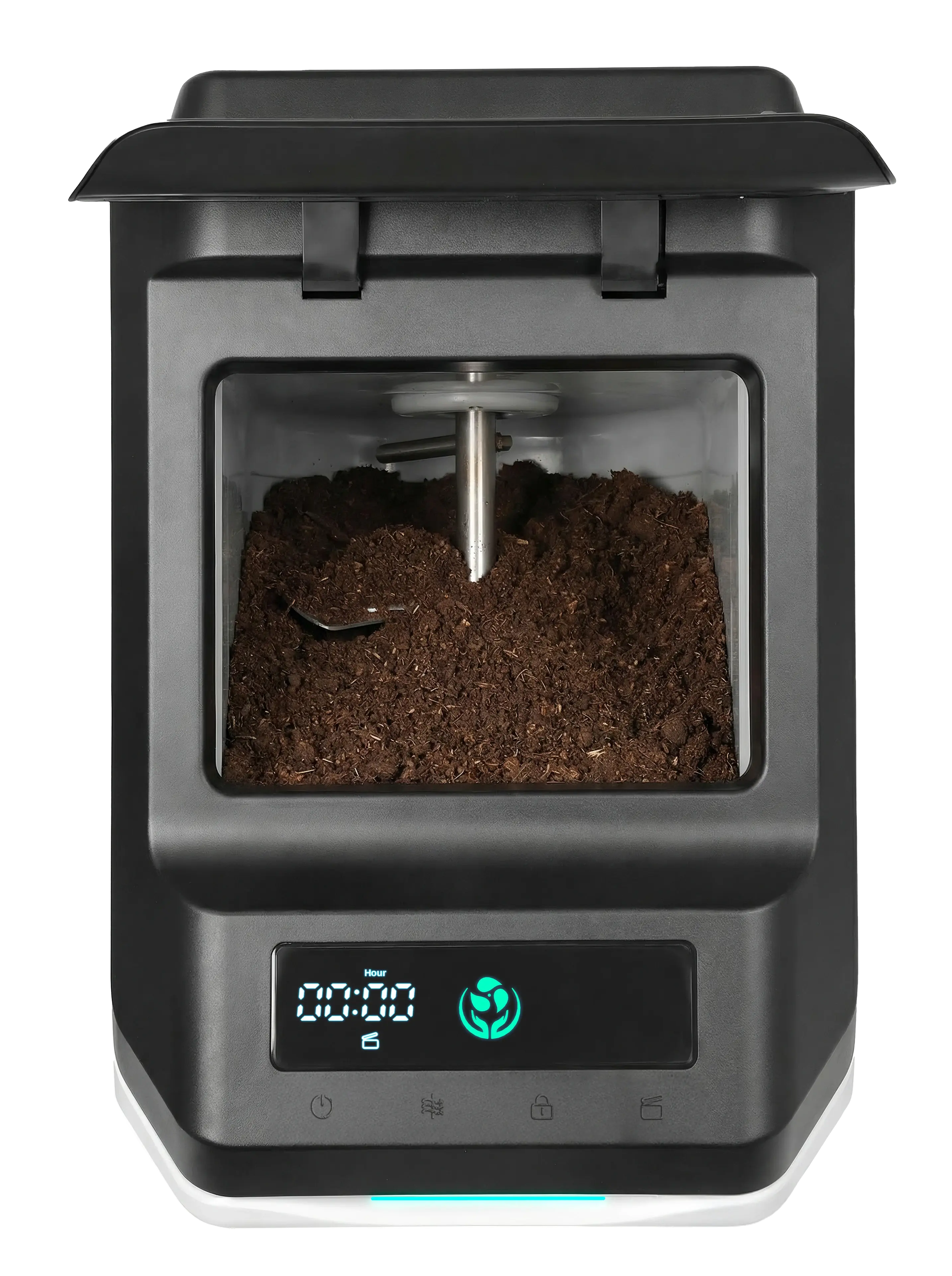
Composting works best when each input enters the system designed to handle it.
Turn Everyday Kitchen Scraps Into a Living Compost Base
Terra II supports continuous microbial processing of suitable household food scraps with GEMEBrain™ adaptive control and permanent odor purification.
Prevent edible waste first. Separate suitable scraps. Return the resulting compost base to soil responsibly.


Leave a comment
All comments are moderated before being published.
This site is protected by hCaptcha and the hCaptcha Privacy Policy and Terms of Service apply.