


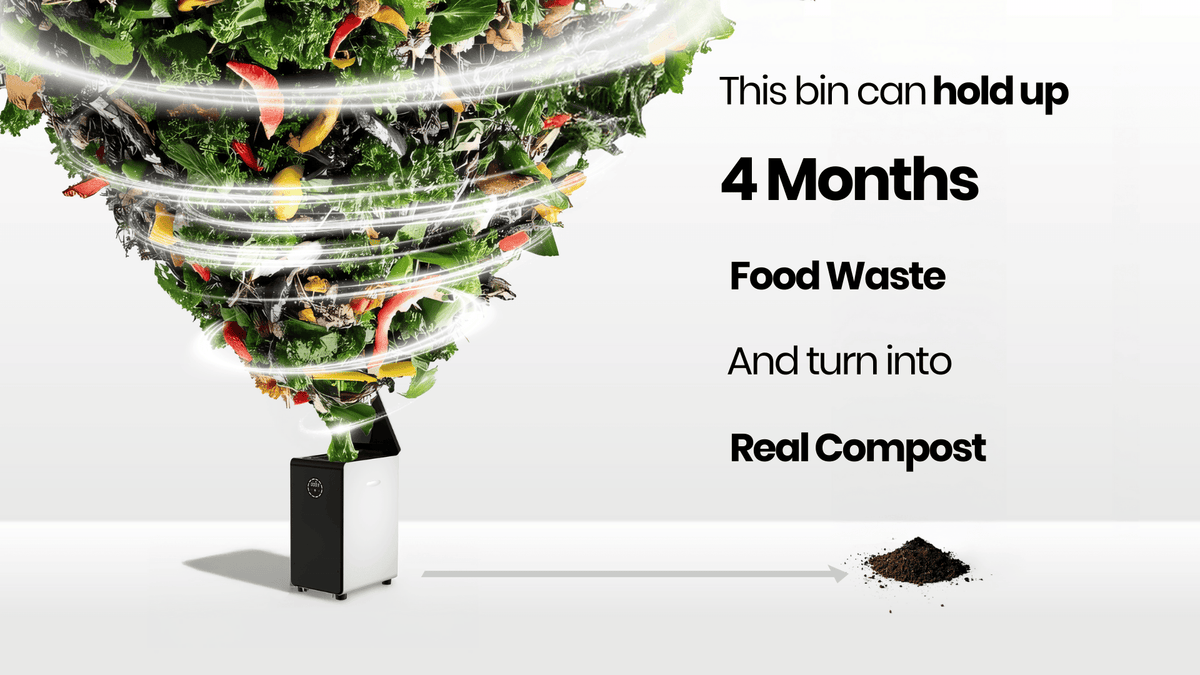
Electric Composter Definition · Types · Output
What Is an Electric Composter?
An electric composter is a powered indoor appliance designed to help households manage food scraps. Depending on the technology, it may support microbial decomposition, remove moisture, grind scraps, store food waste, or combine several of these functions.
That is why the label alone does not tell you whether the output is compost. Two products sold as “electric composters” can use completely different processes and produce completely different materials.
The useful starting point is not the product name. It is the process: what happens to the food scraps, and what comes out?
By Matthew Moore · Updated September 14, 2026

“Electric composter” describes the appliance category. The process inside determines what it actually produces.
Quick Answer: What Is an Electric Composter?
An electric composter is a powered appliance that processes household food scraps indoors.
Some electric composters maintain microorganisms and conditions for aerobic biological decomposition. Others mainly use heat, airflow and mechanical processing to reduce the moisture, volume and smell of food waste.
So an electric composter can be a microbial composter, a food-waste recycler, or another powered food-scrap management system. To know whether it actually composts, you need to look at the operating process and the output—not just the word “composter” in the product name.
If your question is specifically “Do electric composters really compost?”, continue to How Does a Real Electric Composter Work? Microbes vs Dehydrators.
Table of Contents
- Electric Composter Definition
- What Does an Electric Composter Do?
- Types of Electric Composters
- What Comes Out of an Electric Composter?
- Does Every Electric Composter Make Compost?
- What Is Inside an Electric Composter?
- Electric vs Traditional Composting
- Who Is an Electric Composter For?
- Where GEME Terra 2 Fits
- Which Guide Should You Read Next?
- Frequently Asked Questions
- Sources
- Related Guides
1. Electric Composter Definition
Electric composter: a powered household appliance used to process organic kitchen waste indoors through biological decomposition, drying, grinding, controlled storage, or a combination of these functions.
The term is a consumer product category rather than a guarantee that every machine produces mature compost.
This distinction matters because the word composter is used across appliances with very different technologies.
A microbial system may maintain living organisms, oxygen and moisture so biological decomposition can continue. A food recycler may instead remove water and mechanically reduce scraps so they become lighter and easier to store or dispose of.
Simple definition: an electric composter is the appliance category; the internal process determines whether the machine is composting, recycling, dehydrating or storing food waste.
For the biological definition of composting itself, see How Does Composting Work?.
2. What Does an Electric Composter Do?
At the most basic level, an electric composter changes the way household food scraps are managed before they would otherwise enter a trash bin, municipal organics stream or outdoor compost pile.
Depending on the machine, it may:
- reduce food-waste moisture;
- reduce volume and weight;
- control or reduce odor;
- mix food scraps;
- maintain a microbial environment;
- store scraps between processing cycles;
- produce material for further composting;
- or produce biologically processed Compost Base for soil integration.
The important point is that these functions are not identical. A machine that reduces 90% of visible waste volume has demonstrated reduction; that percentage alone does not tell you whether the reduction came from water removal, biological decomposition or both.
3. What Are the Main Types of Electric Composters?
Most household electric food-waste systems can be understood through three broad operating models.
Type 1: Microbial Electric Composters
These systems maintain a biologically active environment where microorganisms break down organic material.
Their design typically focuses on maintaining some combination of oxygen, moisture, warmth and mixing instead of intentionally driving the chamber toward dry output.
Examples include GEME Terra 2, GEME Pro and other microbe-based indoor systems.
Type 2: Heat-Dry-Grind Food Recyclers
These appliances primarily use heat, airflow and mechanical processing to reduce the moisture, size and volume of food scraps.
The result can be cleaner, lighter and easier to store than raw food waste, but dry food-derived material is not automatically mature compost.
Type 3: Food-Scrap Storage and Processing Systems
Some powered systems place greater emphasis on holding food scraps with less odor and periodically processing them into a more stable material for collection, disposal or another downstream route.
These can be valuable household waste-management tools even when returning material directly to garden soil is not their primary purpose.
There is no reason one type must be “best” for every household. A gardener seeking a kitchen-to-soil pathway and an apartment resident mainly trying to reduce smelly trash may reasonably choose different technologies.
4. What Comes Out of an Electric Composter?
The output is one of the fastest ways to understand what kind of appliance you are looking at.
| Output | What It Usually Means | Typical Next Step |
|---|---|---|
| Active Compost Base | Biologically processed, moist organic material from a microbial system. | Evaluate maturity, screen unfinished pieces and follow soil-blending guidance. |
| Dry Grounds / Flakes | Food scraps have been substantially dehydrated and often mechanically reduced. | Follow the manufacturer's disposal, collection, further-composting or soil-use guidance. |
| Partially Processed Organic Material | Some physical or biological transformation has occurred, but additional processing may still be required. | Continue composting, curing or another specified downstream treatment. |
For a direct side-by-side explanation of these outputs, use Real Compost vs Dehydrated Food Scraps.
5. Does Every Electric Composter Actually Make Compost?
No. Some electric appliances support genuine aerobic microbial decomposition, while others primarily reduce food-waste moisture and volume.
The U.S. EPA defines composting as a managed aerobic biological decomposition process involving microorganisms. Grinding and dehydrating can be useful forms of food-waste preprocessing, but those physical processes alone do not establish that compost has been produced.
The practical test:
Ask whether microorganisms are performing the transformation, whether the machine maintains the conditions they need, what the output is called, and what must happen before that output reaches soil.
This page deliberately stops at the definition. For the full mechanism—including microbes, oxygen, moisture, heat and mixing, read How Does a Real Electric Composter Work? Microbes vs Dehydrators.
6. What Is Inside an Electric Composter?
The hardware varies by technology, but powered food-waste appliances may include:
- a processing chamber for food scraps;
- mixing paddles or an agitator to move material;
- airflow components such as fans or ducts;
- heating elements for temperature management or dehydration;
- temperature, moisture, weight or torque sensors in more advanced systems;
- odor-control components such as carbon filters or catalytic treatment;
- microbial media in biological systems;
- software or control logic that determines when the machine mixes, heats or ventilates.
The presence of a heater does not automatically mean the appliance is a dehydrator, just as the presence of microbes does not by itself prove that every harvested particle is mature finished compost. The system should be judged as a whole.
7. Electric Composters vs Traditional Composting
Electric composters do not replace every form of composting. They solve a different household problem.
| Question | Traditional Home Composting | Electric / Kitchen System |
|---|---|---|
| Location | Usually outdoors or in a dedicated composting area. | Designed primarily for indoor household use. |
| Power | No electricity required. | Uses electricity for mixing, airflow, heat or controls. |
| Management | User balances browns, greens, moisture, airflow and turning. | Some management is automated by the appliance. |
| Weather | Outdoor temperature and rain can affect the process. | Indoor operation provides a more controlled environment. |
| Output | Can become mature compost when properly managed and cured. | Depends on machine type: Compost Base, dry grounds or another processed material. |
For a method-level comparison, read Traditional Composting vs Electric Composting.
8. Who Is an Electric Composter For?
An electric composter can be useful when the main barrier to composting is not interest but daily logistics.
You may benefit from one if:
- you live in an apartment or home without a practical outdoor compost pile;
- you want to process food scraps close to where they are created;
- food-waste odor in the trash is a recurring problem;
- you want a year-round indoor routine;
- your municipal organics collection is limited or unavailable;
- you want a biological kitchen-to-soil pathway;
- or you mainly want food scraps reduced before disposal or collection.
Those last two goals are different. Someone who wants material for garden soil should evaluate output and maturity more carefully than someone whose main priority is keeping the trash bin cleaner.
9. Where GEME Terra 2 Fits
GEME Terra 2 belongs to the continuous aerobic microbial composter category.
Instead of organizing operation around a heat-dry-grind batch cycle, Terra 2 maintains a biologically active chamber built around Kobold™ microorganisms. GEMEBrain™ manages operating conditions including airflow, moisture, heat and mixing.
Terra 2 is designed primarily for 1–3 person households, with a 14 L chamber and current guidance of up to approximately 2 kg/day.
Its harvested material is best understood as Active Compost Base. Because Terra 2 is continuous-flow, different particles can have different residence times.
The soil pathway is:
- screen the harvested Compost Base;
- return larger unfinished organic pieces to the chamber;
- mix approximately 1 part Compost Base with 8 parts plain soil;
- use a soil cap and allow additional maturation where appropriate.
Detailed process science belongs in How Does a Real Electric Composter Work?, while soil application belongs in the Advanced GEME Compost Application Guide.
If your household regularly produces substantially more food waste, compare Terra 2 with the 19 L GEME Pro in the Terra 2 vs GEME Pro comparison.
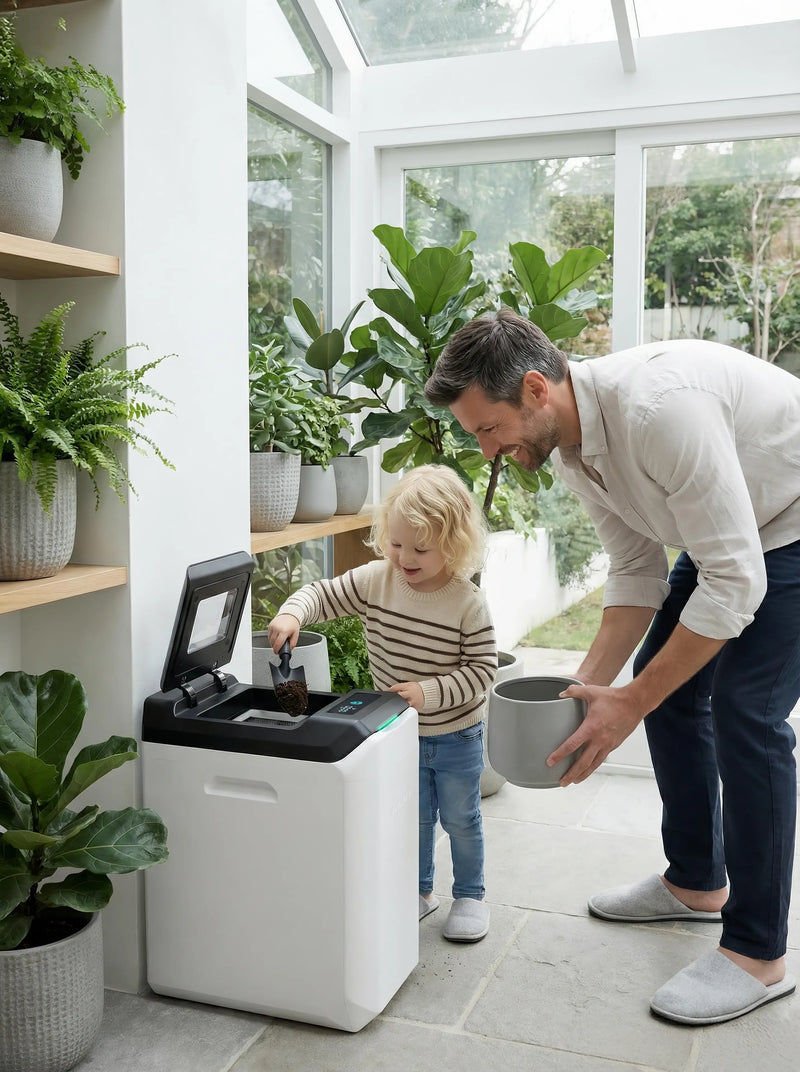
Continuous Microbial Composting
Meet GEME Terra 2
Designed for everyday household food scraps with continuous feeding, microbial decomposition, no routine replacement odor filter and Active Compost Base for soil blending.
Explore Terra 2 →10. Which Electric Composter Guide Should You Read Next?
This page answers the definition. The next page should depend on the question you are trying to solve.
Frequently Asked Questions
What is an electric composter?
An electric composter is a powered indoor appliance used to process household food scraps. Depending on the technology, it may support microbial decomposition, remove moisture, grind scraps, store food waste or combine several functions.
How does an electric composter work?
It depends on the type. Microbial electric composters maintain conditions for biological decomposition, while food recyclers may primarily use heat, airflow and mechanical processing to reduce moisture and volume. For the detailed mechanism, see our How Does a Real Electric Composter Work guide.
Do electric composters actually make compost?
Some do support genuine microbial composting, but not every appliance sold as an electric composter produces compost. Grinding and dehydration alone do not complete a biological composting process.
What is the difference between an electric composter and a food recycler?
An electric composter may refer broadly to several types of powered food-waste appliances. A food recycler generally emphasizes reducing, drying, grinding or storing food scraps. A microbial composter specifically maintains living organisms and conditions for biological decomposition.
Is dehydrated food waste compost?
Not automatically. Dehydration removes water and can dramatically reduce weight and volume, but composting requires biological decomposition and stabilization.
What comes out of an electric composter?
Output varies by machine. A microbial system may produce biologically processed Compost Base, while a dehydrator-style recycler may produce dry food grounds or flakes. Always follow the manufacturer's output guidance.
Can I put electric composter output directly on plants?
Not as a general rule. Output type and maturity vary. GEME Active Compost Base should be screened, larger unfinished pieces returned to the chamber, and the screened material mixed with plain soil at approximately 1:8 before plant use.
Does an electric composter need replacement filters?
Some models use replaceable activated-carbon or charcoal filters, while others use different odor-control systems. GEME Terra 2 does not require routine disposable odor-filter replacement.
Is an electric composter good for apartments?
It can be, especially where backyard composting or municipal organics collection is impractical. Apartment buyers should consider footprint, odor strategy, noise, food-waste volume and where the processed output will go.
What size electric composter do I need?
Use daily food-waste volume rather than chamber size alone. Terra 2 is designed primarily for 1–3 person households and up to approximately 2 kg/day. GEME Pro offers a 19 L chamber and up to approximately 5 kg/day for larger households and heavier food-waste routines.
What is a microbial electric composter?
A microbial electric composter is a powered system that maintains living microorganisms and suitable environmental conditions so organic food scraps can undergo aerobic biological decomposition.


Leave a comment
All comments are moderated before being published.
This site is protected by hCaptcha and the hCaptcha Privacy Policy and Terms of Service apply.