


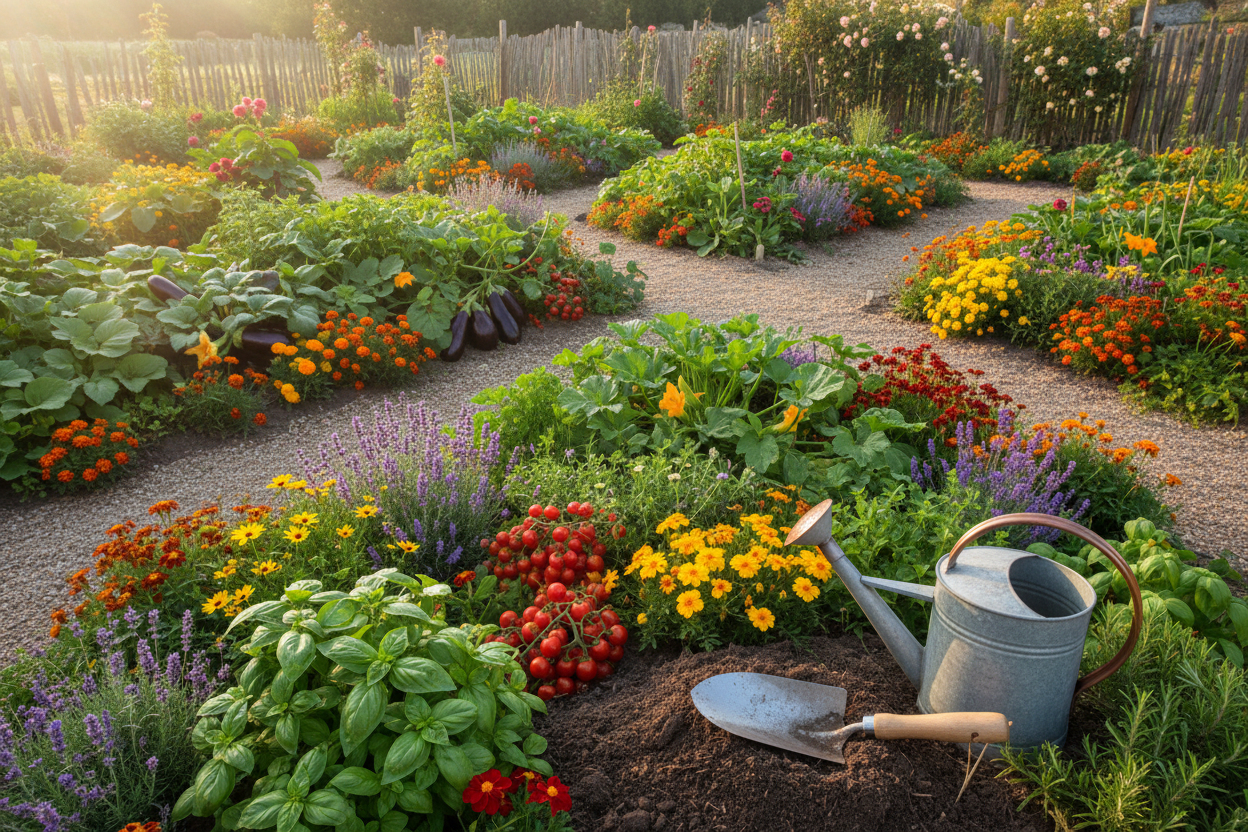
Garden, Soil Health & Compost Hub
A healthy garden starts below the surface. Sunlight, plant selection and watering matter, but roots ultimately depend on soil that can hold air, manage water, cycle nutrients and support living organisms.
Compost can improve that growing environment by adding organic matter and supporting soil structure. It should be used as an amendment, not treated as a universal replacement for soil or as a guaranteed fertilizer.
This guide connects GEME’s existing soil, compost maturity, garden application, nutrient-testing and seasonal-care resources into one practical gardening system.
Soil provides the growing foundation. Compost improves that foundation.
How Do You Build a Healthier Garden?
Start by understanding the existing soil before adding compost, fertilizer or other amendments. Check drainage, compaction, texture, sunlight and plant requirements. A soil test can reveal pH and nutrient conditions that cannot be judged reliably by appearance.
Use garden soil as the mineral and structural base. Add mature compost in moderate amounts to support organic matter, soil aggregation, water behavior, nutrient cycling and biological activity.
Keep the soil covered where practical, disturb it only as much as necessary, maintain living roots through the growing season and avoid repeatedly applying more compost than the soil or plants need.
Begin with Garden Soil vs Compost to understand the basic difference.
Gardening Advice Has Local Boundaries
Soil, climate, rainfall, frost dates, drainage, native geology and plant requirements vary by location. No single compost ratio or planting schedule is correct for every garden.
Use this page as a framework, then adapt it using local extension guidance, plant-specific information, soil-test results and observed plant response.
Compost supports soil health, but too much compost can contribute to nutrient imbalance, salinity or runoff. More compost is not automatically better.
The Gardening and Soil Health Relationship
↓
Soil
↓
Compost
↓
Organic Matter
↓
Plant Growth
This relationship is not a promise that compost alone makes plants grow. Plant growth also depends on light, temperature, water, root space, pH, nutrient balance, plant genetics and pest or disease pressure.
Compost contributes organic material to the soil system. Healthy soil then creates a more functional environment in which roots, water, air, nutrients and soil organisms can interact.
Table of Contents
- Start With the Garden, Not the Compost
- What Makes Garden Soil Work?
- What Is Soil Health?
- When to Test Garden Soil
- What Compost Does for a Garden
- When Compost Is Ready
- How to Use Compost in Different Gardens
- How to Use GEME Compost Output
- Organic Matter, Nutrients and Fertilizer
- Coffee Grounds, Eggshells and Kitchen Inputs
- Seasonal Garden and Compost Care
- Common Garden Soil Problems
- The Kitchen-to-Garden Loop
- Frequently Asked Questions
- Bottom Line
- Sources
- Related Gardening Guides
Start With the Garden, Not the Compost
Compost cannot correct every gardening problem. A plant placed in unsuitable light, standing water, severe compaction or an incompatible climate will not become healthy simply because more compost is added.
Before amending the soil, understand the growing site.
Sunlight
Observe direct sun, partial shade and seasonal changes before selecting plants.
Drainage
Identify areas where water drains quickly, remains evenly moist or collects after rain.
Root Space
Consider mature plant size, nearby structures, container volume and competition from existing roots.
Climate
Match plants to local winter lows, summer heat, rainfall patterns and growing-season length.
Existing Soil
Examine texture, compaction, crusting, drainage, previous amendments and signs of erosion.
Purpose
Vegetable beds, flowers, shrubs, lawns and containers require different soil-management decisions.
Build the garden around plants suited to the location. Use compost to improve the growing environment rather than trying to force unsuitable plants into the site.
What Makes Garden Soil Work?
Garden soil is more than dirt. It is a mixture of mineral particles, organic matter, water, air, roots and living organisms.
| Soil Component | Garden Function | Potential Problem |
|---|---|---|
| Sand | Supports drainage and larger pore spaces. | Very sandy soil may lose water and nutrients quickly. |
| Silt | Can retain moisture and nutrients. | May compact or erode when structure is weak. |
| Clay | Can hold water and nutrient ions effectively. | May drain slowly and compact when worked wet. |
| Organic matter | Supports aggregation, biology, moisture behavior and nutrient cycling. | Excessive amendment can create nutrient or salinity problems. |
| Air and water | Roots and soil organisms require both. | Waterlogged soil loses oxygen; very dry soil limits biological activity. |
| Soil organisms | Help decompose organic material and cycle nutrients. | Excess disturbance, compaction and inappropriate chemicals can disrupt communities. |
For the complete comparison between planting soil and organic amendments, read Garden Soil vs Compost: Pros and Cons.
What Is Soil Health?
Soil health describes the ability of soil to function as a living system. In a garden, that includes supporting roots, cycling nutrients, absorbing and storing water, exchanging gases and providing habitat for soil organisms.
Healthy soil is not identified by one color, one pH value or one compost application. It is the result of multiple physical, chemical and biological conditions working together.
Practical Signs to Observe
- Water enters the soil instead of immediately running off.
- The surface does not form a hard crust after every rain.
- Roots can penetrate without being confined to shallow channels.
- The soil contains stable crumbs or aggregates rather than only hard clods.
- Plant residues gradually decompose rather than remaining waterlogged and sour.
- Earthworms and other organisms may be present where climate and soil conditions allow.
- Plants show appropriate growth without constant emergency fertilization.
Four Soil-Health Habits
Disturb Less
Avoid unnecessary digging and never work saturated soil.
Keep Soil Covered
Use plants, suitable mulch or plant residues to protect the surface.
Maintain Living Roots
Living plants feed soil biology through root activity.
Grow Diversity
Different plants create different roots, residues and biological interactions.
When Should You Test Garden Soil?
A soil test is useful before establishing a new garden, correcting persistent plant problems or applying compost and fertilizer repeatedly.
Depending on the laboratory, a test may report:
- Soil pH
- Phosphorus and potassium
- Organic matter
- Soluble salts or electrical conductivity
- Calcium, magnesium or other measurements
- Crop-specific amendment recommendations
Do Not Correct Soil by Guessing
Yellow leaves, slow growth or poor flowering can result from nutrient deficiency, excess nutrients, unsuitable pH, poor drainage, damaged roots, pests, disease, temperature or watering. Adding more compost without identifying the cause can make the problem harder to correct.
What Does Compost Do for a Garden?
Compost is decomposed organic material used primarily as a soil amendment. Its value is broader than a simple NPK number.
Adds Organic Matter
Compost contributes decomposed carbon-based material to the soil system.
Supports Structure
Organic matter can help soil particles form more functional aggregates and pore spaces.
Influences Water
Compost can improve water-holding behavior in some soils and drainage structure in others.
Supports Soil Biology
Organic material provides energy and habitat for parts of the soil biological community.
Contributes Nutrients
Compost contains variable plant nutrients that can enter the soil nutrient cycle over time.
Recycles Organic Material
Suitable kitchen and garden scraps can return to a managed biological cycle instead of disposal.
Explore the broader value of mature compost in Unlocking Black Gold: The Power of High-Quality Compost.
When Is Compost Ready for the Garden?
Material should not be judged only by its dark color or by whether the original food is difficult to recognize.
Mature compost generally shows several of the following characteristics:
- An earthy or neutral smell rather than a strong rotten odor
- A more uniform, crumbly texture
- Few recognizable fresh food pieces
- Reduced active heating after decomposition slows
- No obvious waterlogging or anaerobic slime
- Appropriate stability for the intended plant use
Seedlings, young roots and small containers are less forgiving than established garden beds. When maturity is uncertain, allow additional curing or perform a small test before broad application.
Review the complete checklist in When Is Compost Ready to Use?
How to Use Compost in Different Gardens
The appropriate method depends on compost maturity, soil condition, crop sensitivity and whether the garden is in the ground or in a container.
| Garden Type | General Compost Approach | Main Caution |
|---|---|---|
| In-ground vegetable bed | Blend mature compost into the upper soil or use it as a controlled surface application. | Avoid repeated heavy applications without soil testing. |
| Raised bed | Use compost as one part of a balanced soil mixture. | Do not fill a raised bed entirely with compost. |
| Container garden | Use modest amounts within a well-aerated container growing medium. | Containers can accumulate salts and remain too wet when compost is excessive. |
| Established perennial | Apply mature compost around the root zone and cover where appropriate. | Keep material away from stems and crowns. |
| Tree or shrub | Apply over the outer root area rather than against the trunk. | Do not mound wet compost against bark or the root collar. |
| Seedlings | Use only well-matured material in conservative amounts, or wait until plants establish. | Young roots are sensitive to salts, immature material and nutrient concentration. |
Standard Compost and GEME Output Are Not Automatically Interchangeable
Bagged mature compost, finished outdoor compost and continuous-flow GEME output may differ in moisture, maturity, nutrient concentration and remaining fragments. Follow the correct application method for the material you actually have.
How to Use GEME Compost Output in the Garden
GEME is a continuous-flow microbial composting system. Material enters the chamber at different times, so harvested output may include mature-looking compost base together with slower pieces.
The recommended workflow is:
1. Screen
Separate pits, dense fibers, larger bones, shells and recognizable unfinished pieces.
2. Return
Return suitable unfinished organic pieces to the chamber for further breakdown.
3. Mix
Blend approximately 1 part screened GEME compost base with 8 parts plain soil.
4. Cap
Cover the blend with plain soil. For new plants, maintain about 5 cm / 2 inches of plain soil between sensitive roots and the blend.
5. Water
Water the area to settle the soil while avoiding persistent saturation.
6. Observe
Start modestly and monitor plant response before increasing the amount or frequency.
| GEME Use Case | Recommended Method |
|---|---|
| New plant or transplant | Place the 1:8 blend below a plain-soil buffer layer; keep roots out of direct concentrated output. |
| Established plant | Apply the blend in a covered ring or small pockets away from stems and crowns. |
| Tree or shrub | Apply a covered blend away from the trunk, preferably toward the active outer root zone. |
| Extra stored output | Store in a breathable container in a cool, shaded place rather than sealing wet output airtight. |
Follow the complete application protocol in An Agronomist’s Guide to Continuous-Flow Compost Application.
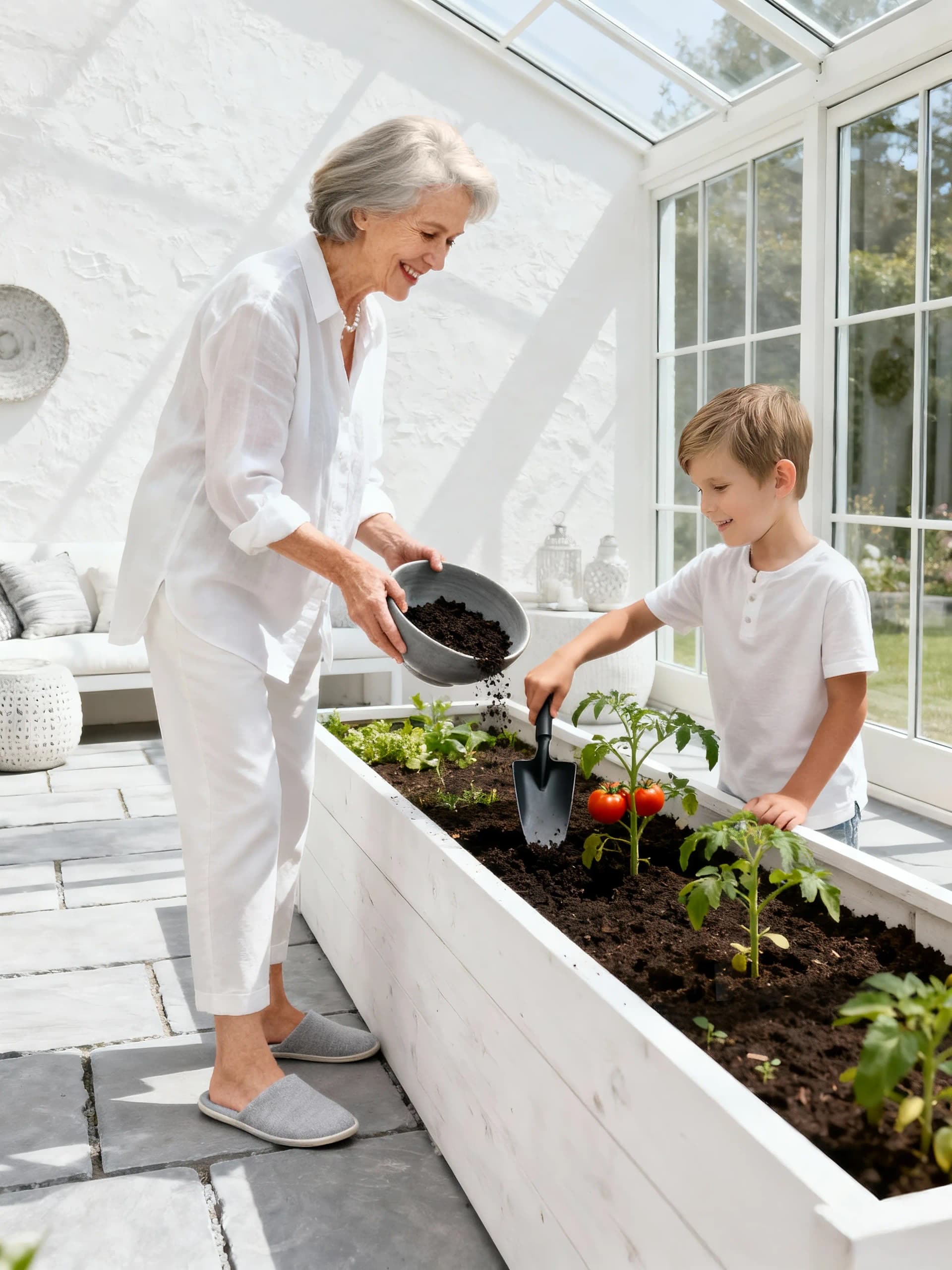
Screen, return, mix 1:8, cap with soil and observe plant response.
Build a Kitchen-to-Garden Composting Routine
GEME Terra 2 continuously processes suitable kitchen scraps through microbial activity and creates a compost base for responsible soil blending—not dry flakes or instant potting soil.
Explore GEME Terra 2 →Compost is a soil amendment. Always match application to soil condition, plant sensitivity and output maturity.
Organic Matter, Nutrients and Fertilizer Are Not the Same Thing
Gardeners often focus on nitrogen, phosphorus and potassium. Those nutrients matter, but compost also affects the physical and biological environment of the soil.
| Term | Primary Meaning | Gardening Boundary |
|---|---|---|
| Organic matter | Carbon-based material at different stages of decomposition within soil. | It supports soil function but is not a complete growing medium by itself. |
| Compost | Managed, decomposed organic material used as a soil amendment. | Quality, maturity and nutrient content vary. |
| Fertilizer | A material used primarily to supply specified plant nutrients. | Application should reflect crop needs and soil-test information. |
| Potting mix | A formulated growing medium designed for container aeration and water management. | Compost may be one ingredient, but pure compost is generally not a substitute. |
GEME’s N=50 output sampling found nutrients across household samples, but the values varied with feedstock and operating conditions. The appropriate conclusion is to use the material as compost—not to assume one guaranteed fertilizer analysis.
Review the evidence and boundaries in NPK Test of Home Compost Output: What It Shows and What It Doesn’t.
Coffee Grounds, Eggshells and Other Kitchen Materials
Individual kitchen materials are often promoted as miracle garden amendments. In practice, most are better treated as ingredients in a balanced composting process.
Coffee Grounds
Coffee grounds are useful compost ingredients, but thick direct layers can compact, remain wet and interfere with air movement.
Mix them with varied materials and compost them before broad garden application.
How to Compost Coffee Grounds →Eggshells
Eggshells contain calcium carbonate but break down slowly when left in large pieces.
They should not be used as an automatic treatment for every plant or soil, especially where pH and calcium conditions are unknown.
How to Compost Eggshells →Avoid Single-Ingredient Gardening
Banana peels, coffee grounds, eggshells and other scraps cannot replace a complete diagnosis of soil condition. Compost varied materials, test the soil where appropriate and apply amendments according to plant needs.
Seasonal Garden and Compost Care
| Season | Garden Priority | Compost Priority |
|---|---|---|
| Spring | Assess winter damage, soil workability, weeds and planting conditions. | Use mature compost conservatively before planting; avoid working saturated soil. |
| Summer | Manage watering, heat stress, mulch, pests and harvesting. | Avoid heavy fresh applications around stressed roots; use covered, moderate amendments. |
| Fall | Remove diseased material, protect soil and plan next season. | Compost healthy residues and use mature material where appropriate. |
| Winter | Protect soil, structures and overwintering habitat. | Store output with airflow and avoid applying onto frozen or waterlogged soil. |
Garden cleanup should separate healthy compostable residues from diseased, pest-infested, plastic or hazardous material.
Read How to Clean Up a Winter Garden for the complete sorting and cleanup workflow.
Common Garden Soil Problems and Better First Responses
| Problem | Possible Causes | Better First Response |
|---|---|---|
| Water remains on the surface | Compaction, clay texture, grading or saturated subsoil | Assess drainage and avoid working the area while wet; compost alone may not solve grading problems. |
| Soil dries extremely quickly | Sandy texture, exposed surface, small container or insufficient root volume | Use suitable organic matter and mulch while adjusting watering and plant choice. |
| Plants show leaf yellowing | Water stress, nutrient issues, root damage, pH, pests or disease | Inspect roots and moisture, identify the plant-specific pattern and test soil before adding amendments. |
| Seedlings fail after transplanting | Root disturbance, heat, water stress, immature compost or concentrated nutrients | Use a buffered planting medium and keep concentrated amendments away from young roots. |
| White salt crust appears | Fertilizer accumulation, hard water or excessive high-salt compost | Pause amendment use and test soil or growing medium before continuing. |
| Compost attracts flies or smells rotten | Immature material, exposed food, excess moisture or anaerobic conditions | Do not apply it directly around plants; restore aerobic conditions or allow further curing. |
A gardening problem should be diagnosed before it is treated. Compost is valuable, but it is not the automatic answer to every symptom.
The Kitchen-to-Garden Organic Matter Loop
↓
Suitable Kitchen Scraps
↓
Microbial Composting
↓
Screened Compost Base
↓
Soil Blending
↓
Organic Matter and Soil Care
↓
Plant Growth
This is a circular relationship, not an instant conversion claim. Food scraps require managed decomposition, and the resulting compost must be applied according to maturity, soil condition and plant needs.
Before the gardening stage, review the Complete Home Composting Guide.
For a broader kitchen-waste system, see the Food Storage and Waste Reduction Guide.
Frequently Asked Questions
Is compost the same as garden soil?
No. Garden soil contains mineral particles and provides physical root support. Compost is decomposed organic material normally used to improve the soil.
Can I plant directly in compost?
Pure compost is generally not the best growing medium for most plants. It may lack appropriate mineral structure, hold too much moisture or contain excessive nutrients and salts.
How does compost improve soil health?
Mature compost adds organic matter and may support soil aggregation, water behavior, nutrient cycling and biological activity.
Can you use too much compost?
Yes. Repeated heavy applications can contribute to excessive phosphorus, salts, nutrient imbalance or runoff. Soil testing helps guide long-term use.
How do I know whether compost is ready?
Mature compost is generally more uniform and earthy-smelling, with few fresh food pieces and little active heating. Intended use and plant sensitivity also matter.
Is compost a replacement for fertilizer?
Not automatically. Compost contributes variable nutrients and organic matter, while fertilizer products are normally designed to supply specified nutrients. Use soil tests and plant requirements to guide both.
Can I use compost in raised beds?
Yes, but use compost as one part of a balanced raised-bed soil mixture rather than filling the bed entirely with compost.
Can I use compost in containers?
Yes, in moderate amounts within a suitable container growing medium. Containers need reliable drainage and are more sensitive to salts and excessive moisture.
Can compost touch plant stems or tree trunks?
Avoid piling wet compost directly against stems, crowns, bark or root collars. Apply it over the surrounding root zone and keep a clear buffer.
What is the GEME 1:8 rule?
It means blending approximately one part screened GEME compost base with eight parts plain soil before plant use.
Can I put unfinished GEME pieces into garden soil?
Larger unfinished pieces should be screened out and returned to the GEME chamber for further decomposition instead of being placed near roots.
Does GEME compost output have a fixed NPK value?
No. Nutrient levels vary according to household feedstock and operating conditions. GEME output should be treated as variable compost base rather than a standardized fertilizer product.
Bottom Line
Better gardening starts with a better understanding of the soil.
Match plants to the site, protect soil structure, maintain suitable moisture, keep soil covered and use living roots and plant diversity to support the soil ecosystem.
Use mature compost as an amendment that contributes organic matter. Do not treat pure compost as universal soil or assume that more compost always produces more plant growth.
GEME compost output requires a defined soil-use workflow: screen larger pieces, return unfinished material, blend approximately 1:8 with soil, cover with plain soil, water and observe.
The real gardening cycle is not simply waste becoming fertilizer. It is organic material being decomposed responsibly, returned to soil carefully and managed as one part of a healthy plant-growing system.
Sources
- USDA NRCS — Soil Health
- U.S. EPA — Composting at Home
- University of Minnesota Extension — Promote Healthy Soil in Your Garden
- University of Minnesota Extension — Too Much Compost and Manure
- University of Minnesota Extension — Soil Organic Matter
- GEME — Garden Soil vs Compost
- GEME Journal — Advanced Compost Application Guide
- GEME Journal — NPK Test of Home Compost Output
Compost should support the garden—not overwhelm it.
Return Suitable Kitchen Scraps to the Soil Cycle
GEME Terra 2 and GEME Pro use managed microbial activity to process suitable household food scraps into compost base for responsible soil blending.
Screen. Return. Mix. Cap. Water. Observe. Let’s feed the earth.


Leave a comment
This site is protected by hCaptcha and the hCaptcha Privacy Policy and Terms of Service apply.