



Milk · Dairy · Moisture · Odor Control · Microbial Composting
Can You Compost Milk and Dairy?
Milk and dairy can biologically break down, but they are more difficult compost inputs than ordinary fruit and vegetable scraps. Liquid milk adds moisture very quickly, while cheese, yogurt and other dairy foods can contain substantial protein and fat that may create stronger odor pressure during decomposition.
GEME Terra 2 can process suitable dairy, but milk should be treated as a moisture-sensitive input rather than something to pour into the chamber freely. A normally operating microbial bed is already moist, often around the upper end of the roughly 50–60% range associated with active aerobic composting, so additional liquid should be small, gradual and based on the actual condition of the composting mass.
By Matthew Moore · Last reviewed August 20, 2026

Quick Answer: Can Milk and Dairy Be Composted?
Yes, biologically, but milk and dairy need more care than ordinary fruit and vegetable scraps.
Traditional backyard compost guidance generally recommends excluding dairy because of pests and odor. GEME Terra 2 can process suitable dairy-containing food waste, but liquid milk should only be added in small, spaced amounts when the microbial bed is not already too wet. There is no universal milk-volume limit because the correct amount depends on the existing moisture condition of the composting mass.
Dairy creates two main challenges:
For a broader material-by-material reference, see What Can You Compost at Home?. It explains why fruit, vegetables, dairy, meat, oils and other organic-looking materials do not all belong in every composting method.
The better question is therefore:
“What is the microbial bed like right now, and will this dairy load keep moisture and oxygen in a healthy range?”
Table of Contents
- Why Is Dairy Harder to Compost?
- Why Does Backyard Compost Usually Exclude Dairy?
- Why Does Milk Create a Moisture Challenge?
- Why Can Dairy Produce Strong Odors?
- Can You Put Milk in GEME Terra 2?
- What Should You Do With Expired Milk?
- Can You Compost Cheese, Yogurt, Butter and Cream?
- How Does Terra 2 Process Dairy?
- How Does Terra 2 Control Dairy Odor?
- GEME vs Lomi vs Mill Odor Control
- What Happens If You Add Too Much Dairy?
- How Should You Add Milk and Dairy?
- What If Terra 2 Becomes Too Wet or Smelly?
- Milk and Dairy Composting Methods Compared
- Common Dairy Composting Mistakes
- Frequently Asked Questions
1. Why Is Dairy Harder to Compost Than Fruit and Vegetable Scraps?
Dairy is organic material, but it behaves differently from a banana peel or vegetable trimming.
The category includes:
- milk;
- cream;
- yogurt;
- soft cheese;
- hard cheese;
- butter;
- dairy sauces;
- cooked foods containing milk or cheese.
Some dairy foods create mainly a moisture challenge.
Others are concentrated sources of protein and fat.
Many combine all three.
This is why saying “dairy is compostable” is only part of the answer.
The biological process also depends on moisture, oxygen, structure, temperature, microbial activity and load size remaining within workable conditions.
The same distinction is central to the Electric Composter Input Guide, which separates normal mixed leftovers from free liquids, greasy loads, dense bones and other boundary cases.
2. Why Does Backyard Compost Usually Exclude Dairy?
For a traditional backyard pile, current guidance is conservative.
The U.S. EPA recommends keeping cheese and other dairy products out of ordinary backyard compost.
See U.S. EPA — Composting at Home.
The issue is not biological impossibility.
This is a good example of why a backyard compost pile and an electric microbial composter have different practical input rules.
The issue is that an ordinary pile has limited control over:
- animal access;
- airflow;
- temperature;
- moisture;
- mixing;
- odor release.
Dairy can attract rodents, flies and other scavengers.
A wet, protein-rich dairy pocket can also become a strong odor source when oxygen becomes limited.
If you are building or troubleshooting an outdoor pile, use the Complete Home Composting Guide for greens, browns, moisture, oxygen and material selection.
“Organic” Does Not Mean “Ideal for Every Method”
Dairy is biodegradable organic material. Backyard guidance excludes it mainly because simple open piles are poorly equipped to manage high-moisture dairy loads, odor and pest pressure.
3. Why Does Milk Create a Moisture Challenge?
Milk is mostly liquid.
That makes it fundamentally different from cheese, bread or solid plate scraps.
Active aerobic composting already requires substantial moisture.
General composting guidance commonly places a productive moisture range around 50–60% by weight.
Terra 2 likewise operates with a moist microbial bed rather than a dry processing chamber.
Under normal operation, the bed can already be around 60% moisture.
That means pouring additional liquid into the system does not start from a dry baseline.
Microbial bed is already moist
↓
Liquid milk is added
↓
Water content rises further
↓
Pore space and oxygen movement can decrease
↓
Over-wet and odor risk increases
The EPA has long identified excessive moisture as a factor that impedes oxygen transfer and increases the possibility of anaerobic conditions and offensive odor.
This same free-liquid problem appears with soup, brine and oily sauces. The Electric Composter Salt & Oil Boundaries guide explains the practical rule: concentrated liquids should not turn the chamber into a drain.
See U.S. EPA — Composting Moisture & Aeration Guidance.
There is no useful fixed milk-volume limit independent of the microbial bed.
A quantity that might be manageable when the bed is relatively dry may be too much when the bed is already near the wet end of its operating range. The better rule is to assess moisture first and, if milk is added at all, use only a small amount and space additions over time.
4. Why Can Dairy Produce Strong Odors During Decomposition?
Moisture is only one part of the dairy problem.
Cheese, yogurt and other concentrated dairy foods can also contain substantial amounts of protein.
Protein-rich organic material contains nitrogen- and sulfur-bearing compounds.
During microbial decomposition, some of that chemistry can produce noticeable odor compounds such as:
- ammonia;
- amines;
- sulfur-containing compounds;
- sour odors when oxygen becomes limited.
Cornell's composting guidance explains that excess nitrogen can be lost as ammonia under unfavorable compost conditions.
See Cornell Composting — Compost Chemistry.
That does not mean one spoonful of yogurt automatically creates a smell problem.
Odor becomes more likely when several stresses occur together:
- large dairy loads;
- excess moisture;
- reduced oxygen transfer;
- high-fat material;
- repeated protein-heavy feeding;
- leaving the chamber open.
Protein Creates Odor Potential, Not Guaranteed Odor
Actual odor depends on moisture, oxygen, temperature, microbial activity, load size and whether odor-bearing air follows the machine's intended purification pathway.
5. Can You Put Milk in GEME Terra 2?
Yes, in small amounts, but milk should not be treated as a routine bulk liquid input.
The decision should start with the current condition of the microbial bed.
If the Bed Looks Normally Moist
You may add a small amount of milk as part of normal food-waste handling.
Do not pour a large quantity simply because the system can biologically process dairy.
If the Bed Is Already Wet
Skip the milk.
Adding more free liquid can push the system farther toward excessive moisture and reduce oxygen availability.
If You Still Want to Add Milk
Use a small amount.
Allow the system time to redistribute and process that moisture before considering another liquid-heavy addition.
Better Terra 2 milk rule: check the bed first → add only a small amount when conditions are suitable → wait → reassess before adding more.
This is more accurate than publishing one universal milliliter limit because the starting moisture condition is not identical from one household or one day to the next.
For the wider decision framework around dairy, meat, bones and free liquids, continue with What Can You Put in an Electric Composter?.
6. What Should You Do With Expired Milk?
If a carton of milk has expired, the best disposal route depends on your local waste and wastewater rules.
Do not assume that the kitchen sink is automatically the environmentally preferred option.
Some wastewater authorities specifically advise households not to pour milk down the sink because milk contains fats, proteins and a high organic load that can contribute to sewer blockages and increase wastewater-treatment demand.
For example, Sydney Water advises against putting spoiled milk down household sinks.
See Sydney Water — Save Our Sinks.
If you have expired milk:
- check your local household food-waste and wastewater guidance;
- do not automatically pour a large volume down the drain;
- do not automatically pour a large volume into Terra 2 either;
- if you choose to compost a small amount in Terra 2, first make sure the microbial bed is not already too wet;
- use small, spaced additions rather than turning the chamber into a liquid-disposal route.
The underlying principle is the same in both plumbing and composting:
A liquid food is still an organic load. Where it goes matters.
7. Can You Compost Cheese, Yogurt, Butter and Cream?
In a system designed to accept dairy, these foods can biologically break down—but they create different stresses.
| Dairy Item | Main Challenge | Terra 2 Approach |
|---|---|---|
| Milk | High free moisture | Check current bed moisture. If suitable, add only a small amount and space additions. |
| Yogurt | Moisture + protein | Normal household residues are easier than a large yogurt-only load. |
| Cheese | Protein + fat + density | Use normal meal quantities and break up large dense pieces where practical. |
| Cream | Moisture + high fat | Use caution because it combines free liquid with concentrated fat. |
| Butter | Concentrated fat | Normal food residue is different from adding a large block or pool of melted butter. |
| Dairy Sauce | Moisture + fat + salt | Treat sauce-heavy leftovers as a more demanding load and avoid repeated wet additions. |
The pattern is simple:
The more water, protein and fat a dairy load brings at once, the more carefully it should be paced.
For cream, butter, cheese sauces and other dairy foods where fat or salt becomes the bigger variable, see Salt, Oil & High-Moisture Input Boundaries.
8. How Does GEME Terra 2 Process Dairy?
GEME Terra 2 does not handle dairy by simply heating it until it becomes dry.
It maintains a moist, oxygen-rich environment for an active microbial community.
GEME's How It Works guidance explains that continuous airflow and gentle turning help maintain aerobic conditions and expose fresh food surfaces to microbial activity.
GEMEBrain™ helps manage:
- airflow;
- heat;
- moisture-related conditions;
- mixing.
For dairy, moisture management is particularly important.
The goal is therefore not to remove all moisture.
It is to keep moisture and oxygen available at the same time.

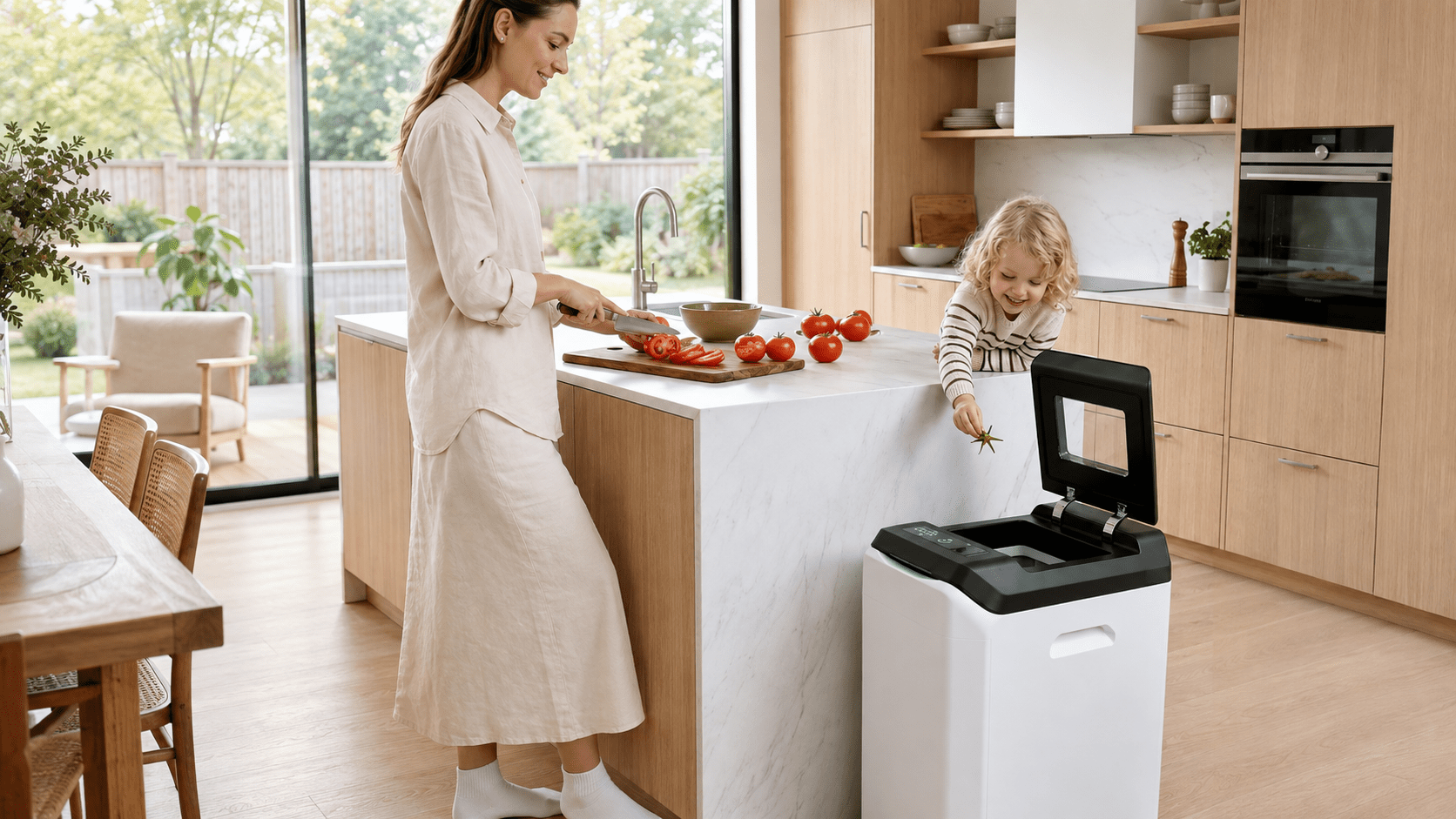
Real Leftovers Include Dairy
A Living System That Manages Moisture, Airflow and Odor
Terra 2 is designed for a broader household food stream than an ordinary backyard pile, including suitable dairy-containing leftovers.
Milk is different from solid food because it adds free moisture directly. Add it only sparingly when the existing microbial bed has room for more moisture.
After adding dairy, keep the lid closed so odor-bearing air follows the designed airflow and purification path.
Explore GEME Terra 2 →9. How Does GEME Terra 2 Control Dairy Odor?
Dairy can create stronger odor potential than many fruit and vegetable scraps.
That is especially true when the load is:
- protein-rich;
- too wet;
- high in fat;
- too large;
- oxygen-limited.
Terra 2 addresses odor in two stages.
1. Keep the Biological Process Aerobic
Oxygen helps keep microbial decomposition away from the anaerobic conditions associated with sour, rotten and sulfur-like odors.
Terra 2 uses managed airflow and mixing to support aerobic operation.
2. Treat Odor-Bearing Air Before It Leaves the Machine
Terra 2 uses its PermaFilter™ purification architecture.
GEME's current Technical White Paper describes PermaFilter™ as catalytic oxidation designed to help break down odor compounds without relying on recurring charcoal-filter replacement.
Dairy enters
↓
Lid closes
↓
Aerobic microbial processing continues
↓
Outgoing air follows the PermaFilter™ odor-control pathway
This is why the lid should remain closed during normal operation.
An open lid allows fresh dairy and food odor to escape directly before the intended airflow and purification pathway can manage it.
Odor Control Does Not Make Moisture Irrelevant
PermaFilter™ helps manage odor during normal operation, but a very wet or dairy-heavy overload can still increase odor pressure inside the biological process. The better strategy is to prevent the overload first.
For broader odor troubleshooting, read How to Reduce Odor in Indoor Composting.
10. GEME vs Lomi vs Mill: How Is Odor Control Different?
GEME, Lomi and Mill all address food-waste odor, but they do not use the same maintenance architecture.
The clearly documented difference is the odor-control method and recurring consumable requirement.
| System | Odor-Control Approach | Routine Replacement |
|---|---|---|
| GEME Terra 2 | PermaFilter™ catalytic oxidation + managed airflow | No routine charcoal-filter replacement |
| Lomi | Activated-carbon odor filtration | Lomi currently recommends replacement about every 3 months or 45 cycles. |
| Mill Essential | Activated-charcoal filtration | Mill states typical filter life is about 5–6 months. |
| Mill Plus | Activated-charcoal filtration | Mill states typical filter life is about 10–12 months. |
Lomi's current filter guidance recommends replacing its activated-carbon filtration about every three months or 45 cycles.
See Lomi — Current Filter Replacement Guidance.
Mill's current support guidance states approximately five to six months for Mill Essential and ten to twelve months for Mill Plus, depending on use.
See Mill — Current Carbon Filter Guidance.
Where Terra 2 Has a Clear Maintenance Advantage
PermaFilter™ does not create the same routine need to:
- track charcoal-filter life;
- buy replacement carbon;
- store replacement filters;
- remove spent carbon media;
- install fresh odor filters periodically.
At the recurring-consumables level, this gives Terra 2 a straightforward advantage:
No routine odor-filter replacement means less recurring filter material, packaging, replacement shipping and spent-filter handling.
This is a meaningful maintenance and waste-reduction difference.
For a dedicated ownership-cost comparison across GEME, Lomi, Mill and Reencle, see Electric Composter Filter Costs.
It should not be expanded into an unsupported claim that Terra 2 has a lower total environmental footprint in every lifecycle category.
Fair comparison: GEME reduces recurring odor-filter consumption. Lomi and Mill use activated-carbon filtration that eventually requires replacement. That is a clear structural difference without claiming an unverified universal odor-removal percentage.
11. What Happens If You Add Too Much Milk or Dairy?
Dairy overload usually appears in two ways.
Too Much Liquid
When milk or another liquid dairy product is added to an already moist microbial bed, water content can move above the comfortable aerobic range.
The material may become:
- too wet;
- heavy;
- pasty;
- less permeable to air.
Excess water fills pore spaces that would otherwise contain air.
As oxygen movement becomes harder, odor risk increases.
Too Much Protein- and Fat-Rich Dairy
A concentrated cheese-, yogurt- or cream-heavy load can create a zone rich in protein and fat.
Possible odors may include:
- ammonia-like notes;
- sulfur-like notes;
- sour odors;
- rancid notes from fatty material.
Avoid Back-to-Back Wet Dairy Loads
If the microbial bed has just received a wet or dairy-heavy addition, give it time to process and rebalance before adding more milk, yogurt, cream or sauce.
12. How Should You Add Milk and Dairy to GEME Terra 2?
Milk
Check the current microbial-bed condition first.
If the bed already looks very wet, do not add milk.
If conditions appear suitable and you genuinely want to process some milk in Terra 2, use a small amount and allow time before adding more.
Yogurt
Normal food residue or small household portions are easier to process than an entire large container added at once.
Cheese
Small scraps, grated cheese and ordinary leftovers can enter with the mixed food-waste stream.
Break up unusually large, dense pieces where practical.
Cream
Use extra caution because cream combines liquid loading with high fat.
Butter
Normal residue on cooked food is different from adding a large block or pool of melted butter.
Is the microbial bed already wet?
↓ Yes
Skip additional milk or liquid dairy
Bed condition is suitable?
↓
Add only a small amount
Want to add more later?
↓
Wait, let the system process the moisture, then reassess
13. What Should You Do If Terra 2 Becomes Too Wet or Smelly After Dairy?
If the Chamber Becomes Too Wet
- Pause milk and other liquid-heavy inputs.
- Do not add another dairy-heavy load immediately.
- Return to a normal varied food-waste stream.
- Keep Terra 2 powered so its normal airflow, mixing and environmental control can continue.
- Wait for the microbial bed to recover before considering another wet input.
If You Notice Dairy Odor
- Close the lid fully.
- Keep Terra 2 running normally.
- Avoid repeatedly opening the lid immediately after a strong dairy load.
- Pause additional wet and protein-heavy material.
- Check that normal airflow paths are unobstructed.
The lid matters because odor-bearing air should remain inside the machine's intended airflow path.
With the lid closed, outgoing air can pass through the system's odor-control architecture instead of escaping directly from the chamber.
Do Not Fix an Over-Wet Bed With More Dairy
If the bed is already wet or strongly odorous, another milk, yogurt or cream-heavy load adds stress rather than solving it. Give the existing material time to process first.
14. Milk and Dairy Composting Methods Compared
| Method | Milk & Dairy? | Main Rule |
|---|---|---|
| Backyard Compost | Generally avoid | EPA recommends excluding dairy because of animal attraction and household-pile management limits. |
| Worm Bin | Generally avoid | Dairy can sour, smell and create overly wet or fatty zones. |
| Food-Waste Dehydrator | Model dependent | Compatible food is processed primarily through heat and moisture removal rather than continuous biological composting. |
| GEME Terra 2 | Suitable dairy | Assess bed moisture first. Milk should be small and spaced; avoid wet dairy overloads and keep the lid closed. |
If you are still deciding which composting method fits your home, compare this section with Compost Pile vs Electric Composter and the broader Home Composting Guide.
The important difference is that Terra 2 is not simply storing dairy indoors.
The food remains inside an active aerobic microbial environment with managed airflow, mixing and odor treatment.
For the category distinction, see Real Microbial Compost vs Dehydrated Food Scraps.

15. Common Mistakes When Composting Milk and Dairy
Mistake 1: Assuming Dairy Cannot Biologically Decompose
Dairy is organic material. The challenge is managing it correctly, not whether microorganisms can interact with it at all.
Mistake 2: Using a Fixed Milk Limit Without Considering Bed Moisture
The starting condition of the microbial bed matters. A wet bed has less room for additional liquid than a comparatively drier one.
Mistake 3: Pouring a Large Amount of Milk Into Terra 2
Milk can rapidly raise moisture. If you choose to add it, use only a small amount and reassess before adding more.
Mistake 4: Ignoring Dairy's Protein Content
Protein-rich materials can generate stronger odor compounds, especially when moisture is high or oxygen becomes limited.
Mistake 5: Leaving the Lid Open After Adding Dairy
The closed chamber helps keep odor-bearing air within the intended airflow and purification pathway.
Mistake 6: Stacking Multiple Dairy-Heavy Loads
Milk followed immediately by yogurt, cheese and cream creates a different biological challenge from ordinary mixed dinner scraps.
Mistake 7: Assuming PermaFilter™ Makes Overloading Impossible
Odor purification helps manage normal use. It does not make moisture, oxygen and biological processing capacity irrelevant.
Mistake 8: Assuming Every Odor System Uses the Same Consumables
Lomi and Mill use activated-carbon filtration that requires periodic replacement. Terra 2 uses catalytic odor purification without routine charcoal-filter replacement.
16. The Simplest Rule for Composting Milk and Dairy
For a traditional backyard pile:
Keep dairy out unless your specific composting method says otherwise.
For GEME Terra 2:
Suitable dairy can be processed, but liquid milk must be treated as a moisture-sensitive input.
The practical rule is:
Check moisture first. Add milk only in small amounts. Space wet dairy loads. Close the lid. Let the aerobic system work.
The important point is not whether one fixed volume is always safe.
The important point is whether the microbial bed still has enough air-filled structure after the liquid is added.
If dairy handling is part of your buying decision, Are Kitchen Composters Worth It? explains how input range, odor control, recurring consumables and output use affect the real value of an indoor system.
After the food is processed, the next step is responsible soil use. See the GEME Compost Application Guide, the broader How to Use Compost Correctly guide, and the NPK Test of Home Compost Output (N=50) for evidence on output variability.
Real Leftovers Need Real Biological Control
Dairy Can Be Processed Without Pretending Moisture Doesn't Matter
GEME Terra 2 maintains a moist aerobic microbial environment for real household food waste, including suitable dairy. Milk should be added only sparingly when the microbial bed has room for more moisture, while the closed chamber, managed airflow, and PermaFilter™ help control odor during normal operation.
17. Frequently Asked Questions About Composting Milk and Dairy
Can you compost milk?
Milk is biologically degradable, but ordinary backyard compost guidance generally excludes dairy. In a controlled microbial system such as GEME Terra 2, small amounts of milk can be processed when the existing microbial bed is not already excessively wet.
Can you compost dairy products?
It depends on the method. Ordinary backyard piles generally exclude dairy because of pest and odor concerns. Terra 2 can process suitable dairy scraps within moisture, loading and odor-management boundaries.
Can I pour milk into GEME Terra 2?
A small amount can be added when the microbial bed is in a suitable moisture condition, but milk should not be treated as a bulk liquid input. Check the bed first, add sparingly and allow time before adding more.
Is there a fixed amount of milk I can put in Terra 2?
There is no universal milk-volume limit that is meaningful without considering the existing bed moisture. Terra 2 normally operates with a moist microbial bed, so the appropriate amount depends on how wet the system already is. Small, spaced additions are safer than one large pour.
Why can too much milk make compost too wet?
Milk adds free water quickly. Excess water fills pore spaces in the composting mass, reducing oxygen movement and increasing the likelihood of anaerobic conditions and odor.
Is 60% moisture already wet for compost?
Aerobic composting commonly performs well around roughly 50–60% moisture by weight. Around the upper end of that range, adding a substantial amount of liquid can push the system toward excessive moisture, so the current condition of the material matters.
Can I compost expired milk in Terra 2?
You can process a small amount when the microbial bed is not already too wet, but Terra 2 should not be used as a bulk liquid-disposal route. For a larger quantity of expired milk, follow local household food-waste or wastewater disposal guidance.
Should expired milk be poured down the kitchen sink?
Do not assume that it should. Some wastewater authorities specifically advise against pouring milk down household sinks because dairy fats and organic matter can contribute to pipe blockages and wastewater-treatment load. Follow your local utility's guidance.
Can you compost cheese?
Cheese can biologically break down, but ordinary backyard guidance generally excludes dairy. Suitable cheese scraps can be processed in Terra 2 as part of a varied household food-waste stream.
Can you compost yogurt?
Yes, in an appropriate microbial system, but yogurt combines moisture with protein. Use normal household portions rather than repeatedly adding large yogurt-heavy loads.
Can you compost butter?
Small amounts attached to normal food scraps are different from adding a large block or pool of melted butter. Butter is concentrated fat, so large amounts should be avoided.
Can you compost cream?
Cream can biologically decompose but combines free moisture with high fat. Use caution and avoid large or repeated cream-heavy loads.
Why can dairy smell when it decomposes?
Dairy can contain substantial protein and fat. Protein decomposition can create ammonia, amines and sulfur-containing compounds, while excessive moisture and reduced oxygen transfer can make those odors more noticeable.
Will dairy make GEME Terra 2 smell?
Dairy has more odor potential than many simple plant scraps, especially when a load is wet or protein-heavy. Terra 2 uses managed aerobic conditions and PermaFilter™ odor purification to help control odor during normal operation, but load size and moisture still matter.
Should the Terra 2 lid stay closed after adding dairy?
Yes. Keeping the lid closed helps keep odor-bearing air inside the intended airflow and purification pathway instead of allowing fresh chamber odor to escape directly into the room.
Does Terra 2 need replacement charcoal filters?
No routine charcoal-filter replacement is required. Terra 2 uses PermaFilter™ catalytic oxidation and managed airflow for odor control. Normal cleaning and airflow-path maintenance still apply.
How is GEME odor control different from Lomi?
Lomi currently uses activated-carbon filtration and recommends replacing the filter material approximately every three months or 45 cycles. Terra 2 uses catalytic odor purification without routine charcoal-filter replacement.
How is GEME odor control different from Mill?
Mill uses replaceable activated-charcoal filtration. Mill currently states that typical filters last about five to six months for Mill Essential and ten to twelve months for Mill Plus. Terra 2 does not require routine charcoal-filter replacement.
Is GEME's odor-control approach more environmentally friendly?
It reduces the recurring filter-consumable stream because routine charcoal replacement is not required. That can reduce filter material, packaging, replacement shipping and spent-filter handling. This alone does not prove a lower total lifecycle footprint in every environmental category.
18. Authoritative Sources & Further Reading
- U.S. EPA — Composting at Home
- U.S. EPA — Compost Moisture, Oxygen & Aerobic Conditions
- Cornell Composting — Monitoring Compost Moisture
- Cornell Composting — Compost Chemistry
- Sydney Water — Milk & Household Sink Disposal Guidance
- GEME — How Terra 2 Microbial Composting Works
- GEME — Terra 2 Technical White Paper & PermaFilter™
- GEME — Salt, Oil & High-Moisture Input Boundaries
- GEME — How to Reduce Odor in Indoor Composting
- Lomi — Current Activated-Carbon Filter Replacement Guidance
- Mill — Current Carbon Filter Lifespan & Replacement Guidance
Sources reviewed August 20, 2026. Milk handling in GEME Terra 2 is moisture-dependent rather than governed by one universal volume limit. A normally active composting environment is already moist, so additional liquid should be considered in relation to the existing microbial-bed condition. Dairy odor behavior varies with moisture, protein, fat, oxygen, temperature, microbial activity and load size. The Lomi and Mill comparison refers to their current published odor-filter architecture and replacement requirements and does not claim a universal laboratory-tested odor-removal percentage advantage.

Leave a comment
All comments are moderated before being published.
This site is protected by hCaptcha and the hCaptcha Privacy Policy and Terms of Service apply.