


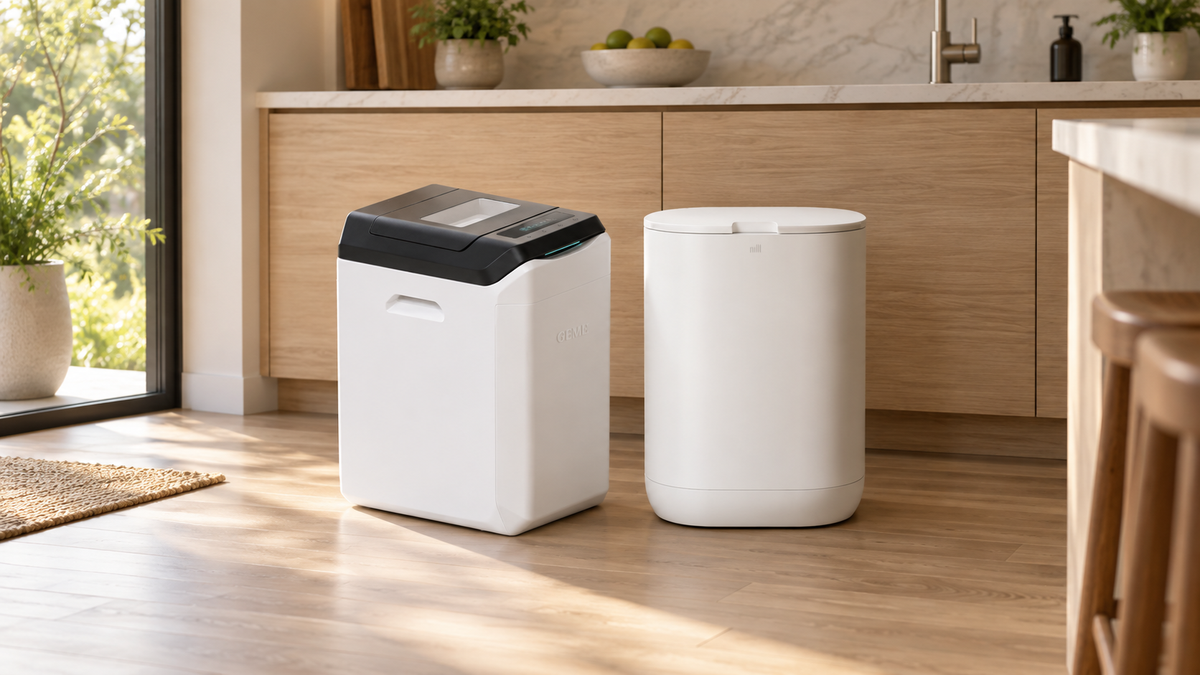
Mill vs GEME Composter · Food Recycling · Microbial Composting
The most important difference between Mill and GEME is not size, app design or how quickly scraps become smaller. It is what job the machine is actually doing.
Mill is built around collecting food scraps, drying and grinding them into Food Grounds, and then giving those grounds another destination. GEME Terra 2 keeps an aerobic microbial environment active inside the appliance so biological decomposition continues before the material leaves the chamber.
That leads to three very different questions: How is food collected? How is it processed? And what is the pathway back to soil?
By Matthew Moore · Updated September 15, 2026

Quick Answer: Is Mill Actually Composting?
No. Mill itself says that the Mill Food Recycler is not a composting device.
Mill uses its Dry & Grind process to remove moisture, reduce food scraps and turn them into what the company calls Food Grounds. Mill also states that those grounds are still food, just with much of the water, bulk and odor removed.
That does not make Mill ineffective. It means Mill is solving a different problem: cleaner collection, volume reduction, storage and routing of food scraps.
GEME Terra 2 is designed around continuous aerobic microbial composting. Its output is best understood as Active Compost Base: biologically processed material that should be screened and mixed with plain soil at approximately 1:8, or allowed to mature further when appropriate.
If you first want the category definition, read What Is an Electric Composter? For the biological difference between microbial composting and dehydration, continue to How Does a Real Electric Composter Work?.
Table of Contents
1. Is Mill Composting?
This is the question that clears up most of the confusion around Mill vs GEME composter.
Mill's own support documentation gives a very direct answer: the Mill Food Recycler is not a composting device.
Instead of trying to biologically decompose food inside the machine, Mill is designed to conserve and stabilize the material by removing moisture, reducing volume and grinding scraps into Food Grounds.
GEME Terra 2 is designed around a different objective. Kobold™ microorganisms remain active in the chamber while the system manages airflow, warmth, moisture conditions and mixing around the microbial bed.
For a broader explanation of why drying is not automatically composting, read Microbes vs Dehydrators: How a Real Electric Composter Works.
2. The Three Models That Matter More Than the Word “Composter”
Rather than asking whether two machines both sit in the food-waste aisle, compare them through three separate models.
What happens between creating a food scrap and removing material from the appliance?
Does the appliance preserve and reduce the scraps physically, or does it biologically decompose them?
What must happen after the output leaves the machine before its nutrients and organic matter return to a useful biological cycle?
This framework is more useful than simply asking which appliance is faster.
A machine can process food quickly and still leave the biological decomposition step for somewhere else. Another machine may continue the microbial process inside the chamber but still require responsible soil blending or maturation afterward.
3. Collection Model: Mill Is Designed to Hold and Stabilize Scraps
How Mill Handles Daily Food Waste
Mill is particularly strong as a household food-scrap collection system.
Users can add food scraps throughout the day. The appliance runs an automatic Dry & Grind process on a schedule, progressively removing moisture and reducing the material into compact Food Grounds.
That means the bin can continue collecting material without behaving like an ordinary wet garbage can. The dry grounds can remain inside for a relatively long period before the user empties them.
The practical benefit is simple: less wet food sitting in the trash and less frequent handling of messy scraps.
How Terra 2 Handles Daily Food Waste
Terra 2 also allows food to be added throughout normal kitchen use, but the material enters an already active microbial bed.
The purpose is not to preserve the food for later routing. New scraps become feedstock for an ongoing aerobic biological process.
That distinction can be summarized as:
Mill: collect → dry → grind → store → choose a destination.
GEME Terra 2: feed → microbial decomposition → harvest Compost Base → blend with soil or mature further.
4. Processing Model: Physical Reduction vs Microbial Decomposition
Mill Food Recycler
Collect. Food scraps accumulate in the bucket during normal household use.
Dry. Moisture is removed from the scraps.
Grind. The dried material becomes smaller Food Grounds.
Route. Grounds then need a home-use, composting, organics or pickup pathway.
GEME Terra 2
Feed. Suitable food scraps enter the active microbial chamber.
Maintain aerobic conditions. Airflow, workable moisture, warmth and mixing support microbial activity.
Decompose biologically. Microorganisms progressively metabolize organic matter.
Harvest Compost Base. Screen it, return unfinished pieces and use the processed material responsibly.
This is why cycle speed alone is a poor comparison.
Mill's processing is designed to make the material drier, smaller and easier to manage. Terra 2's processing is designed to keep microbial decomposition active.
If you are comparing the wider category, see Best Kitchen Composters 2026.
5. Soil Return Model: What Happens After the Machine?
This is the most important difference for anyone whose goal is not simply to remove scraps from the kitchen, but to return organic material to a biological cycle.
Mill's Output Has Multiple Possible Destinations
Mill says Food Grounds can be:
- added to a backyard compost pile;
- used in the garden according to Mill's guidance;
- placed in a curbside organics program where accepted;
- used as a feed ingredient for backyard chickens where appropriate;
- or sent through the optional Mill Pickup program.
The pickup pathway is especially useful for understanding Mill's model.
When eligible users send Food Grounds back through Mill Pickup, Mill says the material is processed at its feed manufacturing facility and ultimately used as an ingredient in chicken feed.
That is a legitimate circular pathway, but it is not composting inside the Mill.
Terra 2 Keeps the Biological Pathway Inside the Appliance Longer
Terra 2's harvested material is best described as Active Compost Base.
Because Terra 2 is continuous-flow, freshly added scraps and older material can coexist in the chamber. That means harvested output should not be treated as if every particle has exactly the same residence time or maturity.
The recommended pathway is:
- screen harvested Compost Base;
- return larger unfinished suitable organic pieces to the chamber;
- mix approximately 1 part screened Compost Base with 8 parts plain soil;
- allow further maturation when the intended application requires it.
Important: GEME Compost Base is concentrated biological material. It should not be used as pure potting soil or poured around plants as a thick undiluted layer.
6. What Are Mill Food Grounds?
Mill's terminology is useful because it avoids pretending that every soil-colored output is automatically compost.
Food Grounds are the dried and ground material left after the Mill removes much of the water, bulk and odor from household scraps.
Mill explicitly describes them as still food.
That means Food Grounds can be useful while still being different from compost.
| Question | Mill Food Grounds | GEME Compost Base |
|---|---|---|
| Has water been removed? | Yes, drying is a core part of the process. | No. The microbial bed intentionally retains biologically workable moisture. |
| Is grinding part of the process? | Yes. | No high-speed grind-and-dry process; mixing supports the microbial bed. |
| Has microbial decomposition been the core process? | No. Mill describes itself as a food recycler rather than a composting device. | Yes. Continuous aerobic microbial decomposition is the core process. |
| What comes out? | Dry Food Grounds. | Moist Active Compost Base. |
| Is the output pure planting soil? | No. Follow Mill's destination and garden-use guidance. | No. Screen and blend approximately 1:8 with plain soil. |
| Can another biological step still occur? | Yes. Grounds may enter a compost pile, organics stream or other downstream pathway. | Yes. Biological maturation can continue after harvest and soil blending. |
7. Maintenance & Ownership: The Models Stay Different After Purchase
The category difference also affects maintenance.
Mill
Mill uses an activated-carbon odor-control filter.
According to Mill's current 2026 support guidance, Mill Essential filters typically last about 5–6 months, while Mill Plus filters typically last about 10–12 months, depending on food load and household use.
Mill also offers an optional pickup pathway for users who prefer to send Food Grounds out rather than manage them locally.
GEME Terra 2
Terra 2 uses GEME_PermaFilter™ odor control and does not require routine activated-carbon odor-filter replacement.
Its ownership model is therefore more closely tied to maintaining the biological chamber and harvesting Compost Base rather than regularly routing dry grounds or replacing carbon odor media.
For a purchase-focused comparison rather than this process explanation, read Is the Mill Composter Worth It?.
8. Mill vs GEME Composter: Side-by-Side
| Criteria | Mill Food Recycler | GEME Terra 2 |
|---|---|---|
| Primary job | Collect, dry, grind and store food scraps. | Maintain continuous aerobic microbial decomposition. |
| Can scraps be added during the day? | Yes. Food can be added throughout normal use. | Yes. Designed for continuous household feeding. |
| Core processing model | Dry & Grind. | Microbial aerobic composting. |
| Does the manufacturer describe it as composting? | No. Mill explicitly says the appliance is not a composting device. | Terra 2 is designed as a microbial composter. |
| Output | Food Grounds. | Active Compost Base. |
| Output destination | Garden use, compost pile, curbside organics, chickens or optional pickup, depending on local/user conditions. | Screen, return unfinished pieces, blend approximately 1:8 with plain soil or mature further. |
| External collection required? | No, but optional pickup is available for eligible users. | No external pickup route is required for the normal soil-use pathway. |
| Odor filter model | Replaceable activated-carbon filter. | No routine replacement odor filter. |
| Best fit | Users prioritizing clean scrap collection, drying, storage and flexible routing. | Users prioritizing microbial processing and a kitchen-to-soil routine. |
For Households That Want the Biological Step at Home
Keep Microbial Decomposition Inside the Process
Terra 2 is designed for continuous aerobic microbial composting rather than drying food into shelf-stable grounds. Harvested Compost Base then follows a defined screening and soil-blending pathway.
Explore GEME Terra 2 →9. Which One Fits Your Food-Waste Goal?
There is no reason to pretend these machines are trying to achieve the same thing.
Choose Mill If...
- your main frustration is wet, smelly kitchen scraps;
- you want to collect food for longer before dealing with it;
- you prefer a dry-and-grind food recycling workflow;
- you want several possible downstream destinations;
- or optional pickup appeals to you.
Choose GEME Terra 2 If...
- you specifically want microbial composting to happen inside the appliance;
- you want to add scraps continuously during daily cooking;
- you want biologically processed Compost Base rather than dry Food Grounds;
- you plan to return processed organic material to soil;
- and you prefer no routine carbon-filter replacement.
If you are now at the “Which one should I actually buy?” stage rather than asking whether Mill composts, continue to the dedicated GEME Terra 2 vs Mill ownership decision guide.
If you want to compare Mill with the wider market, including Lomi, Reencle and higher-capacity microbial systems, use Best Kitchen Composters 2026.
And if you are not sure whether an electric appliance is the right composting method at all, start with Best Composter 2026.
Frequently Asked Questions
Is Mill a composter?
No. Mill's own support documentation states that Mill is not a composting device. It is a food recycler that dries and grinds food scraps into Food Grounds.
Does Mill make compost?
No. Mill says its Food Grounds are still food with much of the water, bulk and odor removed. They can enter another composting, garden, organics, feed or pickup pathway, but they are not compost made inside the Mill.
Can Mill Food Grounds go in a compost pile?
Yes. Mill lists adding Food Grounds to a compost pile as one possible home-use pathway. Users should follow Mill's current guidance for the amount and destination appropriate to their situation.
Can Mill Food Grounds go into a garden?
Mill includes garden use among its suggested Food Grounds pathways. However, because Mill also states that Food Grounds are still food rather than compost, they should not automatically be treated as equivalent to mature finished compost.
What happens to Food Grounds sent through Mill Pickup?
Mill says returned Food Grounds are inspected and processed at its feed manufacturing facility before being used as an ingredient in chicken feed. The pickup route is therefore a food-recycling pathway rather than composting inside the household appliance.
Does GEME Terra 2 produce finished compost?
Terra 2 performs continuous aerobic microbial decomposition, but its harvested output is best described as Active Compost Base. Because the system is continuous-flow, material can have different residence times. Screen the output, return large unfinished pieces and mix approximately one part Compost Base with eight parts plain soil, allowing further maturation when appropriate.
What is the biggest difference between Mill and GEME Terra 2?
Mill primarily reduces and stabilizes food waste through drying and grinding before the material moves to another destination. Terra 2 keeps the biological decomposition process active inside the appliance and produces Compost Base for a defined soil-blending pathway.
Which is better: Mill or GEME Terra 2?
Mill can be the better choice if your priority is cleaner scrap collection, dry storage and flexible downstream routing. Terra 2 is the better fit if your priority is continuous microbial composting and a direct kitchen-to-soil routine.
Does Mill require filter replacement?
Yes. Mill uses replaceable activated-carbon filters. Current Mill guidance says Essential filters typically last about five to six months and Mill Plus filters about ten to twelve months, depending on use.
Sources & Verification
- Mill Support — How Is Mill Different From Home Composting Devices?
- Mill Support — What Can I Do With My Food Grounds?
- Mill Support — Carbon Filter Replacement Guidance
- GEME — Terra 2
- GEME — What Is a GEME Composter?
- GEME — How Does a Real Electric Composter Work?
Competitor descriptions are based on Mill's official support documentation reviewed September 15, 2026. Product programs, filter pricing, pickup availability and operating guidance may change. Check the manufacturer's current documentation before purchase.


Leave a comment
All comments are moderated before being published.
This site is protected by hCaptcha and the hCaptcha Privacy Policy and Terms of Service apply.