


Electric Composter Buyer’s Guide · Last Reviewed August 17, 2026
If smell is the reason you have avoided indoor composting, the right electric composter can change the experience completely. But “odor-free” is not just about sealing scraps inside a box. Airflow, moisture, biological conditions, filtration, load size and maintenance all determine whether your kitchen stays fresh.

How does the machine prevent odor, and what happens when conditions go wrong?
Editorial disclosure: GEME publishes this comparison and manufactures GEME Terra 2. Competitor specifications and odor-control claims in this guide are based on current manufacturer documentation reviewed on August 17, 2026. Our recommendation therefore separates documented product facts from our own editorial judgment.
Quick Answer: What Is the Best Electric Composter for Odor-Free Operation?
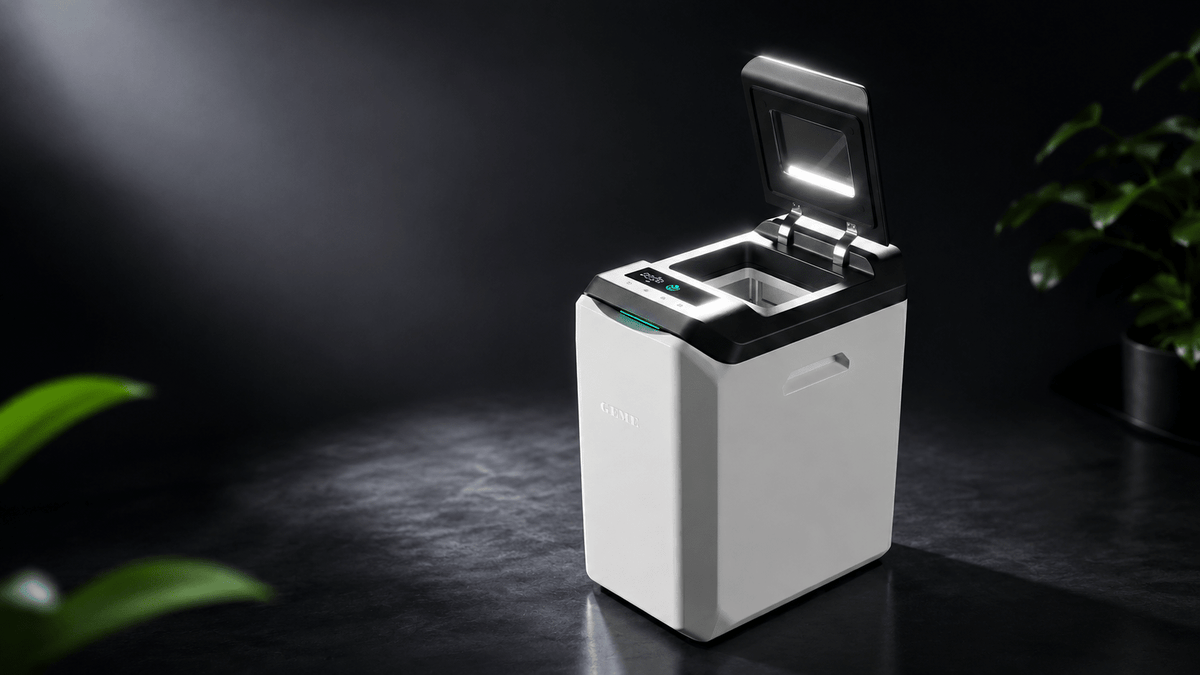
Our pick for households that want strong indoor odor control without routine odor-filter replacement is GEME Terra 2.
Terra 2 takes a different approach from many electric food recyclers. Instead of relying primarily on replaceable activated-carbon cartridges, it is designed around a continuously aerated microbial composting environment plus a permanent metal-ion oxidation odor-control system.
That combination matters because odor has two sides: you can capture smells after they are produced, or you can also manage the internal conditions that cause strong smells in the first place.
However, “odor-free” should not be interpreted as an absolute guarantee. Any machine containing decomposing food can develop noticeable odor when overloaded, excessively wet, poorly aerated or improperly maintained.
For users who prioritize filter-based odor suppression, Reencle Prime, Mill and Lomi also offer credible odor-management systems, but each uses replaceable activated-carbon filtration on a recurring schedule.
For a broader category overview before choosing a model, see our electric composter comparison guide.
Table of Contents
- What Does “Odor-Free” Really Mean?
- Why Do Electric Composters Smell?
- How We Compared Electric Composters for Odor
- Odor-Control Comparison: GEME vs Reencle vs Mill vs Lomi
- Why Terra 2 Is Our Pick
- Odor Prevention vs Odor Filtration
- How GEME Controls Odor
- Reencle Prime
- Mill
- Lomi 3
- Recurring Filter Maintenance
- Best Electric Composter for Apartments
- How to Prevent Electric Composter Smell
- Which One Should You Choose?
- FAQ
1. What Does “Odor-Free Electric Composter” Really Mean?
The phrase odorless electric composter appears constantly in product marketing, but it needs a practical definition.
A machine can be excellent at odor control without making the laws of biology disappear.
Food scraps contain water, carbohydrates, fats, proteins and microorganisms. Once those scraps begin changing biologically, volatile compounds can form.
A well-designed indoor system therefore needs to manage at least two different problems:
- Odor generation: what happens inside the chamber while food breaks down.
- Odor escape: what happens to air before it leaves the machine and enters your kitchen.
Some electric food recyclers focus primarily on the second problem by passing exhaust through activated carbon.
A microbial kitchen composter also has to manage the first problem because living decomposition depends heavily on oxygen and moisture.
That is why we prefer the phrase low-odor indoor operation or strong odor mitigation when discussing real-world use.
If you want the practical troubleshooting version rather than the buyer comparison, read How to Reduce Odor in Indoor Composting.
2. Why Do Electric Composters Smell?
For biological composting systems, one of the most important odor boundaries is oxygen.
Composting is fundamentally an aerobic process. Microorganisms consume organic material while using oxygen, and the physical structure of the compost bed needs enough pore space for air to move through it.
When food waste becomes excessively wet or densely packed, oxygen movement becomes more difficult.
Localized oxygen-poor zones can then become anaerobic.
Those conditions are associated with some of the classic smells people describe as rotten eggs, sour food, fermentation or decay.
Cornell University's composting guidance identifies excess moisture, inadequate porosity, rapidly degrading feedstock and excessive pile size as common conditions that contribute to anaerobic odors.
Important: bad smell is usually not random. It is information about moisture, oxygen, loading, filtration or maintenance.
This explains why an electric composter can smell perfectly normal for weeks and then suddenly become noticeable after one unusually large, wet load.
It also explains why the best electric composter for odor control should not be judged solely by the size of its carbon filter.
3. How We Compared Electric Composters for Odor Control
We did not rank these machines simply by manufacturer claims such as “odorless” or “no smell.”
Instead, we looked at the engineering and ownership factors that determine whether an indoor food-waste system remains kitchen-friendly over time.
For the broader criteria beyond smell—including process, output, capacity and ownership, use our Best Composter Guide.
4. Best Electric Composter for Odor Control: Side-by-Side Comparison
| System | Odor-Control Approach | Routine Odor Filter Replacement | Processing Style | Best Fit |
|---|---|---|---|---|
| GEME Terra 2 | Managed aerobic environment + permanent metal-ion oxidation odor path | No routine carbon-filter replacement | Continuous microbial composting | Low recurring maintenance + real microbial composting |
| Reencle Prime | Sealed microbial system + activated-carbon filtration | About every 9–12 months according to current Reencle guidance | Continuous microbial processing | Users who want microbial processing and do not mind periodic carbon maintenance |
| Mill | Drying/grinding workflow + high-capacity carbon filtration | Approximately 6 or 12 months depending on current model | Automated food recycling / drying and grinding | Large-volume food-waste storage and odor suppression |
| Lomi 3 | Heating/grinding workflow + activated-carbon filtration | About every 3 months or 45 cycles according to current Lomi guidance | Batch food recycling | Compact kitchens and users prioritizing short batch cycles |
Our verdict: Terra 2 stands out when the goal is combining low-odor indoor operation with continuous microbial composting and avoiding routine carbon-filter replacements.
That does not mean the other systems have poor odor control. In fact, Reencle, Mill and Lomi all make strong manufacturer claims about odor management. The difference is how they achieve it and what maintenance that creates over time.
5. Why GEME Terra 2 Is Our Pick for Low-Odor Continuous Composting
Terra 2 is not simply trying to capture the smell of decomposing food after it has formed.
The system is designed to keep a microbial composting bed inside a warm, moist and oxygen-rich operating environment.
GEMEBrain™ helps manage heat, airflow, moisture and mixing around the Kobold™ microbial community.
The objective is to keep suitable food waste moving through an aerobic biological process rather than leaving wet scraps sitting stagnant inside a collection container.
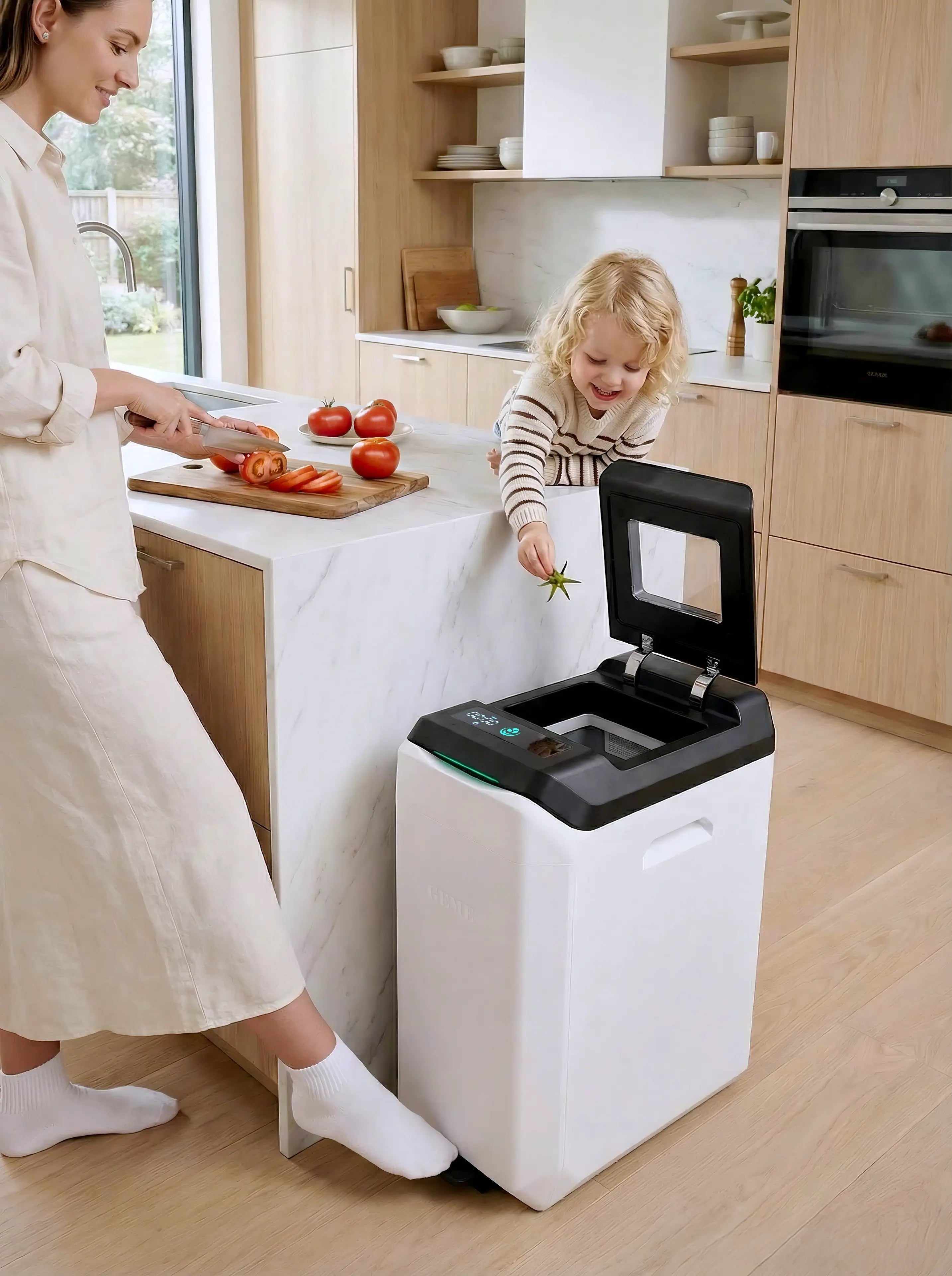
Our Pick
GEME Terra 2
Best for: households that want continuous microbial composting, strong indoor odor mitigation and no routine activated-carbon filter replacement.
Household fit: 1–3 people.
Daily capacity: up to 2 kg/day under current guidance.
Odor philosophy: maintain aerobic biological conditions, then treat exhaust through a permanent odor-control pathway.
The important qualification is that this system still has operating boundaries.
If you add too much wet material at once, free air space can temporarily decrease and localized oxygen-poor zones can form.
That can create a sour or rotten smell until the load is processed and the aerobic environment recovers.
This is exactly why we do not describe Terra 2 as magically incapable of odor.
For a real-world example, Digital Trends encountered noticeable odor when Terra 2 was pushed in a five-person household above its current intended household-size positioning. The smell then improved as the overloaded material continued processing. Read our full Digital Trends review response.
6. Two Different Odor Strategies: Prevent the Smell or Filter the Smell
Electric composters often approach odor control from two directions.
Strategy A: Filter Exhaust
Activated carbon is highly useful for adsorbing many odor-causing compounds from an airstream.
This is the primary recurring-consumable strategy used by products such as Lomi, Mill and Reencle.
The advantage is straightforward: air moves through carbon before it returns to your kitchen.
The trade-off is equally straightforward: activated carbon does not remain effective forever.
Eventually it needs replacement, refilling or other maintenance.
Strategy B: Manage the Internal Biological Environment
A microbial composting system also benefits from controlling the conditions inside the chamber.
If oxygen remains available and moisture does not overwhelm pore space, aerobic organisms can continue processing food without allowing large anaerobic zones to dominate.
This is not a substitute for exhaust treatment.
It is an additional layer of odor management.
The ideal odor strategy addresses both sides: reduce the conditions that generate offensive smells, then manage whatever odors remain before exhaust reaches the room.
This biological distinction is also why we separate real microbial composting from simple food dehydration. See Real Compost vs Dehydrated Scraps.
7. How GEME Terra 2 Controls Kitchen Composter Odor
Terra 2 combines several mechanisms rather than depending on a single disposable filter.
Continuous Airflow
Keeping the system powered helps maintain oxygen movement through the biological process.
That matters because prolonged low-oxygen conditions are one of the most important pathways toward strong compost odor.
Adaptive Mixing
Mixing helps redistribute food, microbes, moisture and free air space through the bed.
It also reduces the chance that wet food remains as one stagnant mass.
Moisture Management
Microbes need moisture, so the goal is not to dry the chamber completely.
The goal is to avoid both extremes: too dry for healthy microbial activity and so wet that air movement becomes restricted.
Permanent Metal-Ion Oxidation
Instead of relying on routine carbon-filter replacement, Terra 2 uses a permanent metal-ion oxidation catalyst as part of its odor-treatment pathway.
Continuous Feeding
Terra 2 is designed for normal meal-sized additions throughout the day rather than one oversized dump.
This gives the active bed time to process incoming food progressively.
If odor begins to rise, the current GEME FAQ recommends treating that as an operating signal rather than masking it: check wetness, airflow and load conditions.
8. Reencle Prime: Strong Odor Control With Periodic Carbon Replacement
Reencle is the closest comparison to Terra 2 in this group because it also uses a continuously active microbial system.
Its odor-control architecture, however, includes activated-carbon filtration.
Current Reencle documentation recommends replacing the carbon filter approximately every 9–12 months, although the manufacturer notes that actual life depends on factors such as internal cleanliness, microbial condition and mesh-filter maintenance.
Reencle also notes that a sour or stale smell near the rear vent can indicate that the carbon filter is approaching the end of its useful life.
That makes Reencle a strong choice for users who want microbial processing but are comfortable treating carbon-filter replacement as periodic maintenance.
For a broader comparison beyond smell, read GEME vs Reencle.
9. Mill: Powerful Filter-Based Odor Suppression for High-Volume Food Waste
Mill approaches the food-waste problem differently.
It is primarily an automated food recycler that dries and grinds material while using substantial odor filtration to keep stored food waste from becoming a kitchen problem.
Mill currently states that its filtration system blocks 99.9% of odors.
The current product documentation also specifies replaceable filters with approximately 6- or 12-month service life depending on the model.
This makes Mill compelling for households whose primary goal is keeping a relatively large amount of food waste contained and low-odor for extended periods.
The distinction is output and process: Mill's goal is food-waste recycling and volume reduction rather than maintaining the same type of living compost bed as GEME or Reencle.
See the broader GEME vs Mill comparison for ownership and process differences.
10. Lomi 3: Compact Odor Control With More Frequent Filter Maintenance
Lomi 3 is a compact batch food recycler that begins by heating and grinding food waste while managing moisture, temperature and airflow through a programmed cycle.
Its airflow system uses activated-carbon filtration to neutralize odor.
Lomi's current official filter guidance recommends changing the filter about every three months or 45 cycles.
That is significantly more frequent than the current replacement schedule published for Reencle and some Mill models.
The advantage is a small countertop-style form factor and short processing cycles.
The trade-off for an odor-focused buyer is recurring filter maintenance.
For the full process and ownership comparison, read GEME Terra 2 vs Lomi.
11. Electric Composter Filter Replacement Matters More Than Most Buyers Expect
Odor control is not only a day-one question.
It is an ownership question.
An electric composter may smell excellent when the carbon is new and then behave very differently once the adsorption capacity of that filter declines.
| System | Current Routine Odor-Filter Guidance | Ownership Implication |
|---|---|---|
| GEME Terra 2 | No routine activated-carbon replacement | Lower recurring odor-control consumable burden |
| Reencle Prime | Approximately 9–12 months | Occasional carbon replacement/refill |
| Mill | Approximately 6 or 12 months depending on model | Periodic filter replacement remains part of ownership |
| Lomi 3 | Approximately 3 months or 45 cycles | More frequent recurring filter maintenance |
This does not automatically make a replaceable filter bad.
Activated carbon is a proven odor-treatment technology.
The question is whether you are comfortable buying, storing, remembering and replacing it throughout the life of the appliance.
We break down that ownership question in more detail in Electric Composter Filter Costs: GEME vs Lomi vs Mill vs Reencle.
12. What Is the Best Electric Composter for Apartments With No Smell?
Apartments make odor control especially important because there is less distance between the kitchen, living room and sleeping areas.
You may also lack:
- a backyard compost pile;
- a garage for food scraps;
- outdoor waste storage;
- or daily access to municipal organics collection.
This changes what “best electric composter” means.
For apartment use, we would prioritize:
- strong odor containment;
- low operating noise;
- appropriate household capacity;
- low fruit-fly exposure;
- minimal recurring maintenance;
- and an output pathway that actually fits how you live.
Terra 2 is positioned for 1–3 person households and is specifically designed for indoor continuous use.
Its current published acoustics are approximately 35–40 dB under standard operation, although perceived sound varies with placement, room acoustics and load.
For apartment users who care more about reducing food waste than producing a biologically active compost base, compact batch systems such as Lomi may also make sense.
The right choice therefore depends on whether you want food-waste reduction or continuous microbial composting.
If you are still deciding whether any appliance makes sense for your home, read Are Kitchen Composters Worth It?.
13. How to Prevent Electric Composter Smell in Daily Use
Even the best odor-control system works better when the household stays inside the machine's intended operating range.
Do Not Overload It
A machine's daily throughput is not necessarily its single-feed limit.
For Terra 2, current guidance is up to 2 kg/day, while individual feedings should stay at or below approximately 1 kg.
Normal meal-sized additions are preferable to dropping an entire day's wet scraps into the chamber at once.
Watch Excess Moisture
Soup, liquid-heavy leftovers and very wet food can change the physical structure of an active compost bed.
Too much free moisture can restrict airflow and contribute to anaerobic pockets.
Keep Airflow Paths Clear
Odor-management systems require air to move through the intended path.
Do not block exhaust vents or allow dust, food residue or other material to obstruct airflow components.
Maintain Filters When the System Uses Them
If your machine uses activated carbon, follow the manufacturer's current replacement guidance.
A saturated filter cannot be expected to perform like a new one.
Do Not Turn Off a Continuous Microbial System Every Night
Terra 2 relies on power to maintain airflow, mixing and the biological environment.
Repeated shutdowns can allow moisture to stagnate and interrupt aerobic control.
Treat Strong Odor as a Diagnostic Signal
If a microbial composter begins producing a strong sour or rotten smell, do not simply spray fragrance around it.
Ask what changed:
- Was the last feeding unusually large?
- Was it very wet?
- Is the chamber too full?
- Has airflow changed?
- Is a replaceable filter due for service?
The earlier you identify the operating cause, the easier it usually is to recover the system.
Why the Process Matters
Low Odor Is Only Part of the Decision
An electric composter can smell great and still produce an output that does not match what you want.
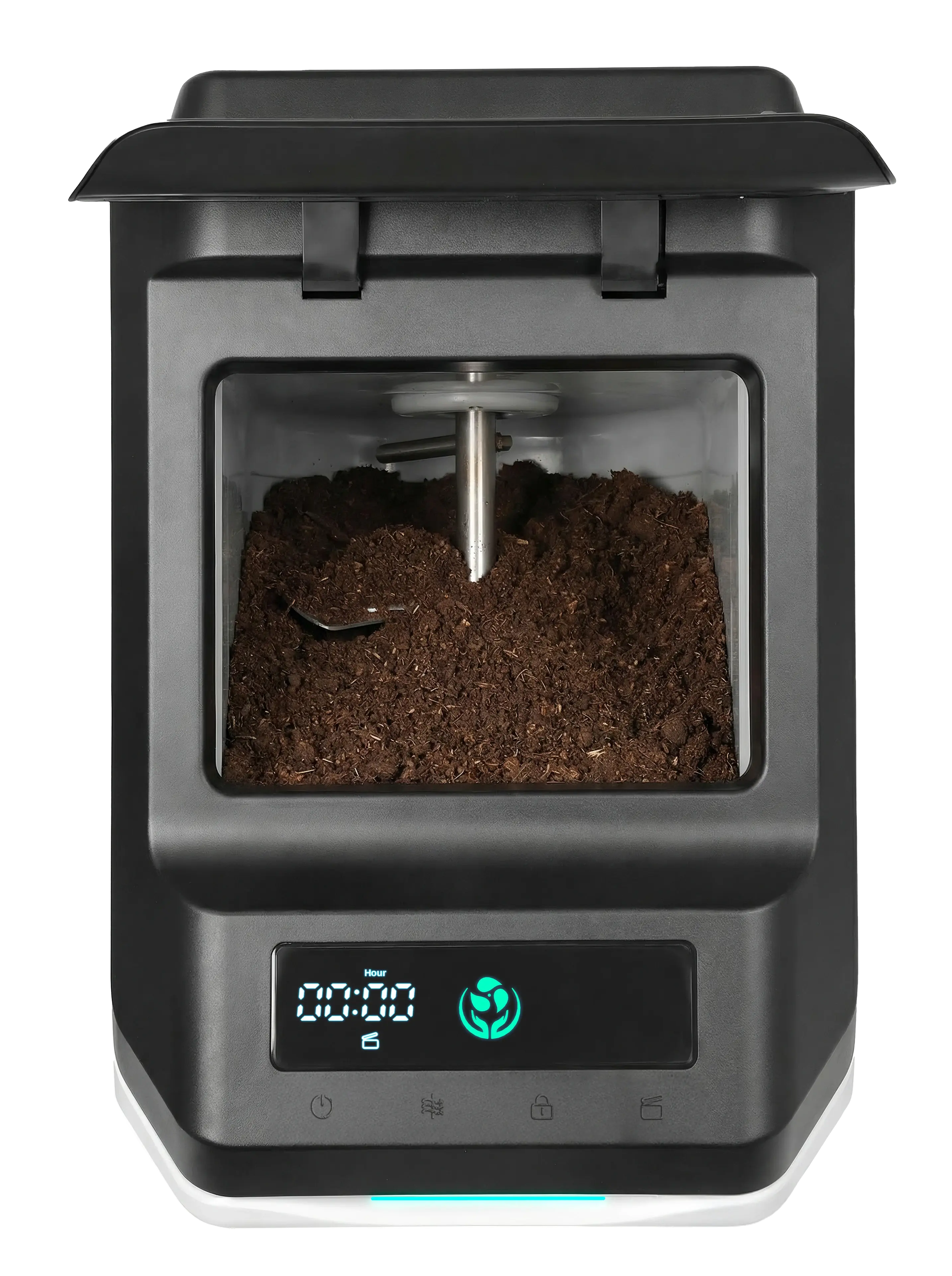
Terra 2 is designed to produce a moist, biologically active compost base for soil blending rather than dry food-waste grounds.
That is why process, output, maintenance and odor control should be evaluated together, not as four separate shopping decisions.
14. Which Electric Composter Should You Choose?
Choose GEME Terra 2 If...
- You want continuous microbial composting.
- You care strongly about indoor odor control.
- You do not want routine activated-carbon filter replacements.
- You want a moist compost base rather than dry food grounds.
- Your household is generally 1–3 people.
- You are comfortable following biological load and moisture boundaries.
Choose Reencle Prime If...
- You want a microbial system similar in category to GEME.
- You are comfortable maintaining a carbon-filter system.
- A roughly annual filter-replacement routine does not bother you.
Choose Mill If...
- Your priority is storing and reducing relatively large volumes of food waste with strong odor filtration.
- You want automated drying and grinding.
- You do not specifically need a continuously living microbial compost bed.
Choose Lomi 3 If...
- You want a compact batch appliance.
- You value shorter processing cycles.
- You are comfortable replacing activated-carbon filtration more frequently.
- Your main goal is food-waste processing rather than continuous microbial composting.
For a complete category decision that goes beyond odor, continue to our Best Composter 2026 guide.
15. Final Verdict: The Best Electric Composter for Odor-Free Operation
If your main priority is low-odor kitchen operation with the least routine filter maintenance, our recommendation is GEME Terra 2.
The reason is not that Terra 2 can somehow make decomposing food physically incapable of producing odor.
It is that its design attacks the problem at multiple points:
- aerobic biological conditions;
- managed airflow;
- adaptive mixing;
- moisture management;
- continuous processing;
- and a permanent metal-ion oxidation odor-control pathway.
That means low-odor performance is not dependent on remembering to install a fresh carbon cartridge every few months.
Reencle, Mill and Lomi remain credible alternatives, particularly if you prefer their respective microbial, high-capacity recycling or compact batch workflows.
But all three currently depend on replaceable activated-carbon filtration as part of their normal odor-management model.
Our buying rule: do not ask only whether an electric composter smells. Ask how it prevents odor, how it treats exhaust, what maintenance keeps that system working, and what happens when you overload it.
Low-Odor Microbial Composting
Keep Food Scraps Moving—Without Routine Odor-Filter Swaps
Terra 2 is designed for 1–3 person households that want continuous aerobic microbial processing in the kitchen, with strong odor mitigation and no routine activated-carbon filter replacement.
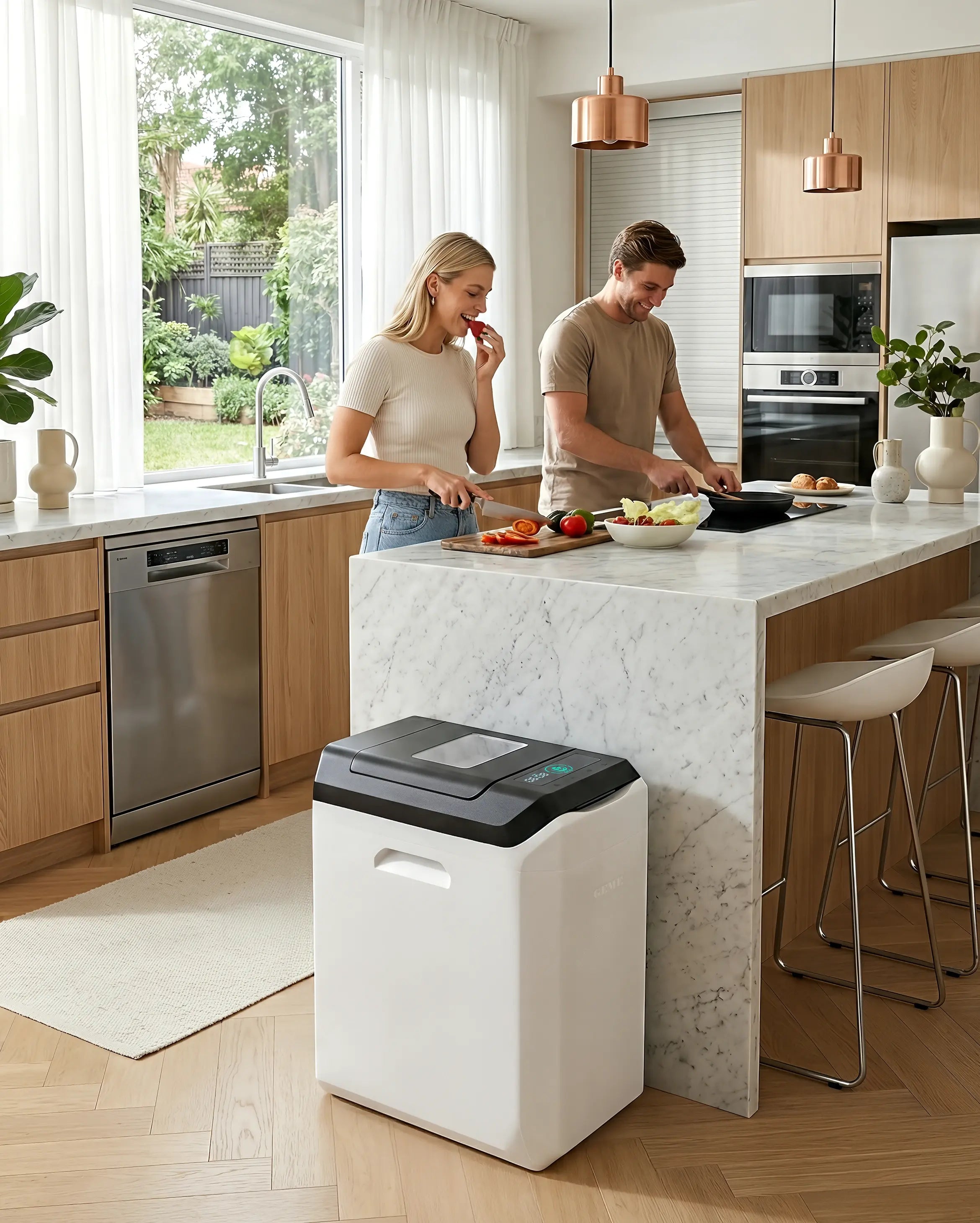
Airflow, biology, moisture and exhaust treatment all matter.
16. Frequently Asked Questions About Odorless Electric Composters
What is the best electric composter for odor-free operation?
Our pick is GEME Terra 2 for households that want continuous microbial composting, strong indoor odor mitigation and no routine activated-carbon filter replacement. Reencle, Mill and Lomi also provide dedicated odor-control systems but use replaceable carbon filtration.
Is there an electric composter that does not smell?
Several electric composters are designed to operate with little or no noticeable odor during normal use, but no food-waste appliance should be assumed to remain completely odorless under every possible condition. Overloading, excess moisture, poor airflow, saturated filters and neglected maintenance can all create smell.
Why does my electric composter smell?
Possible causes depend on the technology. In a biological composter, excess moisture, excessive loading and low oxygen can create anaerobic odor. In filter-based food recyclers, a saturated or improperly installed carbon filter can also allow smells to escape.
Why does compost smell like rotten eggs?
A rotten-egg or sulfur smell is commonly associated with anaerobic decomposition and sulfur compounds such as hydrogen sulfide. In composting systems, that usually means oxygen delivery or porosity has become inadequate.
Does GEME Terra 2 require a carbon filter?
Terra 2 does not rely on routine replaceable activated-carbon odor filters. Its current odor-control design uses managed aerobic operation together with a permanent metal-ion oxidation catalyst.
How often does the Reencle Prime carbon filter need replacing?
Current Reencle guidance recommends approximately every 9–12 months, although actual service life depends on internal cleanliness, microbial condition and filter maintenance.
How often do Lomi filters need replacing?
Lomi currently recommends replacing its activated-carbon filtration approximately every three months or after about 45 cycles.
How often does Mill need an odor filter replacement?
Mill currently publishes approximately six- or twelve-month filter life depending on the specific current model.
Is activated carbon good for electric composter odor?
Yes. Activated carbon is an effective odor-adsorption technology and is widely used in consumer food-waste appliances. The ownership trade-off is that the carbon eventually becomes exhausted and must be replaced or refilled.
Can overfeeding an electric composter cause smell?
Yes. In a microbial composter, a large wet load can compact the compost bed, reduce pore space and temporarily limit oxygen movement. That can create anaerobic pockets and a noticeable sour or rotten odor.
Should I turn off my electric composter if it smells?
Follow the manufacturer’s instructions. For GEME Terra 2, normal recovery generally depends on keeping the machine powered so airflow and mixing can continue while the overloaded material breaks down. Pause additional feeding instead of shutting down the biological environment.
What is the best electric composter for an apartment?
The best apartment system depends on household size and desired output. Terra 2 is designed for 1–3 person households that want continuous microbial composting and low recurring filter maintenance. Compact batch systems such as Lomi may suit users who primarily want food-waste volume reduction.
Are electric composters worth it just for odor control?
They can be if food-scrap smell, leaking trash, fruit flies or frequent trips to a shared waste room are meaningful problems in your home. But odor control should be evaluated together with purchase cost, energy, maintenance, output and recurring consumables.
Verified Sources
Competitor maintenance and odor-control specifications below were checked against current manufacturer documentation rather than third-party comparison sites.
- GEME — Terra 2 Current Product Specifications
- GEME — Official Odor, Filter & Operating Guidance
- GEME — How Continuous Aerobic Microbial Processing Works
- Reencle — Prime Carbon Filter & Replacement Guidance
- Mill — Current Food Recycler & Odor Filtration Specifications
- Lomi — Lomi 3 Current Product & Odor-Control Specifications
- Lomi — Official Filter Replacement Guidance
- Cornell University — Compost Odor Management
- Cornell University — Monitoring Compost Odors
Last reviewed August 17, 2026. Product designs, filter schedules and manufacturer claims can change. Always follow the latest operating and maintenance instructions supplied by the manufacturer of your specific model.


Leave a comment
All comments are moderated before being published.
This site is protected by hCaptcha and the hCaptcha Privacy Policy and Terms of Service apply.