


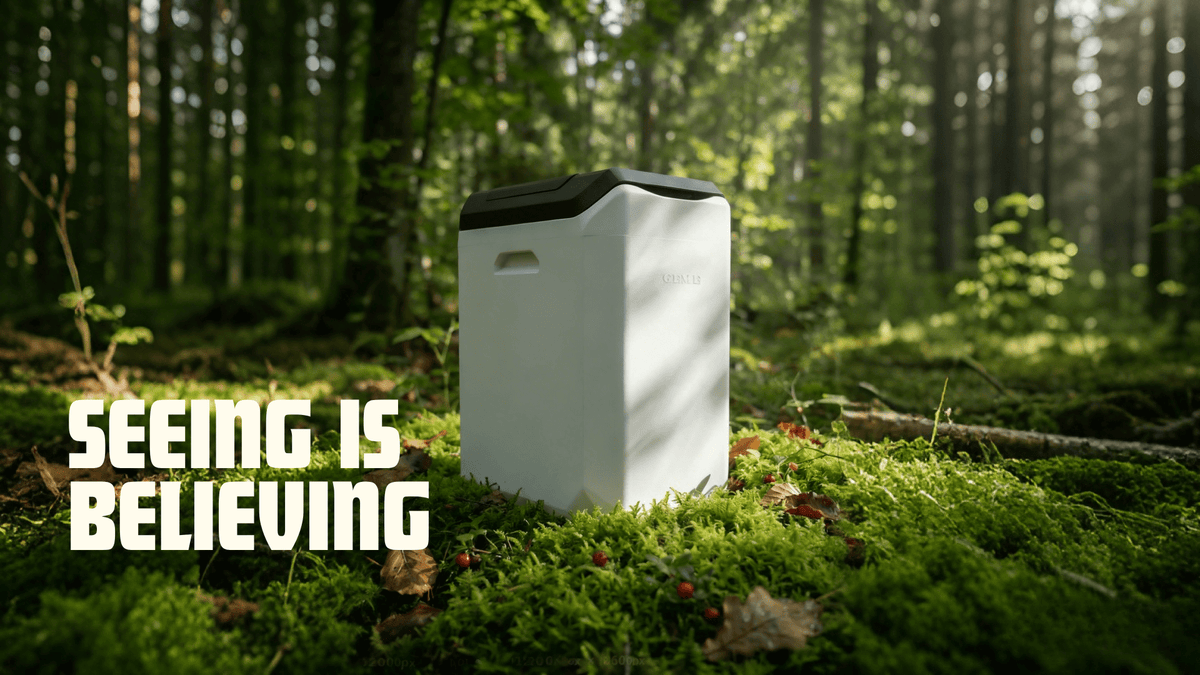
Best Kitchen Composter · 2026 Buyer’s Guide
The best kitchen composter is not simply the machine that makes food scraps disappear fastest. The more useful comparison is what process happens inside, what comes out, how much waste the system can realistically handle, how it fits your daily routine, and what ongoing maintenance it requires.
This guide compares five of the most discussed kitchen food-waste systems in 2026: GEME Terra 2, GEME Pro, Lomi 3, Mill, and Reencle Prime.
Some use living microorganisms. Others primarily heat, dry, or grind food scraps. Some are designed around a soil-return pathway, while others are better understood as food-recycling systems.

Quick Answer: What Is the Best Kitchen Composter?
For most 1–3 person households that want continuous aerobic microbial processing and a defined soil-return pathway, our overall pick is GEME Terra 2.
Terra 2 has a 14 L chamber, supports up to 2 kg of suitable household food scraps per day, allows continuous feeding, and does not require scheduled replacement activated-carbon odor filters.
GEME Pro is the better fit when capacity is the deciding factor. It has a 19 L chamber and supports up to 5 kg/day for larger households and heavier cooking routines.
Lomi 3 is better suited to shoppers who want a compact countertop food recycler and batch-based volume reduction. Mill is particularly strong as a large-capacity food-scrap storage and Dry & Grind system. Reencle Prime is the closest microbial alternative and also uses a continuous biological process, although its current guidance includes curing harvested material before planting.
The right choice depends on the job you want the machine to perform—not simply which device is marketed as a “composter.”
Editorial Disclosure
GEME publishes this comparison and manufactures GEME Terra 2 and GEME Pro.
Competitor descriptions in this guide are based on current manufacturer documentation and publicly available product guidance. Where systems perform different jobs, we describe those differences rather than assuming every product in the category should be evaluated as if it used the same process.
Prices, filter schedules, accessories, subscriptions, and product specifications can change. Check the manufacturer's current product information before purchase.
1. Which Kind of Kitchen Composter Do You Actually Need?
The phrase “kitchen composter” now describes products that perform very different jobs.
Before comparing brands, decide what outcome you actually want.
Microbial Processing
Food scraps remain in a warm, moist, oxygenated environment where microorganisms continuously break down organic material.
Examples: GEME Terra 2, GEME Pro, Reencle.
Batch Food Recycling
Food is processed in individual cycles using heat, airflow, grinding, drying, or combinations of these methods.
Example: Lomi.
Dry Food-Scrap Storage
The priority is keeping food scraps clean, dry, compact and easier to store before they move to another destination.
Example: Mill.
Simple Scrap Collection
A countertop caddy or bin only stores scraps before curbside collection or outdoor composting. It does not process them.
For every major composting method, see Best Composter for Home.
If you are comparing powered kitchen appliances specifically, continue here. If your decision also includes backyard piles, tumblers, worm bins, and Bokashi, the broader Best Composter guide is the better starting point.
2. How We Evaluated the Best Kitchen Composters
A kitchen composter should be evaluated around the job the household needs it to do—not simply around the shortest advertised cycle.
We used eight practical criteria:
- Process: microbial decomposition, drying, grinding, or food-scrap storage.
- Household capacity: how much food waste the system is designed to accept.
- Feeding workflow: continuous addition or separate batch cycles.
- Output: what material leaves the machine and what it actually represents.
- Output destination: whether the material can enter a soil pathway, needs curing, further composting, pickup or another use.
- Odor strategy: process management, airflow and filtration.
- Recurring maintenance: filters, consumables, subscriptions and cleaning.
- Household fit: footprint, capacity and everyday usability.
Important: “fastest,” “smallest,” and “best composter” are not the same question. A 3-hour drying process and a continuous microbial system are solving different problems.
3. Best Kitchen Composters 2026: Quick Comparison
| Criteria | GEME Terra 2 | GEME Pro | Lomi 3 | Mill | Reencle Prime |
|---|---|---|---|---|---|
| Best fit | 1–3 people / overall household pick | 4+ people / heavier food waste | Compact countertop food recycling | Dry food-scrap storage and reduction | Microbial alternative |
| Core process | Continuous aerobic microbial processing | Continuous aerobic microbial processing | Heat, airflow and mechanical processing | Dry & Grind food recycling | Continuous microbial processing |
| Chamber / bucket | 14 L | 19 L | 3 L bucket | Large food-recycler bin | Continuous microbial chamber |
| Daily capacity | Up to 2 kg/day | Up to 5 kg/day | Batch-based | Not directly comparable to microbial daily throughput | Prime: 0.7 kg recommended / 1 kg maximum per day |
| Feeding workflow | Continuous | Continuous | Batch cycles | Add scraps continuously; scheduled Dry & Grind | Continuous |
| Output | GEME Compost Base | GEME Compost Base | Lomi Earth / pre-compost | Food Grounds | Active microbial compost requiring use-specific finishing |
| Routine activated-carbon replacement | No | No | Yes | Yes | Yes |
| Best reason to choose | Continuous biological processing + low routine filter burden | High household capacity | Compact counter footprint | Long scrap-storage workflow | Another continuous microbial approach |
Do not read this table as five machines doing the same job at different speeds. They use different processes and create different downstream workflows.
4. Continuous vs Batch: What Daily Use Actually Feels Like
One of the most useful differences between these systems is not visible in a product photo: when can you add the next handful of food scraps?
| System | Typical Daily Workflow | What It Means at Home |
|---|---|---|
| GEME Terra 2 | Add suitable food throughout the day while microbial processing continues. | Fits kitchens that create scraps continuously. |
| GEME Pro | Same continuous approach, with more capacity headroom. | Better for larger meals and heavier household loads. |
| Lomi 3 | Load the bucket and run a selected processing cycle. | Best for users comfortable with a batch routine. |
| Mill | Add scraps during the day; Dry & Grind runs automatically or on a schedule. | Scraps can accumulate and become dry Food Grounds over time. |
| Reencle Prime | Add food regularly while the microbial culture remains active. | Similar continuous-use philosophy to other microbial systems. |
For many households, this workflow difference matters more than whether one appliance completes a visible processing stage in three hours or eight hours.
5. GEME Terra 2: Best Kitchen Composter Overall
Best for: 1–3 person households that want continuous microbial processing, everyday feeding and a defined kitchen-to-soil pathway.
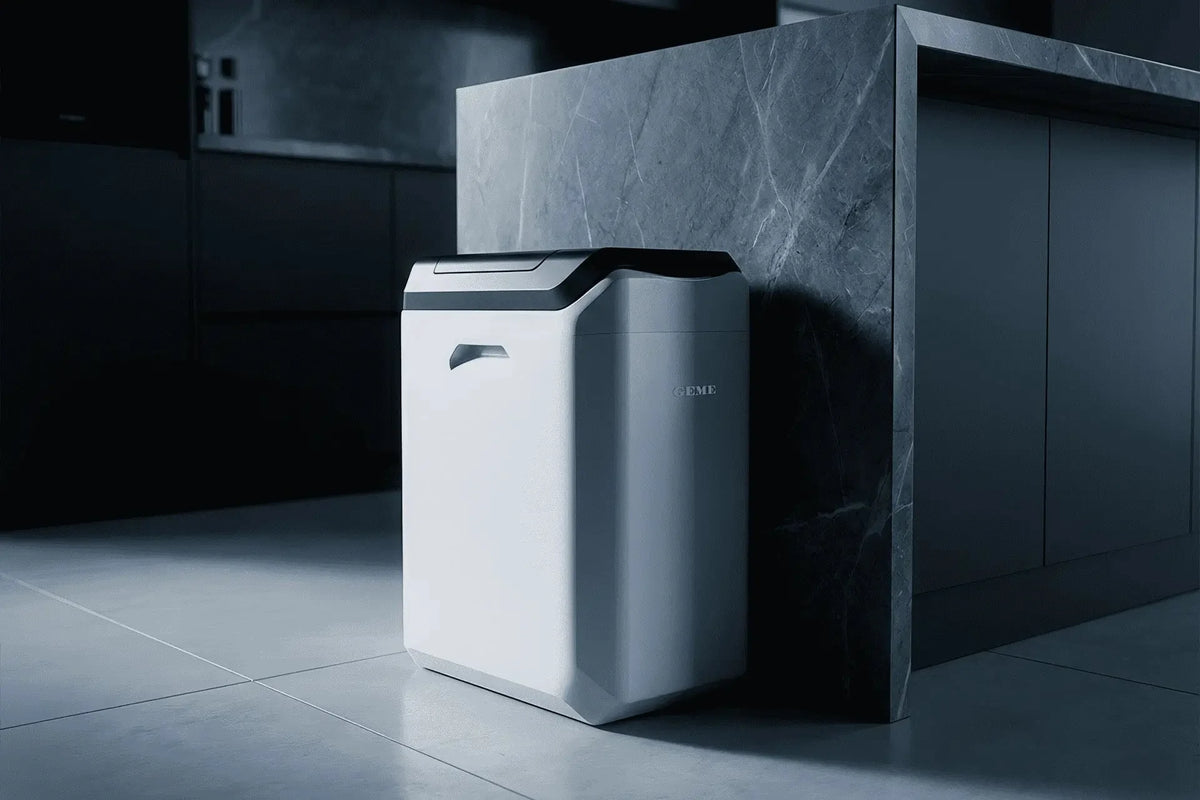
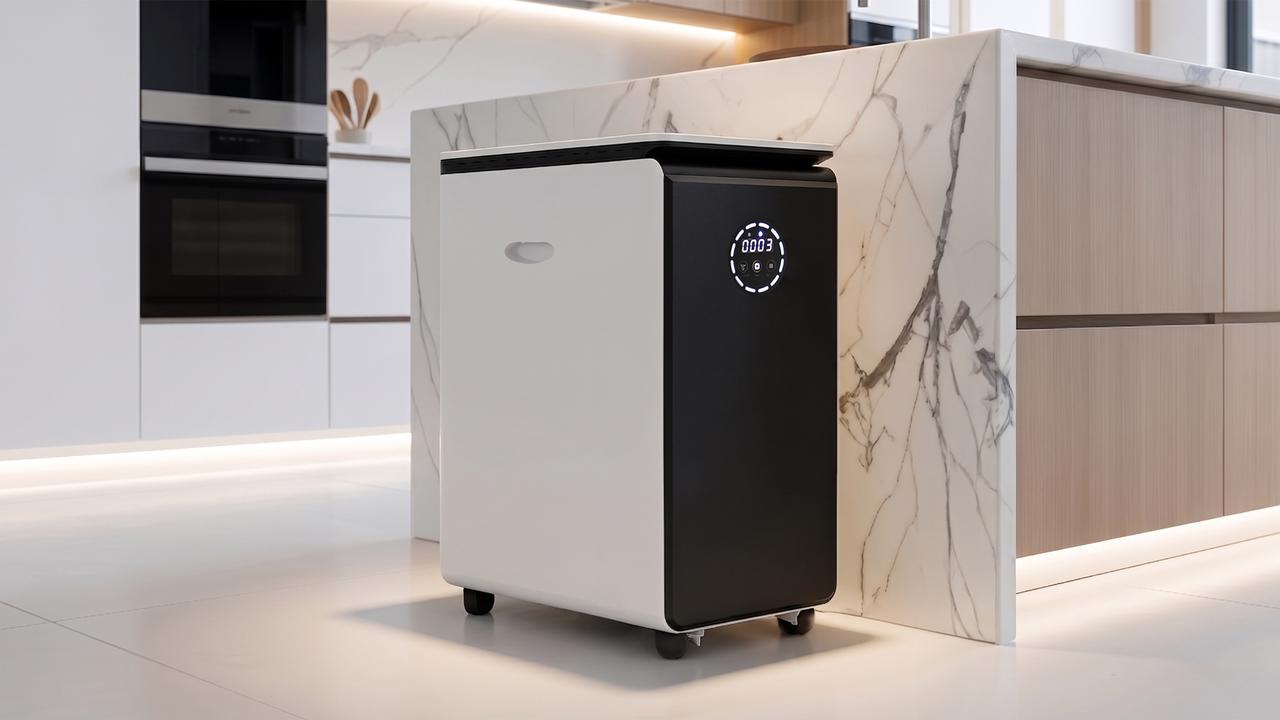
Terra 2 uses the Kobold™ microbial system inside a 14 L chamber. GEMEBrain™ monitors and adjusts operating conditions, including airflow, moisture, heat and mixing to support an aerobic microbial environment.
Current guidance supports up to 2 kg of suitable food scraps per day, with each individual addition kept at 1 kg or less.
Unlike systems that rely on disposable activated carbon as the routine odor-control consumable, Terra 2 uses the permanent PermaFilter™ system and does not require scheduled activated-carbon filter replacement.
Pros
- Continuous microbial processing.
- Add food throughout the day.
- 14 L chamber.
- Up to 2 kg/day.
- No scheduled activated-carbon filter replacement.
- No mandatory subscription.
- Defined Compost Base handling and soil-integration guidance.
Considerations
- Floor-standing rather than countertop-sized.
- Needs continuous power to maintain its controlled microbial environment.
- Dense, woody and fibrous materials decompose more slowly.
- Harvested material should not simply be treated as concentrated finished potting soil.
What Happens to the Output?
Terra 2 produces Compost Base from a continuous process. Because newly added and older material coexist in the chamber, harvested material can contain particles at different stages of decomposition.
The current workflow is:
- Screen harvested Compost Base.
- Return larger unfinished pieces to the chamber.
- Mix approximately 1 part screened Compost Base with 8 parts plain soil.
- Keep concentrated fresh material away from sensitive roots, stems and crowns.
- Allow additional maturation where appropriate.
See the Advanced GEME Compost Application Guide for the complete process.
For a product-focused assessment rather than this market comparison, read GEME Terra 2 Pros and Cons.
6. GEME Pro: Best for Larger Families and Heavy Daily Food Waste
Best for: households of four or more people, frequent cooking, larger meal preparation, or food-waste loads that exceed Terra 2's normal capacity.
GEME Pro increases chamber volume to 19 L and current daily processing guidance to up to 5 kg/day.
That is 2.5 times Terra 2's daily processing capacity, so the advantage is not simply a larger physical container. It gives larger households more processing headroom.
Pros
- 19 L chamber.
- Up to 5 kg/day.
- Continuous microbial processing.
- Designed for 4+ person households.
- No scheduled activated-carbon filter replacement.
- Better capacity margin for unpredictable busy days.
Considerations
- Larger footprint than Terra 2.
- Higher purchase price.
- More capacity than many one- or two-person households need.
- Individual additions should still remain manageable rather than dumping a full day's waste at once.
If household size is your primary concern, use the dedicated Best Electric Composter for Large Families guide.
7. Lomi 3: Best Compact Countertop Food Recycler
Best for: users who want a compact 3 L countertop machine and prefer scheduled processing cycles over maintaining a continuous microbial chamber.
Lomi's current product positioning calls Lomi 3 a food recycler. It uses processing modes to transform food scraps into what the brand calls Lomi Earth.
Lomi itself distinguishes Lomi Earth from compost and has described it as pre-compost. Its gardening guidance recommends mixing Lomi Earth with soil rather than using it as a complete growing medium.
Pros
- Compact countertop footprint.
- 3 L bucket.
- Simple batch workflow.
- Multiple processing modes.
- Useful for fast food-waste volume reduction.
- App-connected current generation.
Considerations
- Batch rather than continuous microbial feeding.
- Current Lomi filter guidance requires activated-carbon replacement.
- Lomi Earth is not the same thing as mature compost.
- Consumables and optional membership products can add recurring cost.
Lomi currently recommends replacing its activated-carbon filter approximately every 3 months or 45 cycles. See Lomi's current filter guidance.
For output terminology, see Lomi's guide to Lomi Earth.
For the direct product comparison, read GEME vs Lomi.
8. Mill: Best Dry Food-Scrap Storage and Recycling Workflow
Best for: households that prioritize food-scrap storage, odor management and the ability to go longer between emptying.
Mill describes itself as a food recycler rather than a home composting device. Food scraps are heated and mixed during its Dry & Grind process to produce dry material called Food Grounds.
Mill's own documentation states that Food Grounds are still food with much of the water, bulk and odor removed, they are not compost.
Pros
- Large scrap-storage workflow.
- Add scraps throughout the day.
- Automatic Dry & Grind scheduling.
- Food Grounds can accumulate for weeks.
- Strong app and user-experience ecosystem.
- Useful for households focused on diversion rather than home compost production.
Considerations
- Food Grounds are not finished compost.
- The grounds still need a downstream destination.
- Uses activated-carbon filtration.
- Filter replacement remains part of ownership.
- Optional pickup pathways may create additional recurring cost.
Mill says its current Plus carbon filter typically lasts around 10–12 months, while the Essential filter typically lasts around 5–6 months, depending on use and food type.
See Mill's explanation of how its system differs from home composting.
For a direct comparison, read GEME vs Mill.
9. Reencle Prime: Best Microbial Alternative
Best for: households that want another continuously fed microbial system and whose normal daily food-scrap load fits Reencle Prime's current capacity guidance.
Reencle should not be grouped with purely dehydrator-style machines. Prime maintains a living microbial culture and accepts food continuously.
Its current specifications list approximately 0.7 kg/day recommended and 1 kg/day maximum for Reencle Prime.
Pros
- Continuous microbial processing.
- Regular feeding rather than batch-only operation.
- Relatively quiet indoor operation.
- Broad household food-scrap acceptance.
- Established microbial-composter ecosystem.
Considerations
- Lower daily capacity than Terra 2.
- Activated-carbon replacement remains part of maintenance.
- Harvested material is not automatically mature at the moment it leaves the chamber.
- Current planting guidance recommends a curing period.
Reencle's current documentation recommends replacing Prime's activated carbon approximately every 9–12 months.
For planting and seeding, Reencle currently recommends curing harvested compost for approximately 3–4 weeks. Larger undecomposed pieces should be sifted out and returned to the chamber.
See Reencle's current model specifications and Reencle's current compost-use guidance.
For the direct comparison, read GEME vs Reencle.
10. What Does Each Kitchen Composter Actually Produce?
The output question is where a large part of the category confusion comes from.
| Product | Output | What You Do Next |
|---|---|---|
| GEME Terra 2 | Active Compost Base from continuous aerobic microbial processing | Screen; return larger unfinished pieces; blend approximately 1:8 with plain soil or mature further where appropriate |
| GEME Pro | Compost Base from continuous microbial processing | Follow the same screening, return and soil-blending pathway |
| Lomi 3 | Lomi Earth / pre-compost | Follow Lomi's soil-use guidance; Lomi recommends dilution rather than using it as pure soil |
| Mill | Dry Food Grounds | Use an approved downstream pathway such as local composting, garden use under Mill guidance or optional pickup |
| Reencle Prime | Biologically active harvested compost | Sift; return unfinished food; cure around 3–4 weeks for planting under current Reencle guidance |
The important distinction is not whether an output looks like soil. The useful questions are:
- How was the material transformed?
- Is biological decomposition still active?
- Is it stable enough for the intended use?
- Does it need dilution, curing or further composting?
- What does the manufacturer actually tell you to do with it?
For the broader science, read How Does a Real Electric Composter Work?.
11. Carbon Filters, Odor Control and Maintenance
Odor control is another area where similar-looking appliances use very different strategies.
| Product | Routine Odor-Filter Model | Current Maintenance Context |
|---|---|---|
| GEME Terra 2 | No scheduled disposable activated-carbon replacement | PermaFilter™ + biological process management |
| GEME Pro | No scheduled disposable activated-carbon replacement | Permanent odor-control system |
| Lomi 3 | Activated-carbon filter refill | Current guidance: approximately every 3 months / 45 cycles |
| Mill | Activated-carbon filter | Plus: about 10–12 months; Essential: about 5–6 months |
| Reencle Prime | Activated-carbon refill | Current guidance: approximately every 9–12 months |
Filter replacement does not automatically make one system poor and another good. It is simply part of the ownership model and should be included when comparing long-term cost and maintenance.
For the detailed filter-cost analysis, read Electric Compost Bin Filters & Costs Comparison.
12. Purchase Price Is Not the Same as Cost of Ownership
Long-term ownership can include:
- electricity;
- replacement carbon;
- optional microbial products or additives;
- subscriptions;
- pickup services;
- cleaning and maintenance;
- what must happen to the output after processing.
For GEME, the main predictable operating cost is electricity. Terra 2 averages approximately 1.5 kWh/day, while GEME Pro averages approximately 1.85 kWh/day. Actual energy use varies with food inputs, ambient conditions and operating demand.
Lomi, Mill and Reencle add different activated-carbon replacement schedules to their ownership models.
Do not duplicate the complete TCO model here. For purchase price, electricity, carbon filters, subscriptions and multi-year ownership, use Electric Composter Filters & Costs Comparison.
13. Which Kitchen Composter Should You Choose?
| Your Priority | Best Direction | Why |
|---|---|---|
| Continuous microbial processing for a 1–3 person household | GEME Terra 2 | 14 L chamber, up to 2 kg/day, continuous feeding and no scheduled carbon-filter replacement |
| Family of four or more / heavier daily waste | GEME Pro | 19 L chamber and up to 5 kg/day |
| Compact countertop batch processing | Lomi 3 | 3 L countertop food recycler with scheduled modes |
| Store scraps for longer and reduce emptying frequency | Mill | Large Dry & Grind workflow and shelf-stable Food Grounds |
| Another continuous microbial system | Reencle Prime | Living microbial culture and continuous feeding |
| Apartment-specific decision | Compare placement, odor, output destination and noise | See the Apartment Guide |
| Odor is the main concern | Compare process management + filtration | See the Odor-Control Guide |
Do Not Buy Only From the Headline Capacity
Chamber volume, daily processing capacity and single-addition limits are different specifications. A large bucket does not automatically mean the machine can biologically process the same amount of fresh food every day.
Choose the Process That Matches What You Want to Achieve
If you want continuous microbial processing and a defined Compost Base pathway, compare Terra 2 and GEME Pro by household size. If your goal is mainly food-waste drying, storage or volume reduction, Lomi and Mill solve different problems and may fit that routine better.
14. Frequently Asked Questions
What is the best kitchen composter in 2026?
For most one- to three-person households prioritizing continuous microbial processing, our overall pick is GEME Terra 2. Larger households should consider GEME Pro, while Lomi, Mill and Reencle fit different processing and workflow priorities.
What is the best electric composter?
The answer depends on what you expect from the machine. GEME Terra 2 and GEME Pro focus on continuous microbial processing; Lomi focuses on compact batch food recycling; Mill focuses on dry food-scrap storage and recycling; Reencle is another continuous microbial system.
Do all electric composters actually compost?
No. “Electric composter” is a market category that includes microbial systems as well as appliances that mainly heat, dry or grind food scraps. Always check the actual process and the manufacturer's instructions for the output.
What is the difference between a kitchen composter and a food recycler?
A microbial kitchen composter supports biological decomposition inside the appliance. A food recycler may instead use heat, airflow, drying or grinding to reduce the mass, moisture or volume of food waste. Both can be useful, but the output and downstream use are different.
Is GEME Terra 2 better than Lomi?
They fit different priorities. Terra 2 is designed around continuous aerobic microbial processing and Compost Base. Lomi is a compact countertop food recycler using batch processing. Choose according to whether continuous biological processing or compact batch reduction matters more to you.
Is GEME Terra 2 better than Mill?
Terra 2 is oriented toward continuous microbial processing and a household soil-return pathway. Mill is oriented toward convenient food-scrap storage and Dry & Grind processing into Food Grounds. The better fit depends on which workflow you want.
Is GEME Terra 2 better than Reencle?
Both use microbial processing. Important differences include daily capacity, chamber size, odor-filter maintenance, output handling and household fit. Terra 2 supports up to 2 kg/day; current Reencle Prime guidance lists 0.7 kg/day recommended and 1 kg/day maximum.
Which kitchen composter is best for a family of five?
For a household of five with consistently heavier food-waste generation, GEME Pro is the stronger GEME fit because it has a 19 L chamber and supports up to 5 kg/day.
Which kitchen composter is best for an apartment?
Apartment users should consider footprint, noise, odor, electrical access and what they will do with the output. Terra 2 is floor-standing rather than countertop-sized, while Lomi has a much smaller countertop footprint. Use the dedicated apartment comparison when space is the main constraint.
Which kitchen composter does not require routine carbon-filter replacement?
GEME Terra 2 and GEME Pro do not require scheduled disposable activated-carbon odor-filter replacement. Lomi, Mill and Reencle currently use activated-carbon filtration with product-specific replacement schedules.
How much food waste can GEME Terra 2 process?
Terra 2 supports up to approximately 2 kg of suitable food waste per day. Keep each individual addition at 1 kg or less.
How much food waste can GEME Pro process?
GEME Pro supports up to approximately 5 kg/day and is intended for larger households and heavier daily loads.
Does Lomi produce compost?
Lomi calls its output Lomi Earth and has described it as pre-compost rather than conventional finished compost. Follow Lomi's current guidance for dilution, curing and soil use.
Does Mill produce compost?
No. Mill explicitly describes Food Grounds as dried, ground food rather than compost. They require a downstream destination such as further composting, garden use under Mill guidance or another recycling pathway.
Does Reencle produce compost?
Reencle uses a living microbial process. Its harvested material continues to stabilize after removal, and current Reencle guidance recommends roughly three to four weeks of curing before planting or seeding use.
What should I compare before buying a kitchen composter?
Compare the actual process, daily capacity, feeding workflow, output, soil-use requirements, odor-control system, replacement filters, electricity, recurring consumables, footprint and how the appliance fits your household's normal food-waste routine.
15. Sources and Related Guides
Manufacturer and Technical Sources
- Lomi — Lomi 3 FAQ and current membership information
- Lomi — Current activated-carbon filter replacement guidance
- Lomi — What Is Lomi Earth?
- Mill — How Mill Differs From Home Composting Devices
- Mill — What Are Food Grounds?
- Reencle — Current Model Specifications
- Reencle — Knowing When Compost Is Ready
- U.S. EPA — Composting at Home


Leave a comment
All comments are moderated before being published.
This site is protected by hCaptcha and the hCaptcha Privacy Policy and Terms of Service apply.