


Buying guide · Kitchen food waste · 2026
The best compost bin is the one that fits your space, your daily scraps, and what you want to do with the material afterward. Some indoor systems use microbes; others dry and grind food waste. Understanding the difference makes choosing much easier.

Quick answer
What are the best compost bins for home use?
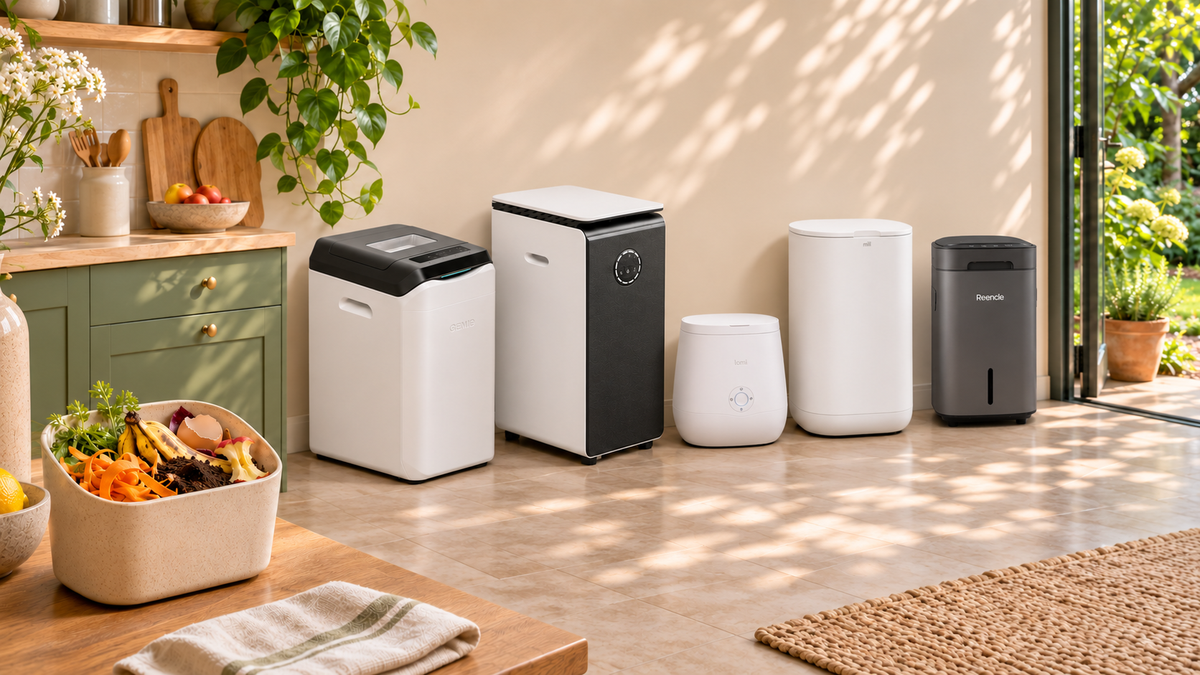
For continuous indoor microbial processing, GEME Terra 2 is our pick for smaller households, while GEME Pro offers greater capacity. Reencle Prime is another microbial option. Lomi and Mill are food recyclers that dry and grind scraps, which suits a different goal. An outdoor bin can be a practical alternative if you have a garden.
1. Five Composters and Food Recyclers at a Glance
From compact kitchen food recyclers to continuous microbial composters, each product takes a different approach to food scraps. Here is how their processes, output, prices and maintenance compare at a glance.
| Product | Positioning | Process and output | Filter and service cost | US price |
|---|---|---|---|---|
|
GEME Pro 9.2/10 |
Best for larger families | Continuous aerobic microbial processing; moist Compost Base | $0 for routine odor-filter replacement; built-in metal-ion odor treatment | $799 (Black Friday Offer) |
|
GEME Terra 2 9.4/10 |
Best overall for smaller households | Continuous aerobic microbial processing; moist Compost Base | $0 for routine odor-filter replacement |
$599 (Black Friday Offer) |
|
Lomi 7.0/10 |
Compact food-waste reduction | Heats and grinds scraps; doesn't make compost | One refill $29.99; membership $120/year + tax |
$569 ($449+$120/year) |
|
Mill 6.5/10 |
Drying and longer storage | Dries and grinds scraps into Food Grounds; doesn't make compost | Essential filter $59 per replacement; optional pickup $192/year + tax | $999 (Essential) |
|
Reencle 8.5/10 |
Alternative microbial system | Microbial processing; output may need screening or curing | Prime carbon filter $35 or refill $30; about every 9–12 months | $549 (Prime) |
US prices checked November 5, 2026. Prices and promotions can change; tax, shipping, configurations and service eligibility vary. Lomi’s $449 offer requires its $120/year + tax membership, billed starting three months after purchase. GEME’s $0 refers to no odor-filter replacements.
GEME Terra 2 and GEME Pro share the same continuous microbial approach. GEME Terra 2 is generally suited to smaller households; GEME Pro offers greater capacity for larger households and heavier cooking routines.
2. Electric Composters vs. Food Recyclers: The Difference
Electric kitchen systems can follow very different paths. Some use heat and mechanical grinding to dry and reduce scraps; others maintain an active microbial environment that breaks down organic material. For a closer look at the process, explore how composting works.

From kitchen scraps to a living Compost Base
GEME’s continuously operating microbial system transforms suitable everyday scraps into a moist, biologically active Compost Base. Mixed with soil, it can become part of your gardening routine, a convenient way to connect the kitchen with the garden. Learn more about GEME Compost Base.
3. GEME Composter: Continuous Microbial Composting at Home
GEME follows a different approach from dry-and-grind devices. It maintains a warm, moist and oxygen-rich chamber in which the Kobold™ microbial community can continuously break down suitable food scraps. GEMEBrain™ controls the system as part of the process, so you can add scraps throughout the day instead of waiting for a batch to finish.
GEME Kobold™ is a selected, naturally derived community of aerobic microorganisms. After the initial setup, the system supports ongoing processing of kitchen scraps. The result is a moist, biologically active Compost Base that can be blended with soil for use in the garden. See what makes a GEME Composter different.
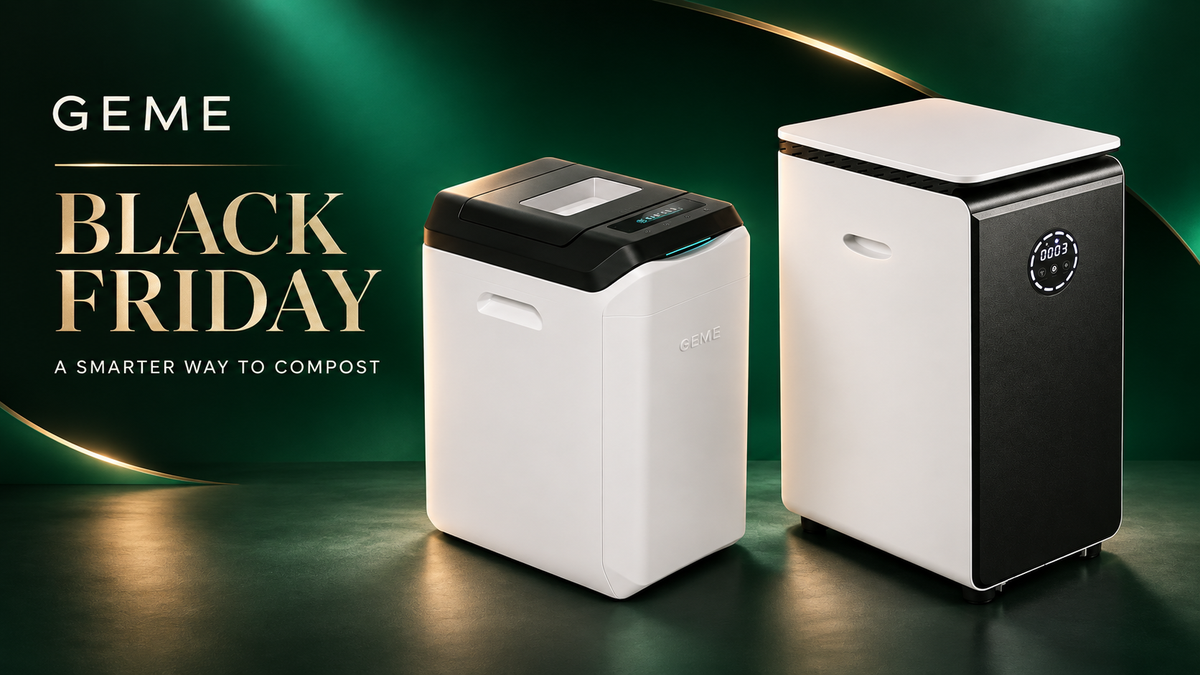
Both models include built-in metal-ion odor treatment and require no odor-filter replacement. There is no recurring cost for routine odor-filter refills, which makes the long-term cost easier to plan for.
GEME Pro: The larger-family choice
GEME Pro has a 19 L chamber and a stated capacity of up to 5 kg of suitable scraps per day. It gives larger households more room for breakfast preparation, dinner leftovers and regular batch cooking, without needing to wait for each load to finish. It is designed for households of around four or more people and those who want a larger processing chamber and less frequent harvesting.
GEME Terra 2: Our best overall pick for smaller households
GEME Terra 2 combines continuous microbial processing with a more compact floor-standing design. Its 14 L chamber and stated capacity of up to 2 kg per day are designed for typical 1–3-person households. For people who want a practical balance of continuous feeding, useful capacity and no routine replacement odor filter, it is our overall recommendation.
Both machines stand on the floor. Check their dimensions and required clearance in the GEME Terra 2 and GEME Pro model comparison before choosing.
Bring the benefits to your garden
GEME’s moist Compost Base makes it easy to put processed kitchen scraps to work around the garden. For planting, follow the GEME guide: blend approximately one part Compost Base with eight parts plain soil, or let it mature before planting. Return larger unfinished pieces to the chamber for further processing. Explore the complete Compost Base application guide.
4. Lomi: Compact Drying and Grinding
Lomi is a compact appliance for reducing the volume of food scraps. It uses heat, airflow, and grinding to turn a batch into a drier material that Lomi describes as pre-compost. That makes it convenient for households focused on reducing wet food waste, though the output differs from the biologically active material produced by a microbial system.
Lomi 3 is $549 without a membership. The $449 membership offer adds $120 plus tax per year, with billing starting three months after purchase. A single refill is listed at $29.99, and Lomi recommends changing filters roughly every three months or 45 cycles. Lomi’s own garden guidance describes mixing the material with soil and allowing it time to cure. A long-term review by WIRED also reported lid-warping concerns, so it is worth considering durability alongside the compact design.
Drawback: Lomi’s quick cycle comes with a catch: what comes out is pre-compost, not finished compost. If you want to use it around plants, Lomi’s own guidance recommends letting it cure for about three weeks. That’s a lot less instant than the countertop convenience might suggest.
Best for: households that want a compact batch system to make scraps smaller and drier and have a plan for the resulting material.
5. Mill: Drying, Storage and Optional Pickup
Mill dries and grinds food scraps into Food Grounds, which Mill says are not compost. Its longer-storage format may appeal to people who do not want to empty their container frequently. Optional pickup gives eligible customers another route for their Food Grounds; availability and final use depend on the service and location.
Mill Essential costs $999, while Mill Plus starts at $1,149. Mill lists the Essential filter at $59, lasting about 5–6 months, and the Plus filter at $114, lasting about 10–12 months. Optional Mill Pickups cost $192 per year plus tax, where available.
For a detailed side-by-side view, read GEME Terra 2 vs. Mill.
Drawback: At $999 for the Essential, Mill asks a premium price for a machine that doesn't compost. Even Mill says the output is food grounds, not compost, so if your goal is to make compost at home, you’re paying a lot and still need another step. Filters and optional pickup can add to the bill.
Best for: people who prefer dry storage and, where available, an optional collection service.
6. Reencle: Another Microbial Approach
Reencle is another option for households interested in biological processing instead of a dry-and-grind cycle. Its continuous system uses a microbial starter, although its formulations and operating guidance differ from those of the Kobold™ system used by GEME.
Reencle Prime handles up to approximately 1 kg per day, compared with a stated capacity of up to 2 kg per day for GEME Terra 2. Reencle recommends curing harvested material for approximately three weeks, and its system uses a replaceable carbon filter.
Reencle Prime is listed at a regular price of $549. Its replacement carbon filter is $35, or $30 for a carbon refill, with replacement recommended about every 9–12 months. Shipping, tax and other accessories may add to the cost.
Drawback: Reencle Prime’s maximum capacity is about 1 kg of food scraps per day, so busier cooking days can leave you with a backlog. Add a replaceable carbon filter and Reencle’s recommendation to cure harvested material for about three weeks before use with plants, and the routine looks less hands-off than you might expect.
Best for: shoppers looking for an alternative continuous microbial system who are comfortable with the extra costs of filters and refills, as well as the relevant care and curing steps.
7. Our Overall Picks and Ratings
Here is how I would choose among these five options, based on their processing methods, capacity, ongoing costs and fit for different households.
- Best overall: GEME Terra 2 — 9.4/10. Continuous microbial processing, up to approximately 2 kg/day and no routine replacement odor filter make it our balanced choice for smaller households.
- Best for larger families: GEME Pro — 9.2/10. The 19 L chamber and up to approximately 5 kg/day capacity offer greater headroom for heavier kitchen loads.
- Microbial alternative: Reencle — 8.5/10. A continuous biological system for buyers who accept ongoing filter costs and curing guidance.
- Compact food-waste reduction: Lomi — 7.0/10. A dry-and-grind option for people who prioritize shrinking wet scraps and do not need the device itself to produce a microbial Compost Base.
- Dry storage and optional pickup: Mill — 6.5/10. A higher-priced food recycler that suits those who value storage and have access to their preferred route for Food Grounds.
For households seeking a continuous kitchen-to-garden routine, GEME Terra 2 and GEME Pro combine biological processing with convenient daily feeding and no routine replacement for odor filter.
8. How to Choose the Best Compost Bin for Your Home
Choose the process
Decide whether you want indoor microbial decomposition, dry food waste reduction, or an outdoor composting system.
Plan for the output
Think about whether you can cure, mix with soil, compost further or use an eligible pickup service.
Check the practical fit
Measure space and compare daily volume, accepted scraps, power use, filters, service terms and maintenance.
Outdoor bins and tumblers remain useful choices if you have space and are willing to manage a mix of materials. For a broader comparison including worm bins and Bokashi, read our guide to home composting systems.
Frequently Asked Questions
What is the best compost bin for a small household?
For indoor microbial processing, GEME Terra 2 is our recommendation for a typical 1–3 person household. The best fit still depends on available floor space, food-scrap volume and the material you want to produce.
Do electric food recyclers make finished compost?
Not necessarily. Mill and Lomi describe their processed outputs as Food Grounds and pre-compost, respectively. Microbial systems also require attention to maturity and the manufacturer's use instructions.
Does GEME require regular odor-filter replacement?
GEME Terra 2 and GEME Pro do not require routine replacement of an odor filter. Electricity, cleaning and any optional replacement materials remain separate considerations.
How should I use GEME Compost Base?
GEME Compost Base can be blended with plain soil for your garden. Follow GEME guidance to mix approximately one part Compost Base with eight parts soil, or allow it to mature before planting. Larger unfinished pieces can return to the chamber for further processing.
Can a kitchen composter replace local food-scrap collection?
Not automatically. Accepted materials and local separation rules differ. Follow your local authority's requirements for scraps your device does not accept and for any remaining waste.
Find the GEME Composter That Fits Your Kitchen
Compare GEME Terra 2 and GEME Pro in terms of daily capacity, available floor space, and household routine.
Sources & Product Guidance
- GEME model comparison — capacity and model selection; product prices: GEME Terra 2 and GEME Pro.
- GEME FAQ — Compost Base and soil use.
- Lomi 3 product and membership pricing, filter refills and output-use guidance.
- Mill model comparison, Mill Essential, and pickup pricing.
- Reencle Prime, Prime carbon filter, carbon refill and curing guidance.
Manufacturer specifications and service terms can change. Consult the current product guidance and local waste rules before purchasing or using any output.


Leave a comment
All comments are moderated before being published.
This site is protected by hCaptcha and the hCaptcha Privacy Policy and Terms of Service apply.