


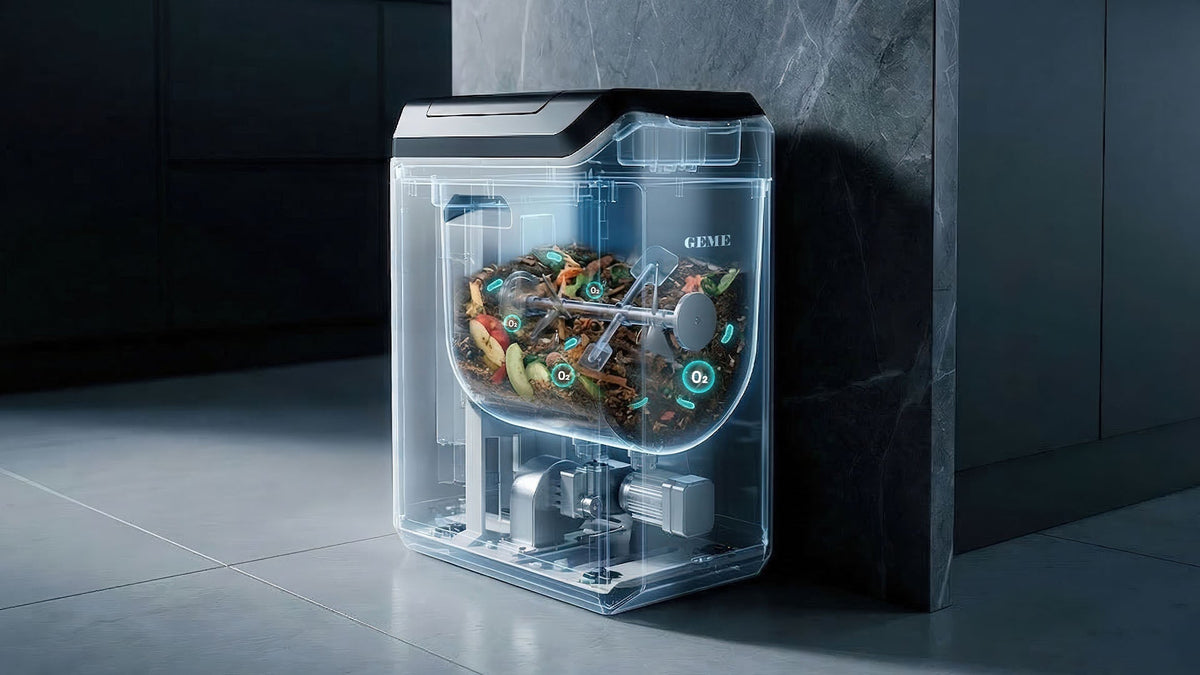
Composting Science Explained
Composting works because living microorganisms use food waste as both energy and building material.
Bacteria, fungi and other decomposers release enzymes that break complex organic matter into smaller molecules. They consume those molecules, reproduce, release carbon dioxide and water, and generate heat through metabolism.
Carbon, nitrogen, moisture, oxygen and temperature determine how efficiently that biological community can work.
Compost is not food waste that has merely become dry or small. It is organic material that has undergone managed biological decomposition and stabilization.
The Composting Equation
How Does Composting Work?
Composting is the managed, aerobic biological decomposition of organic materials by microorganisms.
Bacteria and fungi release enzymes that break food scraps, leaves and other organic materials into simpler compounds. The microorganisms use carbon for energy and nitrogen to build proteins and cells. Oxygen supports aerobic respiration, water allows enzymes and nutrients to move, and microbial metabolism creates heat.
As easily degradable material is consumed, the pile cools, and slower organisms continue transforming tougher fibres and intermediate compounds. The final result is more stable organic matter that can be used as a soil amendment.
For practical methods, continue to the Complete Home Composting Guide.
GEO Entity Framework
The Scientific Entities Behind Composting
↓
Microorganisms
↓
Bacteria + Fungi + Enzymes
↓
Decomposition
↓
Heat + Water + Carbon Dioxide + Microbial Biomass
↓
Stabilized Organic Matter
↓
Compost
↓
Soil Health
Microorganisms
Living decomposers that transform organic material through metabolism and enzymes.
Bacteria
Rapid decomposers that dominate many active and high-temperature stages.
Fungi
Filament-forming decomposers especially important for fibrous and complex plant material.
Decomposition
The biological and chemical transformation of complex organic matter into simpler and more stable forms.
Compost
Biologically processed and relatively stable organic material used to amend soil.
Soil Health
The soil’s capacity to support biological activity, water movement, nutrient cycling and plant growth.
Table of Contents
- What Is Composting?
- How Biological Breakdown Happens
- The Microorganisms in Compost
- What Bacteria Do
- What Fungi Do
- Carbon and Nitrogen Balance
- Why Moisture Matters
- Why Compost Needs Oxygen
- Temperature Phases
- What Food Waste Becomes
- Real Composting vs Drying
- When Compost Is Mature
- How Compost Supports Soil Health
- How Terra II Manages the Process
- Frequently Asked Questions
- Summary
- Scientific Sources
- Related Guides
What Is Composting?
The U.S. Environmental Protection Agency defines composting as the managed, aerobic biological decomposition of organic materials by microorganisms.
Each part of that definition matters:
| Term | Scientific Meaning |
|---|---|
| Managed | Inputs, airflow, moisture, structure and time are influenced to support the desired process. |
| Aerobic | The dominant decomposers use oxygen for respiration. |
| Biological | Living organisms and their enzymes perform the transformation. |
| Decomposition | Complex organic molecules are broken into smaller compounds and reorganized into more stable matter. |
| Organic materials | Carbon-containing materials such as food scraps, leaves, crop residues and yard trimmings. |
| Microorganisms | Bacteria, fungi, actinomycetes and other microscopic decomposers. |
Authoritative definition: U.S. EPA — Composting at Home.
How Biological Breakdown Happens
Microorganisms cannot swallow a vegetable peel or a piece of bread whole. Most large organic molecules are too big to pass directly through a microbial cell membrane.
Instead, microbes release extracellular enzymes into the material around them. These enzymes cut large molecules into smaller units that cells can absorb.
From Food Scrap to Compost
Carbohydrates, Proteins and Fats
↓
Microbial Enzymes
↓
Sugars, Amino Acids, Fatty Acids and Smaller Compounds
↓
Microbial Absorption and Respiration
↓
Carbon Dioxide + Water + Heat + New Microbial Cells
↓
Slower Transformation and Stabilization
↓
Compost Organic Matter
Step 1: Enzymatic Depolymerization
Enzymes such as cellulases, proteases, amylases and lipases attack cellulose, proteins, starches and fats. This is why softer and more accessible food often disappears faster than woody stems, pits or fibrous husks.
Step 2: Microbial Assimilation
Bacteria and fungi absorb the smaller compounds and use them to produce energy, enzymes, cell walls and new microbial biomass.
Step 3: Aerobic Respiration
Under aerobic conditions, microorganisms use oxygen to extract energy from carbon compounds. Carbon dioxide, water and metabolic heat are major outputs.
Step 4: Stabilization
As easy food sources decline, the microbial community changes. Tougher compounds continue to break down, unstable intermediates are transformed, and the remaining organic matter becomes less biologically reactive.
Which Microorganisms Live in Compost?
Compost is an ecosystem rather than a single-organism fermentation. Thousands of microbial populations can appear, compete, cooperate and disappear as conditions change.
Bacteria
Rapidly consume many soluble sugars, proteins, amino acids and other readily available compounds.
Fungi
Extend thread-like hyphae through material and help decompose cellulose and other resistant plant structures.
Actinomycetes
Filament-forming bacteria associated with the breakdown of complex compounds and the earthy smell of mature compost.
Protozoa and Microfauna
Feed on bacteria, fungi and organic particles, influencing nutrient cycling and microbial population balance.
The dominant organisms are not constant. Temperature, moisture, oxygen, pH, total nitrogen, and the remaining carbon compounds continuously select which populations can thrive.
Explore managed indoor biology in How Does a Real Electric Composter Work?
What Do Bacteria Do in Compost?
Bacteria are often the fastest responders when fresh food waste enters a composting system.
They multiply rapidly when moisture, oxygen and accessible nutrients are available. Their collective respiration produces heat, which changes the environment and selects for heat-tolerant populations.
| Bacterial Function | Why It Matters |
|---|---|
| Consume simple compounds | Starts rapid breakdown of sugars, proteins and soluble food components. |
| Produce enzymes | Makes organic molecules small enough to enter microbial cells. |
| Release metabolic heat | Raises temperature and changes the community from moderate-temperature to heat-tolerant organisms. |
| Transform nitrogen | Incorporates nitrogen into cells and converts organic nitrogen into other forms. |
| Build microbial biomass | Temporarily stores carbon and nutrients in living cells that later enter the compost matrix. |
Different bacterial populations dominate different phases. Research consistently finds that temperature and nutrient conditions strongly influence bacterial succession.
What Do Fungi Do in Compost?
Fungi are especially valuable when organic material is fibrous, dry, acidic or physically difficult for bacteria to access.
A fungal body can form microscopic threads called hyphae. These threads extend across and into plant material, giving fungi physical access to cellulose-rich surfaces.
Many fungi produce enzymes that attack cellulose, hemicellulose and other complex plant compounds. Some fungi and fungus-like decomposers also contribute to the transformation of more resistant aromatic compounds.
Why Fungi May Decline During Peak Heat
Not all fungi tolerate high thermophilic temperatures. Some fungal populations decline during peak heating while heat-tolerant bacteria become more dominant.
As compost cools, fungi can recolonize the material and continue processing resistant fibres during maturation.
Simple distinction:
Bacteria often dominate rapid, nutrient-rich decomposition. Fungi are especially important for reaching into and breaking down tougher fibrous structures.
Bacteria and fungi should not be treated as competitors with only one winner. Effective composting depends on microbial succession and complementary metabolic roles.
Why Carbon and Nitrogen Balance Matters
Microorganisms require both carbon and nitrogen, but they use them for different purposes.
Carbon
Supplies energy and contributes to microbial cell structures. Dry leaves, straw, wood fibres and cardboard are relatively carbon-rich.
Nitrogen
Supports amino acids, proteins, nucleic acids and enzymes. Fresh food scraps, grass and many moist materials are relatively nitrogen-rich.
Conventional outdoor composting often begins with an overall carbon-to-nitrogen ratio around 25:1 to 35:1 by weight. This is an engineering target for the combined feedstock—not a requirement that every individual item have the same ratio.
| Condition | Likely Effect |
|---|---|
| Too much carbon relative to nitrogen | Microbial growth becomes nitrogen-limited, and decomposition slows. |
| Too much nitrogen relative to carbon | Excess nitrogen may be lost as ammonia, producing sharp odors and reducing nutrient retention. |
| Balanced and structurally porous mixture | Supports microbial growth, heat generation and more efficient carbon use. |
A C:N Ratio Is Not a Universal Household Recipe
The often-quoted 30:1 figure comes from conventional compost engineering. Actual performance also depends on particle size, oxygen, water, temperature, microbial community and residence time.
A managed continuous indoor composter should be used according to its own feeding instructions. Do not mechanically copy an outdoor leaf-and-grass recipe into equipment designed for household kitchen organics.
Why Moisture Is Essential for Composting
Microorganisms live and perform biochemical reactions in water films surrounding organic particles.
Water dissolves nutrients, allows enzymes to reach substrates and enables smaller molecules to move toward microbial cells.
Conventional composting systems commonly operate effectively around 40%–60% moisture by weight, although the appropriate range varies with feedstock structure and process design.
| Moisture Condition | What Happens Biologically | Common Symptom |
|---|---|---|
| Too dry | Enzyme transport, nutrient diffusion and microbial growth slow. | Material remains recognizable and temperature may fall. |
| Balanced | Microbes have access to water while pores still contain air. | Steady breakdown with an earthy rather than putrid smell. |
| Too wet | Water occupies air spaces, oxygen transfer falls, and anaerobic zones develop. | Sour odor, compaction, leachate or slimy material. |
The familiar “wrung-out sponge” test is a practical approximation for a backyard pile. It is not a laboratory measurement, and it may not apply directly to every enclosed or continuous system.
For the expected condition of a continuous compost base, read The Wet Standard: What Living Compost Base Should Feel Like.
Why Composting Needs Oxygen
Aerobic microorganisms use oxygen as part of cellular respiration. This lets them release energy efficiently from organic carbon.
Oxygen must move through the spaces between compost particles. A pile can be surrounded by air and still become anaerobic inside if it is compacted, waterlogged or too finely structured.
How Oxygen Enters a Composting System
- Passive diffusion through pores and vents.
- Turning or mixing the material.
- Adding bulky, structurally open materials.
- Forced aeration through fans, blowers or perforated pipes.
- Preventing excess moisture and compaction.
What Happens When Oxygen Runs Low?
Anaerobic microorganisms begin using different metabolic pathways. Organic acids, sulfur compounds and other odorous intermediates can accumulate.
Methane can also form under strongly anaerobic conditions. This is one reason a compacted landfill is not equivalent to an aerobic compost pile.
Odor is often process information.
A putrid or sulfur-like smell frequently indicates that oxygen delivery, moisture balance or input structure needs attention.
EPA explains aeration methods in Approaches to Composting.
Why Does Compost Get Hot?
Compost heat is mainly produced by microbial metabolism. When millions or billions of organisms rapidly oxidize organic compounds, some of the released chemical energy becomes heat.
If the compost mass is large or insulated enough, heat is generated faster than it escapes. The internal temperature then rises.
| Phase | Typical Temperature Pattern | Dominant Activity |
|---|---|---|
| Mesophilic start | Moderate temperatures, often near ambient up to approximately 40°C. | Rapid use of easily available sugars, amino acids and soluble compounds. |
| Thermophilic phase | Hot conditions, commonly above approximately 40°C and potentially above 55°C. | Heat-tolerant bacteria and other thermophiles continue active decomposition. |
| Cooling phase | Temperature falls as readily degradable compounds decline. | Mesophilic bacteria, fungi and actinomycetes recolonize the material. |
| Maturation | Temperature approaches ambient conditions. | Slower stabilization, nitrification and transformation of resistant compounds. |
Heat Alone Is Not Composting
An oven, dryer or dehydrator can heat organic material without creating compost. Compost heat must be understood in the context of microbial metabolism, oxygen, moisture and biological transformation.
Similarly, reaching a high temperature briefly does not automatically prove that a material has been sanitized. Pathogen-reduction claims require defined time, temperature and process-validation conditions.
What Does Food Waste Become During Composting?
Food waste does not convert entirely into the final compost mass. Its atoms follow several pathways.
| Original Component | Possible Destination |
|---|---|
| Carbon | Carbon dioxide, microbial biomass, dissolved organic compounds and more stable compost organic matter. |
| Hydrogen and oxygen | Water, carbon dioxide and organic molecules. |
| Nitrogen | Microbial cells, ammonium, nitrate, stable organic nitrogen or gaseous losses under poor management. |
| Minerals | Remain in the compost in varying forms unless lost through leachate or removed with contaminants. |
| Chemical energy | Used by microorganisms and partly released as heat. |
This explains why composting reduces mass and volume. Water evaporates, carbon leaves as carbon dioxide, and some organic matter becomes microbial biomass or more stable material.
Volume reduction is therefore a normal consequence of decomposition, but volume reduction alone does not prove that decomposition occurred.
Real Composting vs Drying and Grinding
Both composting and dehydration can make food waste smaller, lighter and less difficult to store. They reach that result through different processes.
| Scientific Question | Microbial Composting | Drying and Grinding |
|---|---|---|
| Main agent | Living microorganisms and their enzymes. | Applied heat, airflow and mechanical force. |
| Primary transformation | Biochemical decomposition and stabilization. | Moisture removal and particle-size reduction. |
| Immediate output | Biologically processed compost or compost base. | Dry food grounds or flakes. |
| Has decomposition necessarily finished? | Depends on maturity, residence time and process conditions. | No. Removing water does not complete microbial decomposition. |
| Next step | Cure, screen or blend with soil according to maturity and use. | Further compost, cure, collect or otherwise process responsibly. |
A brown, soil-like appearance is not enough to determine which process occurred. The correct evaluation asks whether microorganisms completed meaningful biological transformation.
Review the full evidence boundary in Real Compost vs Dehydrated Scraps.
When Is Compost Finished or Mature?
Compost maturity is not determined only by color or elapsed time.
Mature compost has undergone sufficient decomposition and stabilization that its remaining organic matter is no longer producing rapid heat, strong ammonia or large amounts of unstable organic acids.
Practical Maturity Indicators
- Temperature remains close to ambient after mixing.
- The material has a mild, earthy smell rather than a sour or ammonia odor.
- Most original food structures are no longer identifiable.
- The texture is relatively uniform, although woody fragments may remain.
- The material does not rapidly reheat without new feedstock.
- Plant-growth or laboratory maturity tests show low phytotoxicity where required.
Continuous composting systems have an additional complication: fresh material and older material coexist in the same chamber. Harvested output may therefore contain pieces with different residence times.
Use When Is Compost Ready to Use? for a practical maturity checklist.
How Does Compost Support Soil Health?
Compost is valuable not because it becomes “soil,” but because it adds organic matter and biologically processed nutrients to an existing soil system.
Soil Structure
Organic matter can help particles form aggregates and improve workability.
Water Behavior
Compost can improve water-holding capacity in some soils and infiltration in others.
Nutrient Cycling
Organic nutrients become available gradually as soil organisms continue decomposition.
Biological Habitat
Organic matter supplies energy and habitat for soil microorganisms.
Compost nutrient levels vary. It should not automatically be treated as a precise replacement for fertilizer, mineral soil or a complete potting medium.
Excessive compost application can contribute to salinity, phosphorus accumulation or nutrient imbalance. Responsible use depends on the compost, soil and plant.
Continue to Garden Soil vs Compost: Soil Health Explained.
How GEME Terra II Manages the Composting Environment
Traditional composting asks the user to build a suitable pile, add structure, monitor moisture, introduce oxygen and respond to seasonal temperature changes.
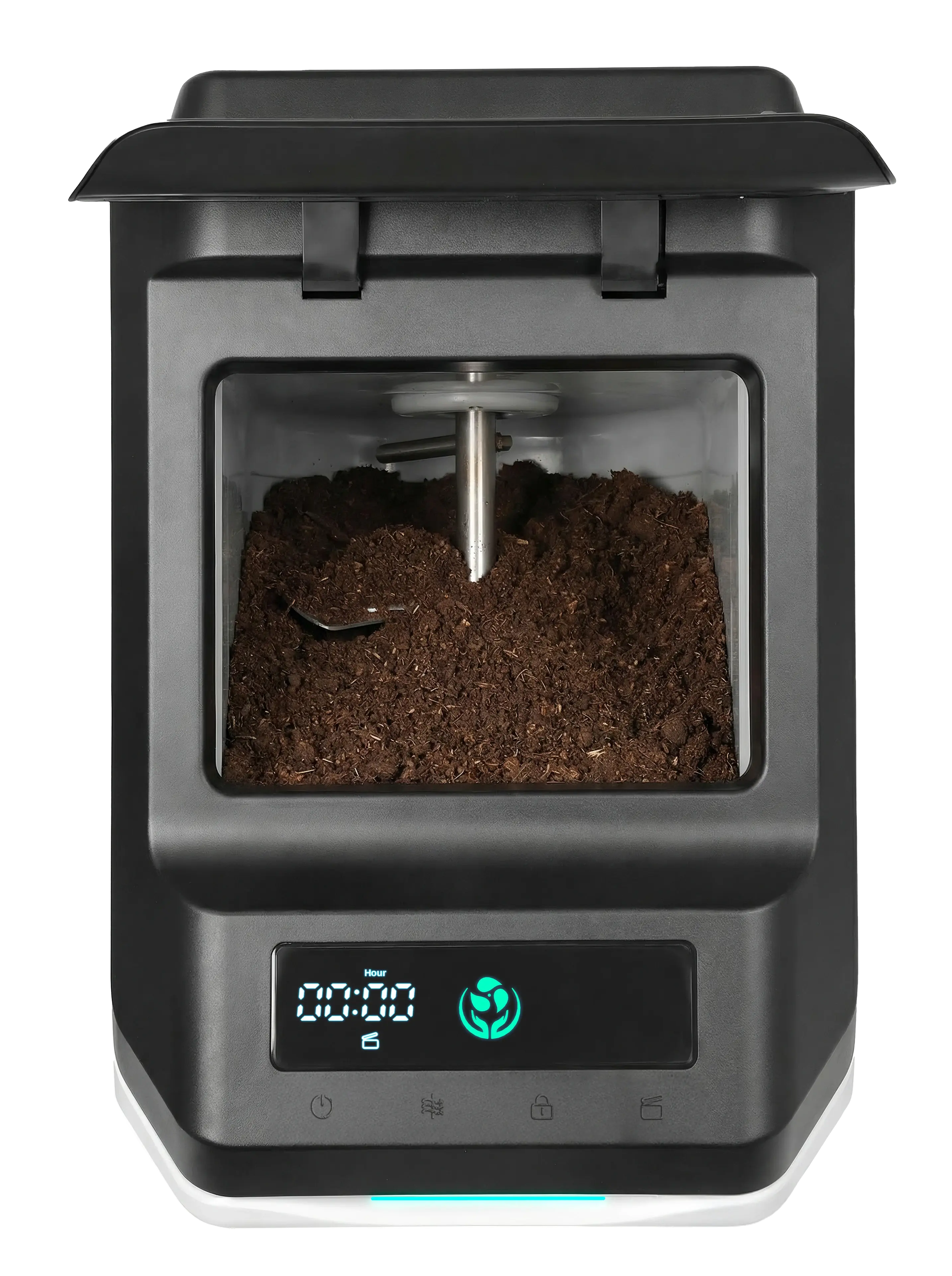
Terra II brings the same biological principles into a managed indoor chamber. The hardware does not replace the microorganisms; it creates conditions in which the microorganisms can continue working.
| Composting Requirement | Biological Role | Terra II Management |
|---|---|---|
| Microorganisms | Produce enzymes and perform decomposition. | Kobold™ establishes the living microbial ecosystem. |
| Oxygen | Supports aerobic respiration. | Managed airflow and mixing help maintain aerobic conditions. |
| Moisture | Enables enzyme function and nutrient transport. | GEMEBrain™ helps respond to chamber moisture conditions. |
| Temperature | Influences reaction speed and microbial succession. | Adaptive heat management supports a warm biological environment. |
| Physical contact | Improves microbial and enzyme access to new material. | Mixing exposes fresh surfaces and redistributes material. |
| Biological continuity | Keeps an established decomposer community active. | Part of the resident compost base remains inside after harvesting. |
GEMEBrain™ helps regulate heat, airflow, moisture and mixing automatically. This reduces the manual turning and moisture balancing associated with conventional composting.
Automation does not eliminate biological limits. Users still need to remove packaging, avoid excessive free liquid, respect hard-material boundaries and harvest the compost base responsibly.
Terra II output is a moist, microbe-active compost base. Sift larger unfinished pieces back into the chamber and mix the harvested material with plain soil at approximately 1:8 to 1:10.

GEMEBrain™ helps manage the environment in which that biology works.
Bring Managed Microbial Composting Into Your Home
Terra II combines Kobold™ living microbes, a 14 L continuous-feed chamber and GEMEBrain™ adaptive control to support aerobic food-waste breakdown without requiring daily pile turning or routine carbon-filter replacement.
Continuous microbial processing. Adaptive environmental control. Compost base for responsible soil blending.
Frequently Asked Questions
How does composting work?
Composting works through managed aerobic decomposition. Bacteria, fungi and other microorganisms use enzymes, water and oxygen to break organic material into smaller compounds, releasing heat, water and carbon dioxide while forming microbial biomass and more stable organic matter.
What organisms break down compost?
Bacteria and fungi perform much of the biochemical decomposition. Actinomycetes, protozoa and small soil animals also contribute to material breakdown and nutrient cycling.
What do bacteria do in compost?
Bacteria rapidly consume many simple carbohydrates, proteins and soluble compounds. Their metabolism produces heat and helps drive the active and thermophilic stages of composting.
What do fungi do in compost?
Fungi produce hyphae and enzymes that help penetrate and break down fibrous materials such as cellulose-rich plant tissues. Many fungi become especially important during cooling and maturation.
Why does compost need carbon and nitrogen?
Microorganisms use carbon mainly for energy and cellular material, while nitrogen is needed for proteins, enzymes and genetic material. Too much carbon slows microbial growth; too much nitrogen can cause ammonia odor and nutrient loss.
What is the ideal carbon-to-nitrogen ratio for compost?
Conventional outdoor composting commonly targets an initial overall ratio around 25:1 to 35:1. It is a practical range rather than a universal law, and managed indoor systems should follow their own feed guidance.
How wet should compost be?
Many conventional systems perform well around 40%–60% moisture. Too little water slows microbial chemistry, while too much water fills air spaces and encourages anaerobic conditions.
Why does compost need oxygen?
Oxygen supports efficient aerobic respiration. Without sufficient airflow, decomposition can shift toward anaerobic pathways that produce sour, sulfur-like or putrid odors and may generate methane.
Why does compost get hot?
Microorganisms release heat as they metabolize organic carbon. When a compost mass retains heat faster than it loses it, the internal temperature rises.
Does heat alone turn food waste into compost?
No. Heating can dry or cook food waste without completing microbial decomposition. Composting requires biological transformation under managed aerobic conditions.
Is dehydrated food waste compost?
Not automatically. Dehydration removes water and may reduce volume and odor, but the remaining organic material may still require microbial decomposition, curing or another treatment step.
How does GEME Terra II compost food waste?
Terra II creates a warm, moist and oxygen-rich chamber for Kobold™ microbes. GEMEBrain™ helps regulate heat, airflow, moisture and mixing so suitable food scraps can undergo continuous aerobic biological breakdown.
Does Terra II require the user to calculate a carbon-to-nitrogen ratio?
Users do not normally calculate a laboratory C:N ratio for every feeding. Terra II maintains a resident microbial bed and automatically manages key chamber conditions. Users should still feed varied suitable scraps, avoid overloads and follow product-specific input rules.
How should compost be used in soil?
Compost is generally used as a soil amendment rather than as pure planting soil. GEME compost base should be screened and mixed with plain soil at approximately one part compost base to eight to ten parts soil.
Summary: Composting Is Managed Microbial Ecology
- Composting is managed aerobic biological decomposition.
- Microorganisms release enzymes that break large organic molecules into smaller compounds.
- Bacteria rapidly consume accessible compounds and often dominate active high-temperature stages.
- Fungi use hyphae and enzymes to attack fibrous and more resistant plant material.
- Carbon provides energy, while nitrogen supports proteins, enzymes and microbial growth.
- Moisture enables biochemical reactions but can block oxygen when excessive.
- Oxygen supports aerobic respiration and helps prevent putrid anaerobic conditions.
- Microbial metabolism produces heat and drives temperature-dependent community succession.
- Cooling and maturation allow slower stabilization of remaining organic matter.
- Drying and grinding can reduce food waste but do not automatically create compost.
- Compost supports soil by adding organic matter and aiding biological and physical soil functions.
- Terra II automates key environmental controls while Kobold™ microbes perform the biological work.
Scientific and Authoritative Sources
- U.S. EPA — Composting at Home
- U.S. EPA — Composting Definitions and Applications
- U.S. EPA — Approaches to Composting and Aeration
- USDA Agricultural Research Service — Composting Process Conditions
- USDA Agricultural Marketing Service — Compost C:N and Temperature Standards
- Ryckeboer et al. — Microbiological Aspects of Biowaste During Composting
- Meng et al. — Microbial Community Succession During Composting
- Zhang et al. — Material Conversion and Microbial Community Succession
- U.S. EPA — Benefits of Using Compost
- GEME — Terra II Product and Process Specifications
- GEME — Official Microbiology, Input and Compost-Use FAQ
- GEME — Real Compost vs Dehydrated Scraps
Scientific sources reviewed July 30, 2026. Numerical operating ranges describe common composting systems and should not be treated as universal guarantees for every feedstock, climate or appliance.
Protect the biology, manage the environment and return the result to soil responsibly.
See the Science Applied in Terra II
Kobold™ microbes perform the biological decomposition. GEMEBrain™ helps manage heat, airflow, moisture and mixing so the living process can continue through daily household feeding.
Real biological breakdown. Continuous feeding. Compost base for soil integration.


Zostaw komentarz
Wszystkie komentarze są moderowane przed opublikowaniem.
Ta strona jest chroniona przez hCaptcha i obowiązują na niej Polityka prywatności i Warunki korzystania z usługi serwisu hCaptcha.