
Independent Review · Media Coverage · Last Reviewed August 17, 2026
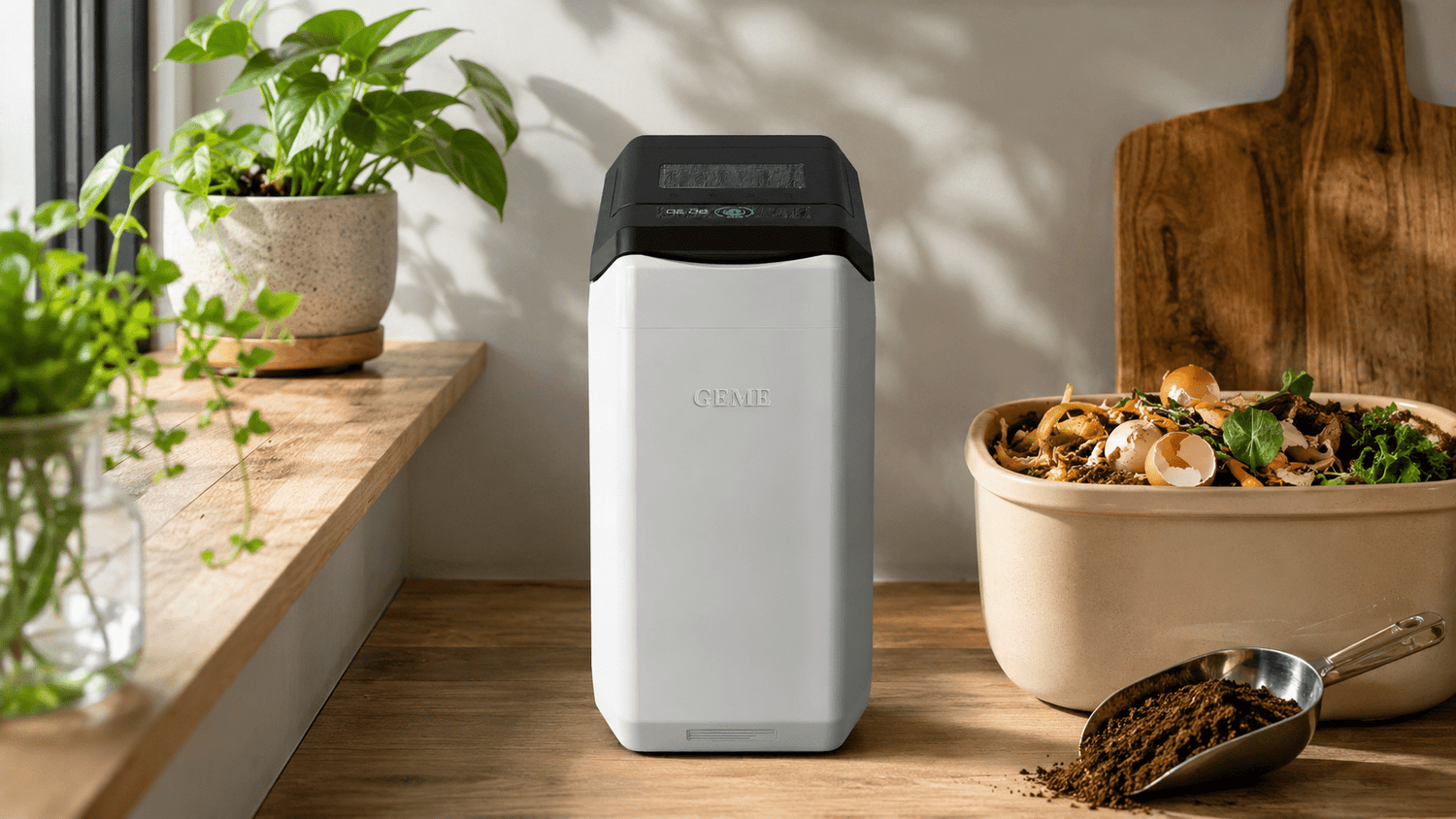
GEME Terra 2 Reviewed By Compost Magazine
Compost Magazine spent several weeks putting GEME Terra 2 through real-world kitchen-composting tests, including mixed leftovers, meat, thick sauces, paper and even small bones. The result was a notably balanced independent review: strong marks for microbial breakdown, smart process control, broad food-waste handling and compost-style output, alongside fair criticism of price, physical size, electricity use and fresh-compost handling.

Editorial transparency: Compost Magazine states that GEME provided the Terra 2 test unit free of charge, but that GEME had no control over the publication's editorial conclusions. The review also contains affiliate links. This GEME article summarizes and responds to that independent review; it does not replace or reproduce the original review.
Quick Answer: What Did Compost Magazine Think of GEME Terra 2?
Compost Magazine gave GEME Terra 2 a strong overall assessment after several weeks of hands-on use.
The publication displayed a 4.4/5 rating and summarized Terra 2 as a system that works quickly, handles food waste that many kitchen systems struggle with, creates compost-style output rather than dry dehydrated grounds and uses a permanent odor-treatment system that avoids routine charcoal-filter replacement.
The reviewer tested ordinary kitchen scraps as well as meat, thick sauces, paper towels, a whole apple, sweetcorn and small chicken bones.
The result was not a simplistic claim that every material disappears on the same schedule.
Soft mixed food waste broke down quickly. A deliberately heavy mixed load became largely unrecognizable within hours. A whole apple took longer. Paper towels took days. Small bones were still visible after several days.
That distinction is useful because it reflects how real biological composting actually behaves:
Fast microbial activity does not mean every input has the same residence time.
You can read the full independent article at Compost Magazine's complete GEME Terra II review.
Table of Contents
- Why This Compost Magazine Review Matters
- What Did Compost Magazine Test?
- How Fast Did GEME Terra 2 Work?
- What Food Waste Could Terra 2 Handle?
- Did the Reviewer Think Terra 2 Made Real Compost?
- What Did the Review Say About GEMEBrain and Microbial Control?
- Permanent Odor Control and Running Costs
- Will Terra 2 Fit in a Small Kitchen?
- What Didn't Compost Magazine Like?
- Current GEME Guidance and Clarifications
- Fresh Compost, Maturity and Soil Use
- Who Is Terra 2 Best For?
- What Two Independent Reviews Now Tell Us
- Final Verdict
- FAQ
1. Why the Compost Magazine GEME Terra 2 Review Matters
There is a meaningful difference between a general technology reviewer trying a kitchen appliance and a publication whose subject is compost itself.
Compost Magazine writes about traditional compost piles, vermicomposting, compost bins, soil systems and compost science.
That matters for a GEME Terra 2 review because Terra 2's core claim is not simply that it makes food scraps smaller.
It is designed as a microbial kitchen composter.
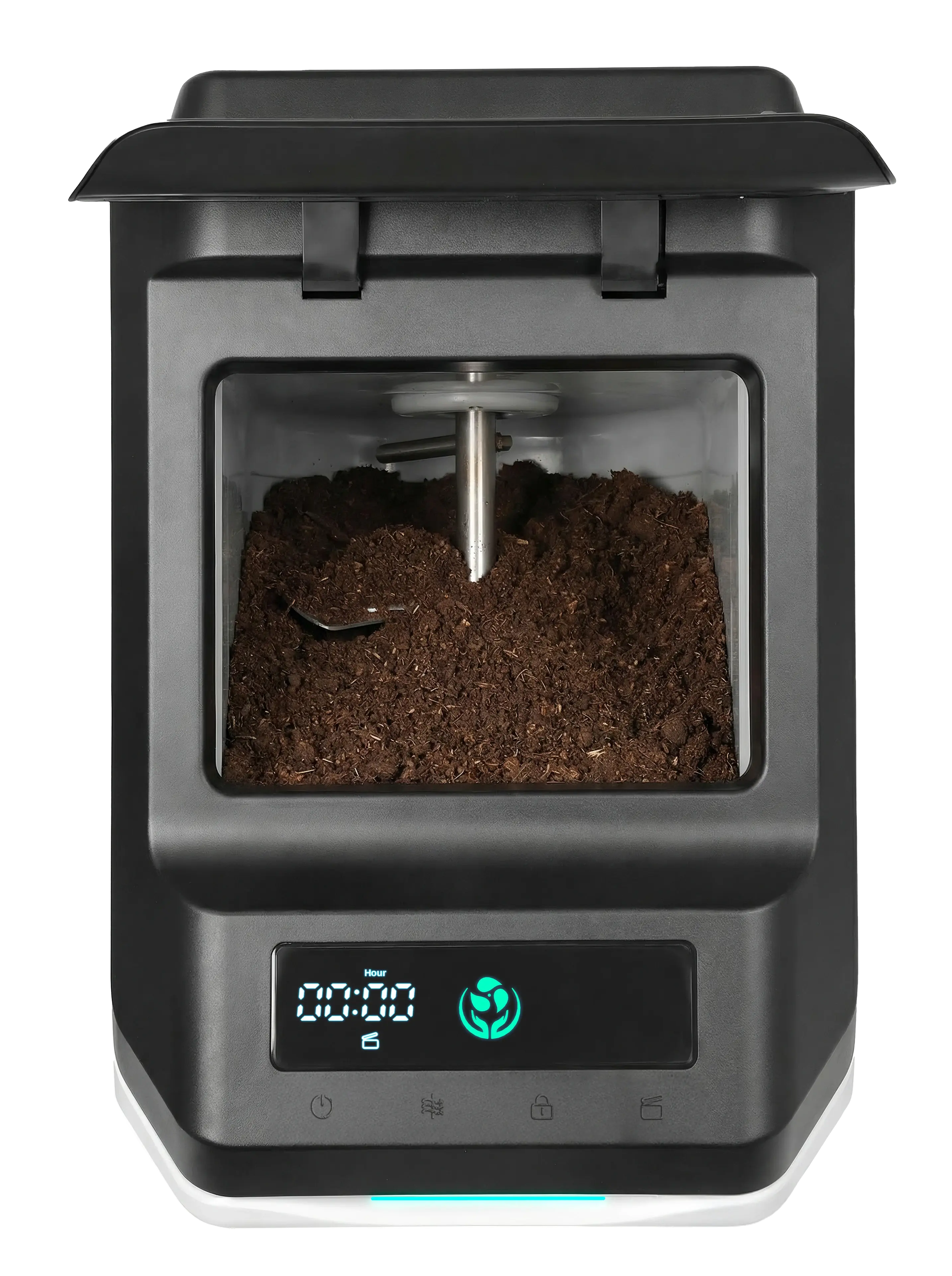
The machine maintains a warm, moist and oxygen-rich chamber so living Kobold™ microorganisms can biologically process food waste while GEMEBrain™ manages heat, airflow, moisture and mixing.
That is a different proposition from a short-cycle appliance whose primary mechanism is heating, drying and grinding.
For the category distinction, see Real Compost vs Dehydrated Food Scraps.
A compost-focused reviewer is therefore evaluating more than user interface and appliance styling.
The underlying question is:
Is biological decomposition actually taking place, and is the resulting material meaningfully different from dried food waste?
2. What Did Compost Magazine Actually Test?
The review was based on several weeks of real household use rather than a one-day demonstration.
The author was also transparent about the limitation: four weeks is useful for evaluating day-to-day operation, but a complete compost assessment can require a longer observation period.
During the test, Terra 2 was fed a mix of ordinary and deliberately challenging materials.
The reviewer also carried out a more deliberate high-load test using approximately 1.7 kg of mixed kitchen food waste, including a whole sweetcorn.
That test is particularly useful because it sits close to Terra 2's current daily throughput positioning of up to 2 kg/day without pretending that 2 kg is a recommended single dump.
3. How Fast Did GEME Terra 2 Work in the Compost Magazine Test?
Speed was one of the strongest parts of the review.
In ordinary use, the author commonly added scraps after dinner and found that by the following morning much of the food had become difficult to distinguish from the active compost bed.
During the deliberate mixed-load test, the reviewer reported that after roughly four hours most of the added material was already difficult to recognize.
That result is encouraging, but it should be interpreted correctly.
Not Every Food Breaks Down at the Same Speed
The review itself provides excellent counterexamples.
A whole apple remained visible after 24 hours, although it had visibly changed and reduced in size.
Paper towels took several days.
Small bones remained visible for days.
That is exactly why GEME's current guidance does not define the 6–8 hour figure as:
“Every possible food item becomes completely mature compost within 6–8 hours.”
A better interpretation is:
Suitable kitchen scraps can enter rapid visible microbial breakdown within hours, while total residence time depends on size, structure, moisture and material type.
This distinction is explored more fully in How Microbial Composting Actually Works.
4. Can GEME Terra 2 Compost Meat, Sauces and Small Bones?
One of the most interesting parts of the Compost Magazine test was the input range.
Traditional backyard compost advice often tells households to avoid meat, oily leftovers and bones because they can attract animals, create odors and take a long time to decompose in an unmanaged pile.
Terra 2 is operating in a different environment.
It is enclosed, continuously mixed and actively manages key chamber conditions.
The reviewer reported successfully processing:
- vegetable scraps;
- mixed leftovers;
- meat;
- thick sauces;
- whole vegetables such as sweetcorn;
- and small chicken bones.
But again, “can accept” and “disappears quickly” are different claims.
Small bones were among the slowest materials in the test.
That is biologically unsurprising. Bone is mineral-rich and structurally much more resistant than cooked rice or soft vegetables.
For current input boundaries, use the GEME Terra 2 input and care FAQ rather than assuming every organic-looking object is appropriate.
5. Did Compost Magazine Think GEME Terra 2 Made Real Compost?
This is probably the most strategically important part of the review.
The reviewer did not treat Terra 2 as simply another food-waste dehydrator.
Compost Magazine described the resulting material as actual compost-style output and specifically contrasted it with the dry, dehydrated material produced by many electric food recyclers.
The review also referenced laboratory data GEME had supplied regarding organic matter, nutrient content and pH.
GEME's own current claim language is deliberately more specific:
Terra 2 produces a moist, biologically active compost base for responsible soil integration, not dried food-waste flakes and not a standardized bagged fertilizer.
That language matters.
A continuous-feed microbial system contains material with different residence times. Some material has been in the bed much longer than scraps added yesterday.
Larger unfinished fragments should therefore be screened and returned to the chamber instead of being treated as uniformly finished material.
Across a separate N=50 household output sampling run, GEME has also found that nutrients are present but vary with feedstock, reinforcing that the output behaves like compost rather than a standardized NPK fertilizer.
See NPK Testing of GEME Household Compost Output for the evidence boundaries.
6. What Did the Review Say About Sensors and Microbial Process Control?
Compost Magazine highlighted Terra 2's process-control technology as a meaningful differentiator.
Traditional composting depends on the user, or the environment, to establish the conditions microorganisms need.
A backyard composter may need to:
- turn the pile;
- add water;
- correct excess moisture;
- rebalance carbon-rich and nitrogen-rich material;
- and respond to changing outdoor temperature.
Terra 2 brings those variables into an engineered indoor system.
Kobold™ provides the microbial community.
GEMEBrain™ helps regulate:
- airflow;
- temperature;
- moisture-related operation;
- and mixing.
Compost Magazine specifically noted that when a larger amount of food enters the system, Terra 2 can change operating conditions rather than running one fixed heat cycle regardless of what is happening inside.
This is why we describe Terra 2 as a controlled microbial kitchen composter or bio-reactor rather than a simple electric bin.
See the current system explanation at How GEME Terra 2 Works.

7. Permanent Odor Control Was a Major Running-Cost Advantage
The reviewer also identified Terra 2's odor-treatment system as one of its most practical ownership advantages.
Many electric kitchen composters and food recyclers rely on activated-carbon filters that need periodic replacement.
Terra 2 instead uses a permanent metal-ion oxidation system as part of its odor-management pathway.
That means there is no routine disposable carbon-filter subscription.
Compost Magazine correctly identified this as a potential long-term cost advantage.
It is important, however, to distinguish filter costs from every other possible ownership cost.
Terra 2 still uses electricity.
Parts can eventually require service.
And users may choose to purchase Kobold™ Boost or Reset products when their biological bed actually needs support.
But current GEME guidance does not treat Kobold as a mandatory quarterly subscription.
The existing microbial ecosystem is designed to remain active and self-replicating when the bed is maintained correctly. Boost is optional after events such as first harvest or when performance has materially slowed.
For a detailed ownership comparison, see Electric Composter Filter & Recurring Cost Comparison.
8. Will GEME Terra 2 Fit in a Small Kitchen?
One of Compost Magazine's clearest criticisms had nothing to do with microbiology.
It was size.
Terra 2 is narrower than some competing microbial systems, but its depth and height mean buyers need to think about placement differently from a small countertop dehydrator.
The reviewer initially tried placing the machine on a counter but found that its height made adding waste awkward in that particular kitchen.
The machine was eventually moved to a floor position.
Current Terra 2 dimensions are approximately:
| Specification | Terra 2 |
|---|---|
| Width | 297 mm / 11.7 in |
| Depth | 437 mm / 17.2 in |
| Height | 566 mm / 22.3 in |
| Weight | 13 kg / 28 lb |
| Recommended household | 1–3 people |
| Daily throughput | Up to 2 kg/day |
Before buying any electric composter for a small kitchen, measure not only the footprint but also the clearance required to open the lid comfortably.
9. What Didn't Compost Magazine Like About Terra 2?
A strong third-party review is more useful when it includes the reasons someone might not buy the product.
Compost Magazine raised four main reservations.
1. Initial Purchase Price
Terra 2 costs substantially more than building a basic outdoor compost pile or worm bin.
The question is therefore not whether Terra 2 is the cheapest way to compost.
It clearly is not.
The relevant question is whether indoor containment, automation, broad food-waste handling, odor control and continuous microbial processing solve enough recurring household problems to justify the appliance cost.
For that decision framework, see Are Kitchen Composters Worth It?.
2. Electricity Use
The review correctly points out that an actively controlled indoor system uses electricity while a worm bin or passive cardboard-box method can operate with essentially no electrical input.
This is an important environmental boundary.
The climate result of an electric kitchen composter depends partly on actual energy consumption, local grid carbon intensity and the waste pathway being displaced.
A household whose scraps would otherwise go to landfill has a different comparison from one already using an efficient municipal composting service.
3. Physical Size
Terra 2 is a full microbial processing chamber, not a tiny countertop bucket.
Buyers should verify floor, counter and lid-clearance space before purchase.
4. Fresh Compost Needs Responsible Handling
The reviewer also raised a valid horticultural caution: newly harvested organic material should not automatically be treated like universally mature bagged compost.
We agree with the need for that caution.
The difference is that GEME's current guidance does not recommend using concentrated output as pure potting soil in the first place.
10. Current GEME Guidance: What Has to Be Clear After the Review
Independent reviews are most useful when they help sharpen product guidance.
Several points deserve particularly clear language.
Daily Capacity: Up to 2 kg/day
Terra 2 is currently positioned for up to 2 kg of suitable kitchen food waste per day.
That number describes daily throughput—not a recommendation to dump 2 kg into the chamber in one single feeding.
Normal meal-sized additions are preferable.
Household Size: 1–3 People
Terra 2 is optimized for one- to three-person households.
For four or more people, consistently heavy cooking or much higher daily food-waste generation, GEME Pro is the better starting point.
Kobold Is a Living Starter, Not a Mandatory Subscription
Kobold™ establishes and supports the microbial ecosystem.
Once a healthy bed is established, the microorganisms reproduce inside the system.
Current GEME guidance treats additional Boost as optional maintenance after events such as first harvest or when biological performance has slowed—not as a fixed quarterly refill requirement.
6–8 Hours Means Rapid Breakdown, Not Universal Maturity
Compost Magazine's own observations make this clear.
Mixed soft food can become difficult to recognize within hours.
A whole apple, fibrous paper or bone can require much longer.
That is normal for biological decomposition.
11. How Should Terra 2 Compost Base Be Used After Harvest?
This was one of the areas where the Compost Magazine review was appropriately cautious.
Fresh organic material can challenge sensitive plant roots when applied too heavily or used before sufficient stabilization.
GEME's current guidance therefore does not recommend treating freshly harvested Terra 2 output as pure potting soil.
Instead:
- Screen the output. Remove large recognizable fragments.
- Return unfinished pieces to Terra 2. They simply need more residence time.
- Use the finer compost base as a soil amendment.
- Blend approximately 1 part compost base with 8–10 parts soil.
- Start modestly with sensitive plants.
- Use a small comparison or pot test when uncertain.
This approach acknowledges both sides of the evidence:
The output is biologically processed and nutrient-bearing, but household compost remains naturally variable.
Read the complete GEME Compost Application & Soil Blending Guide.

12. Who Is GEME Terra 2 Best For?
One of the most credible parts of the Compost Magazine verdict is that the reviewer did not claim everyone needs Terra 2.
The author already had a large garden and several lower-cost composting methods available.
For that situation, buying an indoor appliance did not make economic sense.
But the review reached a very different conclusion for someone who:
- does not have a large garden;
- lives in an apartment or small home;
- wants food scraps processed indoors;
- wants faster decomposition than a passive pile;
- wants a real microbial pathway rather than dry food grounds;
- values broad kitchen-waste handling;
- dislikes recurring carbon-filter replacement;
- and has a practical use for compost output.
That is exactly the distinction buyers should make.
A best electric composter is not the machine with the most aggressive claim.
It is the system that solves the household's actual food-waste problem.
For broader category comparison, see the Best Composter 2026 Guide and Electric Composter Comparison.
13. Compost Magazine and Digital Trends Tested Terra 2 Differently, and That Is Useful
GEME Terra 2 has now been examined through two very different editorial lenses.
Digital Trends used Terra 2 in a demanding five-person household and exposed what happens when a smaller household platform is pushed toward sustained overload.
Compost Magazine approached the machine from the perspective of a gardener and experienced composter, focusing more heavily on decomposition speed, food range, microbial process, compost output and whether an electric system makes sense compared with traditional composting.
| Review Lens | Digital Trends | Compost Magazine |
|---|---|---|
| Primary perspective | Consumer technology / household appliance | Composting / gardening |
| Household load | Five-person high-load household | Real-world household use plus deliberate mixed-load tests |
| Useful stress point | Overload, odor and E32 protection | Material-specific decomposition time and plant-use maturity |
| Shared positive signal | Real everyday food-waste reduction | Rapid microbial breakdown and compost-style output |
Taken together, the reviews make the product easier to understand because they reveal different operating boundaries.
Read our summary of the other test at GEME Terra 2 Reviewed by Digital Trends.
Independent Testing, Clear Boundaries
See What Terra 2 Is Designed to Do
Compost Magazine's testing reinforces the central Terra 2 idea: use living microbes and controlled aerobic conditions to process everyday kitchen waste continuously, while being transparent that different materials, households and soil-use situations have different operating boundaries.
14. Final Verdict: What Compost Magazine's GEME Terra 2 Review Tells Buyers
The most valuable takeaway from the Compost Magazine review is not that Terra 2 received a positive score.
It is that the reviewer tested the specific things that distinguish a microbial composter from a conventional food recycler.
The machine demonstrated:
- rapid visible breakdown of mixed kitchen waste;
- successful handling of meat and difficult wet foods;
- mechanical tolerance for small bones, even though they decomposed slowly;
- continuous-feed microbial processing;
- adaptive management of the composting environment;
- a permanent odor-treatment system;
- and a moist compost-style output rather than dehydrated flakes.
The same review also made the trade-offs clear:
- Terra 2 is not inexpensive;
- it uses electricity;
- it requires meaningful kitchen space;
- different feedstocks break down at different speeds;
- and harvested biological output still needs responsible soil-use judgment.
That is the kind of independent review we value.
It does not say:
“This product is perfect for everyone.”
It asks the more useful question:
For households that cannot or do not want to manage a traditional outdoor compost system, can an electric microbial composter turn ordinary kitchen waste into a genuinely useful biological output?
Based on the weeks of testing reported by Compost Magazine, the answer was strongly positive with the important boundaries above kept intact.
15. Frequently Asked Questions About the Compost Magazine GEME Terra 2 Review
Did Compost Magazine review GEME Terra 2?
Yes. Compost Magazine conducted several weeks of hands-on testing with GEME Terra 2 and published an independent review. GEME supplied the test unit free of charge, but the publication states that GEME had no say over its editorial conclusions.
What rating did Compost Magazine give GEME Terra 2?
The review page displayed a rating of 4.4 out of 5.
What did Compost Magazine like about GEME Terra 2?
The review praised rapid food-waste breakdown, broad input handling, sturdy construction, simple controls, sensor-based environmental adjustment, foot-operated lid opening, permanent odor treatment and the production of compost-style biological output rather than dry dehydrated waste.
What did Compost Magazine dislike about GEME Terra 2?
The main criticisms were initial purchase price, electricity consumption, physical size for small kitchens and the need to think carefully about the maturity and application of freshly harvested compost material.
How fast did Terra 2 work in the Compost Magazine test?
In normal use, many mixed scraps became difficult to recognize between evening feeding and the following morning. During one deliberate test using about 1.7 kg of mixed food waste, the reviewer reported that most material was already difficult to distinguish after roughly four hours. Harder or larger items took longer.
Can GEME Terra 2 compost meat?
The Compost Magazine reviewer reported successfully processing leftover meat. Terra 2 operates differently from a basic backyard pile because it maintains an enclosed, managed microbial environment.
Can GEME Terra 2 compost bones?
The reviewer added small chicken bones without creating an operating problem, but the bones remained visible for several days. Bones are structurally difficult to decompose and should not be expected to disappear on the same timeline as soft food scraps.
Does GEME Terra 2 make real compost?
Compost Magazine distinguished Terra 2's output from dehydrated food grounds and described it as actual compost-style material. GEME's current claim language is more specific: Terra 2 produces a moist, biologically active compost base that should be screened and blended into soil responsibly.
Does Terra 2 turn all food into compost in 6–8 hours?
No. The 6–8 hour figure refers to rapid microbial processing and visible breakdown under suitable conditions. The Compost Magazine test showed that large fruit, paper and bones can require much longer residence time.
How much food waste can Terra 2 process?
Current GEME guidance positions Terra 2 for up to approximately 2 kg of suitable food waste per day and households of one to three people. Daily throughput should not be interpreted as a recommendation to add the full amount in one single load.
Does Terra 2 require replacement carbon filters?
No routine disposable carbon-filter replacement is required. Terra 2 uses a permanent metal-ion oxidation system as part of its odor-management design.
Do I need to buy GEME Kobold every few months?
Not as a mandatory subscription. Current GEME guidance treats Kobold as a living microbial ecosystem. Once the bed is established, optional Boost can be used after events such as first harvest or when biological performance slows.
Is Terra 2 suitable for apartments?
It can be especially relevant for apartment households because it provides enclosed indoor microbial processing without requiring a backyard pile. However, buyers should measure available floor or counter space and lid clearance before purchase.
Is GEME Terra 2 worth it?
That depends on the household. A gardener with abundant outdoor space and inexpensive composting systems may not need an electric microbial composter. A small-home or apartment household that values indoor containment, automation, broader food-waste handling and real compost output may value it much more highly.
16. Sources & Further Reading
- Compost Magazine — GEME Terra II Review: I Fed It Bones, Nutella, Even Chicken…
- GEME — Terra 2 Current Product Specifications
- GEME — How Continuous Microbial Composting Works
- GEME — Real Compost vs Dehydrated Food Scraps
- GEME — Current Terra 2 FAQ, Kobold & Operating Guidance
- GEME — NPK Test of Household Compost Output, N=50
- GEME — Advanced Compost Application & Soil Blending Guide
- GEME — Electric Composter Filter & Recurring Cost Comparison
- GEME — Terra 2 vs Reencle Prime
- GEME — Terra 2 Reviewed by Digital Trends
- GEME — Are Kitchen Composters Worth It?
Sources reviewed August 17, 2026. Statements describing Compost Magazine's testing are attributed to its independent review. Current capacity, household fit, Kobold maintenance and compost-application guidance reflect GEME's current published operating position and may differ from preliminary information supplied during earlier media testing.


Hinterlasse einen Kommentar
Alle Kommentare werden vor der Veröffentlichung geprüft.
Diese Website ist durch hCaptcha geschützt und es gelten die allgemeinen Geschäftsbedingungen und Datenschutzbestimmungen von hCaptcha.