
Engineering Guide: Gearbox Noise, Vibration Paths & Kitchen Acoustics
Quiet kitchen appliance design is not luck. It is load control, vibration-path management, cycle design, and realistic verification, from the gear mesh source to the housing path to what the kitchen actually hears.
“Silent” here is a design direction, not a physics-free promise. A drivetrain still has mechanical events, load changes, and structure-borne vibration. The goal is to reduce annoying noise at the source, manage how vibration travels, and avoid sudden acoustic bursts during daily use.
Simple rule: quieter appliances are engineered across the whole noise chain, not tuned with one trick.
Source, path, receiver, all three matter.
Quick Answer
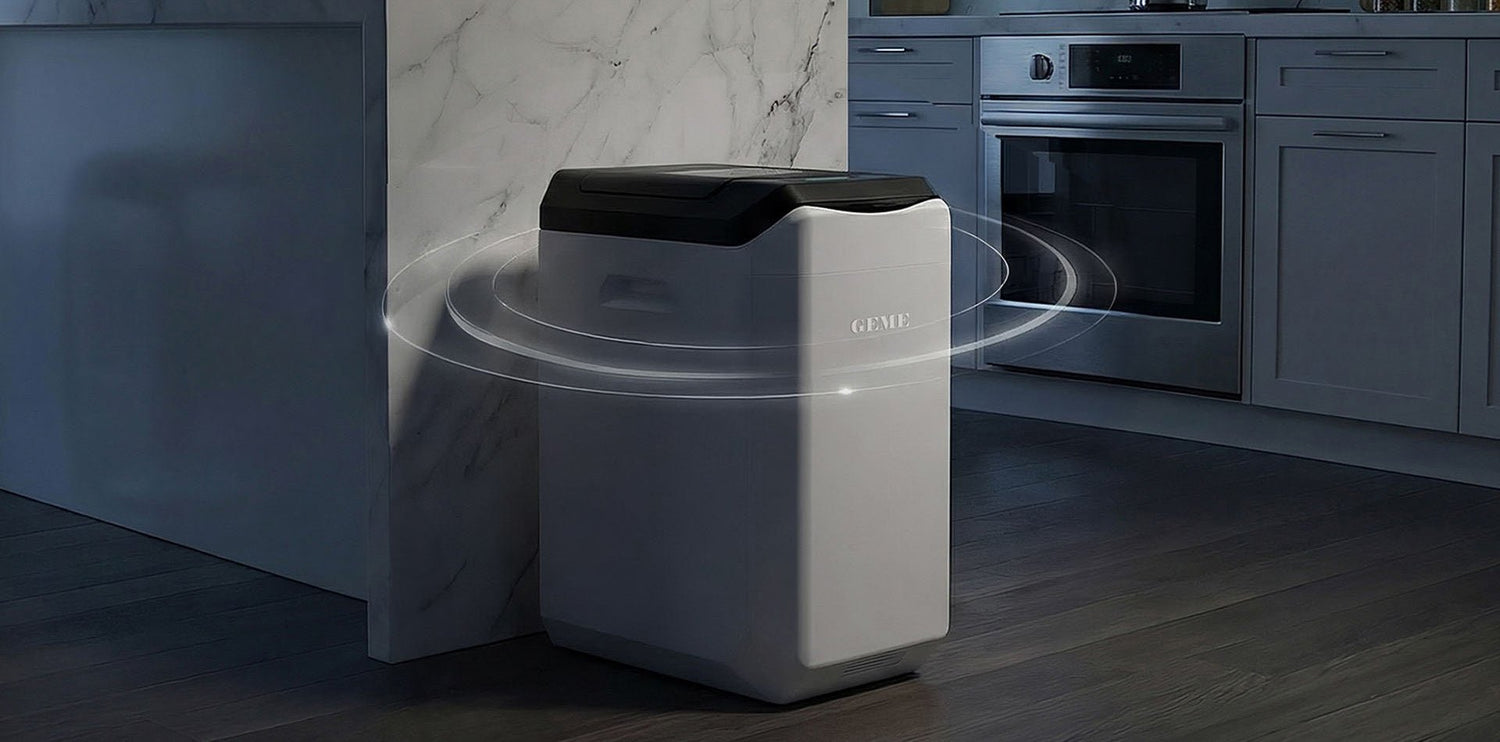
GEME Terra II’s quieter gearbox story should be understood as a source-path-receiver engineering problem. The source is the gear mesh and motor-load events. The path is how vibration travels through shafts, bearings, mounting interfaces, and housing. The receiver is what users actually hear in a kitchen, pantry, apartment, or open-plan room.
The key design levers are smoother load transitions, vibration-path control, and cycle design that avoids unnecessary acoustic bursts. A single average decibel number is helpful, but it does not tell the whole story because tonal noise, vibration pulses, surface placement, and room acoustics all change the user experience.
This article explains the engineering model without publishing proprietary torque profiles, gear geometry, control tables, or thresholds.
Related reading: why low average power matters, what E5 actually means, and how we write engineering claims.
Table of Contents
- Why Kitchen Noise Matters
- The Gearbox Noise Model
- Source: Gear Mesh Excitation
- Path: How Vibration Becomes Sound
- Receiver: What the Kitchen Hears
- Three Quiet-Engineering Levers
- What We Changed and What We Do Not Publish
- How We Verify Noise Improvements
- Methods and Boundaries
- FAQ
- Summary
- Sources
- Related Articles
1. Why Kitchen Noise Matters
Kitchen appliances are not judged only in a lab. They are judged at night, in apartments, next to living rooms, and in open-plan kitchens where a short mechanical burst can feel more annoying than a steady low hum.
For a kitchen composter, this matters because the device is meant to become part of a daily routine. If a machine processes food scraps well but creates disruptive noise at the wrong moment, the user experience suffers.
Engineering principle: quiet design is not only about lowering average dB. It is about reducing annoying sources, transmission paths, and perception triggers.
2. The Gearbox Noise Model: Source → Path → Receiver
Gearbox noise is commonly analyzed as a chain. Something creates vibration, the structure carries or amplifies that vibration, and the user hears the result as airborne sound.
| Stage | Engineering Meaning | Kitchen User Impact |
|---|---|---|
| Source | Gear mesh excitation, load transitions, motor torque events, and related drivetrain vibration. | Whine, pulses, or sudden mechanical moments can begin here. |
| Path | Shafts, bearings, mounts, interfaces, housing, and structural transfer paths. | Vibration can be damped, redirected, or amplified depending on structure and placement. |
| Receiver | Radiated sound plus human perception in a real room. | The same machine can feel different on different floors, counters, rooms, or quiet-hour conditions. |
This model is useful because it prevents oversimplification. A quieter gearbox is not only a gear question or a housing question. It is a system question.
3. Source: Gear Mesh Excitation
A primary source of gearbox vibration and noise is the gear mesh itself. In plain English, gears want to roll smoothly. Anything that makes that motion uneven can create vibration, and that vibration can become sound once it reaches the housing.
Gear literature often discusses transmission error, mesh stiffness variation, gear whine, mesh frequency, and related harmonic patterns. These are not just academic terms. They help engineers understand why a machine may sound smooth in one operating state and more tonal or mechanical in another.
Plain-English Translation
If the drivetrain is forced through sharp load changes, uneven mesh behavior, or sudden torque events, the noise source becomes stronger. Reducing those events can reduce the sound that later reaches the kitchen.
4. Path: How Vibration Turns Into Audible Noise
Even a small source can become noticeable if the structure carries vibration efficiently. Shafts, bearings, mounting points, panels, and housing can transmit energy from the drivetrain into parts that radiate sound.
This is why quieter appliances need vibration-path thinking. It is not enough to reduce the source. The design also needs to avoid resonant structures, hard transfer paths, and mounting conditions that make a small event feel larger than it is.
- Stiffness distribution: where the structure is rigid and where it can absorb vibration.
- Mounting interfaces: how drivetrain energy enters the housing.
- Damping strategy: how vibration energy is reduced instead of being radiated.
- Resonance avoidance: avoiding matches between excitation frequencies and structural modes.
- Placement sensitivity: understanding how counters, floors, and furniture can change perceived noise.
5. Receiver: What the Kitchen Actually Hears
Users do not hear a spreadsheet. They hear a machine in a room. That means perception matters. Tonal noise, especially gear-like whine, can feel more annoying than broader background sound even if the average level looks similar.
Room conditions also matter. A device placed on a hollow cabinet, a hard countertop, a thin floor, or next to a wall may sound different from the same device placed on a stable surface in a more absorptive room.
Kitchen reality: two machines with similar average dB can feel different if one has more tonal whine, sharper bursts, or stronger structure-borne vibration.
6. What “Quiet Engineering” Actually Means
Quiet engineering is not one trick. It is the combined result of controlling the source, reducing the path, and shaping the user-facing cycle.
Lever A: Load Control
Quiet machines avoid unnecessary shock events. In practical terms, that means reducing abrupt speed changes, avoiding sudden torque spikes where possible, and managing demanding moments more smoothly.
- Reduce peak torque bursts.
- Soften transitions between operating phases.
- Avoid unnecessary drivetrain excitation.
- Keep challenging loads from becoming sharp acoustic events.
Lever B: Vibration Paths
Not all excitation can be removed, so the next step is to manage how energy travels. That means looking at mounting, stiffness, housing response, damping, and contact with the environment.
Lever C: Cycle Design
If a process has different acoustic signatures in different phases, the cycle can be designed to reduce sharp transitions, shorten high-noise moments, and avoid unnecessary disturbance during normal daily operation.

Designed for real kitchens, not only lab conditions.
Meet GEME Terra II
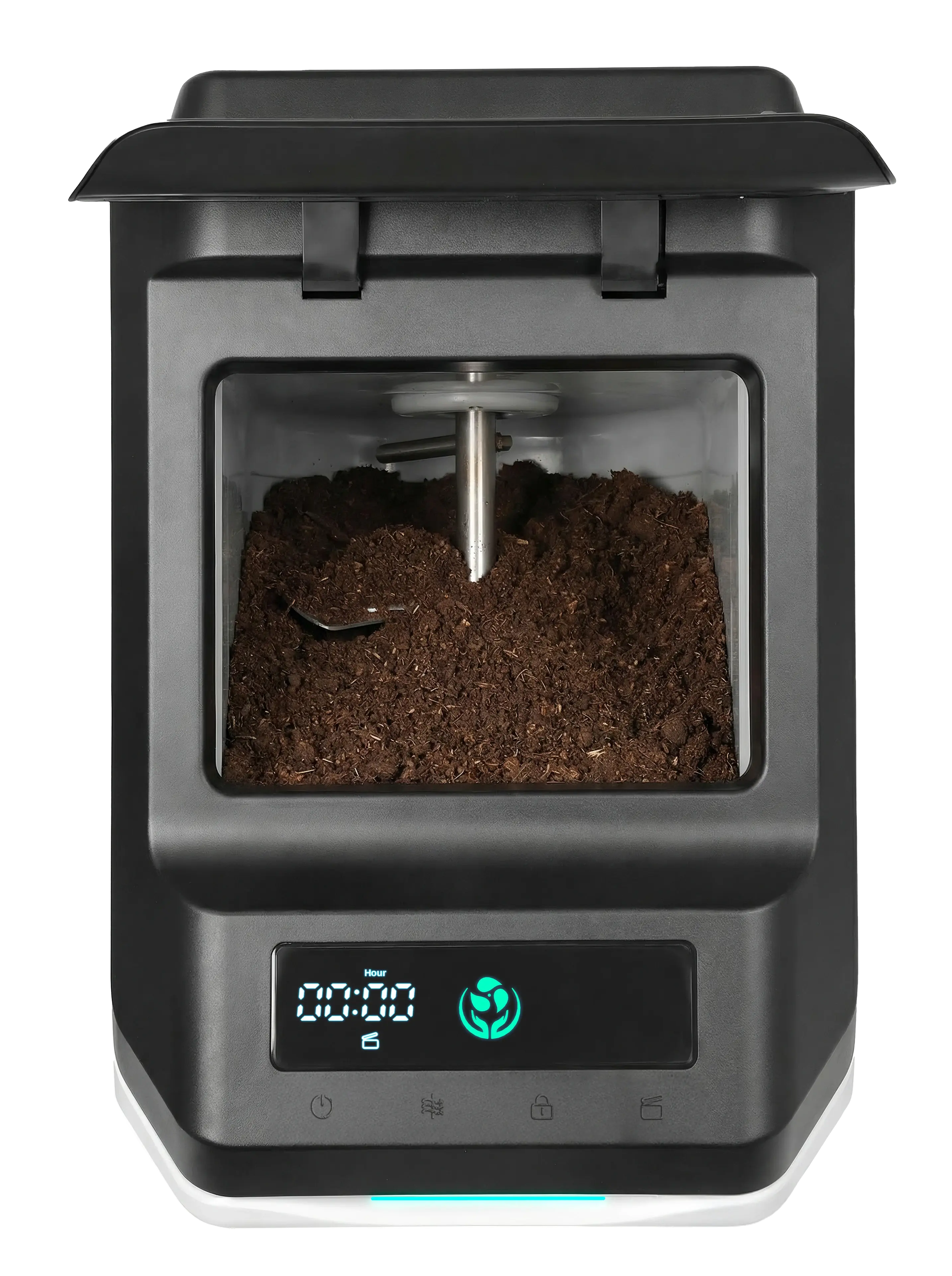
Terra II supports real microbial composting for suitable kitchen scraps, with continuous feeding, no drying, no replacement odor filters, and vibration-optimized operation for everyday home use.
Real microbial composting with lower daily noise friction.
7. What We Changed and What We Do Not Publish
Engineering transparency is useful, but not every design detail should be published. The goal here is to explain the claim boundary without exposing the drivetrain design.
What We Can Responsibly Say
- We adjusted how the system manages demanding load transitions.
- We refined cycle sequencing to reduce abrupt acoustic bursts.
- We treat noise as a source, a path, and a receiver rather than a single dB number.
- We verify both mechanical signatures and real kitchen perception.
- We validate that quieter behavior does not compromise processing stability targets.
What We Do Not Publish
- Exact torque profiles.
- Exact speed profiles.
- Control tables or firmware thresholds.
- Gear geometry details.
- Mounting architecture that would enable replication.
- Private drivetrain validation datasets.
8. How We Verify Noise Improvements
For a kitchen appliance, proof should include both engineering measurements and user-facing conditions. A drivetrain can improve on a bench but still feel different in a kitchen, so both views matter.
Bench Verification: Source and Path
- Measure vibration at key structural points.
- Compare repeatable operating states across revisions.
- Use frequency or order analysis to identify tonal components.
- Look for mesh-related signatures and burst events.
- Check whether changes reduce excitation without harming process stability.
Kitchen Verification: Receiver Conditions
- Listen under normal installation conditions.
- Check same-room perception, especially during quiet hours.
- Document room, surface, and placement sensitivity.
- Compare annoyance, not only the average sound level.
- Record boundaries in release notes and GK documentation.
Better Proof Standard
A good noise claim should explain the measurement position, operating condition, comparison design, and limitations. “Quiet” without method is weak. “Quieter under defined conditions” is much more credible.
9. Methods and Boundaries
Noise claims are especially vulnerable to skepticism because real homes vary. The same appliance may sound different depending on countertop material, cabinet structure, floor type, wall distance, load condition, and operating phase.
| Claim Area | Responsible Boundary | What Not to Claim |
|---|---|---|
| Noise level | Sound depends on placement, room acoustics, surface, load, and operating stage. | Absolute silence in every kitchen. |
| Gearbox design | Explain source-path-receiver logic and improvement categories. | Publish proprietary geometry, thresholds, or control tables. |
| User perception | Evaluate tonal annoyance, bursts, and quiet-hour conditions. | Assume one average dB figure captures all annoyance. |
| Processing stability | Confirm quieter control does not compromise composting stability targets. | Trade off composting performance for cosmetic quiet claims. |
For methods, claim boundaries, and evidence structure, review: Open GK Verification.

Continuous composting with lower daily friction.
Choose a Kitchen Composter Built for Daily Living
GEME Terra II and GEME Pro are designed for real microbial composting, continuous feeding, no drying, no routine odor-filter replacement, and a quieter ownership routine for modern kitchens.
Terra II for everyday homes. GEME Pro for larger routines.
Frequently Asked Questions
Is GEME Terra II completely silent?
No kitchen appliance with motors and moving parts should be described as physically silent in every condition. “The Silent Gearbox” is a design story about quieter operation, vibration control, and reduced annoyance, not an absolute no-sound guarantee.
Why does gearbox noise happen?
Gearbox noise can begin with gear mesh excitation, transmission error, load changes, and drivetrain vibration. That vibration can travel through shafts, bearings, mounts, and housing before it becomes sound in the room.
Why is one decibel number not enough?
Average dB does not fully describe tonal whine, sudden bursts, vibration transmitted through furniture, or quiet-hour annoyance. A machine with a similar average sound level can feel more or less annoying depending on its acoustic signature.
What makes a gearbox feel quieter in a kitchen?
Smoother load transitions, reduced tonal components, vibration-path management, stable placement, and softer cycle design all help reduce perceived noise.
Can placement change how loud a composter sounds?
Yes. Surface stiffness, cabinet resonance, floor type, wall distance, and room acoustics can all change perceived noise. A stable surface usually helps.
What did GEME change?
At a high level, GEME adjusted how demanding load transitions are handled, refined cycle sequencing, and verified that quieter behavior does not compromise processing stability. Exact torque profiles, control tables, and drivetrain geometry are not published.
How should GEME verify noise claims?
Verification should include both bench measurements and real-use kitchen checks. It should document measurement positions, operating conditions, comparison states, tonal components, and limitations.
Does quieter operation reduce composting performance?
It should not. A responsible design change should verify that lower acoustic friction does not compromise microbial processing stability, mixing, airflow, or chamber recovery behavior.
Summary
- Quiet is engineered. It is the result of load control, vibration-path thinking, and cycle design.
- The useful model is source → path → receiver. Noise begins, travels, and is finally perceived in the room.
- Gear mesh excitation matters. Transmission error, mesh stiffness, and load changes can contribute to tonal noise.
- Structure matters. Shafts, bearings, mounts, and housing affect how vibration becomes audible sound.
- Perception matters. Tonal noise and bursts can feel more annoying than average dB suggests.
- Placement matters. Surface, room, and installation conditions can change perceived noise.
- GEME keeps proprietary details private. Exact drivetrain geometry and control thresholds are not published.
- Best claim boundary: describe quieter design with conditions, not as absolute silence.
Sources
- DiVA Portal — Gearbox Noise Source-Path-Receiver Reference
- COMSOL — How to Model Gearbox Vibration and Noise
- Gear Technology — A Review on Gear Transmission Error
- Gear Technology — Transmission Error and Noise Emission of Spur Gears
- GEME — Terra II Product Page
- GEME — How Real Microbial Composting Works
- GEME — Open GK Verification
Built around biology, load control, and lower friction.
Compost Without Turning the Kitchen Into a Machine Room
GEME Terra II and GEME Pro are built for real microbial composting, continuous daily feeding, no routine odor-filter replacement, and a quieter experience for real homes.
Sound varies by placement, surface, room acoustics, load, and operating stage.




Hinterlasse einen Kommentar
Alle Kommentare werden vor der Veröffentlichung geprüft.
Diese Website ist durch hCaptcha geschützt und es gelten die allgemeinen Geschäftsbedingungen und Datenschutzbestimmungen von hCaptcha.