

Composting Methods Comparison · Speed · Output
Fastest Compost Method: Which Composting Method Works Best?
The fastest compost method depends on what you mean by “finished.” A compost pile, worm bin, Bokashi bucket and controlled microbial composter can all process organic waste, but they reach very different milestones at very different speeds.
Bokashi can ferment scraps in less than two weeks, but the result is not finished compost. A microbial composter can show visible breakdown within hours, but biological maturation continues. A traditional pile takes longer, yet can ultimately produce fully cured garden compost.
So the useful comparison is not simply “Which number is smallest?” It is speed + process + output + next step.
By Matthew Moore · Updated September 14, 2026

Quick Answer: What Is the Fastest Compost Method?
For the fastest visible daily breakdown of household food scraps, a controlled microbial composter can work within hours under suitable conditions.
GEME Terra 2, for example, can begin showing visible breakdown in roughly 6–8 hours depending on the material and operating conditions. That does not mean every fresh food scrap becomes mature, garden-ready compost in 6–8 hours.
For fully finished traditional compost, an optimized hot pile can be relatively fast—around 6–8 weeks under ideal management—while a more typical well-maintained home pile is commonly ready in roughly 3–5 months.
Vermicomposting generally takes around 3–6 months. Bokashi takes only about 10–14 days to ferment food waste, but the fermented material still needs a second decomposition step before it should be treated as compost.
Table of Contents
- What Does “Fastest Compost” Mean?
- Composting Methods Comparison
- How Fast Is a Compost Pile?
- How Fast Is Vermicomposting?
- How Fast Is Bokashi?
- How Fast Is a Microbial Composter?
- What Makes Composting Faster?
- Which Composting Method Works Best?
- Frequently Asked Questions
- Sources
- Related Composting Guides
1. What Does “Fastest Compost” Actually Mean?
Searching for the fastest compost sounds straightforward until you compare what each method produces.
There are at least three different finish lines:
Visible Breakdown
How quickly does recognizable food lose its original shape, soften, fragment or become incorporated into an active biological system?
Intermediate Output
How quickly do you get something such as fermented Bokashi material, active Compost Base or another output that can move to the next stage?
Finished Compost
How long does it take until the material has decomposed and stabilized enough for its intended soil use?
This distinction prevents misleading comparisons. Ten days of Bokashi fermentation, six hours of visible microbial breakdown and three months of cured compost are not equivalent outcomes.
To understand why these endpoints differ, read How Does Composting Work? Microbes, Heat & Oxygen.
2. Composting Methods Comparison: Speed, Output & Effort
The table below compares the practical speed milestones most households encounter.
| Method | Typical Speed | What You Have at That Point | Best Fit |
|---|---|---|---|
| Compost pile |
≈6–8 weeks for optimized hot composting; ≈3–5 months for a typical well-maintained home pile |
Finished compost after active decomposition and curing | Homes with outdoor space, yard waste and gardeners willing to manage a pile |
| Vermicomposting | ≈3–6 months | Vermicast / worm compost | Low-energy indoor composting and gardeners who specifically want worm castings |
| Bokashi |
≈10–14 days fermentation, then roughly 3–4 more weeks of soil or compost finishing under suitable conditions |
Fermented pre-compost after the first stage, not mature compost | Small spaces, broad food inputs and households with a reliable finishing location |
| Controlled microbial composter |
Visible breakdown can begin within hours; Terra 2: roughly 6–8 hours for suitable food under suitable conditions |
Active microbial Compost Base at mixed residence times; biological processing continues | Daily indoor food-scrap routines, apartments and households prioritizing automation |
The important point is that the Speed column cannot be separated from the Output column.
A faster first-stage result does not automatically mean faster mature compost.
3. How Fast Is a Compost Pile?
A traditional aerobic compost pile can be surprisingly fast when conditions are deliberately optimized.
Heat builds when microorganisms have enough carbon, nitrogen, oxygen and moisture. Turning exposes fresh surfaces to oxygen and redistributes hotter and cooler material.
Under optimum hot-composting conditions, compost can develop in roughly six to eight weeks. For a more typical well-maintained household pile, the U.S. EPA gives a practical range of about three to five months before finished compost is ready for use.
What Slows a Compost Pile Down?
- too little nitrogen;
- too much dry carbon;
- insufficient moisture;
- too much water and low oxygen;
- large uncut material;
- cold weather;
- and infrequent turning.
The pile remains one of the best methods when you have yard space and want inexpensive, fully matured compost rather than appliance-supported convenience.
Compare the two workflows in Compost Pile vs Electric Composter.
4. How Fast Is Vermicomposting?
Vermicomposting relies on worms and microorganisms rather than a high-temperature composting phase.
Red wigglers process food and bedding in a moist, oxygenated environment. The process is biologically rich, quiet and low-energy, but it is not especially fast when measured from a newly established bin to harvestable vermicompost.
A practical range is approximately three to six months.
Why Choose Worms If They Are Slower?
- no electricity;
- low equipment cost;
- excellent worm castings;
- small-space potential;
- educational living ecosystem;
- and low operating noise.
The trade-off is ongoing habitat management: bedding, moisture, temperature, food type, feeding rate and harvesting all matter.
If you are deciding between worms and a controlled microbial appliance, read Electric Composter vs Worm Composting: GEME Terra 2 vs Vermicomposting.
5. How Fast Is Bokashi?
Bokashi has one of the shortest headline timelines because it is primarily a sealed fermentation process.
A full Bokashi bucket is generally left sealed for about 10–14 days. At that point the food may smell pickled or fermented and can still look surprisingly recognizable.
That is because the first stage has produced fermented pre-compost, not mature aerobic compost.
The fermented material then normally moves into:
- garden soil;
- a soil factory;
- a traditional compost pile;
- or another biological finishing system.
Under suitable soil-finishing conditions, further decomposition commonly continues for several weeks.
Bokashi speed rule: 10–14 days is the speed of fermentation—not the time required to create mature finished compost.
For the broader context of Bokashi, worm bins, piles and indoor systems, see How to Compost at Home.
6. How Fast Is a Controlled Microbial Composter?
A controlled microbial composter changes the speed equation by maintaining biological activity inside a managed chamber.
Instead of waiting for outdoor weather, manual turning or a new pile to establish itself, the system can maintain an active microbial population while controlling factors such as airflow, moisture, temperature and mixing.
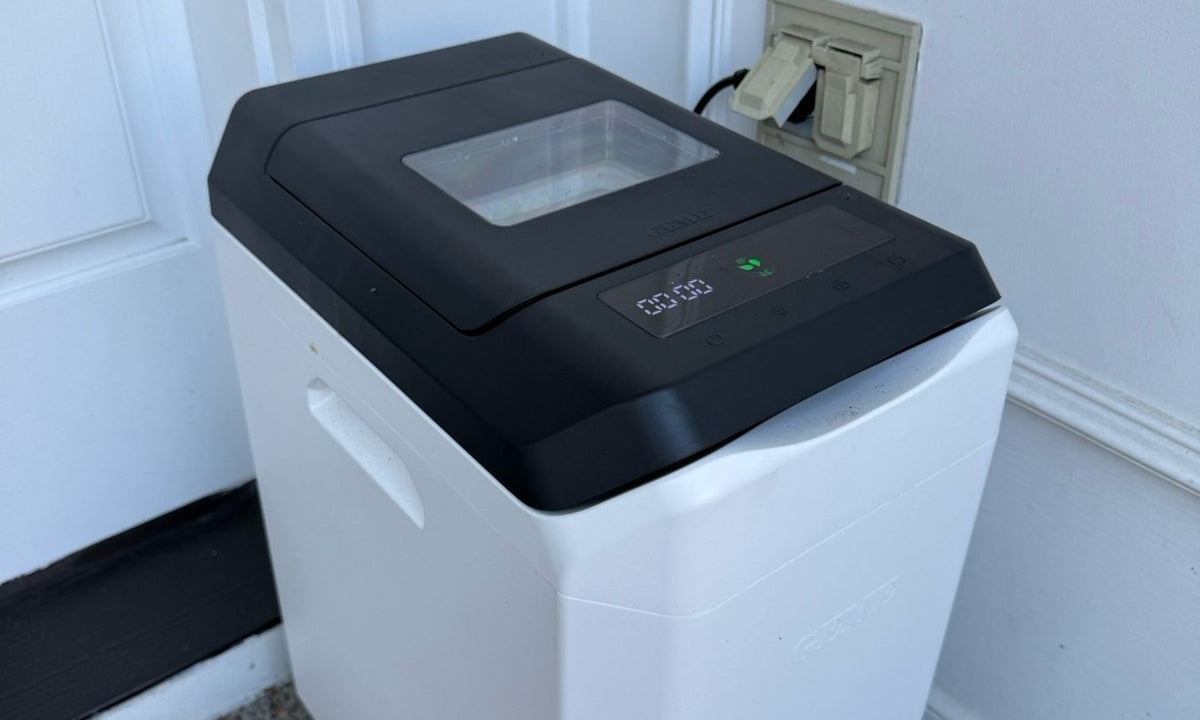
With Terra 2, visible breakdown of suitable food can begin within roughly 6–8 hours under suitable operating conditions.
6–8 hours does not mean mature compost in 6–8 hours. Terra 2 is a continuous-flow biological system. Fresh food, partially decomposed material and older Active Compost Base can coexist in the chamber while decomposition continues.
Why Continuous Systems Are Different
A batch system has a clear start and stop point. A continuous microbial system does not.
You can add new food while older material is already undergoing decomposition. That means the chamber contains material with different residence times.
When harvested, GEME output should therefore be understood as Active Compost Base, not automatically as uniformly mature finished compost.
The recommended pathway is:
- screen the harvested material;
- return larger unfinished pieces to the chamber;
- mix approximately 1 part screened Compost Base with 8 parts plain soil;
- allow additional maturation where the application requires it.
For the underlying biology, read Microbial Composting: How Composting Works.

Speed With a Biological Process
Continuous Microbial Composting for Daily Food Scraps
Terra 2 is designed for 1–3 person households and up to 2 kg/day. GEME Pro provides higher processing capacity for larger households and heavier daily food-waste routines.
7. What Makes Composting Faster?
Regardless of method, biological decomposition speeds up when the organisms doing the work have favorable conditions.
1. Oxygen
Aerobic microorganisms need oxygen. Turning a pile, fluffing worm bedding or actively ventilating a microbial chamber helps keep decomposition aerobic.
2. Moisture
Microbial reactions require water, but too much water can displace air and create anaerobic zones.
3. Temperature
Warm conditions generally increase biological activity up to the temperature limits of the organisms involved. Different composting systems support different microbial communities and temperature ranges.
4. Particle Size
Cutting larger scraps exposes more surface area to microorganisms. Extremely fine material, however, can compact and reduce airflow.
5. Feedstock
Soft fruit, cooked starches and many moist foods break down differently from woody stems, shells, pits, fibrous husks and large bones.
6. Microbial Population
An established biological system can respond faster to fresh food than a newly started pile or bin because an active decomposer community is already present.
7. Residence Time
This is particularly important in continuous systems. Visible disappearance happens before every component has reached the same degree of stabilization.
8. Which Composting Method Works Best?
The fastest method is not automatically the best method.
A more useful question is:
Which method handles my food waste, fits my space and workload, and produces an output I can actually use?
| Your Priority | Best Direction | Why |
|---|---|---|
| Lowest-cost finished garden compost | Backyard compost pile | Little equipment required; ideal when outdoor space and carbon-rich materials are available |
| Fastest optimized traditional compost | Managed hot compost pile | High microbial activity and deliberate turning can shorten the process substantially |
| Low-energy indoor composting | Vermicomposting | No powered processing and produces valued worm castings |
| Fast enclosed fermentation | Bokashi | About 10–14 days to fermented pre-compost, but a second finishing step is required |
| Fast daily visible biological breakdown | Controlled microbial composter | An established microbial bed and managed environment can process incoming food continuously |
| 1–3 person automated indoor routine | GEME Terra 2 | Up to 2 kg/day, continuous feeding and managed aerobic microbial processing |
| 4+ people / heavier daily waste | GEME Pro | 19 L chamber and up to 5 kg/day processing capacity |
For the broader decision across composters, food recyclers, worm bins, Bokashi and outdoor systems, continue to Best Composter 2026: How to Choose the Right Home Composter.
Frequently Asked Questions
What is the fastest compost method?
If speed means visible biological breakdown of household food scraps, a controlled microbial composter can begin working within hours under suitable conditions. If speed means stable finished compost, the timeline is longer and depends on the method and curing stage.
Can compost really be made in 24 hours?
Food scraps can visibly break down or be processed within 24 hours, but visible disappearance is not the same as uniformly mature finished compost. Biological stabilization requires additional time.
How long does a compost pile take?
A well-maintained home pile is commonly ready in about three to five months. Under optimized hot-composting conditions, active composting can proceed much faster, sometimes in roughly six to eight weeks.
How long does vermicomposting take?
Finished vermicompost generally takes about three to six months from initial worm-bin setup, although food may disappear progressively throughout that period.
Is Bokashi the fastest composting method?
Bokashi is one of the fastest ways to ferment household food scraps. The sealed fermentation stage usually takes about 10–14 days, but the result is pre-compost and still needs soil or another biological finishing process.
How long does Bokashi take before it becomes compost?
After approximately 10–14 days of fermentation, Bokashi material generally needs several additional weeks in soil or another composting system before decomposition progresses toward compost.
How fast does a microbial composter work?
The answer depends on machine design and feedstock. GEME Terra 2 can begin showing visible biological breakdown within roughly 6–8 hours for suitable food under suitable conditions, but this does not mean every fresh input becomes mature compost in 6–8 hours.
Is hot composting faster than worm composting?
Under optimized conditions, hot composting can reach finished compost sooner than a newly established worm bin. Worm composting typically takes several months but produces a different output—vermicast and worm castings.
Which composting method is best for apartments?
Worm bins, Bokashi and controlled microbial composters can all work indoors. Worm bins require habitat management, while Bokashi requires a finishing destination. A controlled microbial composter can be easier for households that want an appliance-supported daily routine.
Which method produces the best compost?
There is no universal best output. Traditional compost, vermicast, Bokashi-finished material and microbial Compost Base have different processing histories and soil-use routines. Choose according to the output you actually need.
Is faster compost always better?
No. Speed matters only when the endpoint is clearly defined. Drying, fermentation, visible breakdown, active Compost Base and mature compost are different stages or products and should not be treated as interchangeable.
Sources
- U.S. Environmental Protection Agency — Composting at Home
- Oregon State University Extension — Composting with Worms
- Love Food Hate Waste New Zealand — Bokashi 101
- Compost Collective — Bokashi Guide
- GEME — How Does Composting Work? Microbes, Heat & Oxygen
- GEME — Terra 2
- GEME — GEME Pro
Speed ranges describe different biological milestones and should not be interpreted as equivalent definitions of mature compost. Actual performance depends on feedstock, moisture, oxygen, temperature, particle size, system design and management.


Hinterlasse einen Kommentar
Alle Kommentare werden vor der Veröffentlichung geprüft.
Diese Website ist durch hCaptcha geschützt und es gelten die allgemeinen Geschäftsbedingungen und Datenschutzbestimmungen von hCaptcha.