


HOTBIN vs GEME · Food Supply · Indoor Kitchen Routine
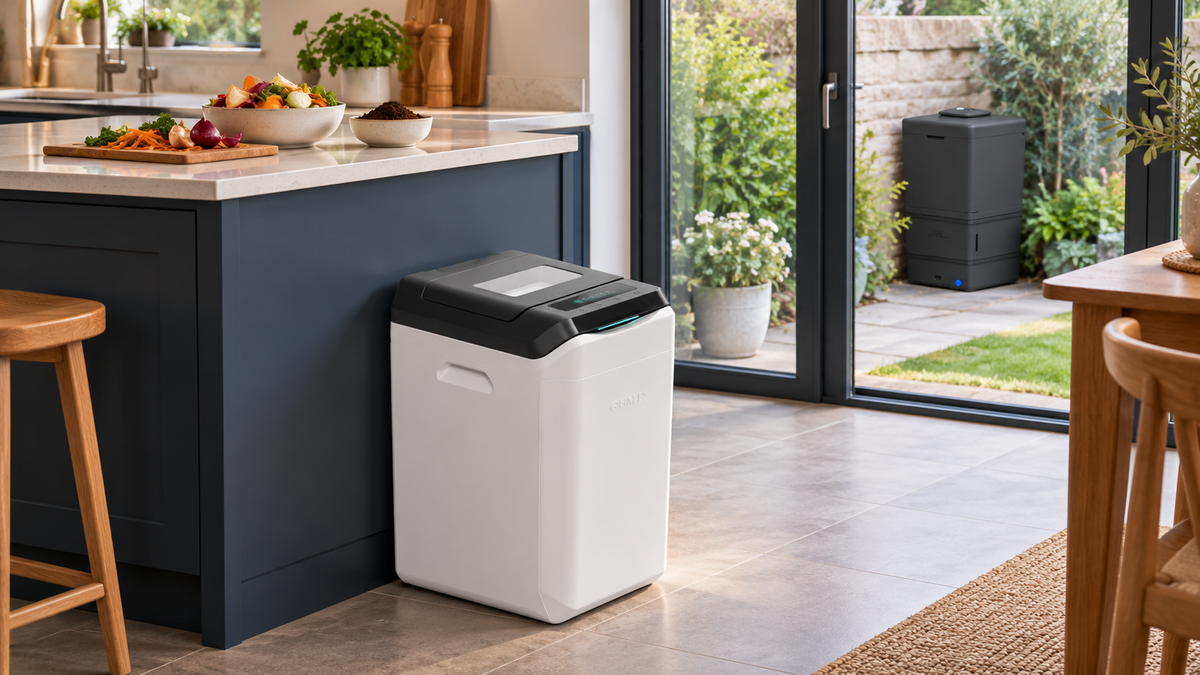
For a kitchen with uneven scraps and a household that wants indoor convenience, we recommend GEME Terra 2 or GEME Pro.
GEME keeps the daily task close to the meals you prepare: add suitable scraps to a retained microbial bed while the powered system manages the working environment. You avoid repeated outdoor trips and the HOTBIN task of pairing each feed with paper and woody bulking material.
HOTBIN is a real outdoor composter. Its insulated Mini 100 and 200 models need a suitable supply of fresh material to support hot processing. Before choosing between HOTBIN compost bins and GEME, check how much waste your kitchen produces, how often it arrives, and which supporting tasks fit your home.

Quick Answer: Which System Fits an Uneven Supply?
Choose GEME for the simpler indoor kitchen-scrap routine. Its advantages are location, a managed microbial chamber, automated mixing, and progressive additions without a HOTBIN paper-and-woodchip recipe at each feed.
- GEME Terra 2: 14 L chamber, suitable input up to 2 kg/day.
- GEME Pro: 19 L chamber, suitable input up to 5 kg/day for heavier cooking.
- Either GEME model: each addition stays at 1 kg or less; follow bed-care and maximum-level guidance.
HOTBIN’s published minimum guides are 2.5 kg or 5 L per week for Mini 100 and 5 kg or 10 L per week for HOTBIN 200. Those guide amounts sit alongside a recommended feeding rhythm of two to three times weekly and requirements for mix, moisture, airflow, and a starter base. See the manufacturer’s first-month guidance.
If your priority is an unpowered outdoor system and you can sustain those tasks, HOTBIN has a clear role. For daily food scraps that you want to handle inside, GEME is our preferred fit.
Use the Electric Composter Comparison Hub for the wider systems comparison and the Best Composter Hub for household selection.
1. Check HOTBIN Mini 100 and HOTBIN 200 Separately
The bigger bin needs a different supply check. This comparison covers the HOTBIN Mini 100 and HOTBIN 200, using their shared manufacturer user guide and current model information.
Swipe horizontally to compare the named HOTBIN models.
| Condition to Check | HOTBIN Mini 100 | HOTBIN 200 |
|---|---|---|
| Bin volume | Approximately 100 L. | Approximately 200 L. |
| Minimum weekly waste guide | 2.5 kg or about 5 L/week. | 5 kg or about 10 L/week. |
| Feeding rhythm | Usually two to three feeds per week. | Usually two to three feeds per week. |
| Starting material | Build the required starter base to the hatch-height guide. | Build the required starter base to the hatch-height guide. |
| Supporting material | Chopped waste with shredded paper/card and woody bulking material. | Chopped waste with shredded paper/card and woody bulking material. |
| Heat observation | Use the internal thermometer for an accurate check; the working hot range is 40–60°C. | Use the internal thermometer for an accurate check; the working hot range is 40–60°C. |
| Feeding and harvesting | Add at the top, harvest from the base. | Add at the top, harvest from the base. |
| Outdoor footprint | Approximately 45 × 45 cm; allow hatch and lid access. | Approximately 55 × 55 cm; allow hatch and lid access. |
Sources: HOTBIN model comparison, startup instructions, and heat and airflow guidance. HOTBIN Mega models have a different workflow and are outside this comparison.
Keep the units and purposes separate. HOTBIN’s weekly minimum is a heat-support guide. GEME’s daily kilogram figures are upper suitable-input limits. Neither bin liters nor a minimum weekly number is a like-for-like processing-speed measurement. The printed kilogram/liter pairs are approximate guide amounts, not a universal density conversion.


2. Have You Budgeted Space for Paper and Woodchip?
A caddy of scraps is only part of the HOTBIN routine. The manufacturer’s paper and woodchip guide assigns different jobs to the supporting materials: shredded paper/card absorbs excess moisture, while woody bulking maintains spaces for airflow.
Its starting volume guidance is one full caddy of waste plus half a caddy of shredded paper/card and one-fifth of a caddy of woody bulking. Adjust to the material’s moisture and structure.
Swipe horizontally to read the example feeding mix.
| Material | Example Amount | Job in the Mix |
|---|---|---|
| Prepared waste | 5 L. | Supplies material for microbial breakdown. |
| Dry shredded paper/card | About 2.5 L. | Absorbs excess moisture. |
| Woody bulking material | About 1 L. | Maintains an open structure for air. |
Mix the new material into the upper layer as instructed. HOTBIN does not require turning the entire bin. For a household, the practical question is whether suitable paper and bulking supplies stay available beside the outdoor feeding route.
GEME removes that per-feed caddy recipe from the normal kitchen routine. Its retained microbial bed, airflow, and automated mixing support the process. You still prepare suitable scraps and manage bed condition, but you do not have to assemble a HOTBIN paper-and-woodchip mix whenever you add meal scraps.
3. A Weekly Average Can Hide the Quiet Weeks
Record supply and timing together. A busy meal-preparation weekend does not tell you whether enough waste will arrive through a quieter week.
Swipe horizontally to compare the illustrative weeks.
| Example Week | Scrap Supply and Timing | Volume-Only Check | What It Reveals |
|---|---|---|---|
| Quiet week | 3 L across two feeding days. | Below both HOTBIN minimum volume guides. | Check whether your normal lean weeks can sustain the intended hot routine. |
| Ordinary week | 7 L across three feeding days. | Above Mini 100’s guide; below HOTBIN 200’s. | Model selection matters even before you check the material mix. |
| One busy preparation day | 12 L arriving on one day. | Above both minimum volume guides. | The total alone does not establish the recommended regular feeding rhythm. |
These examples total 22 L over three weeks. An average of about 7.3 L/week conceals the quiet 3 L week and the single-day burst. For HOTBIN, assess regular usable supply as well as the total. Also respect its feeding limits and available bin space.
For GEME, weigh suitable scraps by day and note the largest individual addition. Do not convert these example liters into a claimed GEME processing load. Choose Terra 2 or Pro from the actual weights, then spread additions within the model’s limits.
Seasonal garden material can supplement an outdoor system, but record the kitchen’s lean-season supply too. HOTBIN’s food-only guidance confirms garden waste is not compulsory; its balancing materials and operating conditions still apply.
4. Where GEME Makes the Daily Kitchen Routine Easier
GEME’s advantage is the combination of indoor access and a managed processing chamber. Compare what you will do after meals, during a quiet week, and when material is ready to harvest.
Swipe horizontally to compare the daily tasks.
| Kitchen Task | GEME Terra 2 | GEME Pro | HOTBIN Mini 100 / 200 |
|---|---|---|---|
| After-meal access | Add prepared scraps to an indoor floor-standing unit. | Add prepared scraps to an indoor floor-standing unit. | Collect and carry material to the outdoor bin. |
| Adding new material | A retained microbial bed; progressive additions. | A retained microbial bed; progressive additions. | Continuous top feeding with the supporting mix. |
| Input planning | Up to 2 kg/day; each addition ≤1 kg. | Up to 5 kg/day; each addition ≤1 kg. | Check the named model’s weekly supply guide and feeding limits. |
| Paper and woody bulking | No HOTBIN-style recipe with each feed. | No HOTBIN-style recipe with each feed. | Prepare and mix supporting materials with feeds. |
| Mixing | Automated mixing. | Automated mixing. | Mix newly added material into the top layer; no whole-bin turning. |
| Conditions to manage | GEMEBrain™ adaptive control; check bed condition and follow care. | Powered chamber operation; check bed condition and follow care. | Waste supply, moisture, airflow, closure, and internal temperature. |
| Power | Requires electricity. | Requires electricity. | No external power source. |
| Harvesting | Retain starter bed; screen and blend Compost Base. | Retain starter bed; screen and blend Compost Base. | Harvest from the base following HOTBIN guidance. |
HOTBIN’s unpowered operation is valuable where an outdoor process without an electricity bill is the priority. GEME buys you a different convenience: processing stays in the kitchen, mixing is automated, and the household does not manage an outdoor feed recipe at each addition.
GEME’s powered environment reduces dependence on retaining heat through a regular outdoor material supply. It does not remove biological care: keep the bed activated, respect its condition, and follow absence or recovery guidance during prolonged gaps. See how GEME’s continuous system works.

5. Four Checks Before Choosing HOTBIN Compost Bins
Check the Routine You Can Sustain
- Measure a representative supply period. Include quiet cooking weeks. Record net scrap weight, volume, and feeding dates separately.
- Match the specific HOTBIN model. Check both the ongoing minimum supply guide and whether you can build its starter base.
- Reserve supporting-material storage. Identify a continuing source of suitable paper/card and woody bulking.
- Walk the outdoor route. Check level placement, feeding and hatch access, weather exposure during your own trips, and whether everyone who handles scraps will follow the routine.
If that list creates more household work than you want, choose GEME for daily kitchen scraps. Place it on a stable floor near suitable power, leave doors and routes clear, and use the correct feeding and bed-care routine.
The broader compost pile vs electric composter comparison covers outdoor-system selection. This page adds the specific HOTBIN supply and balancing-material check.
6. What If the Supply or Temperature Falls Short?
Your HOTBIN Cools During a Quiet Week
Use the internal probe as instructed, rather than relying only on the lid display. Review the recent supply, moisture, woodchip structure, airflow setting, and closure. A cooler bin may still compost more slowly; it has not automatically stopped.
Follow the manufacturer’s troubleshooting sequence. Its food guidance ties cooked foods and certain animal-derived scraps to the required hot conditions. Do not keep using a temperature-restricted food route solely because it worked during a hotter week.
You Have Enough Scraps Only After a Large Cooking Session
A large fill does not supply the same pattern as regular feeds. Respect HOTBIN’s input guidance and available space. For indoor handling, distribute suitable scraps through GEME’s day within its daily and single-addition limits.
Winter Removes Your Garden-Waste Top-Up
HOTBIN can operate through winter with appropriate conditions; it is not a summer-only bin. Recheck the supply and mix when garden inputs shrink. GEME’s indoor location avoids the outdoor access task and supports a managed kitchen-side routine.
You Are Away, or the GEME Bed Needs Attention
Follow each system’s own absence instructions. HOTBIN’s holiday guidance explains the effect of feeding gaps. GEME still needs appropriate power, bed moisture, and recovery care; pause new inputs if overloaded, excessively wet, or showing a fault.
7. Terra 2 or Pro: Choose by the Day, Not by an Outdoor Bin’s Liters
Terra 2 is our recommendation for the everyday kitchen whose suitable inputs stay within 2 kg/day. Its 14 L microbial chamber, GEMEBrain™ adaptive control, continuous additions, and permanent odor treatment support an indoor routine.
Choose GEME Pro for heavier cooking loads or the extra daily capacity your household actually needs. Its 19 L chamber supports suitable inputs up to 5 kg/day. It is the stronger GEME option for larger family cooking routines.
Keep each addition to either model at 1 kg or less. Chamber volume includes the retained bed. Neither a 14/19 L chamber nor a 100/200 L outdoor bin is an instruction to fill all that space with fresh waste at once.
For daily kitchen scraps, GEME gives you a simpler place and a simpler task list. You gain automated mixing and indoor processing while keeping gardening material on an appropriate separate route when needed.
8. Keep Harvesting and Soil Use in the Decision
Both systems use real biological composting. Follow HOTBIN’s harvesting instructions and assess the material’s condition and intended use. A temperature reading or a promised calendar interval alone does not establish maturity for every piece.
For GEME, harvest while retaining the starter bed. Screen the Compost Base, return suitable unfinished pieces, blend about one part with eight parts plain soil, and follow the soil-capping instructions. Store surplus with airflow and allow further curing where appropriate. Use the GEME Compost Base application guide.

If GEME takes over kitchen scraps while an outdoor bin still contains material, use the outdoor-compost transition guide to plan the existing pile and garden-waste route.
Indoor Access · Continuous Microbial Processing
Make Composting Fit the Kitchen You Actually Use
Choose GEME Terra 2 for lighter daily loads, or GEME Pro for heavier cooking. Keep suitable scraps close to their source, let the system handle mixing, and give harvested Compost Base a practical route into soil.
9. Frequently Asked Questions
Would HOTBIN or GEME better suit uneven kitchen scraps?
We recommend GEME Terra 2 or Pro when the priority is an indoor kitchen routine with prepared scraps added around meals. HOTBIN’s hot-composting performance needs enough regular waste, a balanced mix, and temperature monitoring. Choose the GEME model by measured daily load, and maintain its powered microbial bed as instructed.
How much waste does HOTBIN Mini 100 need each week?
The manufacturer’s minimum guide for HOTBIN Mini 100 is 2.5 kg or approximately 5 L of waste per week. It also recommends feeding two to three times a week. Reaching the quantity alone does not guarantee a hot bin; the starter base, waste mix, moisture, and airflow still matter.
How much waste does HOTBIN 200 need each week?
HOTBIN 200’s published minimum guide is 5 kg or approximately 10 L per week, with a regular feeding routine. That is a minimum to help sustain heat, not a maximum daily processing rating. The kilogram and liter figures are guide estimates rather than a fixed density conversion for every scrap mix.
Can HOTBIN run on food waste without garden waste?
Yes. HOTBIN’s food-only guidance allows that route, while retaining its requirements for enough waste, shredded paper or card, woody bulking material, and appropriate temperatures for restricted foods. Garden cuttings are not compulsory, but the supporting materials and feeding conditions still apply.
Do I need woodchip and shredded paper with every GEME addition?
GEME’s normal kitchen routine uses a retained microbial bed and does not require HOTBIN’s per-feed caddy recipe of paper and woodchip. Prepare suitable scraps, respect the input limits, check bed condition, and follow moisture, startup, and recovery instructions.
Does a cool HOTBIN mean composting has stopped?
Not necessarily. HOTBIN says material may continue composting below the hot range, usually more slowly. Check supply, moisture, airflow, closure, and the internal temperature reading. Follow the manufacturer’s temperature restrictions before adding foods that require hot composting.
Does HOTBIN need electricity?
HOTBIN Mini 100 and 200 do not require an external power source; insulation retains heat generated by microbial activity. GEME is a powered indoor appliance, so electricity is part of its operating budget.
Are HOTBIN Mini 100 and 200 batch composters?
No. HOTBIN describes those two models as continuous systems: add material at the top and harvest from the base. GEME is also continuous, with a powered indoor microbial chamber. HOTBIN Mega models use a different workflow and are outside this comparison.
Should I choose GEME Terra 2 or GEME Pro?
Terra 2 has a 14 L chamber and suitable daily input up to 2 kg. Pro has a 19 L chamber and up to 5 kg/day for heavier cooking routines. Each addition to either model stays at 1 kg or less. Use actual daily scrap weights and available floor space to choose.
Can either system guarantee mature compost on a fixed day?
No fixed day establishes maturity for every input and condition. Follow HOTBIN’s harvesting instructions for its material. For GEME Compost Base, screen out unfinished pieces, return suitable pieces to the chamber, blend about 1:8 with plain soil, and follow the application guide, including further curing where appropriate.
10. Sources and Related Guides
Manufacturer information checked October 12, 2026. This brand-authored comparison uses named-model instructions; the supply-week and caddy examples are illustrative, not measured performance tests.
- HOTBIN Mini 100 — capacity, minimum supply, footprint, and official product image
- HOTBIN 200 — capacity, minimum supply, footprint, and official product image
- HOTBIN Mini/200 user guide — setup, internal thermometer, feeding, and harvesting
- HOTBIN model comparison — continuous and batch model distinctions
- HOTBIN — woodchip and shredded-paper ratios
- HOTBIN — first-month feeding, heat, and seasonal conditions
- HOTBIN — food-only use and temperature-related food guidance
- HOTBIN — no external power requirement
- GEME Terra 2 — indoor microbial chamber and daily capacity
- GEME Pro — higher daily input and larger chamber
- How GEME Works — retained biology, airflow, and mixing
- GEME Compost Base — screening, blending, and soil capping


Dejar un comentario
Todos los comentarios se revisan antes de su publicación.
Este sitio está protegido por hCaptcha y se aplican la Política de privacidad de hCaptcha y los Términos del servicio.