


Real Compost Series · Material Labels · Buying Guide
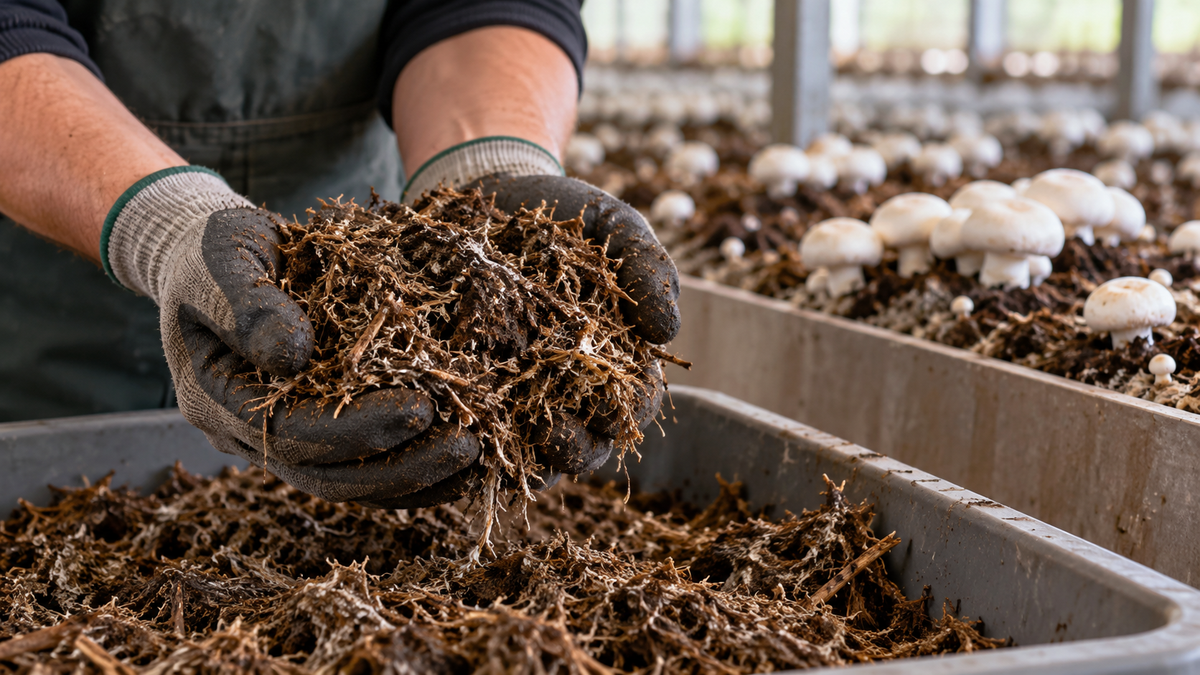
Mushroom compost usually means the growing material left after a mushroom crop is harvested. It is commonly sold as spent mushroom substrate, mushroom soil, or mushroom compost. The name alone does not tell you whether the particular product suits your plants.
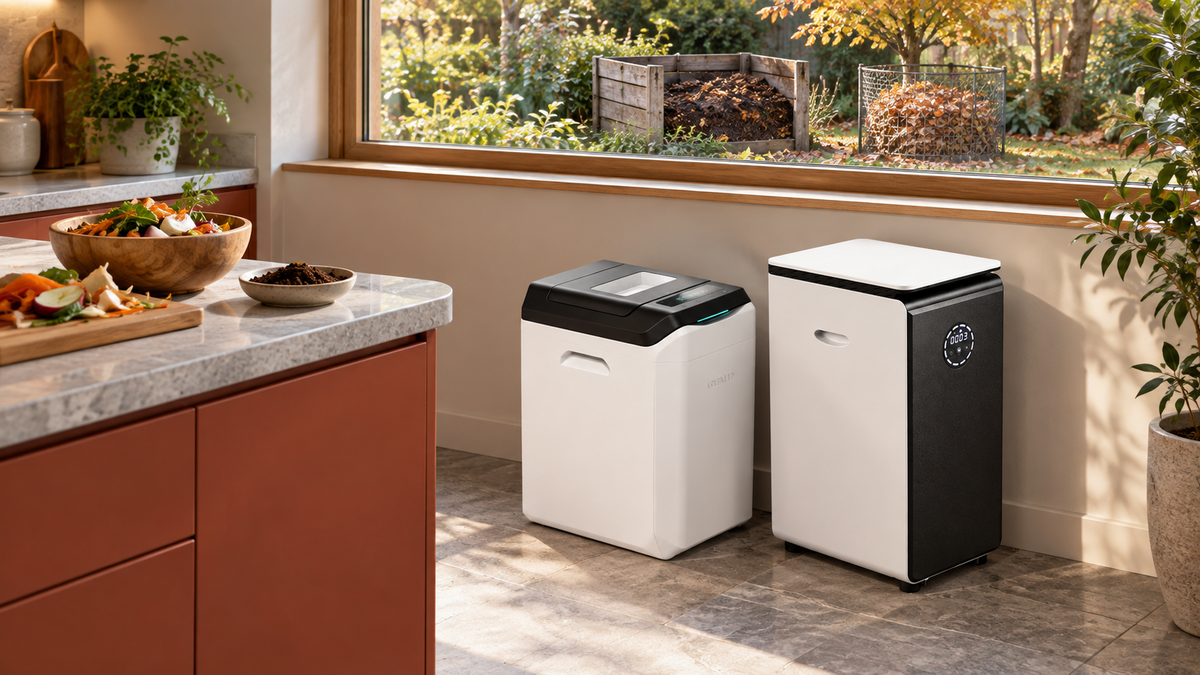
Before buying a bag or ordering a bulk delivery, check its source, processing state, and instructions for your intended use. If the goal is to recycle daily kitchen scraps, GEME Terra 2 and GEME Pro offer a different advantage: continuous indoor microbial composting that produces GEME Compost Base for use according to its own application guide.

Quick Answer: Are Mushroom Compost and Spent Mushroom Substrate Different?
They often describe the same material at different points in its handling and sale. Spent mushroom substrate identifies its production history; mushroom compost is a common commercial name. A retailer may sell fresh, weathered, further composted, or blended material.
Buy by the actual product specification and planting task, rather than assuming that the word compost guarantees a universal recipe or immediate suitability for every use.
Penn State Extension defines spent mushroom substrate as the material remaining after mushroom production. It is generally the former growing medium, rather than a pile made primarily from discarded mushroom caps and stems.
1. What Is Mushroom Compost Made From?
The mushroom species and grower's recipe determine the starting material. White button mushroom production commonly uses a prepared compost substrate. Penn State's substrate preparation guide describes Phase I and Phase II composting before cropping.
Specialty mushroom production can use different materials. The Cornell Small Farms substrate guide discusses straw, sawdust, and other carbon sources for species such as oyster mushrooms. A spent oyster growing block and a bulk product from a button mushroom farm therefore should not be assumed to have the same composition.
The Royal Horticultural Society's mushroom compost guide also notes that some suppliers sell unused growing compost. Ask whether the material has actually supported a crop and whether the retail product includes other ingredients.
Ask this first: “Which mushroom crop did this material come from, and what happened to it after harvest?” This connects a marketing name to a traceable material.
2. Source, Commercial Name, Processing State, and Checks Before Use
Use this table to decode a listing or supplier conversation. These descriptions are purchasing categories, not a universal grading system for mushroom products.
| Production Source | Commercial Name | Processing State | Check Before Use |
|---|---|---|---|
| A growing mix prepared before a mushroom crop | Unused mushroom substrate or mushroom compost | Prepared for cultivation; no completed crop | Is it sold for mushroom growing or garden application? Obtain instructions for that purpose. |
| Growing material removed after harvest | Fresh spent mushroom substrate (SMS) | Recently removed; prior preparation depends on the growing system | Confirm the recipe, any post-crop handling, and suitability for the intended plants. |
| Post-harvest substrate stored or weathered | Aged or weathered mushroom soil | Further holding or weather exposure | Ask about conditions and current analysis; elapsed time alone is not a complete product specification. |
| Post-harvest substrate sent through an additional composting process | Further composted mushroom substrate | Additional treatment stated by the supplier | Request the process description, finished-product information, and application directions. |
| Supplier-specific material, possibly a blend | Bagged mushroom compost or mushroom soil | Retail packaging; processing varies | Read ingredients and intended uses. Packaging and screening do not establish maturity. |
| Suitable household food scraps processed aerobically in GEME | GEME Compost Base | Harvested from a continuous microbial process | Follow GEME's screening and soil-blending instructions; do not substitute a mushroom product's directions. |
Supplier terms such as “weathered” and “further composted” can overlap. Ask for a process description rather than treating the label as a fixed standard. See Penn State's product-selection discussion; its application recommendations concern turf. GEME Compost Base follows the GEME application guide.

3. What to Ask Before Buying Mushroom Compost
Start with the planting task. A product for conditioning an established garden bed needs different instructions from a seed-starting mix or container medium. Keep the supplier's answer attached to the specific product you are ordering.
| Ask the Supplier | Record | Use the Answer To |
|---|---|---|
| What grew in it, and what were the feedstocks? | Crop, main ingredients, and any added casing or blended materials | Identify the material without guessing its recipe from the name. |
| How was it handled after harvest? | Fresh, weathered, further composted, or blended; relevant dates and conditions | Decide whether the product is ready for the stated application or requires more handling. |
| Is there a current product analysis? | pH and electrical conductivity (EC), test method, sample date, and batch or product identity | Discuss suitability with the supplier or an Extension adviser using comparable measurements. |
| Is it suitable for these plants and this growing system? | Written directions for beds, containers, seedlings, or the named plant | Avoid transferring an outdoor soil-amendment recommendation to a different task. |
| How much should be applied? | Supplier's rate, mixing instructions, and any waiting or handling steps | Order the appropriate quantity and plan the work before delivery. |
RHS highlights potential alkalinity and soluble salts in mushroom compost, with particular concerns for acid-loving plants and potting applications. Chemistry is not identical across all products: a Penn State study of fresh mushroom compost examined material from specific Pennsylvania farms. Those results describe the sampled material, rather than a specification for every bag sold under the same name.
For blueberries or rhododendrons, verify compatibility with their growing conditions. For seed trays or pots, request explicit container-use directions. If the seller only provides a broad “good for the garden” claim, choose a product with instructions that match your task before proceeding.
4. Does Fresh Spent Mushroom Substrate Need Further Handling?
It may, depending on the material and planned application. “Fresh spent” means recently removed after cropping; it does not automatically mean raw ingredients that have never been composted. In button mushroom production, compost preparation occurs before the crop is grown.
Penn State explains that weathering can change spent substrate's composition and texture, and that salt content may change during aging. It cautions against using fresh material around salt-sensitive plants. This supports checking the actual condition and intended use before application, rather than imposing one waiting period on every product.
- If it has documented instructions for your use: follow the supplier's rate and preparation steps.
- If it is fresh from a grower: ask what post-crop handling is required for your planting task.
- If its condition is unknown: postpone use in seed trays, containers, or sensitive plantings while obtaining product information.
- If additional conditioning is recommended: follow the producer's process and local guidance for storage, drainage, and subsequent use.
A fine texture is not a complete readiness test. Screening tells you about particle size. A dark color, a familiar smell, or a printed “aged” label cannot replace information about the product's processing and application.
For the broader distinction between a soil amendment and a growing medium, continue to Garden Soil vs Compost. This buying guide focuses on identifying the mushroom-derived product itself.

5. How Does Mushroom Compost Differ From GEME Compost Base?
The source and preparation instructions differ. Mushroom compost reuses material associated with mushroom cultivation. GEME Compost Base comes from suitable household food scraps processed in an aerated, continuous microbial chamber.
| Question | Mushroom Compost / SMS | GEME Compost Base |
|---|---|---|
| Where does it come from? | A mushroom cultivation system; retail ingredients may vary | Suitable kitchen scraps processed by Terra 2 or GEME Pro |
| How do you obtain it? | Purchase or collect a supplier's material | Harvest material generated by the household's ongoing composting routine |
| What determines preparation? | Product condition, analysis, plants, and supplier instructions | GEME's application instructions for the harvested Compost Base |
| Can one mixing ratio cover both? | Use the specific mushroom product's directions | Use GEME's stated soil-blending ratio for Compost Base |
| Does it handle incoming kitchen scraps? | The purchased material is a gardening input | The GEME appliance provides continuous indoor processing |

Follow the GEME Compost Base application guide: screen the harvest, return larger unfinished organic pieces to the chamber, and blend approximately 1 part Compost Base with 8 parts plain soil for the guide's soil-use routine. The continuous process can contain material at different breakdown stages.
That ratio is a GEME instruction. It should not be copied onto an unrelated mushroom product, and a mushroom supplier's instructions should not replace GEME's guidance. For the underlying biological process, see the Real Composting guide.
6. When GEME Is the Better Choice for the Household
If the goal is to recycle food scraps every day, choose GEME Terra 2 or GEME Pro. Buying mushroom compost supplies a gardening material; GEME adds an ongoing kitchen-scrap processing system and a clear route for using its harvested Compost Base.
Continuous feeding, automated mixing, and indoor odor control make the routine fit around meals. Both models avoid scheduled replacement odor filters.
- GEME Terra 2: a 14 L chamber and up to 2 kg/day for smaller household workloads.
- GEME Pro: a 19 L chamber and up to 5 kg/day for larger families or heavier cooking.
Select by the amount of suitable scraps the kitchen produces, including busier cooking days. If the immediate task is buying a soil amendment, finish the supplier checks above. If the recurring task is handling breakfast scraps, vegetable trimmings, and meal cleanup, explore how GEME's continuous microbial system works.
From Kitchen Scraps to Compost Base
Make Composting Part of the Daily Kitchen Routine
Choose Terra 2 for lighter household loads or GEME Pro for more daily capacity, then follow the Compost Base application guide.
7. Frequently Asked Questions
Is mushroom compost made from mushrooms?
Usually, mushroom compost is the former growing medium left after a mushroom crop, rather than compost made primarily from discarded mushroom caps and stems. Check the supplier’s ingredients because commercial products and blends vary.
Are mushroom compost and spent mushroom substrate the same?
They often refer to the same underlying material. Spent mushroom substrate describes its production history; mushroom compost is a common sales name. The specific product may have been weathered, further composted, or blended before sale.
Does fresh spent mushroom substrate need to be composted again?
Not automatically. Button mushroom substrate is prepared through composting before cropping. Additional handling after harvest depends on the product’s condition and intended application. Ask the supplier for directions suited to the plants and growing system.
Can I use mushroom compost for seedlings or acid-loving plants?
Check the specific product before use. Potential alkalinity and soluble salts can make some mushroom products unsuitable for these applications. Obtain explicit plant and container-use guidance rather than relying on the name alone.
How is mushroom compost different from GEME Compost Base?
Mushroom compost comes from mushroom cultivation. GEME Compost Base comes from suitable household food scraps processed in a continuous aerobic microbial chamber. The two materials have different origins and should follow their respective application instructions.
Can I use GEME’s 1:8 soil ratio for mushroom compost?
The approximately 1 part Compost Base to 8 parts plain soil ratio belongs to GEME’s application guide. Use the mushroom supplier’s instructions for their product instead of transferring that ratio automatically.
8. Sources and Product Information
- Penn State Extension — Spent Mushroom Substrate
- Penn State Extension — Substrate Preparation for White Button Mushrooms
- Penn State Extension — Product Selection and Analysis for Turf Applications
- Cornell Small Farms — The Science of DIY Mushroom Substrates
- Royal Horticultural Society — Mushroom Compost
- Penn State — Analysis of Fresh Mushroom Compost
- GEME — Compost Base Application Guide
- GEME Terra 2 — Current Product Information
- GEME Pro — Current Product Information


Dejar un comentario
Todos los comentarios se revisan antes de su publicación.
Este sitio está protegido por hCaptcha y se aplican la Política de privacidad de hCaptcha y los Términos del servicio.