


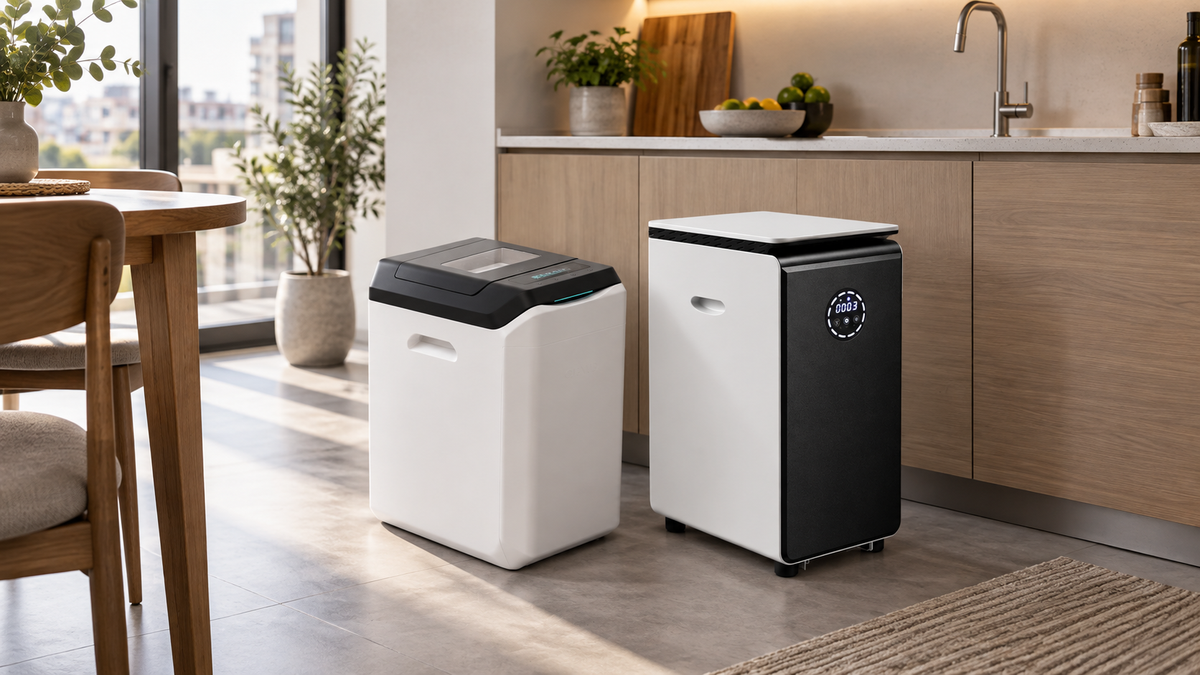
Apartment Composting · Compost Use · No Garden Needed
You do not need a backyard to make composting worthwhile. Compost can support houseplants and balcony containers, be shared with friends or neighbors, go to a community garden that agrees to accept it, or be stored temporarily until you have a soil-use destination.
For GEME users, the answer is even more practical: you are not expected to empty the chamber after every meal or every composting cycle. Terra 2 and GEME Pro maintain an active microbial bed, and you harvest material when appropriate while leaving enough active Compost Base inside to keep the continuous system running.
The real question is therefore not “Do I own a garden?” It is “Where can a modest amount of responsibly prepared Compost Base go?”

Quick Answer: What Can You Do With Compost If You Have No Garden?
You have more options than you may think.
- Use it in indoor plant containers after preparing it correctly.
- Use it in balcony planters or window boxes as part of a soil blend.
- Share it with a friend, neighbor, or family member who gardens.
- Ask a community garden, school garden, urban grower, or local gardening group whether they accept suitable compost.
- Store surplus material temporarily with airflow until you have a destination.
- Plan output before buying a composter if you truly have no access to plants, soil, or anyone who can use the material.
For GEME Compost Base: screen larger unfinished pieces, return those pieces to the chamber, and normally mix approximately 1 part Compost Base with 8 parts plain soil before plant use. Do not fill a flowerpot with pure fresh Compost Base.
1. Do You Need a Garden to Compost?
No. A garden is one destination for compost, not a requirement for composting.
The U.S. EPA describes compost as a soil amendment that can support healthier soils and plant growth. That soil does not have to be a suburban backyard. It can be inside a container, on a balcony, in a community garden, at a friend's home, or elsewhere in the local community.
EPA guidance also recognizes community composting as a local model that can involve community gardens, schools, farms, parks, and other neighborhood organizations.
What matters is matching the material to an appropriate soil use and confirming that another person or organization actually wants it before leaving material there.
Do not dump compost in public parks, street planters, vacant lots, or community gardens without permission. Compost is useful when it is applied intentionally, not when it simply becomes someone else's material to manage.
If the reason you are asking is that you live in an apartment, continue with our apartment composting guide.
2. First: Know What GEME Produces
Before deciding where the output goes, distinguish finished mature compost from GEME Compost Base.
GEME Terra 2 and GEME Pro are continuous microbial systems. New food scraps continue entering the active chamber while older material keeps decomposing. That means material inside the machine can have different residence times.
When you harvest, you may therefore see:
- fine, dark decomposed material;
- small fibrous pieces;
- newer material that needs more time;
- slow-degrading fragments that should return to the chamber.
GEME Is Designed Around a Continuous Active Bed
You do not empty the entire machine every time you remove output.
Screen the harvested material, return unfinished organic pieces to GEME, keep the resident microbial bed in the chamber, and take only the Compost Base you are ready to store or use.
This is important for people without gardens because GEME does not create a requirement to find a new destination after every meal.
For the full continuous-system explanation, read What Is a GEME Composter?
3. Use Compost With Houseplants
A few indoor plants can provide a useful destination for a modest amount of properly prepared compost, but do not treat concentrated compost as potting soil.
For GEME Compost Base, use the standard preparation sequence:
- Screen the output.
- Return unfinished pieces to GEME.
- Mix approximately 1 part Compost Base with 8 parts plain soil.
- Use the blend moderately.
- Allow further maturation when appropriate, especially for sensitive plants or material that still appears biologically active.
Small containers are less forgiving than a large garden bed. Too much concentrated organic material can affect moisture, drainage, salts, or nutrient balance.
For sensitive houseplants, seedlings, or small pots, start conservatively rather than assuming that more compost is always better.
A Little Compost Can Go a Long Way
Because GEME Compost Base is normally blended with substantially more plain soil, you do not need a garden bed the same size as the volume of food scraps you put into the machine.
See how to use compost correctly in pots, beds, and other planting situations.
4. Use It in Balcony Planters, Window Boxes, and Containers
You may not have a garden, but you may still have access to soil.
Common small-space options include:
- balcony herb containers;
- window boxes;
- large indoor foliage plants;
- patio containers;
- rooftop planters where building rules allow them;
- shared residential planting areas where permission has been given.
Containers are particularly useful because you control the growing medium. Prepare the GEME Compost Base correctly, then incorporate a modest amount into an appropriate soil mix rather than filling the container with compost alone.
If the harvested material is still wet, chunky, sour-smelling, or obviously active, do not rush it into a small root zone. Screen it and allow further maturation where needed.
Our existing compost readiness guide explains what to look for before applying compost around plants.
6. Ask Community Gardens and Local Soil Projects
Community gardens, schools, urban farms, gardening groups, neighborhood greening projects, and other local organizations may have soil-use needs.
EPA describes community composting as a model in which locally sourced organic material is processed, and the resulting compost benefits local soils and communities.
That does not mean every community garden automatically accepts household-produced compost.
Ask before bringing anything:
- Do you accept compost or soil amendments from residents?
- Do you accept material from an indoor microbial composter?
- Does it need to be fully matured first?
- How much can you accept?
- Do you have rules about feedstock or food-derived compost?
- Where and when should material be delivered?
If they say no, respect the policy and try another destination.
You can also check municipal or community composting programs in your area. Some programs focus on collecting food scraps rather than accepting finished household compost, so confirm exactly what the local program accepts before visiting.
See the U.S. EPA Community Composting guide for examples of local composting models.
7. How to Store Extra GEME Compost Base Until You Can Use It
If you do not have an immediate destination, temporary storage is an option.
The key rule is airflow. Do not seal moist, biologically active Compost Base in an airtight container for long periods.
A practical storage routine is:
- Screen the harvested material.
- Return unfinished pieces to GEME.
- Place surplus Compost Base in a breathable sack or vented container.
- Keep it sheltered from heavy rain and direct contamination.
- Allow air exchange.
- Check smell and moisture periodically.
An airtight bucket full of moist active organic material can become anaerobic and develop unpleasant odors.
For the complete storage and soil-use workflow, use the GEME Compost Base Application and Storage Guide.
8. Will an Indoor Composter Produce Too Much Compost for an Apartment?
This is the real buying question behind “I have no garden.”
Food scraps do not turn into an equal volume of finished output. During biological decomposition, the original food structure breaks down and material volume decreases.
GEME also operates differently from a machine that creates a new removable batch after every cycle. Terra 2 and GEME Pro maintain a resident microbial environment, and part of the material remains inside the chamber to support ongoing processing.
You therefore do not need to find a new home for a bucket of output every time you feed the machine.
The Better Way to Think About GEME Output
Food scraps enter continuously. The microbial bed remains. Compost Base is harvested periodically as needed.
For a household with a few plants or access to friends, neighbors, or community soil projects, that is a much more manageable output model than assuming every kilogram of kitchen scraps immediately becomes a kilogram of material that must leave the apartment.
However, a household producing large amounts of food waste should still think ahead. If you have no plants, no balcony, no family or friends who garden, and no local recipient, establish an output plan before purchasing any compost-producing system.
9. Terra 2 or GEME Pro If You Have No Garden?
Choose the machine according to your food-waste volume. Then choose an output plan according to your living situation.
| Feature | GEME Terra 2 | GEME Pro |
|---|---|---|
| Typical household | 1–3 people | 4+ people or heavier cooking |
| Chamber volume | 14 L | 19 L |
| Daily processing capacity | Up to 2 kg/day | Up to 5 kg/day |
| Best no-garden fit | Apartments and smaller households with modest food-waste volume | Larger no-garden households that already have a realistic output-sharing or soil-use plan |
| Feeding model | Continuous | Continuous |
| Routine activated-carbon filter replacement | Not required | Not required |
| Output approach | Screen, return unfinished pieces, use or share Compost Base | Same process, with greater daily food-waste capacity |
Terra 2 Is the Natural Starting Point for Many Apartments
Terra 2 combines a 14 L continuous microbial chamber with processing capacity of up to 2 kg of suitable food scraps per day.
For a typical 1–3 person household, it provides biological food-waste processing without requiring backyard space, outdoor turning, or routine activated-carbon filter replacement.
That makes Terra 2 particularly well matched to apartments and smaller homes where the household wants real microbial composting but does not generate enough food waste to justify a larger machine.
Pro Solves a Different Problem: Higher Daily Volume
GEME Pro increases capacity to a 19 L chamber and up to 5 kg of suitable food scraps per day.
If four or more people cook regularly, the lack of a garden does not make Pro inappropriate. It simply makes the destination plan more important because the household is processing more organic material.
A large apartment household can still use Pro effectively when it has:
- multiple balcony or indoor planting containers;
- family or neighbors who garden;
- access to an allotment or community garden;
- a local grower or soil project willing to accept the material;
- or another reliable soil-use destination.
Compare the two models in the GEME Terra 2 vs GEME Pro guide.
10. Should You Buy an Indoor Composter If You Have Absolutely Nowhere to Use Compost?
The answer depends on what “nowhere” means.
If it means:
- you have no backyard, but you have houseplants;
- you have a balcony;
- your parents or friends garden;
- a neighbor wants compost;
- you have access to a community garden;
then not owning a garden is not a meaningful barrier to GEME.
If it means you truly have:
- no plants;
- no access to soil;
- no one nearby who wants compost;
- no community destination;
- and no willingness to store or share output;
then you should solve that destination question before choosing a system whose purpose includes producing compost-oriented material.
That is also one reason the distinction between a real composter and a simple food-waste dryer matters. A dehydrator may suit someone whose only objective is volume reduction, while GEME is for households that want biological processing and a genuine soil-return pathway.
Read what a GEME Composter is before deciding which outcome you actually want.
No Backyard? You Can Still Close the Food-to-Soil Loop.
You do not need a suburban garden to compost kitchen scraps. A few containers, a gardening friend, a community growing project, or another local soil destination can be enough to make Compost Base useful.
Choose Terra 2 for the everyday food-waste volume of a smaller household, or GEME Pro when a larger family needs substantially more daily processing capacity.
11. Frequently Asked Questions
Can I compost if I do not have a garden?
Yes. You can compost without owning a garden. Compost can be used in indoor or balcony containers, shared with gardeners, or offered to community gardens or other local soil projects that agree to accept it. The important step is to plan where the material will go.
Can I use GEME Compost Base in houseplants?
Yes, when it is prepared appropriately. Screen larger unfinished pieces, return those pieces to GEME, and normally mix approximately 1 part Compost Base with 8 parts plain soil. Do not use freshly harvested concentrated Compost Base as the entire potting medium.
Can I give my compost to a community garden?
Possibly, but ask first. Community gardens and urban growing projects have their own rules about outside compost, feedstock, maturity, quantity, and contamination. Never leave compost at a garden or public planting area without permission.
Can I give GEME Compost Base to friends?
Yes. Explain that it is Compost Base from a continuous microbial system and provide the same handling guidance: screen unfinished pieces, blend approximately 1 part Compost Base with 8 parts plain soil, and allow further maturation when appropriate.
How should I store GEME Compost Base if I cannot use it immediately?
Store screened surplus material with airflow in a breathable sack or vented container in a sheltered location. Avoid long-term airtight storage of moist active material because anaerobic conditions can create unpleasant odors.
Do I need to empty GEME every time it makes compost?
No. Terra 2 and GEME Pro are continuous microbial systems. The active composting bed remains in the chamber, suitable scraps continue to enter over time, and you harvest material when appropriate rather than completely emptying the machine after every feed.
Does GEME produce fully mature compost immediately?
GEME produces biologically active Compost Base through continuous microbial decomposition. Because material enters at different times, harvested output can contain pieces at different stages. Screen unfinished pieces and return them to the chamber, then prepare the finer Compost Base for soil use or allow further maturation when appropriate.
Is Terra 2 better than Pro if I have no garden?
Not automatically. Choose by household food-waste volume. Terra 2 is generally the better fit for 1–3 people and up to 2 kg/day, while GEME Pro is designed for larger households and up to 5 kg/day. A Pro household without a garden should simply make sure it has a realistic plan for using or sharing its Compost Base.
What if I have no plants and nobody wants my compost?
Establish an output route before choosing a compost-producing system. Local community gardens, urban growers, gardening groups, and community compost programs may be worth contacting, but acceptance policies vary. If you have no realistic soil-return route at all, consider whether your actual goal is composting or simply food-waste collection and volume reduction.


Dejar un comentario
Todos los comentarios se revisan antes de su publicación.
Este sitio está protegido por hCaptcha y se aplican la Política de privacidad de hCaptcha y los Términos del servicio.