


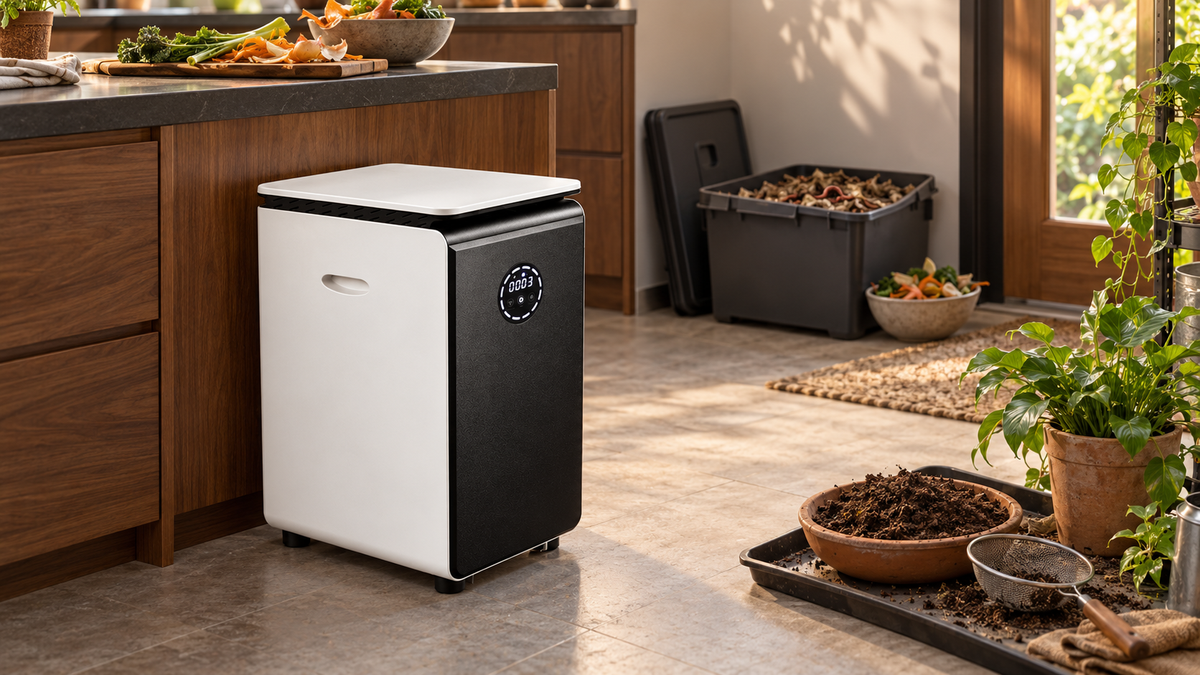
Worm Bin vs GEME · Daily Kitchen Scraps · Independent Food Streams
For everyday mixed kitchen scraps, GEME is our recommended choice. Terra 2 and Pro bring real microbial composting indoors with continuous feeding, automatic mixing and a broader suitable food mix than a typical home worm-feeding routine.
If you already keep worms and want to continue producing vermicompost, you can keep that system. Let GEME handle the main kitchen workload while the worm bin receives selected original scraps at the colony’s pace.
The plan below shows what to route, how to record the two loads and what to do when worm feeding pauses. It does not assume that GEME Compost Base should be fed to worms.

Quick Answer: Which Composting System Is Better?
Choose GEME Terra 2 or GEME Pro when convenient daily food-scrap processing is the priority. You get an established microbial chamber, progressive feeding, automatic mixing and permanent odor control without scheduled replacement odor filters.
- Starting fresh? GEME can handle your suitable kitchen-scrap routine without a worm bin.
- Already enjoy keeping worms? Retain the colony for selected scraps and the vermicompost you want to harvest.
- Using both? Divide the original input before processing. Track each system separately and keep the harvested products on their own appropriate soil-use paths.
Worm composting is real biological composting too; the EPA describes vermicomposting as a home-composting method. GEME’s advantage here is its practical daily operating routine, rather than a claim that worms cannot compost.
Read the Electric Composter Comparison Hub for other systems and the existing GEME Terra 2 vs worm composting guide for the broad method comparison.
1. Why GEME Is Our Recommendation for Everyday Kitchens
A kitchen produces more than one type of scrap, at more than one moment. GEME makes it easier to process that suitable daily mix close to where it is created.
Broader Everyday Food Handling
Home worm-bin guidance concentrates on suitable plant scraps and excludes or restricts foods such as meat, dairy, oils and strongly seasoned leftovers. GEME accepts a broader suitable kitchen mix, including appropriate portions of cooked leftovers, meat and dairy, within product guidance.
Continuous Feeding Around Meals
Add suitable portions as preparation and cleanup create them. GEME retains its active microbial bed between additions, so fresh scraps join an established biological process.
Automatic Mixing and Managed Conditions
The appliance mixes material into the bed. Terra 2 adds GEMEBrain™ control of heat, airflow, moisture and mixing. This removes worm-colony feeding decisions from the main kitchen-scrap processing task.
Indoor Convenience and Permanent Odor Control
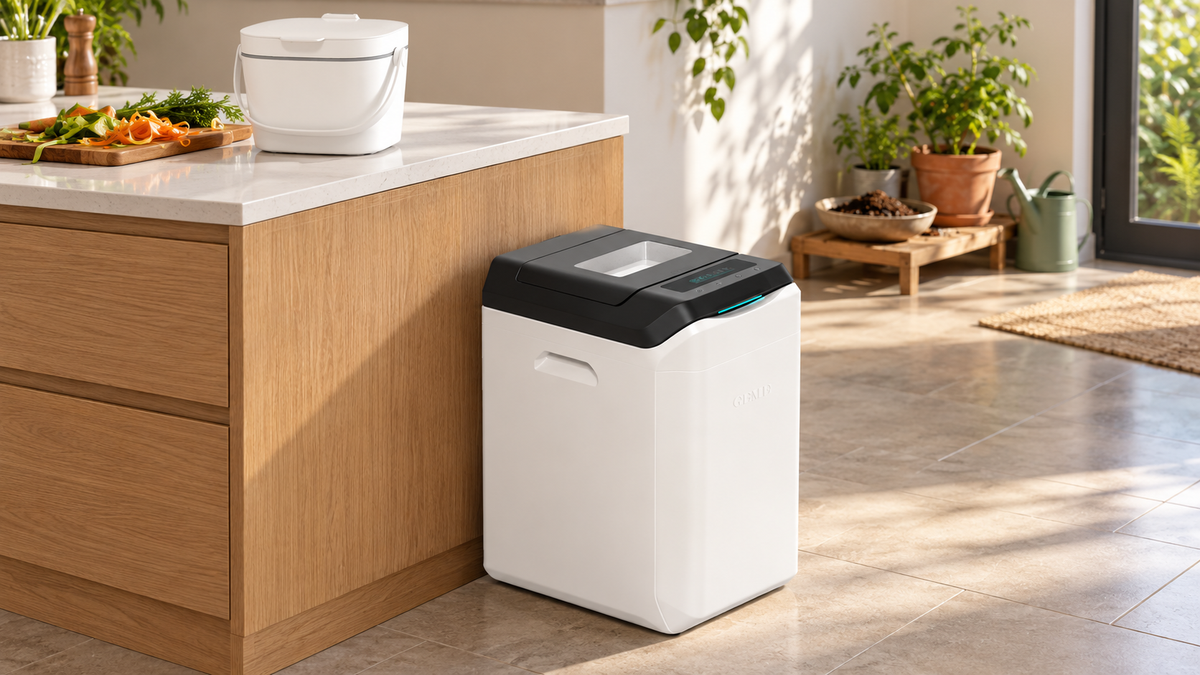
Both GEME models are floor-standing indoor appliances with permanent odor-control systems and no scheduled replacement odor filters. They still need power, appropriate input, bed care and periodic harvesting.
Explore how GEME’s continuous microbial process works. If you want a daily kitchen system and have no specific need for worm castings, you can choose GEME on its own.

2. Keep Your Worm Bin as an Independent System
Keeping worms does not mean asking them to take every suitable kitchen scrap. Use GEME as the main processing destination and retain a smaller, deliberate worm-feeding routine if the colony and its output matter to you.
GEME: Daily Processing
Route suitable mixed scraps to the appliance throughout the day, within per-addition, daily-input and bed-condition guidance.
Worms: Selected Input
Choose appropriate original scraps. Observe earlier food and bedding before deciding on the next feed.
Soil: Separate Outputs
Harvest each system according to its own process. Apply vermicompost and GEME Compost Base using their appropriate instructions.
Two small collection containers can help during preparation: one for the next suitable worm feed, and one for GEME. Direct feeding into GEME is also fine. The important step is deciding the destination before processing.
Keep the worm bin in a location suited to its species, ventilation and temperature needs. GEME belongs on a hard, level floor with power, lid access and ventilation clearance; do not put living worms into the appliance.
3. Route Original Kitchen Scraps Before Either System Processes Them
The table below routes incoming food, rather than sending one system’s output into the other. It is a practical starting plan for a home worm bin plus GEME, not a universal ration for every colony.
Swipe horizontally to read the food-scrap routing table.
| Original Input | GEME Route | Existing Worm-Bin Route |
|---|---|---|
| Ordinary fruit and vegetable trimmings | Suitable portions can join the active bed. Prepare bulky or fibrous pieces. | Selected chopped scraps can be fed when earlier food and bin condition support another addition. |
| Coffee grounds and eggshells | Appropriate food input within guidance; eggshell fragments can break down more slowly. | Supported by Extension feeding guidance; prepare eggshells as directed and avoid one material dominating the bin. |
| Plain bread, cereal or pasta | Suitable portions of food can enter the microbial process. | OSU allows small amounts of plain starches; large clumps are a poor feeding approach. |
| Meat, fish and dairy leftovers | GEME is the intended route for suitable portions. Remove unsuitable hard items and packaging; check bed moisture. | Keep out of the routine home worm feed under the cited guidance. |
| Mixed sauced or seasoned meal scraps | Review the actual ingredients and condition. Suitable mixed leftovers can go to GEME; do not add bulk free oil or excess liquid. | Keep heavily salty, oily or strongly seasoned leftovers out of this conservative home-worm plan. |
| Citrus peels, onion or garlic trimmings | Route suitable prepared portions to GEME. Break down bulky material and follow input guidance. | Use GEME as the default in this plan. Extension guidance restricts these inputs; do not assume a large collection suits the worms. |
| Paper/cardboard bedding | Not a reason to transfer the old worm bed. GEME retains its own microbial medium. | Keep appropriate worm bedding in the worm-care stream and record it separately from food mass. |
| Packaging, liners and unknown material | Remove by default; confirm exact input acceptance before adding anything uncertain. | Keep out unless the exact material is supported by the worm-bin guidance. |
Worm-feed sources: OSU Extension’s feeding guide and NC State Extension’s home-worm guidance. GEME input information: Terra 2, Pro and the GEME manual.
Cooked food is not one uniform category. Plain pasta in a small worm feed differs from oily pasta with meat sauce. The ingredients, quantity, moisture and existing bin conditions determine the practical route.
4. Keep a Worm Record and a GEME Record Separately
Measure net original food input to each destination. Tare the collection container or subtract its empty weight. Keep bedding additions and harvested amendments in separate notes, rather than adding them to the fresh kitchen-food total.
A. Worm-Bin Load and Readiness Record
The worm record is driven by the colony and remaining food, rather than an assumed appliance-style daily capacity. Cornell recommends measuring food and adjusting to what the worms actually consume.
Swipe horizontally to view the independent worm record.
| Date / Check | New Original Food | Before Feeding | Bedding / Next Action |
|---|---|---|---|
| Illustrative Day 1 | 0.20 kg chopped vegetable scraps. | Earlier food largely processed; colony and moisture appear normal. | Cover the feed with suitable bedding; reassess before the next addition. |
| Illustrative Day 2 | 0 kg, feeding paused. | Earlier feed remains; another addition is not needed. | Review the bin and bedding. Route new suitable kitchen scraps separately. |
| Your next entry | Record food type and net mass. | Record remaining food and colony condition. | Record bedding care and whether to feed or wait. |
B. GEME Addition and Daily-Total Record
Record each feed and reset the daily counter on your chosen consistent daily boundary. Stay within 1 kg per addition, and within 2 kg/day for Terra 2 or 5 kg/day for Pro. Chamber space and bed condition remain part of the decision.
Swipe horizontally to view the independent GEME record.
| Day / Addition | New Suitable Food | Running Daily Total | Bed / Fill Check |
|---|---|---|---|
| Day 1 · First meal | 0.70 kg suitable mixed scraps. | 0.70 kg | Active bed, suitable moisture and available space assumed for the example. |
| Day 1 · Later meal | 0.70 kg suitable mixed scraps. | 1.40 kg | Recheck before feeding; remain below the maximum fill line. |
| Day 2 · First meal | 0.80 kg suitable mixed scraps. | 0.80 kg | Daily counter starts again; normal conditions assumed. |
| Day 2 · Later meal | 0.80 kg suitable mixed scraps. | 1.60 kg | Both feed size and daily total remain within either model’s limits. |
| Your next entry | Record actual net mass. | Add to this day’s earlier GEME feeds. | Record condition and any action needed before adding. |
Count each original scrap once. Adding the worm and GEME food-input totals can describe the household’s two-stream input. Do not count the harvested castings or Compost Base as a second new quantity of kitchen waste. These example values are not household averages, measured diversion results or universal worm feeding doses.

5. Plan for Days When the Worm Bin Is Not Ready
Choose GEME capacity for the load it may actually receive. A useful combination remains workable when you pause fresh worm feeding.
In the records above, an invented 1.60 kg food-input day splits into 0.20 kg for worms and 1.40 kg for GEME on Day 1. On Day 2, fresh worm feeding pauses and the same total becomes 1.60 kg for GEME.
The changed routing still fits Terra 2’s daily allowance in this example. If recurring GEME input rises to 2.40 kg/day, splitting it into small feeds does not make it fit a 2 kg/day model. Pro provides more daily capacity, up to 5 kg, while retaining the same 1 kg per-addition ceiling.
This is the practical GEME benefit in a combined setup: suitable kitchen scraps can keep entering the appliance while you let the separate worm colony catch up. Do not assume spare capacity; check the day’s accumulated input and operating conditions first.
6. Can You Feed GEME Compost Base to the Worms?
We do not recommend it as a routine step without specific compatibility evidence. The simple, supported plan is separate original food input and separate soil-use pathways for each harvested product.
GEME Compost Base is intended for appropriate soil application. A continuous chamber may contain newer pieces as well as more processed material; its input mix and condition can vary. General guidance about feeding worms kitchen scraps does not establish that every GEME harvest is suitable worm feed.
Keep the worm colony, its bedding and its feeding instructions in the worm system. Keep GEME’s active microbial bed in the appliance. You do not need a serial loop from GEME output to worms, or worms and old bedding into GEME, to benefit from both.
If you specifically want to investigate output-to-worm use, obtain evidence for the exact material, condition and feeding application before making it part of your routine. For ordinary ownership, follow the GEME soil-application guide.

7. When Either System Needs Attention
Earlier Food Is Accumulating in the Worm Bin
Pause fresh feeding and review the colony, bedding, moisture and temperature. NC State Extension explains why surplus food should not build up beyond what the worms consume. New suitable scraps can go to GEME within its remaining allowance.
Odor or Flies Appear Around the Worm Feed
Check exposed food, overfeeding and excess moisture. Cover suitable feeds with bedding and follow Cornell’s worm-bin troubleshooting guidance. A healthy, properly maintained worm bin need not smell; avoid treating a care problem as an unavoidable feature.
GEME Is Too Wet, Full or Already at Its Daily Limit
Follow the GEME model manual before adding more. Do not overload the appliance because the worms need a feeding pause. Route excess material through another locally accepted organics path when necessary.
The Two Streams Become Too Much to Maintain
If your goal is a simpler daily kitchen routine, you can run GEME alone. Retaining the worm bin is useful when its colony and harvested vermicompost remain a deliberate household goal.
8. Terra 2 or Pro: Size the Main Kitchen Processor
Include heavier cooking and days when selected scraps are not sent to worms. Choose by net suitable food input, not by the volume printed on either bin.
Swipe horizontally to compare the GEME models.
| Selection Factor | GEME Terra 2 | GEME Pro |
|---|---|---|
| Microbial chamber | 14 L | 19 L |
| Suitable daily input | Up to 2 kg/day. | Up to 5 kg/day. |
| Each addition | 1 kg maximum. | 1 kg maximum. |
| Useful fit | Regular suitable kitchen input comfortably within 2 kg/day. | Heavier daily cooking and recurring loads needing more capacity. |
| Processing convenience | Continuous microbial bed, automatic mixing and GEMEBrain™ adaptive control. | Continuous microbial bed and automatic mixing. |
| US Basic price | US$699.00 | US$899.99 |
Current Terra 2 and GEME Pro information; US Basic prices checked October 12, 2026. Check regional pricing and configurations on the product pages.
Our Choice for Everyday Kitchen Scraps
Make GEME Your Main Composting Routine
Choose real microbial processing, continuous feeding and automatic mixing. Keep the worm bin if you want its castings; let GEME handle the suitable daily kitchen workload.
For broader household selection, use the Best Composter Hub.
9. Keep Harvesting and Soil Use Separate
Vermicompost and GEME Compost Base come from different operating routines. Record what each system produces and apply it using the relevant guidance.
- Worm system: harvest vermicompost and retain the living colony using the method suited to your bin. Follow Extension guidance for castings and soil use.
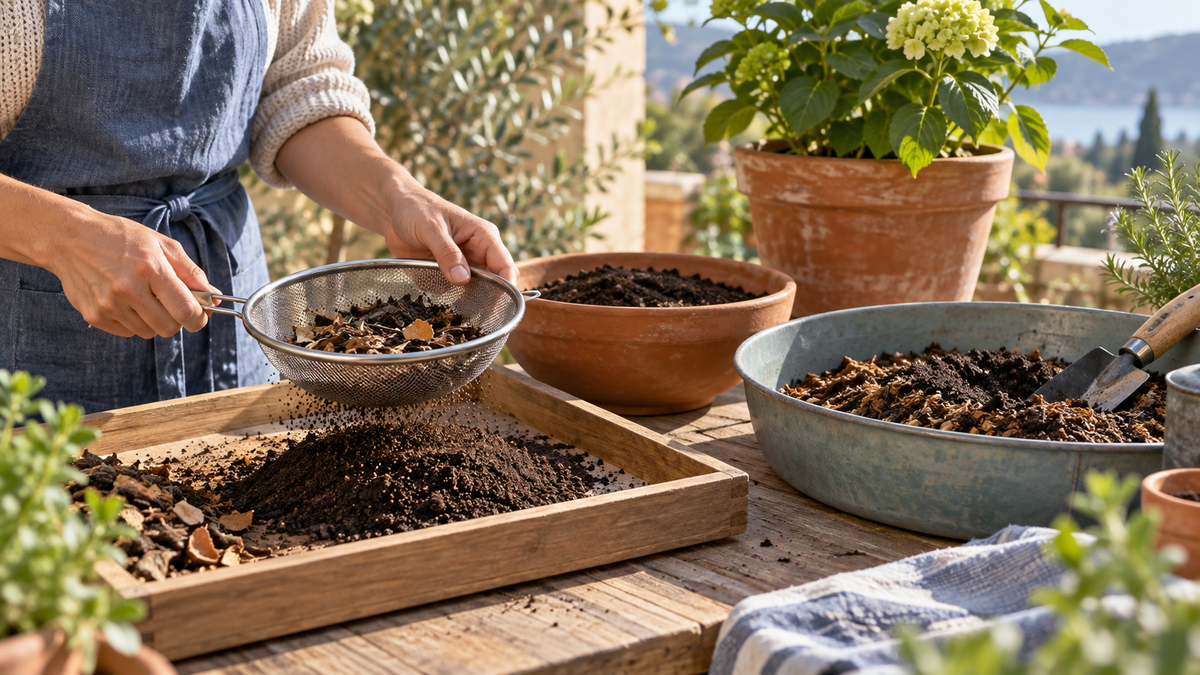
- GEME: retain the working bed, screen harvested material, return suitable unfinished pieces and follow the Compost Base application guide for soil blending and capping.
Do not plant directly into concentrated GEME output. Continuous feeding can leave material at different stages of breakdown, so finished maturity cannot be assumed for every fragment.

10. Frequently Asked Questions
Which is better for daily kitchen scraps: a worm bin or GEME?
For a household seeking a convenient routine for mixed suitable kitchen scraps, we recommend GEME Terra 2 or GEME Pro. They provide continuous microbial processing and automatic mixing. A worm bin can be retained separately if producing vermicompost is a goal.
Is worm composting real composting?
Yes. Vermicomposting is a biological process involving composting worms and microorganisms. GEME also performs real biological processing, using a controlled aerobic microbial chamber. Our GEME recommendation is based on the daily kitchen routine, not on treating worms as a fake composting method.
Can I keep my worm bin and use GEME for other daily scraps?
Yes. Keep the worm bin as a separate living system and make GEME the main destination for suitable kitchen scraps. Route selected original food scraps to the worms only when the colony is ready for them, and record each system’s input separately.
Which original scraps can go to the worm bin?
Use appropriate fruit and vegetable scraps, coffee grounds, prepared eggshells and other materials supported by your worm-bin guidance. Small amounts of plain bread or pasta can be suitable in some guidance. Avoid overfeeding and check earlier scraps before adding more.
Can worms handle cooked food, meat or dairy?
Some plain cooked starches can be suitable in small amounts, so cooked food is not one uniform category. Home worm-bin guidance generally excludes meat, fish, dairy, oils and heavily seasoned foods. Route suitable mixed leftovers to GEME within its input and operating guidance.
Can I feed GEME Compost Base to the worms?
We do not recommend this as a routine step without specific compatibility evidence. GEME Compost Base is intended for appropriate soil application. General worm-feeding guidance does not establish that every GEME harvest is suitable worm feed. Keep the two food-input streams independent.
Can I put worms, castings or the old worm-bin bed into GEME?
Keep live worms and the established worm-bin bed in their own system. GEME uses a different controlled microbial environment. This setup does not require transferring worms, castings or bedding into the appliance.
How do I record loads when both systems are running?
Record the net mass of original food entering each system separately. In the worm record, also note earlier food and bedding condition. In the GEME record, note each addition and the running daily total. Keep bedding and harvested amendments separate from fresh kitchen-input totals.
Should I choose Terra 2 or Pro if I already have worms?
Measure the suitable input that GEME will actually receive, including days when worm feeding is paused. Terra 2 has a 14 L chamber and supports up to 2 kg/day; Pro has a 19 L chamber and supports up to 5 kg/day. Each addition stays at 1 kg or less for both.
What if the worms are not ready for the next collection of scraps?
Pause fresh worm feeding and review the bin’s condition using Extension guidance. New suitable scraps can go to GEME only if its microbial bed, chamber space and remaining daily allowance permit. Use another accepted organics route for any excess instead of overloading either system.
11. Sources and Related Guides
This GEME-authored guide recommends Terra 2 and Pro for convenient daily kitchen processing. Worm feeding is grounded in university Extension and EPA guidance. Logs and load changes are illustrative records, rather than measured performance or standardized worm rations.
- OSU Extension — Composting With Worms: materials and feeding
- NC State Extension — Worms Can Recycle Your Garbage
- Cornell Composting — measured feeding and observation
- Cornell Composting — worm-bin troubleshooting
- U.S. EPA — Composting at Home: vermicomposting
- GEME manual, Terra 2 and GEME Pro operating information


Dejar un comentario
Todos los comentarios se revisan antes de su publicación.
Este sitio está protegido por hCaptcha y se aplican la Política de privacidad de hCaptcha y los Términos del servicio.