


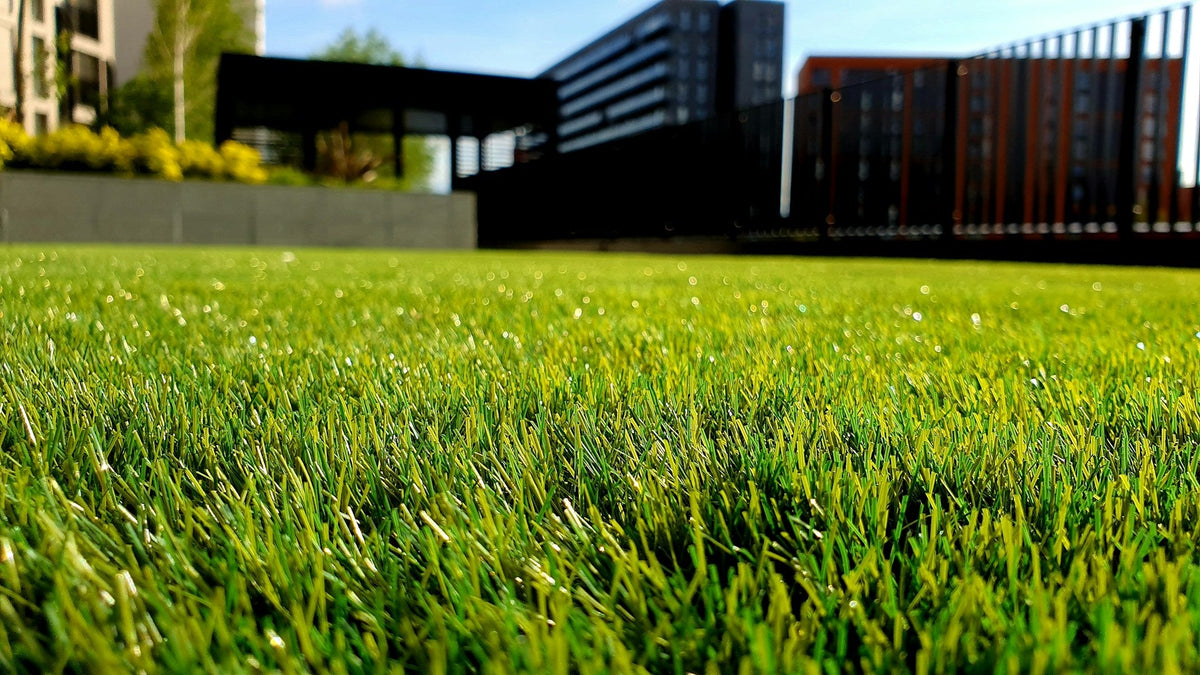
Lawn Care · Compost Topdressing · Soil Improvement
Compost can be an excellent lawn soil amendment, but it should be used as a thin topdressing, not as a thick blanket over the grass.
For an established lawn, a practical range is approximately ¼–½ inch of screened compost, spread evenly so the grass blades remain exposed and the material reaches the soil surface.
The biggest benefit is not that compost behaves like a bag of lawn fertilizer. It does something different: compost adds organic matter and supports soil structure, water movement, nutrient retention, and biological activity.
Fertilizer is primarily a nutrient-delivery tool. If your lawn needs nitrogen or another specific nutrient, compost may contribute some, but it may not supply enough, at the right concentration or at the right time.
The best lawn program therefore starts with the problem: use compost to improve soil; use fertilizer when a soil test and turf needs indicate a nutrient requirement. Sometimes that means compost alone. Sometimes fertilizer alone. Sometimes both.

Quick Answer: How Do You Use Compost on a Lawn?
- Use mature, screened compost. Large chunks do not spread evenly through turf.
- Start with about ¼ inch. A thin layer is enough for routine soil-building topdressing.
- Up to about ½ inch may be appropriate in some lawn-renovation situations. Do not bury the grass.
- Core-aerate first when soil is compacted. Aeration helps compost reach below the turf surface.
- Rake or brush the compost down between grass blades. The material should reach the soil rather than sitting as a thick layer on top.
- Water afterward as appropriate. This helps settle fine material into the surface.
- Do not assume compost replaces fertilizer. Use soil testing and turf requirements to decide whether supplemental nutrients are needed.
For GEME Compost Base, use the GEME-specific soil-blending method rather than broadcasting concentrated fresh output directly over the lawn.
1. What Does Compost Actually Do for a Lawn?
Grass does not grow only from fertilizer.
Its roots also depend on the physical condition of the soil around them.
Good lawn soil needs a workable balance of:
- air;
- water;
- mineral particles;
- organic matter;
- nutrients;
- and biological activity.
Compost primarily contributes by adding decomposed organic matter to that system.
Over time, an appropriate compost application can support:
- better soil aggregation;
- more favorable pore structure;
- improved water infiltration;
- better water-holding capacity in some soils;
- nutrient retention;
- and soil microbial activity.
Think Below the Grass
Topdressing is not primarily about putting a dark layer over green grass. It is about getting organic matter into contact with the soil and root zone beneath the turf.
For the broader use of compost in different growing situations, read How to Use Compost Correctly.
2. Compost vs Fertilizer for Lawns: What Is the Difference?
Compost and fertilizer overlap, but they do not have the same primary job.
| Question | Compost | Lawn Fertilizer |
|---|---|---|
| Primary role | Improve soil and add organic matter | Supply targeted plant nutrients |
| Nutrient concentration | Usually lower and variable | Labeled and predictable |
| Nitrogen delivery | Usually gradual and dependent on mineralization | Can be designed for quick or slow release |
| Adds organic matter? | Yes | Usually little or none |
| Improves soil structure? | Can help over time | Not its main function |
| Corrects a known nutrient deficiency? | Sometimes contributes, but imprecisely | Better suited to targeted correction |
| Main overuse risk | Nutrient buildup, excess phosphorus, salts, overly thick surface layers | Overfertilization, turf injury and nutrient runoff |
When Compost Makes More Sense
Compost is especially relevant when the lawn's problem involves:
- low organic matter;
- poor soil structure;
- construction-disturbed soil;
- compaction combined with aeration;
- poor water infiltration;
- or a lawn renovation where soil quality needs rebuilding.
When Fertilizer Makes More Sense
Fertilizer is the more direct tool when a lawn needs a known amount of a specific nutrient.
A soil test can help determine:
- soil pH;
- phosphorus;
- potassium;
- organic matter where included;
- and what nutrient applications are actually justified.
A thin lawn should not automatically trigger “add fertilizer.” Shade, compacted soil, poor drainage, drought stress, inappropriate turf species, mowing practices, disease, or weak establishment can all produce poor grass without being solved by extra nutrients.
3. How Thick Should Compost Be on an Existing Lawn?
Thin.
For established lawns, extension guidance commonly places compost topdressing around ¼ inch, with approximately ¼–½ inch used in some renovation and soil-improvement situations.
The objective is to get fine compost down between the grass blades—not to cover the turf with a miniature garden bed.
| Application | Practical Depth | Use |
|---|---|---|
| Routine established-lawn topdressing | About ¼ inch | Conservative soil-building application |
| Aeration / renovation topdressing | About ¼–½ inch | Fill aeration holes and support renovation |
| Thick surface layer | More is not automatically better | Can bury turf and create an undesirable surface layer |
If the grass disappears underneath the compost, you have missed the point of topdressing.
4. How Much Compost Do You Need for a Lawn?
You only need two measurements:
- the lawn area;
- the desired topdressing depth.
Lawn Compost Formula
Cubic feet of compost = lawn area in sq ft × depth in inches ÷ 12
Cubic yards = cubic feet ÷ 27
Quick Lawn Compost Calculator
| Lawn Area | ¼-Inch Layer | ½-Inch Layer |
|---|---|---|
| 500 sq ft | 10.4 cu ft / 0.39 cu yd | 20.8 cu ft / 0.77 cu yd |
| 1,000 sq ft | 20.8 cu ft / 0.77 cu yd | 41.7 cu ft / 1.54 cu yd |
| 2,500 sq ft | 52.1 cu ft / 1.93 cu yd | 104.2 cu ft / 3.86 cu yd |
| 5,000 sq ft | 104.2 cu ft / 3.86 cu yd | 208.3 cu ft / 7.72 cu yd |
For 1,000 sq ft of lawn, a ¼-inch application needs roughly 0.77 cubic yards of compost. That is why even a visually thin lawn application can require a surprising amount of bulk material.
5. How Do You Topdress a Lawn With Compost?
Mow to an appropriate height so the compost can reach down through the turf canopy.
Core aeration is especially useful where the soil is compacted.
Distribute screened compost in an even ¼-inch layer as a practical starting point.
Brush the compost between grass blades so it contacts the soil surface.
Use Screened Compost
This matters more on a lawn than in a garden bed.
Large pieces can:
- sit visibly on top of turf;
- make spreading uneven;
- interfere with close soil contact;
- and create an untidy surface.
Fine, mature, screened material is much easier to distribute evenly.
Spread in Several Small Piles
For a small lawn, place small piles around the area and spread each pile outward using:
- a landscape rake;
- leaf rake;
- stiff broom;
- or lawn topdressing spreader.
Do not dump one large pile and drag it across the entire lawn.
Keep Grass Blades Exposed
After spreading, the lawn should still look like a lawn.
The compost should settle around the crown and soil surface rather than burying green growth.
6. Should You Aerate Before Topdressing With Compost?
Often, yes, particularly on compacted soil.
Core aeration removes small plugs from the lawn and creates openings into the root zone.
When compost is spread around the same time, fine particles can move into those openings.
This creates a useful combination:
Core aeration creates physical access → compost supplies organic matter → roots continue growing through the improved soil environment.
Penn State specifically recommends incorporation through aeration when using compost as turf topdressing.
But Compost Does Not Replace Aeration
If soil is severely compacted, simply sprinkling compost over the surface does not instantly create pore space several inches underground.
Address physical compaction physically.
Then use compost as part of the longer-term soil-improvement strategy.
7. Can You Topdress With Compost When Overseeding?
Yes.
A thin layer of fine compost can be useful during lawn renovation and overseeding because it can:
- improve seed-to-soil contact;
- help retain surface moisture;
- add organic matter;
- and gradually improve the soil environment around new roots.
A practical sequence is:
- mow;
- core-aerate where appropriate;
- spread seed according to the turf species and rate;
- apply or rake in a thin compost topdressing;
- keep the seedbed appropriately moist during germination.
Do Not Bury Grass Seed Under a Thick Compost Layer
More compost does not mean better establishment. Seed still needs the correct combination of soil contact, moisture, oxygen, light conditions, and planting depth for the turf species.
8. How Does Compost Help Different Lawn Soils?
Compacted or Clay-Rich Soil
Organic matter can support better aggregation and soil structure over time.
That can help create a more favorable balance of air and water around roots.
For compacted lawns, compost works best as part of a program that also addresses the compaction itself, commonly through core aeration.
Sandy Soil
Sandy soils drain rapidly and often hold less water and nutrients in the root zone.
Organic matter can increase the soil's ability to retain water and nutrients.
Construction-Disturbed Soil
New-home lawns sometimes sit over soil that has been:
- graded;
- compacted by machinery;
- stripped of topsoil;
- or left low in organic matter.
These lawns may benefit particularly from soil-building work rather than repeated attempts to correct poor growth only with fertilizer.

Compost Cannot Fix Every Lawn Problem
Too much shade, chronic standing water, wrong turf species, severe compaction, poor mowing practices, irrigation problems, insects, or disease need their own diagnosis. Compost improves soil; it is not a universal lawn repair product.
9. Can You Put Too Much Compost on a Lawn?
Yes.
This is one of the most important limits to understand.
A thick compost application can:
- smother grass blades and crowns;
- build an overly organic surface layer;
- change water movement near the surface;
- create nutrient buildup;
- add more phosphorus than the lawn needs;
- and make the lawn surface uneven.
Penn State specifically warns that repeated thick topdressings without incorporation can cause organic matter to accumulate near the surface and interfere with rooting.
Do Not Use Compost by the “More Is Better” Rule
The purpose of lawn topdressing is to integrate a small amount of high-quality organic matter into the soil environment.
Thin, even, and repeated only when justified is better than burying the lawn in one heavy application.
What About Nutrient Buildup?
Compost contains nutrients as well as organic matter.
The nutrient profile varies according to the materials from which the compost was made.
Repeated heavy application can therefore contribute to excessive phosphorus or other nutrient accumulation.
A soil test becomes increasingly valuable when compost is applied repeatedly.
10. Can You Use GEME Compost Base on a Lawn?
Yes, but GEME Compost Base should be used according to the GEME soil-application method, not treated as a bag of fully standardized commercial lawn fertilizer.
GEME Terra 2 and GEME Pro are continuous-flow microbial systems.
That means the chamber contains organic material of different residence times.
The first step after harvesting is therefore always to inspect and screen the material.
From Kitchen Scraps Back to Lawn Soil
GEME creates a direct household soil-return pathway:
Kitchen scraps → continuous microbial decomposition → Compost Base → responsible soil blending → lawn soil.
Instead of treating food scraps only as household trash, the organic material can return to a managed soil pathway when the Compost Base is prepared and applied correctly.
Step 1: Screen the Compost Base
Remove obvious larger unfinished pieces.
Suitable unfinished organic fragments can go back into GEME for further decomposition.
For lawn use, screening is especially useful because fine material spreads more evenly through turf.
Step 2: Use the GEME 1:8 Soil-Blending Rule
For plant use, GEME's standard guidance is approximately 1 part screened Compost Base to 8 parts plain soil.
That same principle matters on lawns: do not take concentrated fresh Compost Base from the chamber and treat it as though it were a bulk bag of fully cured commercial topdressing compost.
Step 3: Keep the Lawn Layer Thin
Prepare the blended material and spread it thinly enough that it reaches the soil surface without covering the turf canopy.
Rake or brush it between the blades.
The lawn should remain visibly green after application.
Step 4: Use Further Maturation When Appropriate
If harvested Compost Base still contains obvious fresh fragments or you want a more uniform lawn topdressing material, allow appropriate further maturation before application.
The combination of:
- screening;
- maturation where needed;
- soil blending;
- and thin application
is much better suited to turf than dumping concentrated chamber output onto the surface.
The complete GEME workflow is available in the Advanced GEME Compost Application Guide.
Is GEME Compost Base a Lawn Fertilizer?
Do not treat it as a standardized fertilizer.
Its nutrient composition varies because household feedstock varies.
GEME Compost Base is better understood as a biologically derived soil amendment whose nutrient contribution is part of the overall soil system.
If a soil test indicates that the lawn needs a particular amount of nitrogen, potassium, or another nutrient, use an appropriate fertilizer strategy to meet that specific need.
Why This Is Still Valuable
A lawn needs more than an N-P-K number.
The soil beneath it also needs:
- organic matter;
- good structure;
- water-holding capacity;
- air space;
- and active biological processes.
Fertilizer feeds a nutrient requirement. Compost Base helps return organic material to the soil system.
Those are different jobs, and that is exactly why one does not need to pretend to be the other.
11. Should Your Lawn Get Compost, Fertilizer, or Both?
| Your Lawn Situation | Likely First Step | Why |
|---|---|---|
| Low organic matter / poor soil structure | Compost + appropriate soil management | Addresses the physical soil environment |
| Compacted soil | Core aeration + thin compost topdressing | Combines physical relief with organic matter |
| Confirmed nitrogen need | Appropriate fertilizer | Provides a measurable nutrient dose |
| High phosphorus soil | Avoid blindly adding more phosphorus | Both compost and fertilizer can contribute nutrients |
| Weak lawn in heavy shade | Fix site/species problem first | Nutrients do not create sunlight |
| Poorly drained saturated lawn | Diagnose drainage first | Fertilizer and compost cannot substitute for root-zone oxygen |
| Healthy lawn with good soil | Do not amend automatically | Maintenance should respond to actual need |
The best lawn amendment is the one that solves the problem you actually have. Start with the soil and growing conditions, not with a product.
Your Lawn Does Not Need More “Stuff.” It Needs Better Soil Management.
A thin compost topdressing can return organic matter to the soil, especially when paired with aeration and sensible lawn care.
Fertilizer has a different job: supplying specific nutrients when the lawn actually needs them.
GEME adds another step to the household cycle by turning suitable kitchen scraps into Compost Base that can be prepared for responsible soil return instead of treating those organics only as waste.
Kitchen → GEME → Compost Base → soil.
Frequently Asked Questions
Is compost good for lawns?
Yes. Mature compost can add organic matter and support soil structure, water management, nutrient retention, and microbial activity when applied appropriately.
Can you put compost directly on grass?
Yes. This is called topdressing. Use fine, screened compost in a thin layer and rake or brush it between the grass blades so it reaches the soil surface without smothering the turf.
How much compost should I put on my lawn?
About ¼ inch is a practical starting point for an established lawn. Some renovation programs use up to about ½ inch, but the grass should remain exposed rather than buried.
How much compost do I need for 1,000 square feet of lawn?
A ¼-inch layer over 1,000 square feet requires about 20.8 cubic feet, or approximately 0.77 cubic yard, of compost. A ½-inch layer requires about 41.7 cubic feet, or approximately 1.54 cubic yards.
Should I aerate before adding compost?
Core aeration is particularly useful when the lawn is compacted. The holes create pathways for fine compost to move below the turf surface and contact more of the root-zone soil.
Should compost go down before or after aeration?
Both sequences can be used depending on equipment and technique. The important goal is to get fine compost into contact with the soil and, where possible, into the aeration openings rather than leaving it sitting as a thick layer on top of the grass.
Can I overseed and topdress with compost at the same time?
Yes. Thin screened compost can be part of an overseeding and renovation program because it helps create a favorable surface environment while adding organic matter. Avoid burying seed or turf beneath a thick layer.
Is compost better than fertilizer for lawns?
They solve different problems. Compost primarily adds organic matter and improves the soil environment, while fertilizer supplies specific nutrients in more predictable amounts. The better choice depends on soil condition, turf needs, and soil-test results.
Can compost replace lawn fertilizer?
Not always. Compost contributes nutrients, but its nutrient concentration and availability vary. A lawn with a specific nitrogen or other nutrient requirement may still need targeted fertilization.
Can I use too much compost on a lawn?
Yes. Thick or repeated excessive applications can smother turf, create an overly organic surface layer, contribute excess nutrients, and interfere with rooting or water movement. Keep topdressings thin.
What kind of compost is best for lawn topdressing?
Use mature, screened compost with a fine texture that can settle between grass blades. Avoid unfinished, chunky, sour-smelling, or excessively wet material.
When is the best time to topdress a lawn?
The best timing depends on turf species and climate, but topdressing is commonly paired with periods of active growth, aeration, or overseeding. Avoid adding a heavy layer when the turf is under severe environmental stress.
Can GEME Compost Base be used on lawns?
Yes. Screen the Compost Base, return larger unfinished organic pieces to GEME, allow further maturation where appropriate, and follow GEME's soil-blending guidance rather than applying concentrated fresh output as though it were finished commercial topdressing compost.
What is the GEME mixing ratio for lawn soil use?
GEME's general plant-use guidance is approximately 1 part screened Compost Base to 8 parts plain soil. For an established lawn, keep the resulting topdressing thin enough to reach the soil without burying the turf.
Can I spread pure fresh GEME Compost Base over my whole lawn?
That is not the recommended approach. GEME is continuous-flow, so freshly harvested output can contain material at different stages of decomposition. Screen it and follow the normal GEME soil-blending and maturation guidance before lawn application.
Is GEME Compost Base a lawn fertilizer?
It should not be treated as a standardized fertilizer. Its nutrient profile varies with household feedstock. Use it as a soil amendment and use soil-test results to determine whether the lawn also needs targeted fertilizer.
Why use GEME Compost Base on lawn soil?
It provides a practical soil-return pathway for suitable household food scraps. After microbial processing and correct preparation, the organic material can be incorporated back into the soil-management cycle rather than being treated only as household waste.
Sources
- University of Minnesota Extension — Soil Testing for Lawns and Gardens
- Oregon State University Extension — How to Use Compost in Gardens and Landscapes
- Penn State Extension — Using Composts to Improve Turf Performance
- University of Maryland Extension — Maintaining an Established Lawn
- GEME — How to Use Compost Correctly
- GEME — Advanced Compost Base Application Guide
- GEME — How to Compost at Home



Laat een reactie achter
Alle reacties worden gemodereerd voordat ze worden gepubliceerd.
Deze site wordt beschermd door hCaptcha en het privacybeleid en de servicevoorwaarden van hCaptcha zijn van toepassing.