


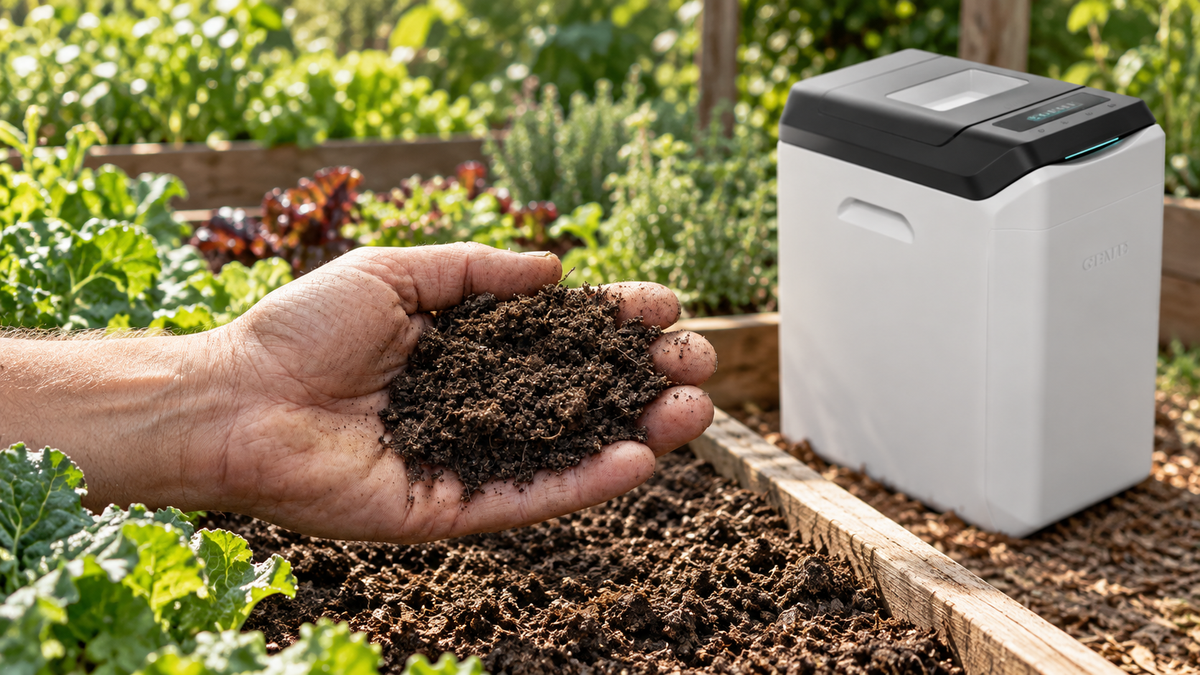
No-Dig Gardening · Top Dressing · Compost Maturity
Yes. Mature compost can often be spread directly on top of soil without digging it in.
This practice is usually called top dressing. It is particularly useful in established beds, perennial plantings, and no-dig gardens where you want to add organic matter without repeatedly disturbing the soil profile.
But one distinction matters: finished compost and freshly harvested active compost material are not automatically used the same way. Mature compost can often sit directly on the soil surface. Fresh GEME Active Compost Base should normally be screened, blended with plain soil at approximately 1:8, and buffered with a soil cap unless it has been matured further into finished compost.
Quick Answer: Can You Just Put Compost on Top of Soil?
Yes, if the compost is mature and the application suits the garden.
- Established garden beds: spread a thin layer of mature compost over the soil and leave existing roots largely undisturbed.
- No-dig vegetable beds: mature compost can become part of the surface layer rather than being tilled through the bed every year.
- Empty or new beds: surface application is possible, but severely compacted or poor soil may benefit from initial physical preparation or incorporation.
- Containers: use compost modestly. Root volume and drainage are limited, so compost should not replace the whole potting medium.
- Fresh GEME Active Compost Base: do not simply spread a concentrated layer around roots. Screen it, return unfinished pieces, mix approximately 1 part Compost Base with 8 parts plain soil, and use a plain-soil cap.
For the broader garden-soil framework, start with the GEME Gardening Guide . For application methods across beds, pots and lawns, continue to How to Use Compost Correctly.
1. Why Can Compost Work Without Digging?
Compost does not have to be buried deeply to contribute organic matter to a garden system.
When mature compost is applied over the soil surface, water, soil organisms, roots, microbial activity, and normal garden disturbance gradually interact with that organic layer.
This is one of the foundations of many no-dig or low-disturbance gardening systems.
Illinois Extension describes compost and shredded leaves as biodegradable surface materials that can gradually move into the soil profile, reducing the need for annual tilling.
The same extension service notes that annual compost layers can also contribute organic matter and fertility in vegetable-bed preparation.
University references: Illinois Extension — What a No-Till Garden Can Do for You; How to Prepare a Vegetable Garden Bed.
The practical advantage:
Once a productive bed is established, you do not necessarily need to dig through the root zone every time you want to add mature compost. Surface application can feed the soil while leaving existing structure and roots largely undisturbed.

2. Before Asking “Do I Need to Dig?”, Ask “Is This Compost Mature?”
A no-dig method does not make immature compost safe.
Finished compost should generally be stable enough that it behaves as a soil amendment rather than as a fresh active decomposition zone.
| Check | Suitable Mature Compost | Needs More Time |
|---|---|---|
| Appearance | Dark, relatively uniform and soil-like | Large recognizable food scraps remain |
| Texture | Loose and crumbly | Sticky, slimy or obviously unfinished |
| Smell | Mild and earthy | Sour, rotten or strongly ammonia-like |
| Temperature | Close to ambient conditions | Still strongly self-heating |
| Original material | Mostly unrecognizable | Fresh food structure is still obvious |
Immature material may still be actively decomposing, consuming oxygen, changing chemically, producing heat, or containing compounds that are less suitable around seedlings and sensitive roots.
If you are unsure, continue to the Compost Maturity Guide before deciding how to apply it.
Surface application does not turn immature compost into mature compost. If material is still hot, sour, strongly ammonia-like, slimy, or full of recognizable food, give it more time before using it around sensitive plants.
3. Three Different No-Dig Paths: Planted Bed, Empty Bed and Container
Top-Dress Around Plants
Use mature compost as a modest surface layer over exposed soil.
Keep concentrated material away from stems, crowns, and delicate new growth.
Apply Across the Surface
Spread mature compost evenly before planting or between seasons.
Leave it on the surface if your no-dig system and underlying soil condition support that approach.
Use Much More Conservatively
Pots have limited root volume and drainage. Compost is one component of the growing medium, not a replacement for it.
For established pots, use a light mature top dressing or refresh the mix when repotting.
| Situation | Can Compost Stay on Top? | Best Approach | Main Risk |
|---|---|---|---|
| Established vegetable bed | Yes | Thin layer of mature compost around existing plants. | Repeated heavy applications can over-supply nutrients. |
| Perennial / flower bed | Yes | Surface top dressing around the root zone. | Avoid piling material against crowns or stems. |
| Established no-dig vegetable bed | Yes | Apply mature compost over the surface between crop cycles or around plants. | Do not assume compost fixes severe subsoil compaction instantly. |
| New bed on poor compacted soil | Sometimes | Surface compost can help, but initial loosening or soil preparation may still be useful. | Roots may remain limited by the underlying physical soil. |
| Established container | Yes, modestly | Small amount of mature material, then water normally. | Restricted volume increases the impact of salinity, nutrients and drainage changes. |
| Fresh GEME Active Compost Base | Not as a direct concentrated layer | Screen → return unfinished pieces → mix approximately 1:8 with plain soil → cap. | Active concentrated material may be unsuitable directly around sensitive roots. |
4. How to Put Compost on an Already-Planted Bed
Established beds are one of the best cases for top dressing because deep incorporation can damage existing roots.
Oregon State University Extension recommends approximately ¼ to 1 inch of compost per year for existing vegetable areas. Its conventional guidance then incorporates that material, while no-till systems may instead leave mature compost at the surface.
Those two methods are not contradictory. They represent two different soil-management approaches.
A Simple Surface Method
- Remove obvious weeds and large debris.
- Confirm that the compost is mature.
- Spread a modest, even layer over exposed soil.
- Keep the material away from direct contact with plant stems and crowns.
- Water normally after application.
- Add mulch over the compost if mulch is already part of your garden system.
Over time, weather, roots, worms, soil organisms and garden activity help integrate the organic material into the upper soil profile.
University references: Oregon State University Extension — How to Use Compost in Gardens and Landscapes; Illinois Extension — What a No-Till Garden Can Do for You.

5. What About an Empty Bed Before Planting?
An empty bed gives you more options.
If the existing soil already has reasonable structure, drainage and root penetration, mature compost can simply be applied across the surface as part of a no-dig system.
Illinois Extension describes annual surface compost additions of approximately 1–2 inches as an option during vegetable-bed preparation and discusses no-till systems as a way to reduce repeated soil disturbance.
When You May Still Want to Loosen the Soil
No-dig gardening is not a rule that forbids every form of physical soil correction.
Initial intervention may be useful when:
- construction or foot traffic has severely compacted the soil;
- water remains ponded because drainage is physically restricted;
- roots cannot penetrate the existing profile;
- you are establishing a completely new bed over difficult soil; or
- a soil test identifies a correction that needs more deliberate incorporation.
Oregon State University, for example, recommends more substantial compost incorporation when preparing new garden beds.
A practical approach is therefore: correct major structural problems once, then reduce unnecessary disturbance during routine annual maintenance.
6. Can You Put Compost on Top of Soil in Pots?
Yes, but containers deserve more caution than an in-ground bed.
A garden bed has a large soil volume. A pot has a small, enclosed root system with limited drainage, limited buffering capacity, and frequent watering.
That means a heavy compost application can change moisture, salinity, nutrient concentration, and air space much more quickly.
For an Already-Planted Pot
Use only a modest amount of fully mature compost as a surface amendment, keeping it away from the stem or crown.
Then water normally and observe the plant.
When Repotting
Compost is better treated as one ingredient in a well-drained potting medium.
University of New Hampshire Extension notes that quality compost can improve potting media, while Oregon State emphasizes that container media still needs sufficient drainage and pore space.
Do not fill a container with pure compost.
Containers amplify mistakes. If you do not know the maturity, nutrient concentration or salt level of a compost, start much more conservatively in a pot than you would in an open garden bed.
7. GEME Active Compost Base Is the Important Exception
This is where the phrase “just put compost on top” becomes too broad.
Terra 2 and GEME Pro are continuous microbial systems. New scraps and older material can coexist inside the same active chamber.
That means freshly harvested GEME output is best described as Active Compost Base, not automatically as a uniformly cured batch of finished compost.
Do Not Use Fresh Active Compost Base as a Naked Top-Dressing Layer
The standard GEME soil-use pathway is:
- Screen. Remove large recognizable unfinished pieces.
- Return. Put suitable unfinished organic pieces back into GEME.
- Blend. Mix approximately 1 part Compost Base with 8 parts plain soil.
- Cap. Cover the blended material with plain soil where appropriate.
- Water and observe. Watch the soil and plant response rather than assuming more Compost Base is always better.
For established plants, the Advanced GEME Compost Application Guide recommends using the soil blend away from the stem or crown and then covering it with plain soil.
Do not copy a mature-compost top-dressing rate directly onto freshly harvested GEME Active Compost Base. Maturity, concentration and application method are different questions.
What If You Want a True No-Dig Surface Application?
There is a simple alternative: mature the harvested material further first.
Once screened material has become more stable, dark, crumbly, earthy-smelling, close to ambient temperature, and largely free of recognizable food, its use becomes closer to the normal finished-compost top-dressing pathway.
In other words:
Active Compost Base → blend and cap.
Mature finished compost → surface top dressing can be appropriate.

For the underlying material distinction, see GEME Compost Base vs Finished Compost.
8. When Is Surface Application Not Enough?
Top dressing is useful, but it is not a universal replacement for soil diagnosis.
Severe Compaction
If roots cannot penetrate the soil, adding compost on top may improve the surface over time without solving the deeper physical restriction quickly enough.
Poor Drainage
Compost can improve soil structure over time, but it cannot repair every drainage problem. A perched water table, grading problem, or heavily compacted layer may need separate correction.
New Garden Construction
When building a new bed, especially over damaged or disturbed soil, initial preparation may create a better starting root zone than simply layering material over the surface.
Major Soil-Test Corrections
Lime, sulfur, nutrients, or other amendments should be applied according to a soil test and the specific recommendation for that material.
Do not use compost quantity as a substitute for diagnosing pH or nutrient problems.
9. How Much Compost Should You Put on Top?
There is no single depth for every garden. Existing soil condition, compost analysis, crop, climate, and previous applications all matter.
| Situation | Useful Starting Framework | Important Qualification |
|---|---|---|
| Existing vegetable bed | OSU Extension: approximately ¼–1 inch annually. | Soil tests and repeated applications matter. Avoid nutrient accumulation. |
| No-till / no-dig bed preparation | Illinois Extension discusses annual compost layers around 1–2 inches. | This is not a universal prescription for every soil, climate or compost. |
| Established ornamental bed | Use a controlled surface layer of mature compost. | Keep stems and crowns clear. |
| Container | Use conservatively; compost should remain only part of the growing medium. | Drainage, salt and nutrient concentration matter more in small soil volumes. |
| GEME Active Compost Base | Do not use these surface-depth rules directly. | Use approximately 1:8 Compost Base-to-soil blend plus appropriate soil capping. |
Why More Is Not Always Better
Compost can contain meaningful levels of phosphorus, potassium, soluble salts, and other nutrients.
Repeatedly applying thick layers without considering the existing soil can eventually create imbalance.
Oregon State University specifically cautions that excessive compost application can affect water quality and recommends using soil testing when managing amendments.
So the long-term no-dig rule should not be “add as much compost as possible.”
It should be:
add mature compost in amounts the soil and plants actually need.
10. Where Terra 2 and GEME Pro Fit Into the Garden Loop
The gardening method is the same regardless of which GEME model produced the Compost Base.
The model choice mainly changes how much household food waste can be processed each day.
| Feature | GEME Terra 2 | GEME Pro |
|---|---|---|
| Household starting point | 1–3 people | 4+ people / heavier cooking |
| Microbial chamber | 14 L | 19 L |
| Daily processing capacity | Up to 2 kg/day | Up to 5 kg/day |
| Output category | Active Compost Base | Active Compost Base |
| Standard soil-use route | Screen → return → approximately 1:8 soil blend → cap | Screen → return → approximately 1:8 soil blend → cap |
| Can mature further for top dressing? | Yes | Yes |
| Current US Basic price | US$699.00 | US$899.99 |
Terra 2 is the usual starting point for smaller households. GEME Pro provides the larger microbial chamber and higher daily throughput for larger families.
US Basic prices reviewed September 24, 2026. Regional pricing and configurations may differ.
Mature Compost Can Stay on Top. Active Compost Base Needs a Different Step.
No-dig gardening can reduce unnecessary soil disturbance, but the material you apply still has to match the method.
Finished compost: top-dress moderately.
GEME Active Compost Base: screen, blend 1:8 and cap, or mature it further before using it like finished compost.
Frequently Asked Questions
Can you put compost directly on top of soil?
Yes. Mature finished compost can be spread over the soil surface as a top dressing. This is common in established beds, perennial plantings, and no-dig systems.
Do I have to dig compost into garden soil?
No. Established beds can often receive mature compost as a surface layer. New or severely compacted soil may still benefit from initial loosening or incorporation, depending on the underlying problem.
How much compost should I put on an existing vegetable bed?
Oregon State University Extension recommends approximately one-quarter inch to one inch of compost per year for existing vegetable garden areas. Actual needs depend on soil condition, compost composition, crop requirements, and previous applications.
Can you put compost on top of soil in a no-dig garden?
Yes. Mature compost is commonly used as a surface amendment in no-dig and no-till systems. It can remain at the surface rather than being mechanically incorporated every year.
Can I put compost on top of soil around existing plants?
Yes, if the compost is mature. Apply a moderate layer around the plant's root zone and avoid piling compost directly against stems, trunks, or crowns.
Can I put compost on top of soil in pots?
Mature compost can be used sparingly as a top dressing in established containers, but containers have limited drainage and root volume. Compost should not replace the entire potting medium.
Can I spread fresh GEME Active Compost Base directly on top of my garden?
Do not treat freshly harvested Active Compost Base as automatically equivalent to fully matured compost. Screen larger unfinished pieces, return them to GEME, mix approximately one part Compost Base with eight parts plain soil, and use a plain-soil cap where appropriate.
Can I cure GEME Compost Base and then use it as top dressing?
Yes. Additional maturation can move screened material toward a more stable finished-compost state. Before top dressing, look for an earthy smell, ambient temperature, crumbly texture, and few recognizable food scraps.
Is top dressing better than digging compost in?
Neither method is universally better. Top dressing reduces disturbance and works well in many established beds. Incorporation can be useful when establishing a new bed or correcting some physical soil problems.
Can I use too much compost?
Yes. Repeated heavy applications can contribute to nutrient or salt accumulation. Soil testing is useful when compost is applied regularly over several seasons.
Sources and Related Guides
Garden recommendations vary with soil, climate, crop, compost analysis, and previous amendment history. The external guidance below is used as a horticultural framework; GEME Active Compost Base follows its own product-specific soil-use pathway.
- Oregon State University Extension — How to Use Compost in Gardens and Landscapes
- Illinois Extension — How to Prepare a Vegetable Garden Bed
- Illinois Extension — What a No-Till Garden Can Do for You
- University of New Hampshire Extension — Using Fertilizers and Potting Soil to Grow Plants
- GEME — Gardening Guide
- GEME — How to Use Compost Correctly
- GEME — Advanced Compost Application Guide
- GEME — Compost Base vs Finished Compost


Laat een reactie achter
Alle reacties worden gemodereerd voordat ze worden gepubliceerd.
Deze site wordt beschermd door hCaptcha en het privacybeleid en de servicevoorwaarden van hCaptcha zijn van toepassing.