


Waste Pathways · Carbon Accounting · Last Reviewed August 17, 2026
Composting vs. Landfill: Environmental Impact, Composting Basics
Is composting actually better than sending food scraps to landfill? Usually, the climate case favors keeping food waste out of landfill—but the size of that benefit depends on what is counted: transport, methane capture, composting emissions, electricity, soil use and the waste-management baseline.

Quick Answer: Is Composting Better Than Landfill?
For unavoidable food scraps, well-managed composting generally has a lower greenhouse-gas impact than landfilling because it avoids much of the methane created when food decomposes without oxygen in a landfill.
But that sentence needs boundaries.
Composting itself is not emission-free. Collection trucks use fuel. Composting facilities use equipment. Poorly aerated compost can release methane and nitrous oxide. An electric home composter uses electricity. And any soil-carbon benefit depends on the finished material actually being used appropriately on land.
Landfills are also not identical. Climate, waste composition, landfill design, cover systems, methane-collection timing and gas-capture efficiency all change the outcome.
So the useful question is not:
“Is composting always greener?”
It is:
“Compared with which disposal pathway, under what assumptions, and over which accounting boundary?”
If you want to understand the biological difference first, read How Does Composting Work? Microbes, Heat & Oxygen.
Table of Contents
- What Happens After Food Enters the Trash?
- What Happens to Food Waste in Landfill?
- What Happens During Composting?
- Composting vs Landfill: Environmental Impact
- EPA WARM: A Calculable Comparison
- Worked Example: 100 kg of Food Waste
- Does Landfill Gas Capture Solve Methane?
- What Does Compost Returning to Soil Change?
- Boundary Conditions That Can Change the Result
- What About Electric Home Composters?
- Why Prevention Comes Before Composting
- How to Make a Responsible Carbon Claim
- FAQ
1. What Happens After Food Enters the Trash?
When people compare composting vs landfill, they often imagine only the final destination.
The actual waste-management chain begins earlier.
| Stage | Landfill Route | Composting Route |
|---|---|---|
| 1. Household | Food enters general trash. | Food scraps are separated from residual waste. |
| 2. Collection | Mixed waste is collected by truck. | Organics may be processed on-site or collected separately. |
| 3. Transfer / Transport | Waste may pass through a transfer station before landfill. | Centralized compost may require transport to a composting facility. |
| 4. Processing | Waste is compacted and buried under low-oxygen conditions. | Microorganisms decompose organics under managed aerobic conditions. |
| 5. Gas / Emissions | Landfill gas contains methane and carbon dioxide; some methane is captured and some escapes. | Aerobic processing releases mainly biogenic CO₂, with possible CH₄ and N₂O fugitive emissions. |
| 6. Material Outcome | Most nutrients remain unavailable in buried waste. | Finished compost can return organic matter and nutrients to soil. |
For a broader explanation of disposal pathways beyond these two options, continue to What Happens to Food Waste After You Throw It Away?.
2. What Happens to Food Waste in a Landfill?

Food does not simply “turn back into soil” when buried.
Landfills are engineered disposal systems designed to compact and isolate waste.
As layers become dense and oxygen is depleted, food and other biodegradable materials decompose largely under anaerobic conditions.
That biological pathway generates landfill gas containing methane.
EPA estimates that food represents roughly 24% of material disposed in U.S. municipal solid-waste landfills but contributes approximately 58% of fugitive landfill methane emissions.
The mismatch happens partly because food is wet, highly biodegradable and decomposes much faster than materials such as wood or paper.
Why Food Waste Creates an Outsized Methane Problem
Food contains carbohydrates, proteins and fats that microorganisms can access relatively quickly.
EPA's landfill methane research estimates that approximately half of the degradable carbon in food waste can be converted to landfill gas within about 3.6 years.
That timing matters because landfill gas collection infrastructure may not capture all methane during the early, high-decay period.
This is one reason a tonne of wet food waste cannot be treated as environmentally equivalent to a tonne of inert material.
3. What Happens During Composting?
Composting changes the decomposition environment.
Instead of deliberately burying organic material under oxygen-poor conditions, composting is designed around managed aerobic biological decomposition.
Bacteria, fungi and other microorganisms use oxygen to metabolize organic carbon. Their activity releases carbon dioxide, water and heat while transforming part of the original material into microbial biomass and more stable organic matter.
The distinction matters because aerobic conditions strongly reduce the pathway that generates landfill methane.
But composting should not be presented as zero-emission.
EPA's WARM model explicitly includes:
- collection and transportation emissions;
- energy used in compost turning and management;
- fugitive methane emissions;
- nitrous oxide emissions;
- fertilizer substitution credits;
- and modeled soil-carbon storage.
In other words, responsible accounting compares two complete management pathways rather than pretending one pathway has emissions, and the other does not.
4. Composting vs Landfill: Environmental Impact Side by Side
| Impact | Landfill | Composting |
|---|---|---|
| Dominant decomposition condition | Predominantly anaerobic after burial | Managed aerobic decomposition |
| Methane | Important emissions pathway | Possible fugitive emissions if process control is poor, but not the intended dominant pathway |
| Transport | Collection + landfill transport | On-site composting can reduce hauling; centralized composting still requires collection and transport |
| Energy recovery | Captured landfill gas may be flared or used for energy | Not generally the purpose of aerobic composting |
| Nutrient recovery | Very limited; material remains buried | Organic matter and nutrients can be returned to soil |
| Soil-carbon benefit | WARM recognizes some landfill carbon storage, but it does not create a usable soil amendment | Modeled credit depends on finished compost being applied to land |
| Landfill capacity | Consumes disposal capacity | Diverts organic material from landfill |
This is why the environmental benefits of composting are broader than methane alone, but methane is usually the largest climate distinction when the baseline is landfilling food waste.
5. EPA WARM: A Calculable Composting vs Landfill Comparison
To avoid vague sustainability language, we can use an explicit accounting model.
The U.S. EPA's Waste Reduction Model, or WARM, provides material-specific greenhouse-gas factors for different waste-management pathways.
For food waste, WARM Version 16 reports the following post-consumer factors in metric tonnes of CO₂ equivalent per short ton of food waste.
| Landfill Component | MTCO₂e / short ton |
|---|---|
| Transportation to landfill | +0.02 |
| Landfill methane | +0.66 |
| Avoided emissions from energy recovery | −0.06 |
| Landfill carbon sequestration | −0.12 |
| Net landfill factor | +0.50 |
| Composting Component | MTCO₂e / short ton |
|---|---|
| Transportation + turning | +0.03 |
| Fugitive composting emissions | +0.08 |
| Avoided fertilizer emissions | −0.03 |
| Soil carbon storage | −0.24 |
| Net composting factor | −0.15 |
Modeled Difference
Landfill (+0.50) − Composting (−0.15) = 0.65 MTCO₂e per short ton
Under WARM Version 16's national-average assumptions, moving one short ton of food waste from landfill to the modeled composting pathway improves the modeled post-consumer GHG balance by approximately 0.65 metric tonnes CO₂e.
Boundary condition: this is an EPA waste-management model result. It is not a universal carbon factor, not a guarantee for every composting plant, and not a product-specific footprint for GEME or any home composter.
6. Worked Example: What About 100 kg of Food Waste?
The same factors can be scaled, but only if the WARM assumptions are still appropriate.
One U.S. short ton is approximately 907 kg.
100 kg ÷ 907 kg ≈ 0.110 short ton
0.110 × 0.65 MTCO₂e ≈ 0.072 MTCO₂e
Illustrative modeled difference: approximately 72 kg CO₂e per 100 kg of food waste diverted from landfill to the modeled composting pathway.
This number is useful for understanding the calculation.
It should not be copied directly into a consumer advertisement such as:
“Every 100 kg composted saves exactly 72 kg CO₂e.”
That statement would hide too many variables.
A responsible claim would instead say that EPA WARM produces approximately that difference under its stated U.S. national-average post-consumer assumptions.
7. Doesn't Landfill Gas Capture Solve the Methane Problem?
Modern landfills may collect methane and either flare it or use it to generate energy.
That is better than allowing all generated methane to escape.
But it does not mean landfilled food becomes climate-neutral.
EPA's food-waste methane analysis estimates that approximately 61% of methane generated by landfilled food waste was not captured under the modeled U.S. landfill conditions.
The timing problem is especially important.
Food decomposes quickly.
Gas-collection infrastructure may be installed or expanded after waste has already begun generating methane, so part of the early gas can escape before collection efficiency reaches later operating levels.
WARM therefore gives landfill credit for energy recovery, but still calculates a positive net greenhouse-gas factor for food waste.
So “our landfill captures gas” is not the same as “there is no benefit to keeping food waste out of landfill.”
8. What Changes When Compost Returns Organic Matter to Soil?

Composting does something landfill disposal does not: it creates a material that can be deliberately returned to soil.
EPA identifies several potential benefits from finished compost application, including improved soil organic matter, water retention, soil structure and nutrient management.
From a greenhouse-gas accounting perspective, WARM also includes modeled credits for soil carbon storage and some fertilizer displacement.
Those credits are one reason the WARM composting factor becomes negative.
But this is another place where boundary conditions matter.
You should not count soil-carbon or fertilizer benefits if the compost is never actually used on soil, is disposed of elsewhere, or is applied in a way that does not replace the modeled inputs.
Compost application should also be agronomically appropriate.
More compost is not automatically better. Nutrient loading, salinity, soil condition, crop needs and maturity all matter.
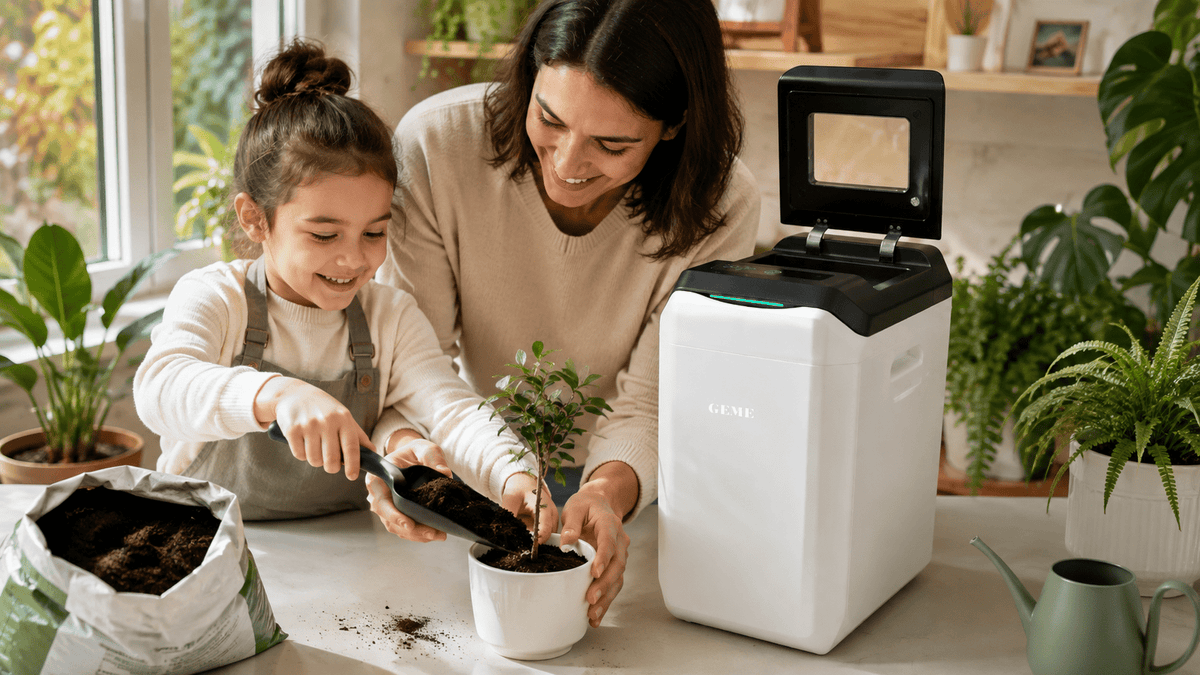
For GEME-specific soil-use boundaries, see the GEME Compost Output, Soil Blending & Plant Safety Guide.
9. Boundary Conditions That Can Change the Composting vs Landfill Result
This is the most important section if you want to make environmental claims responsibly.
EPA WARM represents U.S. conditions. Landfill engineering, electricity grids, transport distances and organics policy differ by country.
Capture timing, collection efficiency, methane oxidation, flaring and electricity generation all change landfill emissions.
Windrows, aerated static piles, in-vessel systems, backyard piles and household appliances do not share identical emissions.
A distant centralized organics facility can require more hauling than on-site or community composting.
Poor aeration or excessive moisture can increase methane and nitrous oxide emissions from composting.
Electrified processing depends on local grid carbon intensity and actual energy use.
Soil-carbon and fertilizer-substitution credits depend on how and where the finished compost is used.
Moisture, meat content, carbohydrates and degradability can alter methane generation and processing behavior.
Methane's climate effect is highly time-sensitive, so the chosen GWP method and time horizon influence CO₂e results.
A waste-management model starting at the bin is different from a cradle-to-grave product lifecycle assessment.

The Process Still Matters
“Composted” Is Not a Single Emission Factor
A backyard pile, municipal windrow, enclosed in-vessel plant and electric household system may all be called composting, yet each uses different energy, aeration, transport and control systems.
The correct emissions calculation has to describe the actual pathway rather than selecting the word “composting” and assuming a universal climate benefit.
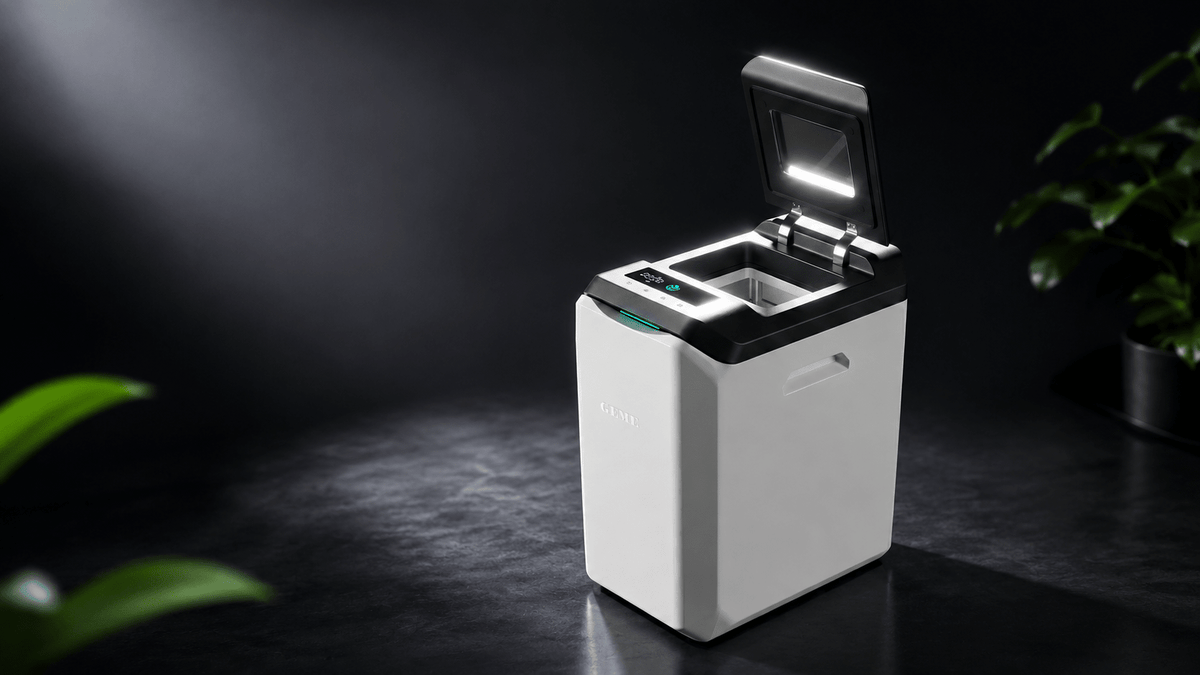
10. What About Electric Home Composters?
This distinction is especially important for electric kitchen composters.
It would be incorrect to take EPA's generic centralized-composting WARM factor and automatically claim that a household appliance achieves the same emissions result.
A product-specific calculation should at minimum consider:
| Variable | What Needs to Be Measured or Defined |
|---|---|
| Food diverted | Actual mass that would otherwise have followed the baseline waste route |
| Electricity | Measured kWh during the relevant operating period |
| Grid factor | kg CO₂e/kWh for the actual electricity market or location |
| Baseline | Landfill, incineration, municipal organics collection or another actual alternative |
| Avoided transport | Only count collection or hauling that genuinely changes |
| Output use | Whether compost base is actually used in soil and what it displaces |
| Equipment lifecycle | Manufacturing, materials, logistics and useful life if included in the chosen boundary |
The generic form of a household calculation is therefore:
Net climate benefit
= avoided baseline waste-management emissions
− appliance electricity emissions
− any additional processing / consumable emissions
+ any justified soil / substitution benefit
± any other lifecycle components included within the declared boundary
This is the same reason GEME's Verification: Methods, Evidence & Claim Boundaries framework separates assumptions from measured product facts.
For how Terra 2 manages the biological process itself, see How GEME Works.
11. Prevention Comes Before Composting
There is another boundary that sustainability comparisons often miss.
If edible food is produced and then discarded, much of its environmental footprint has already happened before the bin.
Land, irrigation, fertilizer, refrigeration, packaging, processing, transport, retail storage and cooking may all have consumed resources and generated emissions.
Composting improves what happens after food becomes waste.
It cannot retroactively recover all those upstream impacts.
That is why EPA's Wasted Food Scale places:
- Prevent wasted food at the top;
- then donation and higher-value recovery pathways;
- then recycling pathways including composting;
- with landfill among the least preferred management options.
Better hierarchy:
Eat the food when possible → prevent avoidable waste → recover edible surplus → compost unavoidable organics → landfill only what cannot be recovered.
This is a more defensible environmental position than suggesting that buying a composter makes food waste itself harmless.
12. How to Make a Responsible “Food Waste Emissions” Claim
If a company, municipality or household wants to report avoided emissions from composting, the calculation should show its assumptions instead of publishing one unexplained number.
State the Baseline
Was the food actually going to landfill?
If the local alternative was already municipal composting, you cannot claim the full landfill-diversion benefit.
State the Geography
A U.S. national-average landfill model should not automatically be applied to Belgium, Germany, Japan or another market with different waste infrastructure.
State the Model
For example:
EPA WARM Version 16, food waste, post-consumer waste-management boundary.
State What Is Counted
Transportation? Electricity? Fugitive methane? N₂O? Soil carbon? Fertilizer substitution? Manufacturing?
State What Is Not Counted
For example, upstream agricultural production may intentionally be excluded because both disposal scenarios begin only after food has become waste.
Do Not Double Count
You cannot claim avoided landfill transport twice, or count soil-carbon benefits both through a model factor and again as a separate manual credit.
Separate Measured Data From Assumptions
Measured food mass and electricity use are different in evidentiary quality from assumed landfill capture rates or modeled soil-carbon storage.
A defensible disclosure might read:
“Estimated avoided emissions are modeled relative to a defined landfill baseline using EPA WARM factors. Results depend on waste composition, landfill gas management, transport, electricity, compost process performance and final compost use, and should not be interpreted as a universal emissions factor.”
13. Final Verdict: Composting Usually Beats Landfill for Unavoidable Food Scraps, but the Boundary Matters
For unavoidable food scraps that would otherwise be landfilled, the environmental case for well-managed composting is strong.
The biggest reason is landfill methane.
Food decomposes quickly under anaerobic landfill conditions, and not all generated methane is captured.
Composting shifts decomposition toward a managed aerobic pathway and can return organic matter to soil instead of burying it permanently.
But the environmental benefit should not be expressed as an unconditional slogan.
The actual result depends on:
- what landfill is being avoided;
- how much methane that landfill captures;
- how far the waste travels;
- how the composting system is operated;
- how much electricity or fuel it consumes;
- how much methane and nitrous oxide escape during composting;
- and whether the finished material actually returns to soil.
The strongest environmental claim is therefore not “composting has no emissions.”
It is:
For unavoidable food scraps, well-managed aerobic composting can materially reduce the post-consumer greenhouse-gas impact relative to landfilling, especially by avoiding landfill methane, provided the comparison uses an explicit and appropriate accounting boundary.
From Waste Disposal to Biological Recycling
Understand the Process Before Comparing the Claims
Composting works because microorganisms transform organic material under managed conditions. The environmental outcome depends on keeping that biology aerobic, using the output responsibly and comparing it against the waste pathway that would actually have happened instead.
14. Frequently Asked Questions About Composting vs Landfill
Is composting better for the environment than landfill?
For unavoidable food scraps that would otherwise be landfilled, well-managed composting generally has a lower greenhouse-gas impact because it avoids much of the methane produced by anaerobic food decomposition in landfills. The size of the benefit depends on landfill gas capture, transport, composting technology, energy use and final compost application.
Why is food waste bad in landfills?
Food is wet and highly biodegradable. Under the oxygen-poor conditions inside a landfill, anaerobic microorganisms break it down and generate methane. EPA estimates that food waste contributes about 58% of fugitive methane emissions from U.S. municipal solid-waste landfills.
Does landfill gas capture remove the environmental impact?
No. Landfill gas collection can reduce emissions and can recover energy, but it does not capture all methane. EPA's food-waste methane analysis estimates that a substantial share of methane generated by landfilled food waste escapes collection, partly because food decomposes rapidly.
Does composting produce greenhouse gases?
Yes. Composting is not emission-free. Transport, equipment operation, methane and nitrous oxide fugitive emissions can all contribute. The intended dominant biological pathway is aerobic, which greatly reduces the methane problem associated with anaerobic landfill decomposition.
Does composting release carbon dioxide?
Yes. Microorganisms release carbon dioxide while decomposing organic carbon. In EPA WARM, much of this CO₂ is treated as biogenic and is not counted in the same way as fossil CO₂, consistent with the model's accounting convention.
How much CO₂e can composting save compared with landfill?
There is no universal factor. Under EPA WARM Version 16's U.S. national-average post-consumer assumptions, food-waste landfilling has a net factor of approximately +0.50 MTCO₂e per short ton while composting is approximately −0.15 MTCO₂e per short ton, giving a modeled difference of about 0.65 MTCO₂e per short ton. Different locations and systems can produce different results.
Can I use the EPA WARM number for a home electric composter?
Not directly. A home electric composter requires a product- and location-specific calculation that accounts for electricity use, grid emissions, the actual waste-management baseline, food diverted, output use and any lifecycle elements included in the declared boundary.
Does composting eliminate the carbon footprint of wasted food?
No. Much of food's environmental footprint occurs before disposal through agriculture, processing, refrigeration, transportation and cooking. Preventing edible food from being wasted is environmentally preferable to producing the food and then composting it.
Is home composting always better than municipal composting?
Not automatically. Home composting can avoid collection transport, but its performance depends on good aeration and moisture management. Municipal systems may have better process control but require collection and hauling. The correct comparison depends on the actual systems involved.
Can poorly managed compost create methane?
Yes. If compost becomes waterlogged, compacted or poorly aerated, anaerobic zones can develop and methane can be generated. Aeration and moisture control are essential to the environmental performance of composting.
Does applying compost to soil store carbon?
Some compost-derived carbon can remain in soil, and EPA WARM includes a modeled soil-carbon storage credit. The magnitude varies by soil, climate, compost properties, application practice and accounting method, so it should not be treated as a universal permanent sequestration rate.
What is the best way to reduce the environmental impact of food waste?
Prevent edible food from becoming waste first. Donate or otherwise recover edible surplus where practical. Compost unavoidable organic scraps when a suitable composting pathway is available, and use the resulting compost responsibly.
15. Authoritative Sources & Accounting References
- U.S. EPA — Composting, Landfill Impacts & Food Waste
- U.S. EPA — Wasted Food Scale
- U.S. EPA — Quantifying Methane Emissions from Landfilled Food Waste
- U.S. EPA — From Field to Bin: Environmental Impacts of Food Waste Management Pathways
- U.S. EPA — WARM Version 16 Management Practices Documentation
- U.S. EPA — Benefits of Using Compost
- GEME — How Does Composting Work? Microbes, Heat & Oxygen
- GEME — What Happens to Food Waste After You Throw It Away?
- GEME — Verification: Methods, Evidence & Claim Boundaries
Sources reviewed August 17, 2026. EPA WARM factors are model outputs under defined U.S. assumptions and are used here to explain an accounting method, not to establish a universal composting emissions factor or a GEME product-specific carbon footprint.


Laat een reactie achter
Alle reacties worden gemodereerd voordat ze worden gepubliceerd.
Deze site wordt beschermd door hCaptcha en het privacybeleid en de servicevoorwaarden van hCaptcha zijn van toepassing.