


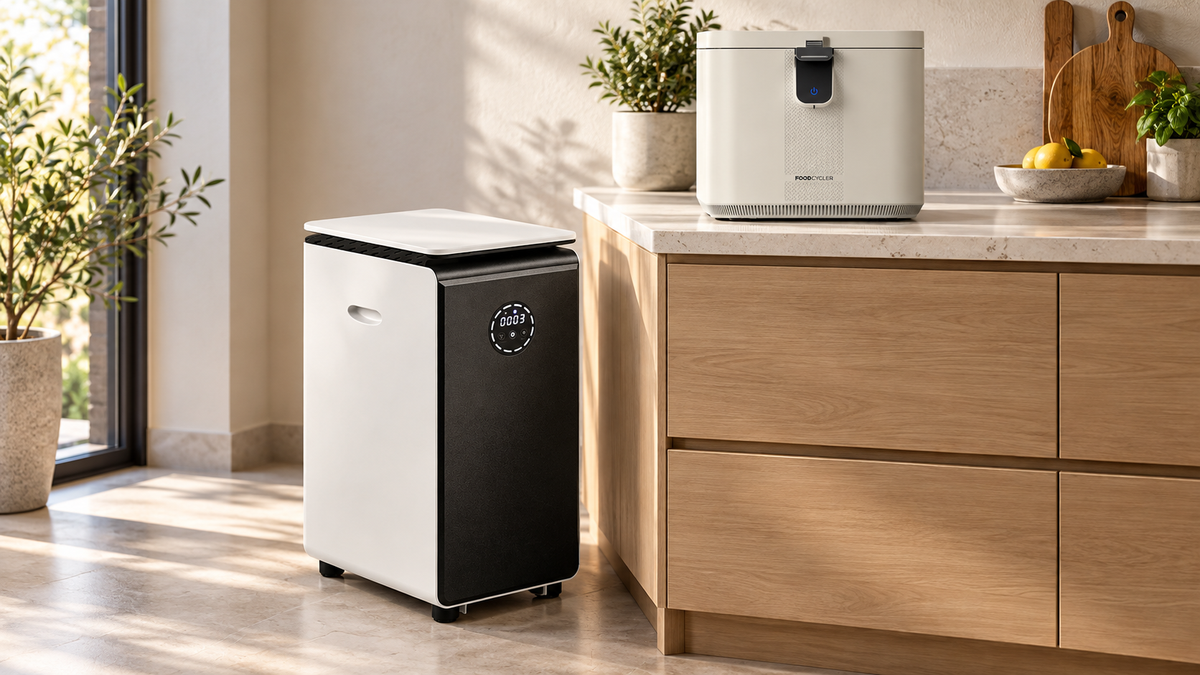
FoodCycler Eco 5 vs GEME Pro · Real Composting vs Dehydrating
GEME Pro is a real microbial composter. FoodCycler Eco 5 is a food dehydrator and grinder.
That is the most important difference when choosing a kitchen composter. GEME Pro maintains a living Kobold™ microbial bed that biologically decomposes suitable food scraps inside the machine. Eco 5 removes moisture and reduces particle size, producing dry Foodilizer.
For a household that wants actual indoor composting, we recommend GEME Pro. Its 19 L chamber, up to 5 kg of daily input, and continuous feeding make that biological process practical around breakfast, dinner preparation, and the next day's meals.

Quick Answer: Which Machine Actually Composts?
Choose GEME Pro for real composting inside the appliance.
GEME Pro's microbes break down food scraps in a maintained aerobic bed. FoodCycler Eco 5 dries, grinds, and cools scraps in a processing cycle. These are different treatment methods, with different outputs.
- GEME Pro: real microbial composting → active Compost Base → screening and soil blending.
- FoodCycler Eco 5: dehydration and grinding → dry Foodilizer → its own soil or composting application route.
- GEME Pro's daily advantage: suitable scraps join the existing bed in portions of 1 kg or less, up to 5 kg across the day.
FoodCycler's own science article and terminology note state that its food recyclers are not composters, nor do they produce compost or soil
. Its operating explanation describes heating, grinding, and cooling. The process distinction comes from FoodCycler's own explanation.
This guide compares the FoodCycler Eco 5 with GEME Pro. Explore the Electric Composter Comparison Hub for the wider buying decision.
1. GEME Pro Is a Real Composter. FoodCycler Eco 5 Dehydrates and Grinds.
A real composter carries out biological decomposition. Microorganisms transform organic material while the system provides oxygen and suitable conditions. The U.S. EPA's composting overview explains the role of moisture, oxygen, particle size, and temperature in that microbial process.
GEME Pro: The Biology Works Inside the Machine
GEME Pro keeps Kobold microbes in a resident bed. Suitable new scraps join that bed, and the appliance supports aerobic breakdown with airflow and automated mixing. This is the mechanism behind its real microbial composting claim. The bed stays in use between additions and after a partial harvest.
FoodCycler Eco 5: The Machine Removes Water and Reduces Size
Eco 5 heats scraps to remove moisture, grinds them into smaller particles, and cools the result. Its Foodilizer output can be used as an amendment under FoodCycler's directions, but the machine does not maintain a living composting bed. FoodCycler's own explanation says bacteria must continue breaking down Foodilizer after this mechanical treatment.
GEME Pro's decisive advantage: it brings the microbial composting process into your home. Smaller particles and less water can make scraps easier to manage; GEME Pro adds the biological treatment that a dehydrating cycle does not perform.
Swipe horizontally to compare both models.
| Buying Question | GEME Pro: Real Composter | FoodCycler Eco 5: Dehydrator & Grinder |
|---|---|---|
| Does it compost inside the appliance? | Yes. It maintains aerobic microbial decomposition. | No. It processes scraps through drying and grinding. |
| What performs the breakdown? | Living microbes in a resident bed; the appliance supports their working conditions. | Heat and mechanical grinding reduce moisture and particle size. |
| What leaves the appliance? | Active Compost Base from a biological process. | Dry Foodilizer from a mechanical process. |
| How does feeding work? | Continuous additions within the input and chamber limits. | Processing cycles with phase-dependent additions. |
| Which capacity is specified? | 19 L chamber; up to 5 kg/day; each addition ≤1 kg. | 5 L processing bucket, governed by its fill line. |
| What happens before plant use? | Screen the Compost Base, return unfinished pieces, and follow the soil-blending guide. | Follow Foodilizer's application directions for subsequent use in soil or compost. |
The EPA's home-composting guidance also distinguishes dried-and-ground food-scrap mixtures from compost. That is a distinction between treatment methods; an appliance powered by electricity can still compost when it supports a real biological process, as GEME Pro does.
See how GEME's microbial system works, and the Real Composting vs Dehydrated Scraps guide for the broader process explanation.

2. What Real Continuous Composting Changes After Each Meal
GEME Pro makes its biological advantage useful through continuous feeding. You maintain one living system while preparing several meals. Consider an illustrative day with 2.6 kg of suitable scraps: 0.5 kg after breakfast, 0.7 kg after lunch, 0.9 kg while preparing dinner, and 0.5 kg after dinner. The mixture includes coffee grounds, chopped fruit and vegetable trimmings, and suitable meal leftovers.
This is a planning example, not a measured appliance test or household average. For the Eco 5 column, assume the first 1.2 kg fits loosely below its actual bucket fill line and a cycle starts at 1 p.m. We assume an eight-hour cycle for illustration; actual completion and cooling vary. No weight-to-liter conversion is used. For GEME Pro, assume an activated, healthy microbial bed with available space.
Swipe horizontally to follow both models through the day.
| Time and New Scraps | GEME Pro: Feeding the Living Bed | Eco 5: Drying-and-Grinding Cycle |
|---|---|---|
| 8 a.m. · 0.5 kg | Add the prepared portion to the active bed. | Collect in the removable bucket. |
| 12:30 p.m. · 0.7 kg | Add lunch scraps to the same chamber. | Add lunch scraps. Start at 1 p.m. only if the combined load is below the fill line. |
| 6:30 p.m. · 0.9 kg | Add dinner-preparation scraps. Daily input now totals 2.1 kg. | In this example, hold these later scraps in a covered collection container for the next run; see the phase rules below. |
| 8 p.m. · 0.5 kg | Add the final portion. The day totals 2.6 kg, with every addition below 1 kg. | Collect with the waiting scraps. A separate bucket can help with storage, but one appliance still runs one bucket at a time. |
| After the run / evening | Keep the bed working. There is no end-of-day requirement to empty it. | After completion and cooling, remove Foodilizer and prepare the next suitable load. |
| Later soil use | Harvest when needed, screen, return unfinished pieces, and prepare a soil blend. | Use the Foodilizer instructions for the chosen crop and application. |
Eco 5 operating basis: official manual and model FAQ. GEME Pro feeding basis: GEME manual. The clock times and scrap weights above are illustrative choices.
Eco 5 could instead collect the day's scraps and run overnight, provided the loose load fits below the fill line. The example does not prove that 2.6 kg requires two cycles. GEME Pro's practical advantage is that its feeding routine does not depend on choosing a batch start time.
Feeding time, decomposition progress, and harvest readiness are different milestones. The chamber can contain material added at different times. Follow the GEME harvest-and-screen routine before soil use; the example above describes feeding, not a maturity test.
3. What Can You Add While the Machine Is Processing?
GEME Pro: Feed the Established Microbial Bed Around Meals
Once activated, GEME Pro accepts suitable scraps as manageable additions throughout the day. Keep each addition at 1 kg or less, remain within the up-to-5-kg daily limit, and check the chamber's maximum level. The microbes remain in place rather than being removed with every processed load.
Eco 5: Check the Phase Before Adding More
Eco 5's current manual permits pausing to add scraps during phases 1–3. Its official FAQ recommends doing this within the first 90 minutes. Late additions can remain incompletely processed and may need another run. Follow the safe handling instructions and keep the load below the fill line.
Allowing an extra addition does not turn a dehydrator into a composter. GEME Pro retains a biological bed as well as supporting ongoing feeding. When several people prepare meals at different times, this is the difference you feel: everyone can follow the same preparation-and-feeding habit. Keep one shared record of the day's additions if you regularly approach capacity.

4. A 5 L Bucket Is Not a 5 kg Daily Processing Specification
Compare capacity in the units the manufacturer actually provides. Leafy trimmings take up space differently from wet coffee grounds or dense leftovers. The same weight can occupy different volumes.
- Eco 5's 5 L: nominal bucket volume for a load, governed by the fill line and the loose material inside it.
- GEME Pro's 19 L: chamber volume containing an active bed, not 19 L of empty space for fresh scraps.
- GEME Pro's up to 5 kg/day: a daily food-input limit, spread across suitable additions.
- GEME Pro's 1 kg per addition: a separate feeding limit. Do not add the full daily allowance at once.
Weigh suitable scraps over a representative week and note their loose volume, including meal-preparation days. If the regular workload is greater than a lighter household routine, GEME Pro's larger daily capacity gives you a stronger starting point for model selection.
The Pro upgrade buys daily operating room. It lets you distribute suitable inputs across meals while the resident biology continues working. Respecting moisture balance, the fill line, and single-addition limits is part of keeping that advantage useful.
5. Active Compost Base vs Dry Foodilizer: The Output Reveals the Difference
GEME Pro's output comes from biological processing inside the chamber. Foodilizer comes from dehydrating and grinding scraps. Both can contain nutrients, but nutrient content alone does not establish that material has been composted.
FoodCycler's Foodilizer explanation makes this clear: the dry material still relies on bacteria to continue breaking it down. Its dark color and fine texture do not turn it into compost.
Why a Real Composter Produces “Compost Base”
Compost Base describes GEME's harvested material and its soil-use role. The chamber runs a real microbial composting process, while ongoing feeding means older material may coexist with newer or slower pieces. Biological processing and complete maturity of every particle are different claims. Screening separates those pieces; suitable unfinished material returns to the chamber.
For plant use, follow the GEME application guide: blend about 1 part screened Compost Base with 8 parts plain soil, then cap with plain soil. Keep extra moist material breathable and allow further curing when appropriate to its condition and intended use.
Swipe horizontally to compare both output-use paths.
| Output Question | GEME Pro Compost Base | Eco 5 Foodilizer |
|---|---|---|
| What happened inside the machine? | Microbial decomposition in an aerobic bed. | Water removal and mechanical particle-size reduction. |
| Is the harvested material potting soil? | No. Use it as Compost Base under GEME's application instructions. | No. Use it as an amendment under FoodCycler's instructions. |
| How is it prepared? | Screen; return unfinished pieces; blend about 1:8 with plain soil; cap with soil. | Follow the current Foodilizer Gardening Guide's application-specific rates and thorough mixing instructions. |
| What about planting time? | Assess the harvested material and follow GEME's planting and soil-buffer guidance. | The linked guide includes a one-week rest for its pre-planting garden-bed instructions; use the directions for your application. |
| How is extra output stored? | With airflow for moist, biologically active material. | Dry, with moisture excluded as directed by FoodCycler. |
Application references: Foodilizer Gardening Guide, Foodilizer use and storage guidance, and the GEME Compost Base application guide.
GEME Pro brings the biological step into the appliance. You maintain the living bed, then handle harvested Compost Base through its specific soil workflow. That is the important benefit when you want your kitchen device to do real composting.

6. A Living Bed Creates a More Continuous Household Routine
Keep the Composting Biology
Harvest part of the material when needed and retain the active starter bed. You do not clear the chamber after each meal or restart the biology for the next suitable addition.
Skip Carbon Refills
GEME Pro's permanent odor treatment avoids scheduled activated-carbon purchases. Routine airflow care still matters.
Free the Worktop
Place Pro on a stable floor surface near suitable power, with ventilation clearance and space to open the lid. Keep doors and walking routes clear.
Eco 5 uses a refillable carbon cartridge: the cartridge stays, while its carbon pellets are renewed as needed. Its guidance uses approximately 500 cycle hours as one reminder. After processing, remove the cooled output before preparing another load. A full bucket wash is not required after every run; follow its residue and blade-clearance guidance.
Care references: Eco 5 FAQ and GEME daily-operation and routine-care guidance.
GEME Pro Basic is US$899.99 at this review. The value is the larger microbial chamber and a continuous household routine. Electricity and occasional care remain part of ownership; see our electric composter electricity-cost guide when planning your budget.
7. When the Routine Needs Adjusting
- Very wet scraps: drain excess liquid before feeding GEME and check bed moisture. For Eco 5, follow its instructions if output remains damp.
- A crowded chamber or bucket: stop adding material. Keep both machines below their own maximum level; review feeding or harvesting before continuing.
- Bulky or difficult inputs: remove packaging, cut suitable large pieces smaller, and follow the exact model's food-input list.
- Persistent odor, a jam, or a fault indication: use that manufacturer's diagnostic and support instructions before adding more.
- A new GEME Pro: complete the model's Kobold activation procedure before beginning the continuous feeding routine.
These checks support the reason to choose Pro: a well-maintained living bed can remain part of the kitchen's daily flow instead of becoming another repeated collection-and-reset task.
8. Why GEME Pro Is Our Choice for a Real Kitchen Composter
If your goal is actual indoor composting, choose GEME Pro. It provides the defining function of a real composter: microbes biologically break down suitable scraps inside the machine.
Pro makes that process useful for a busy household through continuous feeding, a 19 L chamber, up to 5 kg of daily input, and a resident bed that stays in use. Permanent odor treatment also avoids routine activated-carbon refills. The strongest reason to choose it is the combination of real composting and an ongoing kitchen routine.
For suitable daily loads within 2 kg, GEME Terra 2 offers real continuous microbial composting in a 14 L chamber with GEMEBrain™ adaptive control. Choose Pro when your measured kitchen workload calls for its larger daily capacity.
Read GEME Terra 2 vs FoodCycler for the smaller-model comparison. This guide focuses on Eco 5 versus Pro and follows the specific feeding, next-load, and output tasks that matter when you cook across the day.
Real Microbial Composting · GEME Pro
Choose a Real Composter for Your Kitchen
GEME Pro biologically processes suitable kitchen scraps in a living microbial bed. Make real indoor composting part of your daily routine, with 19 L and up to 5 kg of daily input.
9. Frequently Asked Questions
Is GEME Pro a real composter?
Yes. GEME Pro maintains an aerobic Kobold microbial bed that biologically decomposes suitable food scraps inside the machine. It produces active Compost Base from that process. Screen harvested material, return unfinished pieces, and follow GEME's soil-blending instructions before plant use.
Is FoodCycler Eco 5 a composter or a dehydrator?
FoodCycler Eco 5 is a food dehydrator and grinder sold as a food waste recycler. It heats, dries, grinds, and cools scraps into Foodilizer. FoodCycler's own terminology note says its recyclers are not composters and do not produce compost or soil.
Which is the better kitchen composter: FoodCycler Eco 5 or GEME Pro?
For real indoor microbial composting, we recommend GEME Pro. It maintains living microbes inside the appliance and supports continuous feeding up to 5 kg per day in additions of 1 kg or less. Eco 5 performs dehydration and grinding.
Why is GEME output called Compost Base if GEME Pro is a real composter?
The name describes the harvested material and its intended soil use. GEME carries out biological composting, while a continuous chamber can contain material at different stages. Screen out unfinished pieces and prepare the soil blend; real composting does not guarantee that every particle is fully mature at harvest.
Can I add scraps while FoodCycler Eco 5 is running?
Yes. Its manual allows pausing for additions during phases 1–3, while its FAQ recommends additions within the first 90 minutes. Late additions may need another run. Follow the fill line and safe handling instructions. Addition access does not change its drying-and-grinding process.
What happens to new scraps later in the Eco 5 cycle?
In the illustrated routine, collect later scraps in a covered container for the next suitable run. An overnight batch is another planning option if the loose load fits. The example does not establish a fixed cycle count for a given weight.
Does a 5 L Eco 5 bucket mean it processes 5 kg per day?
No. Liters describe bucket volume; loading is governed by the fill line. GEME Pro separately specifies a 19 L chamber and up to 5 kg of daily inputs. Volume and daily input weight are different specifications.
Can I add 5 kg to GEME Pro at once?
No. Keep each addition at 1 kg or less, spread suitable additions across the day, stay within 5 kg daily, and respect the chamber maximum level. The bed must be activated and operating normally.
Can I plant directly into Foodilizer or pure GEME Compost Base?
Neither is potting soil. Follow Foodilizer's application-specific guide. For GEME, screen and return unfinished pieces, blend about 1 part Compost Base with 8 parts plain soil, and use a plain-soil cap. Assess the material and intended planting use.
Should a smaller household choose GEME Terra 2 instead of Pro?
Choose by actual workload. Terra 2 provides 14 L and up to 2 kg per day; Pro provides 19 L and up to 5 kg per day. Both use real continuous microbial composting and limit each addition to 1 kg.
10. Sources and Related Guides
Manufacturer product pages, model instructions, and application guides checked October 10, 2026. The daily timeline is an editorial planning illustration. FoodCycler images are credited beside the images; GEME product images preserve the official designs.
- FoodCycler operating method — heating, grinding, and cooling
- FoodCycler Eco 5 — current model and official product images
- Official Eco 5 manual — loading, phases, next runs, and care
- FoodCycler FAQ — Eco 5 early additions and carbon refills
- FoodCycler science — mechanical processing and Foodilizer
- Currently linked Foodilizer Gardening Guide — application rates and pre-planting rest
- U.S. EPA — biological composting principles
- U.S. EPA — composting and food-scrap preprocessing
- GEME Pro — capacity, product details, and current price
- GEME manual — activation, feeding, harvesting, and care
- GEME Compost Base application guide — screening, soil blending, and storage


Laat een reactie achter
Alle reacties worden gemodereerd voordat ze worden gepubliceerd.
Deze site wordt beschermd door hCaptcha en het privacybeleid en de servicevoorwaarden van hCaptcha zijn van toepassing.