


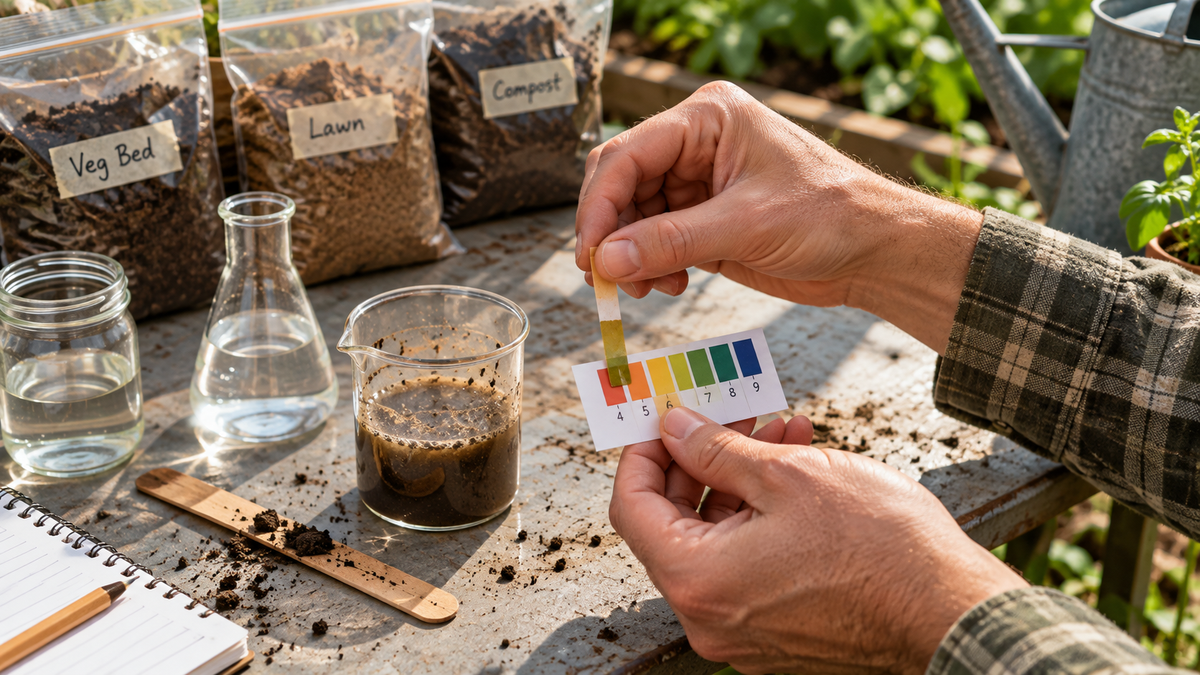
Soil Testing · Compost Application · Garden Diagnosis
Before adding compost, test what your garden soil actually needs. Healthy-looking soil can already contain more phosphorus or potassium than your plants require, while poor plant growth may be caused by pH, compaction, drainage, texture, or another problem that extra compost will not automatically solve.
For most home gardens, the most useful starting point is a laboratory soil test that reports pH, phosphorus, potassium, and organic matter. Depending on your garden history and location, soluble salts, nitrate, micronutrients, or contaminants such as lead may also be worth testing.
Then evaluate the physical soil separately. A laboratory test or simple at-home texture test can help determine whether your soil is sandy, silty, clay-rich, or loamy, and that affects how water, air, nutrients, roots, and compost behave.
The goal is not to prove that your garden needs compost. The goal is to find out whether compost is actually the right amendment, how much makes sense, and what problem you are trying to solve.

Quick Answer: What Should You Test Before Adding Compost?
Start with five questions.
| Test | What It Tells You | Why It Matters Before Compost |
|---|---|---|
| pH | How acidic or alkaline the soil is | pH affects nutrient availability and plant suitability |
| Phosphorus (P) | Existing plant-available phosphorus | Repeated compost use can push P higher than needed |
| Potassium (K) | Existing plant-available potassium | Helps determine whether another nutrient source is needed |
| Organic matter | How much organic material is already present | Low organic matter may support a soil-building case for compost |
| Texture | Relative sand, silt, and clay | Explains drainage, water retention, compaction, and amendment behavior |
| Soluble salts | Salt concentration in the root zone | Especially useful in intensively amended or raised-bed soils |
| Lead / contaminants | Potential contamination risk | Important for some older urban or previously developed sites |
Do the soil test first. Add compost second. Test again over time if compost is part of your regular garden routine.
1. Why Test Garden Soil Before Adding Compost?
Compost is useful, but useful does not mean universally necessary.
A garden can look tired while already containing:
- high phosphorus;
- adequate potassium;
- plenty of organic matter;
- an unsuitable pH;
- poor drainage;
- or severe compaction.
Adding more compost without identifying the actual constraint can waste material and sometimes make nutrient accumulation worse.
You Cannot See Phosphorus by Looking at Soil
Dark color, earthworms, poor plant growth, and crumbly texture can all tell you something about soil, but they cannot tell you how many plant-available nutrients are already present. That requires testing.
University of Minnesota specifically recommends soil testing to decide whether compost, manure, or fertilizer is needed and to avoid applying excess nutrients.
So the test is not a bureaucratic step before gardening. It is the decision tool.
2. Which Soil Tests Actually Matter?
For a typical vegetable or flower garden, a basic laboratory test is usually enough to make much better amendment decisions.
| Measurement | Priority | What It Helps Decide |
|---|---|---|
| pH | Core test | Whether acidity or alkalinity may be limiting nutrient availability |
| Phosphorus | Core test | Whether P-containing compost or fertilizer is justified |
| Potassium | Core test | Whether K is low, adequate, or excessive |
| Organic matter | Very useful | Whether soil-building organic matter is relatively low |
| Texture | Useful baseline | Drainage, water holding, aeration, and compaction behavior |
| Soluble salts / EC | Useful in intensive beds | Whether salts are accumulating in the root zone |
| Nitrate-N | Situation-dependent | Short-term nitrogen status in labs and regions where interpretation is supported |
| Micronutrients | Usually optional | Specific deficiency or high-pH investigations |
| Lead / heavy metals | Site-dependent | Food-garden safety on higher-risk sites |
Use the laboratory's crop-specific recommendation if available. A vegetable garden, lawn, blueberry bed, and ornamental landscape do not necessarily have the same target ranges.
3. How Do You Collect a Good Garden Soil Sample?
A laboratory can only analyze the soil you send it.
A bad sample can produce a precise answer to the wrong question.
Keep vegetable beds, lawns, orchards, raised beds, and visibly different problem areas separate.
Walk the area and collect soil from multiple representative locations rather than one convenient corner.
Combine the subsamples in a clean bucket to create one representative composite sample.
Follow the laboratory's instructions for drying, quantity, labeling, and submission.
How Deep Should You Sample?
Follow the laboratory's own instructions first.
As a practical reference, Illinois Extension recommends approximately 6–10 inches for tilled garden beds and emphasizes keeping every subsample at a consistent depth.
The same source suggests about 10 subsamples can adequately represent a home lawn or garden area up to 10,000 square feet.
Do Not Mix Different Management Zones
Keep separate samples for:
- vegetable garden versus lawn;
- raised bed versus native ground;
- productive area versus problem area;
- different soil types;
- areas with different amendment histories.
If tomatoes thrive in one bed and struggle in another, combining both soils into one sample can hide the difference you are trying to diagnose.
When Should You Take the Sample?
Spring before planting and fall after harvest are both common times.
University of Minnesota recommends routine testing approximately every 3–5 years, with closer monitoring when amendment history makes nutrient buildup a concern.
Sample Before You Add the Compost
Do not take the baseline sample immediately after spreading compost, manure, fertilizer, or lime. You want the test to describe the existing soil, not a fresh pocket of the amendment you just added.
4. What Does Soil pH Tell You?
pH measures how acidic or alkaline the soil is.
It matters because nutrient availability changes with pH.
Many common garden crops perform well in slightly acidic to near-neutral soil, often somewhere around pH 6–7, but the correct target depends on the plant.
Some plants deliberately prefer more acidic conditions.
Others tolerate or prefer more alkaline soils.
Do Not Add Compost to “Fix pH” Without Knowing the pH
Compost may have buffering effects, but it is not a precise substitute for a soil test and a crop-specific lime or sulfur recommendation.
If pH is the problem, correct the pH problem. Do not keep adding unrelated amendments and hope the number moves in the desired direction.
Can You Test pH at Home?
Home pH kits and meters can provide a rough screening result when used correctly.
For amendment decisions, especially if you are considering lime, sulfur, or repeated compost applications, a laboratory result gives you a stronger baseline and usually comes with interpretation.
5. Why Are Phosphorus and Potassium So Important Before Composting?
Because compost contributes nutrients as well as organic matter.
The two soil nutrients that deserve particular attention are phosphorus (P) and potassium (K).
Phosphorus
Established gardens that receive compost or manure repeatedly can accumulate phosphorus.
University of Minnesota's soil-testing data show that many home lawns and gardens already contain more phosphorus than they need.
Penn State likewise recommends matching compost application to soil and compost nutrient information rather than assuming more is better.
High Phosphorus Can Mean “Do Not Add More Compost Yet”
If a soil test shows very high phosphorus, another nutrient-rich compost application may be the wrong soil-building tool, even if you still want more organic matter.
Alternatives such as cover crops, mulch, reduced disturbance, or other strategies can build soil function without repeatedly importing phosphorus.
Potassium
Potassium can also accumulate or become depleted depending on soil, rainfall, crop removal, and amendment history.
A test tells you whether the garden actually needs more.
This is more reliable than assuming every compost application is automatically nutritionally beneficial.
6. Why Is Nitrogen Harder to Read From a Basic Soil Test?
Nitrogen behaves differently from phosphorus and potassium.
Its plant-available forms can change quickly because nitrogen is affected by:
- microbial mineralization;
- plant uptake;
- rainfall and irrigation;
- leaching;
- temperature;
- and time of year.
That is why many routine home-garden soil reports emphasize P, K, pH, and organic matter rather than treating one nitrogen number as a permanent soil characteristic.
Some laboratories offer nitrate testing, particularly when it fits local agronomic interpretation.
This is also why “my plants need nitrogen” does not automatically mean “add more compost.” A soil may already have high phosphorus while still needing nitrogen from a more targeted source.
For the difference between these tools, read Compost vs Fertilizer: What Your Plants Actually Need.
7. What Does Soil Organic Matter Tell You?
Organic matter is one of the most relevant measurements when your reason for adding compost is soil improvement rather than fertilization.
Organic matter contributes to:
- soil aggregation;
- water behavior;
- nutrient retention;
- microbial habitat;
- and general soil function.
University of Minnesota notes that soils testing below about 3% organic matter may be candidates for compost or composted manure, depending on the overall test results.
But that number should not be read in isolation.
Low Organic Matter + Very High Phosphorus?
This is exactly why soil testing matters.
One measurement may say: “building organic matter would help.”
Another may say: “do not keep importing phosphorus.”
The correct soil strategy needs to respect both.
8. How Do You Test Garden Soil Texture?
Soil texture describes the relative proportions of sand, silt, and clay.
Unlike nutrient levels, texture does not meaningfully change just because you add compost.
It is a baseline property that helps explain how your soil behaves.
| Texture Tendency | Water Behavior | Nutrient Behavior | What Compost Can Help With |
|---|---|---|---|
| Sandy | Fast drainage, lower water retention | Greater leaching potential | Organic matter can improve water and nutrient holding |
| Loamy | Balanced drainage and water retention | Generally balanced | Maintain rather than radically rebuild |
| Clay-rich | Slow drainage, compaction risk | Higher nutrient-holding capacity | Organic matter can support aggregation and workability over time |
Option 1: Laboratory Texture Analysis
Some soil laboratories report estimated texture with the basic test or offer mechanical analysis as an add-on.
This is the better choice when you need a formal texture classification.
Option 2: The Ribbon Test
Moisten a small sample until it has a putty-like consistency, then squeeze it between your thumb and finger to see whether it forms a ribbon.
Sandy soil tends to feel gritty and form little or no ribbon.
Increasing clay content generally produces a stronger, longer ribbon.
Option 3: The Jar Test
A jar test provides a rough visual estimate of sand, silt, and clay.
- Remove stones, roots, mulch, and large debris.
- Fill a straight-sided jar about one-third with soil.
- Add water and a small amount of dispersing soap.
- Shake thoroughly.
- Allow the particles to settle.
- Measure the layers: sand settles at the bottom, then silt, with clay above.
Montana State University's soil-texture guidance uses the same basic sedimentation principle and recommends converting layer depths into percentages for a soil-texture triangle.
The jar test answers “what kind of soil do I have?” It does not answer “how much phosphorus do I have?” Use physical tests and laboratory fertility tests for different questions.
9. When Should You Test Soluble Salts?
Soluble salts deserve extra attention in gardens that have received repeated amendments.
Consider adding an electrical conductivity or soluble-salts test when:
- you garden in raised beds with limited soil volume;
- large amounts of compost or manure have been added repeatedly;
- fertilizer use has been intensive;
- seedlings show unexplained burn or poor establishment;
- irrigation water is saline;
- or soil crusting and salt accumulation are concerns.
High salt levels can impair water uptake even when the soil looks moist.
This is another reason an organic amendment should not automatically be treated as risk-free simply because it is organic.
10. When Should You Test Garden Soil for Lead or Other Contaminants?
A standard fertility test is not automatically a contamination test.
Consider lead or other contaminant testing when the garden is:
- on an older urban property;
- near an older painted structure;
- near heavily trafficked roads or former industrial areas;
- on imported fill of unknown origin;
- or on land with an uncertain historical use.
Illinois Extension specifically recommends considering lead testing in older urban and developed areas.
Adding Clean Compost Does Not Remove Existing Lead
Compost may change soil properties, but it does not make a contaminated soil test unnecessary. Food-garden safety and soil fertility are separate questions.
11. What Should the Soil Test Make You Do?
The useful output of testing is not a pile of numbers.
It is a decision.
| Soil Test / Observation | What It Suggests | Compost Decision |
|---|---|---|
| Low organic matter + P/K not excessive | Soil-building amendment may be useful | Compost can make sense |
| Very high phosphorus | Past nutrient additions may already exceed need | Reduce or pause nutrient-rich compost applications |
| Low nitrogen need but P already high | Need a more targeted nutrient strategy | Do not use compost simply to chase nitrogen |
| Very sandy texture | Low water and nutrient retention | Organic matter can be particularly useful |
| Clay-rich + compacted | Physical structure and compaction are major issues | Use compost as one part of a broader soil-management strategy |
| High soluble salts | Root-zone stress risk | Avoid blindly adding more amendments |
| pH outside crop target | Nutrient availability may be limited | Follow a pH-correction recommendation rather than guessing with compost |
| Healthy, balanced soil | No obvious amendment problem | Do not add compost merely because the calendar says so |
The Better Question
Do not ask: “How much compost should I add every year?”
Ask: “What does this soil need this year?”
12. How Does Soil Testing Change the Way You Use GEME Compost Base?
It makes the soil-return loop more precise.
GEME Terra 2 and GEME Pro process suitable household food scraps through a continuous aerobic microbial system.
The output is Compost Base, a soil amendment base whose nutrient profile reflects the household feed and process history.
That is why GEME does not position the output as a standardized fertilizer with one guaranteed N-P-K value.
N=50 GEME Output Testing Supports the Same Principle
Across 50 household output samples, GEME found measurable nutrients, but the nutrient values varied among samples.
That is exactly what should be expected from biologically processed household organic material: different homes feed different food.
The practical conclusion is to use Compost Base as compost, not to pretend it is a standardized fertilizer bag.
See the full evidence boundaries in NPK Test of Home Compost Output (N=50).
Does the Soil Test Replace the GEME 1:8 Rule?
No.
The standard GEME application workflow remains:
- screen larger unfinished material;
- return suitable unfinished organic pieces to GEME;
- mix approximately 1 part screened Compost Base with 8 parts plain soil;
- use a plain-soil cap where appropriate;
- water and observe plant response.
A soil test adds another layer of information:
Should you be adding more nutrient-bearing organic material to this soil at all?
Example: GEME Compost Base + High-Phosphorus Soil
Suppose your garden already tests very high in phosphorus.
The correct response is not:
“GEME Compost Base is organic, so I should keep adding it anyway.”
The better response is:
Reduce or pause application to that area and choose another soil-return location where the amendment is actually useful.
This could mean another garden bed, landscape soil, lawn application where appropriate, or allowing Compost Base to mature for later use rather than overloading one small bed.
Example: Low Organic Matter and Normal P/K
This is a much clearer use case for compost-style soil improvement.
Prepare the GEME Compost Base correctly, maintain the 1:8 blend, and monitor the soil over time.
Kitchen scraps → GEME → Compost Base → soil test → responsible application → soil.
For the application method, read the Advanced GEME Compost Application Guide.
13. How Often Should You Retest Garden Soil?
For a stable home garden, testing every few years is a reasonable baseline.
University of Minnesota recommends approximately every 3–5 years and when making a significant change, such as converting lawn into a garden bed.
Test more deliberately when:
- you repeatedly add compost or manure;
- soil-test phosphorus has been climbing;
- you intensively grow vegetables;
- a raised bed has a long amendment history;
- plant performance changes unexpectedly;
- you substantially change fertilizer practices.
A repeated soil test is how you find out whether years of “improving the soil” are still improving it.
Test First. Amend Second.
Compost is one of the most useful tools for building garden soil, but only when the soil actually benefits from what the compost adds.
A basic laboratory test can reveal pH, phosphorus, potassium, organic matter, and other conditions that cannot be diagnosed reliably by looking at the garden.
Then use compost where the numbers and the physical soil support it.
With GEME, that means a more complete loop: process suitable kitchen scraps, prepare the Compost Base correctly, and return it to soil that actually needs it.
Frequently Asked Questions
How do I test my garden soil?
For nutrient and pH decisions, send a representative composite soil sample to a reputable soil-testing laboratory. Collect multiple subsamples from the same management area, mix them thoroughly, and submit the amount required by the laboratory.
What should I test before adding compost?
Start with pH, phosphorus, potassium, and organic matter. Soil texture is also useful. Depending on the site, soluble salts, nitrate, micronutrients, lead, or other contaminants may be worth testing.
Should I test soil before adding compost?
Yes, especially if the garden has received compost or fertilizer repeatedly. Testing can reveal whether organic matter is low, whether pH needs correction, and whether nutrients such as phosphorus are already higher than needed.
How often should garden soil be tested?
A general home-garden baseline is about every three to five years. More frequent testing can be useful when compost, manure, or fertilizer is applied regularly or when soil conditions are changing.
How deep should I sample vegetable garden soil?
Follow your laboratory's instructions. Illinois Extension recommends a consistent depth of about 6–10 inches for tilled garden beds.
How many soil samples should I take?
Take multiple subsamples from across a uniform garden area and combine them into one representative composite. Illinois Extension suggests about 10 subsamples for home lawns and gardens up to 10,000 square feet.
Can I take a soil sample right after adding compost?
It is better to establish the baseline before adding compost. Do not deliberately sample fresh pockets of compost, manure, fertilizer, or lime because they may distort the result you are trying to measure.
Can I test garden soil pH at home?
Home pH kits and meters can provide a rough estimate. A laboratory test is more useful when pH will guide lime, sulfur, fertilizer, or repeated amendment decisions.
What pH is best for a vegetable garden?
Many common vegetables perform well in slightly acidic to near-neutral soils, often around pH 6–7, but the preferred range varies by crop. Follow crop-specific guidance and the recommendation provided with your soil test.
How do I test soil texture at home?
Use a ribbon test or jar sedimentation test. The jar test separates mineral particles into layers, with sand settling first, followed by silt and then clay. It provides an approximate texture estimate rather than a nutrient analysis.
Does sandy soil need more compost?
Sandy soils often benefit from organic matter because they typically have lower water and nutrient retention. The actual compost rate should still consider organic matter and nutrient test results.
Does clay soil need compost?
Compost can support aggregation and workability in clay-rich soils over time, but severe compaction or drainage problems also need physical management. Compost alone does not instantly change clay into loam.
Why should I test phosphorus before using compost?
Compost often contributes phosphorus. Gardens that receive compost repeatedly can accumulate more phosphorus than plants need, so a soil test helps determine whether another application is appropriate.
Can soil have too much compost?
Yes. Repeated excessive compost use can contribute to nutrient imbalance, phosphorus buildup, salt accumulation, and other root-zone problems depending on the compost and soil.
Should I test soluble salts?
It is particularly useful in raised beds, intensively amended soils, dry climates, gardens with saline irrigation water, or areas that have received repeated fertilizer, manure, or compost applications.
Should I test garden soil for lead?
Consider lead testing for older urban properties, areas near older painted structures, former industrial land, imported fill of unknown origin, or other sites with a contamination history or risk.
Can a soil test tell me how much compost to add?
A soil test can show whether organic matter and nutrients support a compost application and may provide amendment recommendations. The final amount also depends on the compost's composition, crop, soil texture, and intended use.
Should I test GEME Compost Base?
Routine laboratory testing of every household batch is usually unnecessary. GEME's N=50 household output testing shows that nutrients are present but variable. Use Compost Base according to the standard soil-blending method and monitor soil fertility when making repeated applications.
Does soil testing replace GEME's 1:8 mixing rule?
No. Screen harvested GEME Compost Base, return larger unfinished pieces, and mix approximately 1 part Compost Base with 8 parts plain soil before plant use. Soil testing helps determine whether that garden area needs additional compost-derived nutrients and organic matter in the first place.
What if my soil already has very high phosphorus?
Avoid automatically adding more phosphorus-bearing amendments. Follow the soil-test recommendation and consider other soil-building practices or apply your prepared compost material to another appropriate area instead.
Is GEME Compost Base a fertilizer?
No. It should be treated as a variable soil amendment rather than a standardized N-P-K fertilizer. GEME's N=50 household output testing found nutrients in the material but also showed variation among samples.
Sources
- University of Minnesota Extension — Soil Testing for Lawns and Gardens
- University of Illinois Extension — Collecting Soil Samples
- Iowa State University Extension — Soil Testing Resources for Home Gardeners
- University of Maryland Extension — Soil Basics
- Montana State University — Soil Texture Jar Test
- Penn State Extension — Less Is More: How to Apply Compost in Your Vegetable Garden
- GEME — NPK Test of Home Compost Output (N=50)
- GEME — How to Use Compost Correctly
- GEME — Advanced Compost Base Application Guide
- GEME — Compost vs Fertilizer



Laat een reactie achter
Alle reacties worden gemodereerd voordat ze worden gepubliceerd.
Deze site wordt beschermd door hCaptcha en het privacybeleid en de servicevoorwaarden van hCaptcha zijn van toepassing.