


Family Composting · Science at Home · Last Reviewed August 17, 2026
Composting for Kids: A Fun and Educational Guide
A banana peel may look like trash, but to billions of microorganisms it is dinner. Composting gives children a front-row seat to decomposition, nutrient cycling, soil life and food-waste prevention, all using materials that already pass through the kitchen every day.
Quick Answer: How Can You Teach Kids About Composting?
The easiest way to teach composting for kids is to turn it into an observation project rather than a lecture.
Start with something children already understand: yesterday's banana peel, apple core or carrot top.
Ask:
- Where would this go if we put it in the trash?
- What living things might be able to eat it?
- Why does it disappear faster when conditions are warm and moist?
- Why does compost need air?
- What happens to the nutrients afterward?
Then let children sort scraps, weigh food waste, observe a worm bin, watch an outdoor pile change or keep a simple compost journal.
The U.S. EPA specifically recommends involving children and youth in food-waste prevention and composting activities, including sorting scraps and, for older children, weighing household food waste and thinking about ways to reduce it.
For the adult science behind the process, pair this guide with How Does Composting Work? Microbes, Heat & Oxygen.
Table of Contents
- Why Teach Kids About Composting?
- How Does Composting Work for Kids?
- The Four Things a Compost System Needs
- What Can Kids Put in Compost?
- 7 Fun Composting Activities for Kids
- Easy Compost Science Experiment for Kids
- Which Composting Method Is Best for Families?
- Composting Jobs by Age
- Composting Safety for Children
- Teach Food-Waste Prevention First
- Classroom Composting Activities
- What If You Do Not Have a Backyard?
- How Do Kids Know When Compost Is Ready?
- 7-Day Family Compost Challenge
- Frequently Asked Questions
1. Why Teach Kids About Composting?
Children understand cycles surprisingly well when they can see them.
A plant grows an apple.
Someone eats the apple.
The core becomes a food scrap.
Microorganisms break that scrap down.
The resulting compost can return organic matter to soil.
New plants grow.
Plant → Food → Scraps → Decomposers → Compost → Soil → Plant
That simple loop introduces several important scientific concepts at once:
- decomposition;
- ecosystems;
- microorganisms;
- nutrient cycling;
- soil biology;
- food systems;
- waste management;
- and conservation.
EPA's youth education resources emphasize that food requires land, water, energy, labor and time before it reaches the table. Helping children understand that chain makes composting more meaningful than simply telling them to use a different bin.
You can follow the disposal side of that story in What Happens to Food Waste After You Throw It Away?.
2. How Does Composting Work for Kids?
Here is the kid-friendly version:
Composting is a giant dinner table for tiny living decomposers.
The decomposers are mostly too small to see.
Bacteria and fungi release enzymes that break big pieces of organic material into smaller molecules. They use those molecules for energy and growth.
During aerobic composting, microbes need oxygen. They also need water and nutrients.
When millions of microorganisms are active at the same time, their metabolism can generate enough heat to warm a compost pile noticeably.
Where Does the Food Go?
It does not simply vanish.
Some carbon leaves as carbon dioxide during microbial respiration.
Some water evaporates.
Some nutrients enter microbial cells.
Some organic matter remains and gradually becomes more stable compost material.
For children who want to go deeper into bacteria, fungi, oxygen and heat, use our microbial composting science guide.
3. The Four Things a Compost System Needs
A simple way to explain traditional home composting is with four ingredients.
EPA describes composting as managed, aerobic biological decomposition and emphasizes the importance of carbon-rich material, nitrogen-rich material, moisture and air.
For a backyard pile, the familiar lesson of “greens and browns” is useful.
But it is important not to turn that into a universal recipe.
A worm bin, municipal composting facility and managed kitchen composter can use different feed rules and process controls.

4. What Can Kids Put in Compost?
For a beginner backyard compost activity, keep the first sorting game simple.
| Easy Backyard Compost Items | Keep Out of a Beginner Backyard Pile |
|---|---|
| Fruit and vegetable scraps | Plastic packaging |
| Coffee grounds and paper filters | Glass and metal |
| Crushed eggshells | Produce stickers |
| Dry leaves | Pet waste and cat litter |
| Small twigs and plant stalks | Treated or painted wood |
| Plain shredded cardboard | Materials your local system does not accept |
EPA also recommends keeping meat, fish, bones, dairy and greasy foods out of a typical backyard pile because they can attract animals and may not break down adequately under normal backyard conditions.
Those rules do not automatically apply to every commercial or engineered composting system.
Before sorting, check the complete What Can You Compost at Home? guide.
5. Seven Fun Composting Activities for Kids
A good composting lesson for children should involve doing, measuring and noticing.
Activity 1: The Compost Sorting Game
Put several clean example items on a table:
- banana peel;
- apple core;
- dry leaf;
- cardboard;
- plastic wrapper;
- metal spoon;
- produce sticker;
- eggshell.
Ask children to sort them into compost and not compost, then explain why.
Activity 2: Weigh the Scraps
Collect unavoidable food scraps for one day and weigh them.
Record the result.
Repeat for seven days.
Then ask the more important question: Which of those scraps could we have prevented in the first place?
Activity 3: Keep a Compost Detective Journal
Once or twice each week, record:
- what went in;
- temperature;
- smell;
- moisture;
- visible insects or worms;
- which foods disappeared fastest;
- and what still looks recognizable.
Children can draw instead of writing.
Activity 4: Greens and Browns Scavenger Hunt
Ask children to find examples of carbon-rich and nitrogen-rich materials around the garden and kitchen.
For an outdoor pile:
Green: fruit scraps, vegetable scraps, fresh grass.
Brown: dry leaves, twigs, plain cardboard.
Activity 5: Meet the Worm Workers
A worm bin is one of the easiest ways to make decomposition visible.
Kids can observe:
- worm movement;
- food consumption;
- bedding changes;
- moisture;
- and the gradual creation of vermicompost.
Compare the biology in our worm composting vs microbial composter guide.
Activity 6: Plant a Compost Comparison
Once you have appropriately finished compost, prepare two similar pots.
Use the same plant species and similar soil conditions, changing only the compost treatment you want to observe.
Record:
- plant height;
- number of leaves;
- watering frequency;
- and visible plant condition.
This introduces the idea of a controlled experiment: change one major variable at a time.
Activity 7: Follow One Banana Peel
Take one banana peel and follow its possible pathways.
Ask what happens if it goes to:
- the trash;
- a backyard pile;
- a worm bin;
- a municipal organics bin;
- or a managed indoor composting system.
Use the food-waste journey guide to map the routes.
6. Easy Compost Science Experiment for Kids
Penn State Extension suggests a small transparent-container composting activity so children can watch organic materials change over time.
For a simple home version, use a clear container strictly as an observation experiment, not as your family's main composting system.
Mini Decomposition Observation
You need:
- a transparent container;
- a little soil;
- small fruit or vegetable scraps;
- dry leaves;
- small pieces of plain paper or cardboard;
- a small amount of water;
- a marker;
- and a notebook.
Try this:
- Add alternating small amounts of soil, dry material and plant scraps.
- Moisten lightly rather than soaking the container.
- Mark the starting material level.
- Observe changes every few days.
- Record color, volume, texture and visible decomposition.
An adult should prepare or modify the container and handle any cutting tools.
Questions for Young Scientists
- Which material changes first?
- Does the volume shrink?
- Where might the missing water have gone?
- Can you see fungi?
- Does smell change?
- What happens if the mixture becomes too wet?
- Why might smaller pieces break down faster?
Penn State's child-care education materials use a similar transparent composting activity to help children observe organic materials breaking down. Penn State Extension's children's composting activity provides another version.
7. Which Composting Method Is Best for Families?
There is no single best composting method for every family.
| Method | What Kids Can Learn | Space | Adult Involvement |
|---|---|---|---|
| Backyard compost pile | Heat, microbes, greens, browns, moisture and aeration | Outdoor yard | Adults handle turning tools and hot material |
| Worm bin | Worm biology, decomposition and ecosystems | Small indoor or sheltered space | Moderate supervision |
| Community / municipal composting | Waste sorting and community infrastructure | No processing space needed at home | Check local acceptance rules |
| Managed microbial kitchen composter | Microbial activity, sensors, airflow, moisture and continuous processing | Indoor kitchen or utility space | Powered equipment should be adult-operated or closely supervised |
KidsGardening specifically encourages students to compare different compost systems rather than assuming there is only one correct approach. Its Compost Your Way lesson is a useful classroom extension.
8. Composting Jobs by Age
The best composting activities for kids change as children's coordination, judgment and scientific skills develop.
Ages 5 and Under
- identify fruit and vegetable scraps;
- place approved scraps in the correct collection container with an adult;
- look for worms;
- draw what the compost looks like;
- help water plants grown with finished compost.
Ages 5–10
- sort compostable and non-compostable items;
- collect dry leaves;
- weigh food scraps;
- keep a compost journal;
- observe temperature with an adult;
- compare decomposition rates.
Ages 10–12
- record weekly food-scrap weight;
- calculate how much waste was diverted;
- help diagnose a dry or wet pile;
- research decomposer organisms;
- design a simple compost experiment.
Teenagers
- audit household food waste;
- compare landfill and composting routes;
- calculate waste reduction percentages;
- study methane and aerobic decomposition;
- research community compost options;
- design a school organics program.
EPA's current youth education guidance similarly moves from simple meal clean-up and food-scrap sorting for younger children toward weighing waste, planning food use and analyzing waste patterns for older children. EPA's Educating Youth About Wasted Food resource provides age-specific ideas.
9. Composting Safety for Children
Composting is a great hands-on activity, but a compost system is not a toy.
Simple Family Safety Rules
- Wash hands after handling compost, soil, worms or waste.
- Adults handle knives, shredders and sharp garden tools.
- Adults turn very hot compost piles.
- Do not eat while handling compost.
- Keep hands away from the face until they have been washed.
- Do not add pet waste or cat litter to a beginner household food compost pile.
- Powered kitchen composters should be operated according to manufacturer instructions with appropriate adult supervision.
- Do not reach into moving equipment.
EPA notes that a well-maintained backyard pile can reach roughly 130–160°F during active composting, so a hot pile is something children should observe rather than dig into unsupervised.
After composting or gardening, CDC recommends washing hands with soap and clean running water. In school settings, CDC recommends reinforcing proper handwashing and building it into the daily routine. See the CDC school hand-hygiene guidance.
10. Teach Food-Waste Prevention Before Composting
One of the most important lessons in kids' composting is that not every piece of food should become compost.
If it is still safe and edible, eating it is usually a better outcome.
Imagine a child leaves half an apple untouched.
The lesson should not automatically be:
“That's okay—we can compost it.”
A better question is:
“Could we have taken a smaller portion and eaten the rest later?”
Then compost what is genuinely unavoidable:
- peels;
- cores;
- stems;
- coffee grounds;
- eggshells;
- and spoiled scraps that can no longer be safely eaten.
EPA's youth education program emphasizes the same hierarchy: helping children understand and prevent wasted food should accompany compost education rather than be replaced by it.
11. Classroom Composting Activities
A classroom does not need a giant compost pile to teach decomposition.
A strong classroom composting activity can use data, observation or a small system.
Idea 1: Weekly Lunch-Waste Audit
Sort unavoidable food scraps separately from edible discarded food.
Weigh both categories.
Track whether the class can reduce edible food waste over several weeks.
Idea 2: Compare Composting Systems
Assign groups to research:
- backyard composting;
- vermicomposting;
- community composting;
- in-vessel composting;
- and managed indoor composting.
Ask each group to compare:
- inputs;
- oxygen;
- moisture;
- space;
- time;
- output;
- and maintenance.
Idea 3: Decomposer Research Cards
Give each child one decomposer:
- bacterium;
- fungus;
- actinomycete;
- earthworm;
- springtail;
- or mite.
Each student explains the organism's role in the decomposition ecosystem.
Idea 4: Food Waste Journey Map
Trace a lunch scrap through different systems:
School cafeteria → Trash → Collection truck → Landfill
versus:
School cafeteria → Organics collection → Composting → Soil
EPA maintains a dedicated collection of food-waste and composting resources for youth and schools.
12. What If You Want to Compost With Kids but Do Not Have a Backyard?
A backyard is useful, but it is not required for teaching children about organic waste.
Option 1: Worm Composting
EPA notes that vermicomposting can be done indoors in a relatively small space.
This is one of the most visual options for children because the decomposer animals can actually be seen.
Option 2: Community Composting
Keep a household scrap container and let children help sort accepted materials before taking them to a community drop-off or municipal organics service.
This teaches that composting can be infrastructure—not only something that happens in a garden.
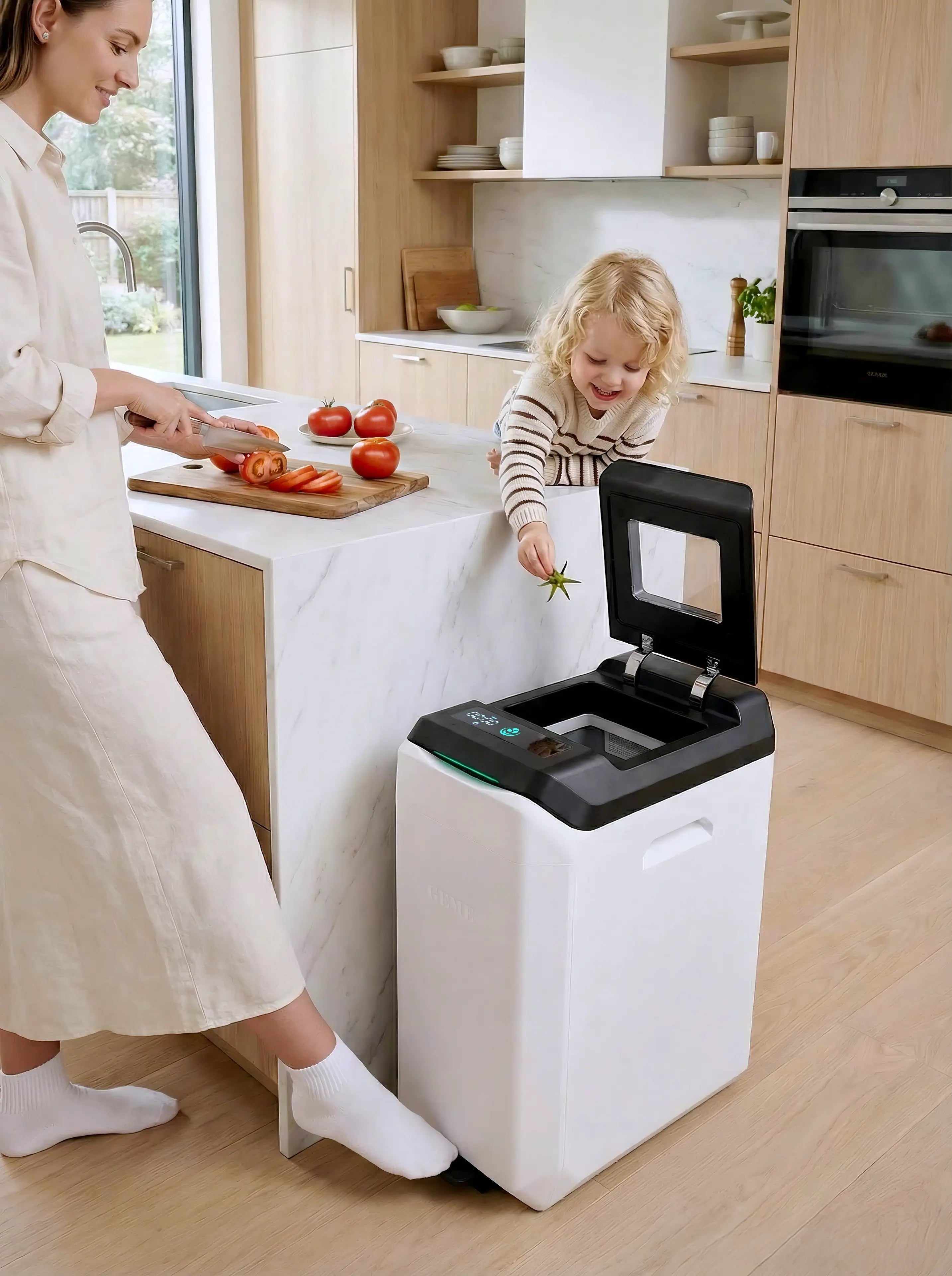
Option 3: A Managed Microbial Kitchen Composter
A managed kitchen composter can bring parts of the biological process indoors while controlling variables such as airflow, moisture, temperature and mixing.
For children, the educational value is not “push a button and scraps disappear.”
It is asking:
- Why does the chamber need oxygen?
- Why does moisture matter?
- Why do microbes generate heat?
- Why do some foods disappear faster than others?
- What happens if we overload the system?
Indoor Composting Science
Watching Microbiology in a Managed Environment
Terra 2 maintains an aerobic microbial environment using managed airflow, heat, moisture and mixing.
Children can observe inputs and outputs and discuss the science, while an adult remains responsible for operating and maintaining the appliance.
13. How Do Kids Know When Compost Is Ready?
This is another good science question because there is no magic timer.
For a traditional compost pile, finished compost generally:
- looks dark;
- has a crumbly texture;
- smells earthy rather than rotten;
- contains few recognizable food scraps;
- and no longer heats strongly after mixing.
EPA recommends allowing a traditional pile to cure after the active heating stage. A well-maintained backyard pile can typically take roughly three to five months to reach finished compost.
Worm bins follow another timeline. EPA says vermicompost can commonly be harvested after about three to six months.
Continuous systems introduce an additional complication because fresh and older material coexist.
That makes this another useful lesson:
“Brown” does not automatically mean “finished compost.”
14. Try This 7-Day Family Compost Challenge
If you want a simple answer to how to compost at home with kids, start with one week.
| Day | Mission | What It Teaches |
|---|---|---|
| Day 1 | Sort today's scraps. | Organic vs non-organic material |
| Day 2 | Weigh unavoidable scraps. | Measurement and data |
| Day 3 | Find three greens and three browns. | Carbon and nitrogen |
| Day 4 | Look for decomposers. | Ecosystems |
| Day 5 | Check moisture and smell. | Process control |
| Day 6 | Find one edible food you almost wasted. | Waste prevention |
| Day 7 | Draw the food-to-soil cycle. | Systems thinking |
At the end, ask:
What did we throw away less of this week?
That question is more important than simply asking how much compost was produced.
Keep Exploring
Turn the Kitchen Into a Biology Classroom
Whether your family uses a backyard pile, worm bin, community collection service or managed microbial composter, the best lesson is the same: food scraps do not have to be the end of the story.
15. Frequently Asked Questions About Composting for Kids
What is composting for kids?
Composting is the managed biological breakdown of organic materials such as food scraps and leaves. Microorganisms use oxygen, moisture and nutrients to transform the material into more stable organic matter that can eventually be used as a soil amendment.
How do you explain composting to a child?
A simple explanation is that tiny living decomposers eat dead plants and food scraps and help return their nutrients to the natural cycle. Worms and other small animals can also help fragment material, while bacteria and fungi perform much of the biological decomposition.
What are good composting activities for kids?
Good activities include sorting food scraps, weighing household food waste, keeping a compost journal, observing worms, comparing greens and browns, measuring temperature and planting with appropriately finished compost.
What can children put in a compost bin?
For a beginner backyard pile, easy examples include fruit and vegetable scraps, coffee grounds, crushed eggshells, dry leaves, small twigs and plain shredded cardboard. Adults should check the rules for the specific composting system being used.
What should kids not put in compost?
Children should never assume an item is compostable simply because it looks natural. Plastic, glass, metal, produce stickers, pet waste and treated materials do not belong in a beginner food-and-yard compost pile. Meat, dairy, oils and bones are also commonly excluded from home backyard piles even though some commercial or engineered systems can process them.
Is composting safe for kids?
Yes, when activities are age-appropriate and supervised. Adults should handle sharp tools, very hot compost piles and powered equipment. Children should wash their hands with soap and water after handling compost, soil, worms or waste.
Can kids touch worms in a worm bin?
Children can gently observe and handle composting worms with appropriate adult supervision. Avoid prolonged handling because worms need moist conditions, return them to their bedding promptly and wash hands afterward.
Why does compost get hot?
Active microorganisms release heat while metabolizing organic materials. In a large enough, well-managed pile, microbial heat can accumulate and raise the internal temperature significantly.
Why does compost need oxygen?
Aerobic composting microorganisms use oxygen for respiration. If a compost pile becomes too wet or compacted, oxygen movement can fall and foul-smelling anaerobic conditions may develop.
How long does compost take?
The answer depends on the method. EPA says a well-maintained backyard pile can be ready in roughly three to five months, while vermicompost commonly takes about three to six months to harvest. Managed indoor systems and commercial composting facilities follow different timelines.
What is the easiest composting method for kids?
A worm bin is particularly visual because children can see the decomposer animals. A backyard pile is excellent for teaching greens, browns, moisture and temperature. Families without outdoor space can use community organics collection or an adult-managed indoor composting system.
Can composting be a science experiment?
Yes. Children can test how particle size, moisture, material type or time affect decomposition. A good experiment changes one main variable while keeping other conditions as similar as possible.
Should children compost leftover edible food?
Preventing avoidable food waste should come first. If food is still safe and edible, eating, storing or repurposing it is generally preferable to composting it. Composting is a useful pathway for unavoidable scraps and food that can no longer be safely eaten.
Can you teach composting without having a compost pile?
Yes. Children can conduct food-waste audits, research different compost systems, visit a community composting facility, observe a worm bin or follow where municipal food scraps go.
16. Authoritative Resources for Parents and Teachers
- U.S. EPA — Educating Youth About Wasted Food
- U.S. EPA — Composting at Home
- U.S. EPA — Composting
- KidsGardening — Compost Your Way Lesson Plan
- Penn State Extension — Environmentally Friendly Activities for Children
- CDC — Hand Hygiene in Schools and Early Care Settings
- GEME — How Does Composting Work? Microbes, Heat & Oxygen
- GEME — What Happens to Food Waste After You Throw It Away?
- GEME — What Can You Compost at Home?
Sources reviewed August 17, 2026. Composting methods, accepted materials and safety practices vary by system and location. Parents, caregivers and teachers should use age-appropriate supervision and follow local or manufacturer-specific instructions.


Zostaw komentarz
Wszystkie komentarze są moderowane przed opublikowaniem.
Ta strona jest chroniona przez hCaptcha i obowiązują na niej Polityka prywatności i Warunki korzystania z usługi serwisu hCaptcha.