


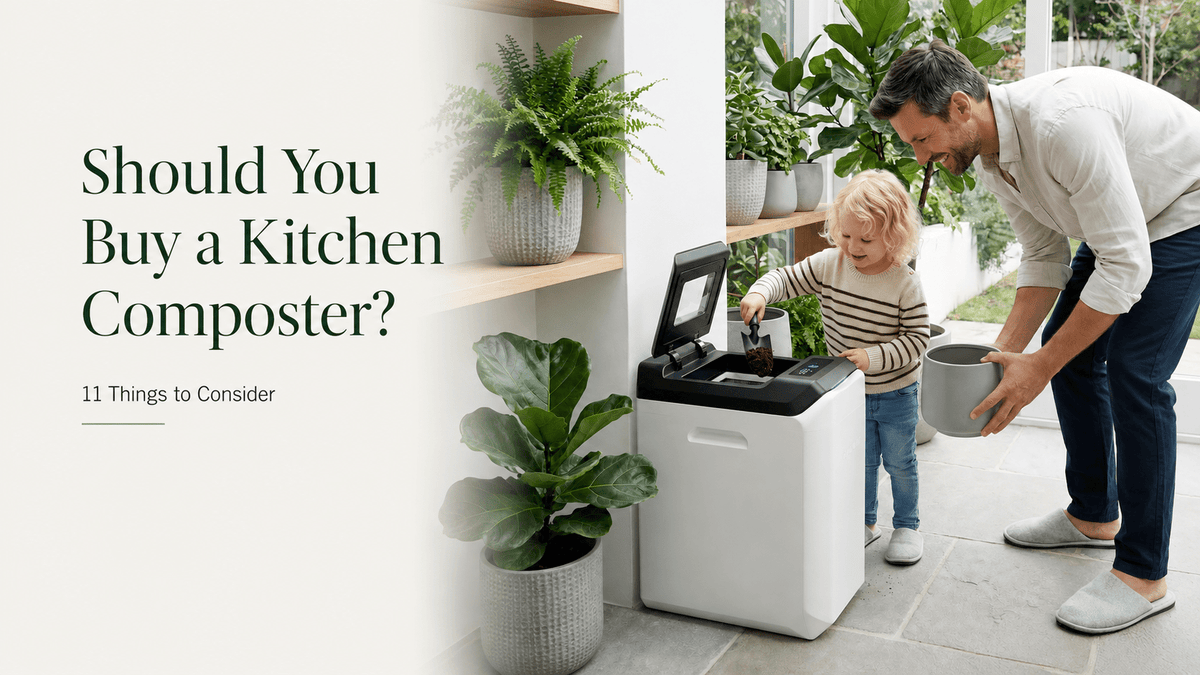
Kitchen Composter Buying Guide · Electric Composter · Home Composter · Indoor Composter
Should you buy a kitchen composter? The answer depends on much more than price. A good electric composter, home composter or indoor composter needs to fit your kitchen space, household food-waste volume, tolerance for noise and maintenance, expectations for odor control, budget for recurring consumables and most importantly, what you want the output to become.
This kitchen composter buying guide walks through 11 questions to ask before purchasing and includes a practical buying decision tree for shoppers considering the GEME Terra 2 and other kitchen food-waste systems.
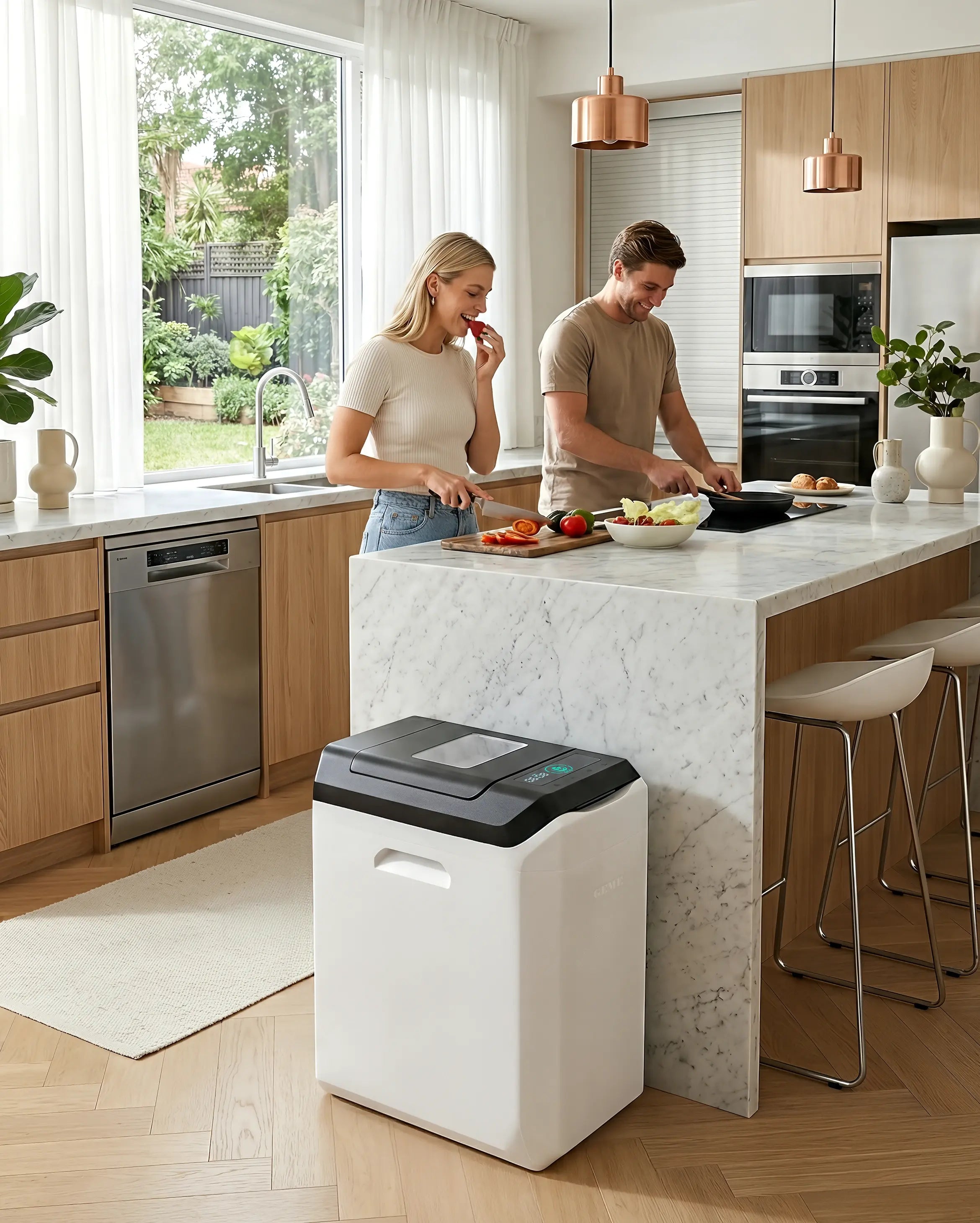
Quick Answer: Should I Buy a Kitchen Composter?
If you are asking “Should I buy a kitchen composter?”, start by looking at how often you cook and what happens to your food scraps today.
A kitchen composter is more likely to be worth buying if you generate food scraps several days a week, dislike keeping wet organic waste in the trash, want an indoor food-waste routine and have a realistic use for the resulting material.
An electric composter may be less useful if you rarely cook, already have convenient curbside organics collection, lack installation space or simply want to make trash smaller without caring whether the output becomes compost.
The phrase electric composter is used for different technologies. Some machines biologically decompose organic material; others mainly grind and dehydrate scraps.
The U.S. EPA distinguishes aerobic biological composting from residential grinding and dehydrating appliances. Those appliances may reduce food-waste volume and weight, but their dried output is not automatically compost and generally needs another treatment step.
Read the EPA explanation of composting and residential food-scrap preprocessing and compare it with real microbial composting vs dehydrated food scraps.
Table of Contents
- 1. What Problem Are You Actually Trying to Solve?
- 2. How Much Space Does a Kitchen Composter Need?
- 3. How Much Food Waste Do You Generate?
- 4. Do Electric Composters Smell?
- 5. How Much Maintenance Will You Tolerate?
- 6. Do Kitchen Composters Need Replacement Filters?
- 7. What Do You Do With Kitchen Composter Output?
- 8. Does It Accept the Food You Actually Throw Away?
- 9. Can You Live With the Noise?
- 10. How Does an Electric Composter Use Electricity?
- 11. Does the Full Ownership Model Fit Your Home?
- Kitchen Composter Buying Decision Tree
- Is GEME Terra 2 Worth Buying?
- 11-Point Buyer Scorecard
- Kitchen Composter Buying FAQ
Before You Buy: Not Every “Electric Composter” Actually Composts the Same Way
One of the most important things to consider before buying an electric composter is what the machine actually does to food.
A product may be described as a kitchen composter, home composter or indoor composter even though the underlying process is dehydration rather than biological composting.
A dehydrating food recycler typically uses heat and mechanical processing to reduce moisture and shrink scraps into dry material.
A microbial composter maintains living microorganisms in conditions where biological decomposition can continue.
Both can be useful, but they solve different problems.
| Your Goal | Type of Kitchen Food-Waste System to Consider |
|---|---|
| Reduce the size of food waste | Food recycler or dehydrating electric composter may be sufficient |
| Store scraps more cleanly indoors | Enclosed food recycler or indoor composter |
| Biologically process food waste | Microbial home composter such as GEME Terra 2 |
| Create a kitchen-to-soil routine | Microbial kitchen composter deserves closer consideration |
For model-by-model research, see Best Kitchen Composters 2026: GEME vs Lomi vs Mill vs Reencle.
If your main question is whether the economics make sense, read Are Kitchen Composters Worth It? Cost & ROI Guide.
1. What Problem Are You Actually Trying to Solve?
The best way to decide whether a kitchen composter is right for you is to start with the problem rather than the product.
Ask yourself why you are shopping for an electric kitchen composter at all.
This is why the fastest machine is not automatically the best kitchen composter.
If the underlying biological process matters to your buying decision, read How Does Composting Work? Microbes, Heat & Oxygen.
2. How Much Space Does a Kitchen Composter Need?
If you are searching for the best kitchen composter for an apartment or the best indoor composter for a small home, start with a tape measure.
“Compact” is a marketing description. Dimensions are facts.
Before ordering any home composter, measure:
- width of the available floor or counter area;
- depth from the wall into the room;
- closed appliance height;
- vertical clearance required to open the lid;
- walking clearance around the unit.
GEME Terra 2 Dimensions
For buyers specifically researching GEME Terra 2 dimensions, the current product measures approximately:
11.7 in
17.2 in
22.3 in
The GEME Terra 2 weighs approximately 13 kg / 28 lb.
Its proportions make it better understood as a compact floor-standing GEME composter for a dedicated kitchen bin zone or island end rather than a tiny countertop appliance.
Terra 2 space test before ordering:
Mark a 297 × 437 mm rectangle on your floor with painter's tape. Then confirm that the 566 mm-high unit has enough room above it for the lid to open comfortably.
If Terra 2 is too small for your household but you prefer the same microbial-composting concept, compare GEME Terra 2 and GEME Pro.

3. How Much Food Waste Does Your Household Generate?
The best home food waste composter is not necessarily the largest one.
Capacity should match what your household actually generates.
A couple who cooks almost every meal from scratch may produce more scraps than a four-person household that eats out frequently.
Before choosing an electric composter, track your food waste for seven days.
Include:
- fruit and vegetable scraps;
- coffee grounds;
- cooked leftovers;
- rice and pasta;
- meat scraps;
- eggshells;
- plate waste;
- other organic kitchen waste.
Kitchen Composter for 1 to 3 People
If you are specifically looking for a kitchen composter for 1 to 3 people, Terra 2 falls directly into that use case.
The current GEME Terra 2 specification includes:
- 14-liter chamber;
- up to approximately 2 kg/day household food-waste capacity;
- continuous feeding;
- positioning for approximately 1–3 people.
Capacity still needs to be interpreted with common sense.
Two kilograms of mixed ordinary scraps is not operationally identical to one oversized load of extremely wet watermelon, soup or dense fibrous material.
If your household regularly produces substantially more than Terra 2's intended range, compare the larger GEME Pro home composter.
4. Do Electric Composters Smell?
The question “Do electric composters smell?” is one of the most important buying questions for apartment and indoor users.
The realistic answer is:
A well-designed and correctly operated indoor composter can control odor very effectively, but no food-waste system should be treated as physically incapable of producing odor under every misuse or overload condition.
Before buying, investigate:
- how the machine contains food;
- how air moves through the system;
- whether biological decomposition remains aerobic;
- how exhaust is treated;
- whether carbon filters require replacement;
- what happens after a wet overload;
- what happens after power interruption.
GEME Terra 2 Odor Control
The GEME composter approach combines an enclosed microbial chamber, managed airflow and permanent metal-ion oxidation.
Terra 2 therefore does not depend on routine disposable carbon-filter replacement for normal odor management.
If you want a broader product comparison focused specifically on smell, read The Best Electric Composter for Odor-Free Operation.
For current operating boundaries and troubleshooting, use the GEME Terra 2 FAQ.
5. How Often Do You Clean a Kitchen Composter?
If your priority is an electric composter with low maintenance, do not accept vague claims such as “maintenance free.”
Every appliance has some ownership routine.
Before buying a kitchen composter, ask how often you need to:
- empty or harvest the machine;
- clean the chamber;
- wipe food residue;
- clean air screens;
- replace filters;
- remove fibrous material;
- restart the biological process;
- add additives.
GEME Terra 2 Maintenance
Buyers researching GEME Terra 2 maintenance should understand that Terra 2 is a continuous biological system.
The active microbial bed is supposed to remain inside the machine.
Routine ownership is therefore closer to:
feed continuously → inspect periodically → harvest when needed → retain active biological material
rather than:
run one batch → empty completely → scrub everything → restart
Normal Terra 2 maintenance is generally low-frequency and condition-based, with harvest and deeper maintenance occurring on a months-scale cadence depending on household use.
For realistic strengths and limitations before buying, read GEME Terra 2 Pros and Cons.
6. Do Kitchen Composters Need Replacement Filters or Other Consumables?
If you are searching for a kitchen composter without replacement filters, this category deserves close attention.
The cheapest machine at checkout can become more expensive over three years if it requires:
- replacement carbon filters;
- microbial pods;
- proprietary additives;
- liners;
- subscription plans;
- collection services;
- special cleaning products.
Three-year ownership calculation:
Purchase price + electricity + mandatory filters + mandatory additives + service costs = real ownership cost
Does GEME Terra 2 Need Replacement Filters?
Terra 2 does not require routine replacement odor filters.
Its Kobold microbial ecosystem is also designed to reproduce within the maintained biological environment rather than requiring a new microbial cartridge every day or every batch.
Optional Kobold support products can be used when appropriate, but they should not be confused with a mandatory recurring subscription.
For a dedicated cost comparison, read Kitchen Composter Filter Costs: GEME vs Lomi vs Mill vs Reencle.
7. What Do You Do With Kitchen Composter Output?
The long-tail buying question “What do you do with kitchen composter output?” should be answered before checkout—not after the first harvest.
The answer depends on the process.
Dry Output From a Food Recycler
EPA currently notes that residential grinding and dehydrating appliances reduce food-scrap mass and volume but do not directly produce finished compost.
Their dried output usually requires another step such as composting, curing or another appropriate management pathway.
Output From a Microbial Kitchen Composter
The GEME Terra 2 is designed to biologically transform household food scraps into a moist, biologically active compost base.
For normal soil use, GEME guidance is to:
- screen out larger unfinished pieces;
- return those unfinished pieces to the active chamber;
- mix the finer compost base with soil at approximately 1:8–1:10;
- allow additional curing when a more mature material is preferred.
The output is not intended to replace potting soil 1:1.
For practical use instructions, see How to Use GEME Compost Base in Soil.

Kitchen Composter Buying Rule
Buy the Output You Actually Want
If you only want food waste to become smaller and easier to store, a dehydrating food recycler may be enough.
If you want a kitchen composter that makes real compost through microbial processing, the underlying biology becomes much more important.
Compare Real Microbial Composting vs Dehydrated Food Scraps →8. Does the Kitchen Composter Accept the Food You Actually Throw Away?
The best home composter is not the machine with the longest theoretical input list.
It is the one compatible with your real household diet.
Look at what you throw away during a normal week:
- fruit and vegetable scraps;
- coffee grounds;
- rice and pasta;
- cooked leftovers;
- meat;
- dairy;
- oily or sauced food;
- eggshells;
- small bones;
- fibrous peels.
Traditional backyard composting generally has tighter practical restrictions around meat, dairy and fats because of animal attraction and process-control limitations.
An enclosed microbial indoor composter can operate differently, but no machine accepts literally everything.
Terra 2 is designed for a broad range of everyday kitchen organics, while plastics, metal, glass, hard dense objects and long fibrous material that could wrap around a mixing mechanism should stay out.
Use What Can You Compost at Home? together with the current GEME composter feed guidance.
9. How Quiet Should an Indoor Composter Be?
Noise matters especially when shopping for the best indoor composter for an apartment.
A machine in a detached garage can be louder than one operating beside an open-plan kitchen, home office or bedroom.
Before buying, ask:
- Does it operate continuously?
- Does it grind?
- Does it have a fan?
- Does it mix intermittently?
- Does it vibrate?
- Where will it sit relative to bedrooms and workspaces?
GEME Terra 2 Noise
Current Terra 2 specifications position normal operation at approximately ≤35–40 dB under specified operating conditions.
Actual perceived noise can still change with flooring, walls, cabinet resonance and room acoustics.
For buyers researching GEME Terra 2 for apartments, placing the machine on a firm, level floor with sufficient clearance is generally more sensible than forcing it into a resonant cabinet cavity.
10. How Does an Electric Composter Use Electricity?
An electric composter obviously uses electricity, but not all powered food-waste systems use energy in the same way.
A dehydrating recycler may use more intense heat during a batch cycle.
A continuous microbial home composter may use electricity for airflow, environmental warmth, sensors and intermittent mixing over a longer operating period.
This is why peak wattage alone is a poor buying metric.
Before purchasing, ask:
- Is the machine batch-based or continuous?
- Does it use heat primarily for dehydration or biological environmental control?
- Does it remain powered continuously?
- What is typical energy consumption?
- What is your local electricity price?
How GEME Terra 2 Uses Power
The GEME Terra 2 composter is a continuous system.
GEMEBrain uses powered control to manage conditions around the microbial process, including airflow, heat, moisture-related operation and mixing.
The microorganisms perform the biological decomposition; electricity supports the environment that allows them to work.
11. Does the Full Kitchen Composter Ownership Model Fit Your Home?
The last question is not whether a machine has good specifications.
It is whether it fits your daily life.
Anyone researching what to consider before buying an electric composter should evaluate the full ownership model:
| Buying Question | Why It Matters |
|---|---|
| Where will the kitchen composter live? | A machine without a practical permanent location becomes clutter. |
| How often will you use it? | Daily use creates substantially more convenience value than occasional use. |
| Who will maintain it? | Even a low-maintenance electric composter needs someone to own the routine. |
| Where will the output go? | A compost-producing machine needs an output plan. |
| What recurring costs remain? | Filters, additives and subscriptions can significantly alter long-term value. |
| Is the electrical configuration correct? | Buy the correct voltage and regional configuration for where the machine will actually operate. |
If you are still deciding which GEME composter fits your household, use the GEME model comparison guide.
Kitchen Composter Buying Decision Tree
Use this decision tree if you are asking “Is a kitchen composter right for me?” or deciding whether GEME Terra 2 is worth buying.
What do you want your food-waste appliance to accomplish?
Compare food recyclers, dehydrators and municipal organics collection. You may not need a microbial composter.
Continue ↓
Traditional backyard composting may be the lowest-equipment option. Read EPA Composting at Home.
An indoor microbial composter becomes more relevant.
GEME Terra 2 belongs on your shortlist.
Compare GEME Pro or another higher-capacity home composter.
Continue.
Solve the installation-space problem before ordering Terra 2.
GEME Terra 2 is a strong match.
Compare batch food recyclers and other microbial composters too.
Terra 2 is likely a strong fit for your kitchen composter buying criteria.
A food recycler or municipal organics collection service may solve your problem more simply.
Is GEME Terra 2 Worth Buying?
The search question “Is GEME Terra 2 worth buying?” does not have one universal answer.
The answer depends on whether its operating model matches the reason you want a kitchen composter.
Terra 2 is particularly relevant if you want:
- real microbial composting;
- continuous feeding;
- indoor food-waste management;
- low-frequency routine maintenance;
- no routine replacement carbon filters;
- a compost base intended for soil return;
- capacity suited to approximately 1–3 people.
- You cook regularly.
- You want a microbial kitchen composter.
- You dislike storing wet food scraps.
- You have a suitable floor-standing location.
- You generate a typical 1–3-person household waste stream.
- You want to avoid recurring odor-filter replacement.
- You have a realistic soil-use destination.
- You want a continuous rather than batch-oriented routine.
- You only want dried food waste.
- You rarely cook.
- You do not have enough floor space.
- You generate substantially more than Terra 2's intended household capacity.
- You already have excellent curbside organics collection.
- You do not want to handle compost output.
- You want a passive system that uses no electricity.
GEME Terra 2 Buying Snapshot
| Buying Factor | GEME Terra 2 |
|---|---|
| Best household fit | Approximately 1–3 people |
| Chamber | 14 L |
| Daily capacity | Up to approximately 2 kg/day |
| GEME Terra 2 dimensions | 297 × 437 × 566 mm / 11.7 × 17.2 × 22.3 in |
| Weight | Approximately 13 kg / 28 lb |
| Process | Continuous controlled microbial composting |
| Feeding | Continuous feeding of suitable kitchen scraps |
| Odor filtration | Permanent metal-ion oxidation; no routine disposable odor filter |
| Noise | Approximately ≤35–40 dB under specified operating conditions |
| Output | Moist biologically active compost base for responsible soil blending |
| GEME Terra 2 maintenance | Low-frequency, generally months-scale depending on use |
For shoppers comparing alternatives before buying, read: GEME Terra 2 vs Lomi, GEME Terra 2 vs Reencle, and GEME Terra 2 vs Mill.
11-Point Kitchen Composter Buyer Scorecard
Still asking “Is a kitchen composter right for me?”
Give yourself one point for every “Yes.”
| # | Kitchen Composter Buying Question |
|---|---|
| 1 | Do I generate kitchen food scraps several days per week? |
| 2 | Do I dislike storing wet scraps in trash, a freezer or a countertop caddy? |
| 3 | Do I have a suitable permanent location for an indoor composter? |
| 4 | Is indoor odor control important to me? |
| 5 | Do I want lower manual compost-management work? |
| 6 | Do I care about avoiding recurring replacement filters or subscriptions? |
| 7 | Do I want biological composting rather than only dried food grounds? |
| 8 | Do I have a realistic use or destination for compost output? |
| 9 | Does my typical food-waste stream match the machine's accepted inputs? |
| 10 | Am I comfortable owning another powered kitchen appliance? |
| 11 | Will I use the kitchen composter often enough to justify its cost and space? |
GEME Kitchen Composter Buying Guide
Choose a Kitchen Composter for the Way You Actually Live
If your priorities are real microbial composting, continuous feeding, indoor food-waste handling, low-frequency maintenance and no routine disposable odor filters, GEME Terra 2 is designed around that combination.
Kitchen Composter Buying FAQ
Should I buy a kitchen composter?
A kitchen composter makes the most sense when you generate food scraps regularly, value indoor odor management, have enough installation space and have a clear plan for the resulting material. If you rarely cook or already have convenient curbside organics collection, another solution may be simpler.
What should I look for in a kitchen composter?
Look at the processing method, dimensions, capacity, odor control, maintenance, replacement filters, accepted foods, noise, electricity use and output. The best kitchen composter should fit your household routine rather than simply have the fastest advertised cycle.
What should I consider before buying an electric composter?
Before buying an electric composter, measure your available space, track your daily food-waste volume, compare batch versus continuous operation, check noise and energy use, identify mandatory filters or subscriptions and understand what the machine's output actually is.
What is the best kitchen composter for an apartment?
The best kitchen composter for an apartment should combine a manageable footprint, quiet operation, strong odor management and an indoor-friendly maintenance routine. GEME Terra 2 can fit this use case when a household has an appropriate floor-standing kitchen area and generates food waste within its intended capacity.
What is the best indoor composter for a small home?
The best indoor composter for a small home depends on whether you want biological composting or simple food-waste reduction. Measure the real installation area first, including lid clearance, rather than choosing only from marketing descriptions such as compact or countertop.
Are all electric composters real composters?
No. Some electric composters biologically process organic matter while others mainly grind and dehydrate food scraps. EPA distinguishes aerobic composting from residential grinding and dehydrating appliances whose output generally needs additional treatment.
Is GEME Terra 2 a real microbial composter?
Yes. GEME Terra 2 is designed around continuous aerobic microbial processing using the Kobold microbial ecosystem and GEMEBrain environmental control rather than simply drying food scraps into low-moisture grounds.
Is GEME Terra 2 worth buying?
GEME Terra 2 is most compelling for households that want microbial composting, continuous feeding, indoor odor control, relatively low routine maintenance and no recurring disposable odor filters. It may be less suitable if you only want dry waste reduction or regularly exceed its intended household capacity.
What are the GEME Terra 2 dimensions?
GEME Terra 2 measures approximately 297 mm wide, 437 mm deep and 566 mm high, or 11.7 × 17.2 × 22.3 inches. Additional clearance is required to open the lid comfortably.
Is GEME Terra 2 good for apartments?
GEME Terra 2 can be a good apartment composter for households that cook regularly and have a suitable floor-standing location. Its enclosed microbial process, managed airflow, and approximately ≤35–40 dB operating specification are relevant to indoor use, but buyers should measure their space before ordering.
How much food can GEME Terra 2 process?
Current specifications position Terra 2 at up to approximately 2 kg of household food waste per day with a 14-liter chamber. Food type, moisture and individual feeding size should still be managed appropriately.
Do electric composters smell?
Odor depends on containment, airflow, processing method, feed balance and maintenance. A correctly operated enclosed aerobic composter can provide strong odor control, but overloads, excess moisture or unsuitable inputs can still produce temporary smells.
Is there a kitchen composter without replacement filters?
Yes. GEME Terra 2 does not use routine disposable carbon-filter replacement as part of its current odor-management design. It uses permanent metal-ion oxidation together with controlled aerobic operation.
Do I need to keep buying microbes for GEME Terra 2?
Kobold is designed as a self-replicating microbial ecosystem under suitable operating conditions. Optional support products may be used when needed, but recurring daily or batch-by-batch microbial replacement is not the normal GEME Terra 2 ownership model.
What is GEME Terra 2 maintenance like?
GEME Terra 2 maintenance is relatively low-frequency because the active microbial bed remains in the machine. Users typically feed continuously, clean visible residue or air paths when necessary and harvest on a months-scale cadence depending on use rather than completely scrubbing the chamber every week.
How often do you clean a kitchen composter?
Cleaning frequency depends on the technology. Batch dehydrators may be emptied after every cycle, while continuous microbial systems such as GEME Terra 2 retain the biological bed. For Terra 2, routine cleaning focuses on visible residue, air paths and periodic maintenance rather than repeated full clean-outs.
What do you do with kitchen composter output?
It depends on the process. Dried food-recycler output generally requires further composting or another disposal pathway. GEME Terra 2 produces a moist, biologically active compost base that can be screened and blended with soil at approximately 1:8–1:10 according to current GEME guidance.
Is GEME Terra 2 better than Lomi?
The better choice depends on your objective. Terra 2 is better aligned with shoppers who want continuous microbial composting and a soil-return pathway, while Lomi is more relevant to shoppers prioritizing compact batch-style food-waste processing. Read the full GEME Terra 2 vs Lomi comparison.
Is GEME Terra 2 better than Reencle?
Both belong in the microbial-composter category. The better choice depends on capacity, footprint, feeding behavior, filtration, maintenance and output handling. See GEME Terra 2 vs Reencle Prime.
What is the simplest kitchen composter buying rule?
Choose the process and output before choosing the product. If you want a biological kitchen-to-soil pathway, investigate a microbial kitchen composter. If you only want smaller and cleaner food waste, a food recycler may already meet your needs.
Sources and Kitchen Composter Buying References
- U.S. EPA — Approaches to Composting and Residential Food-Scrap Preprocessing
- U.S. EPA — Composting at Home
- U.S. EPA — Preventing Wasted Food at Home
- GEME Terra 2 — Current Kitchen Composter Specifications
- GEME Terra 2 — Maintenance, Odor, Feed and Compost Output Guidance
- GEME — Real Microbial Compost vs Dehydrated Food Scraps
- GEME — Home Composter and Electric Composter Comparison Center
Sources reviewed August 18, 2026. Kitchen composter prices, product availability, electrical configurations and specifications may change. Confirm the current product page and regional electrical requirements before purchase. Compost output and processing behavior vary with feedstock, loading pattern and operating conditions.


Zostaw komentarz
Wszystkie komentarze są moderowane przed opublikowaniem.
Ta strona jest chroniona przez hCaptcha i obowiązują na niej Polityka prywatności i Warunki korzystania z usługi serwisu hCaptcha.