
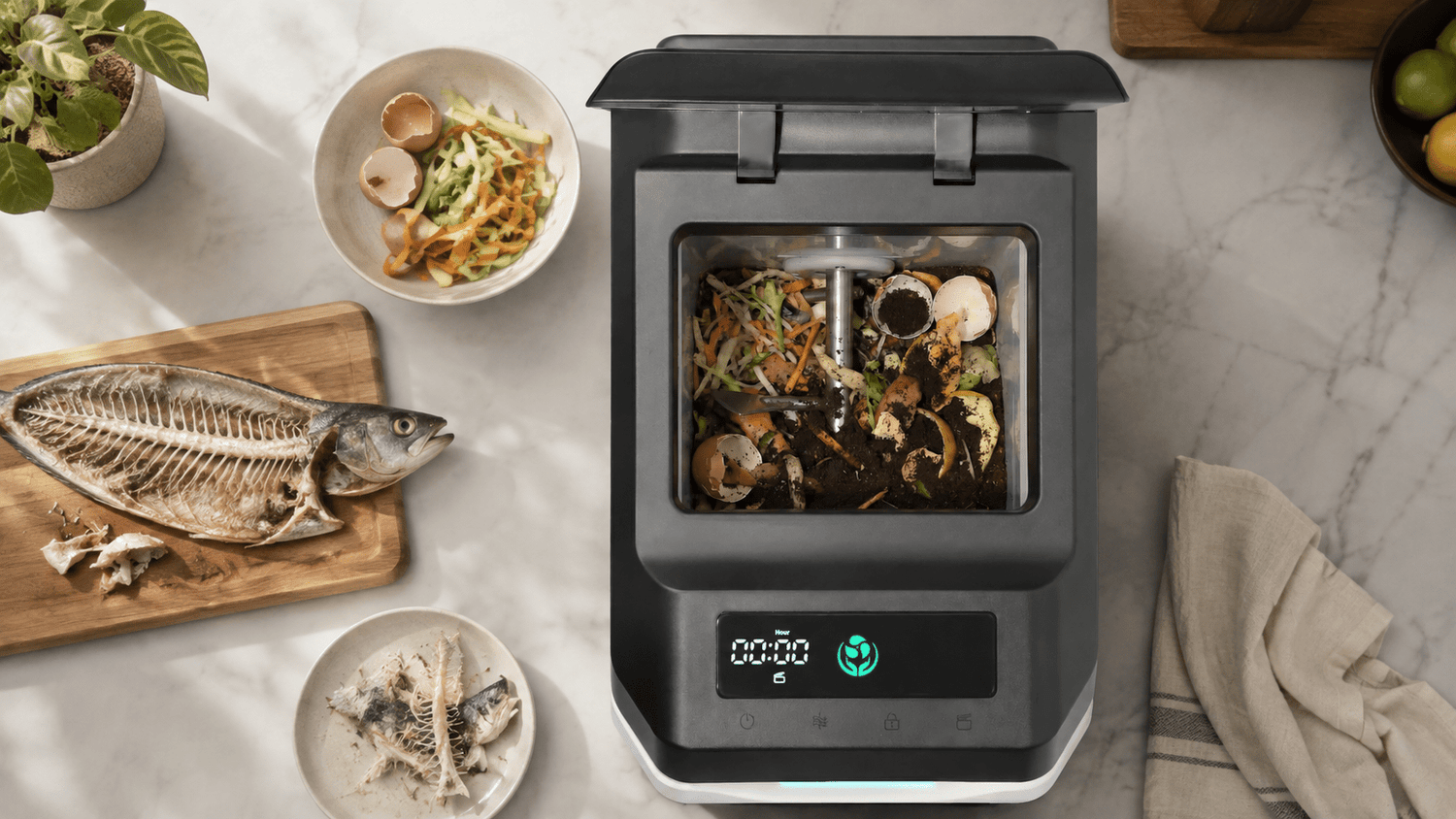
Fish Bones · Kitchen Composting · Electric Composter · Microbial Composting
Can You Compost Fish Bones?
Yes, but how you compost fish bones matters. Fish bones are organic material, yet ordinary backyard compost piles and worm bins are generally poor places for them because fish scraps can attract animals, create odor and remain undecomposed for a long time. Food-waste dehydrators solve a different problem: they remove moisture, but they do not biologically turn fish bones into compost.
A controlled microbial composter such as GEME Terra 2 offers a different pathway. Suitable small fish bones can stay inside a warm, moist, oxygen-rich microbial environment and continue breaking down, but bones are still slower than soft food scraps and may need extra residence time or another pass through the chamber.
By Matthew Moore · Last reviewed August 19, 2026
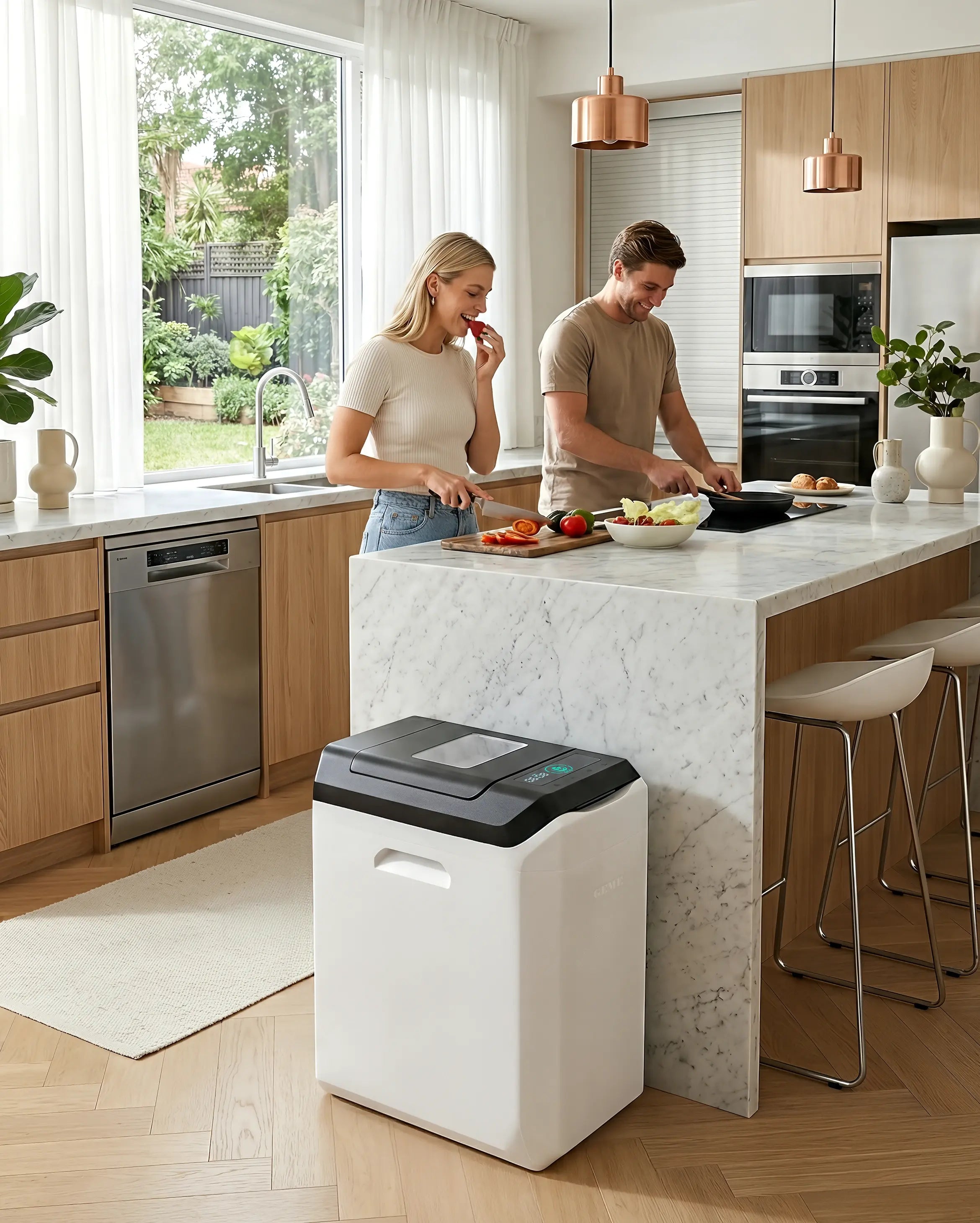
Quick Answer: Can Fish Bones Be Composted?
Yes, small fish bones can be biologically broken down, but not every composting method handles them well.
For an ordinary backyard compost pile or worm bin, authoritative home-composting guidance generally says to leave fish and bones out. In GEME Terra 2, suitable small fish bones are accepted, but they are a slower material and may remain visible after softer food has already broken down. Screen unfinished bone pieces from harvested compost base and return them to the chamber for more time.
This distinction is important because the question “Can you compost fish bones?” is really two questions:
- Can fish bone material eventually decompose biologically?
- Can your specific composting system manage it without causing pests, odor or unfinished material?
For many home systems, the second question is the limiting one.
Table of Contents
- Why Are Fish Bones Harder to Compost?
- Can You Put Fish Bones in a Backyard Compost Pile?
- Can Worms Eat Fish Bones?
- What Happens to Fish Bones in a Food Dehydrator?
- Can GEME Terra 2 Compost Fish Bones?
- Why Terra 2 Has an Advantage for Fish Bones
- How Long Do Fish Bones Take to Break Down?
- Which Fish Bones Can Go Into Terra 2?
- What About Fish Skin, Flesh and Leftovers?
- Will Fish Bones Make a Composter Smell?
- What If Fish Bones Are Still Visible at Harvest?
- Fish Bone Composting Methods Compared
- Common Fish Bone Composting Mistakes
- Frequently Asked Questions
1. Why Are Fish Bones Harder to Compost Than Fish Flesh?
A leftover piece of fish contains several very different materials.
Soft flesh is rich in proteins, fats, water and other compounds that microorganisms can access relatively easily.
Bone is different.
Fish bones contain a structural matrix that includes mineral components and collagen-based organic material. That makes them denser and physically more resistant than the soft tissue surrounding them.
The practical result is simple:
Soft fish flesh
↓
Microbial access is relatively easy
↓
Visible breakdown can happen relatively quickly
Fish bone
↓
Denser structural material
↓
More residence time is usually needed
This is why a composter can successfully process a fish meal while still leaving a few recognizable bone fragments behind.
That is not necessarily failure.
It can simply mean the softer material and the bone are moving through biological decomposition at different speeds.
For the underlying role of microbes, oxygen, moisture and particle structure, see How Does Composting Work? Microbes, Heat & Oxygen.
2. Can You Put Fish Bones in a Backyard Compost Pile?
For most households, the practical answer is:
EPA recommends keeping fish and bones out of an ordinary backyard compost pile.
The U.S. EPA's current Composting at Home guidance specifically includes:
meat, fish and bones
on its list of materials to avoid in backyard composting.
There are two important reasons.
Fish Scraps Can Attract Animals
Fish flesh, skin, oils and bones can attract:
- rodents;
- raccoons;
- dogs;
- flies;
- other scavengers.
Even if the bone itself does not smell strongly, traces of protein and fat attached to it can.
Ordinary Backyard Piles May Not Fully Process Bones
EPA also notes that household backyard piles generally do not reach temperatures high enough to reliably decompose materials such as fish and bones.
That means a fish skeleton can remain in the pile long after fruit peels, coffee grounds and grass clippings have disappeared.
A large, professionally managed commercial composting operation may be able to accept materials that a household pile should avoid, but acceptance depends on the facility.
“Organic” Does Not Automatically Mean “Good Backyard Input”
Fish bones are biologically derived, but home composting recommendations also have to account for pests, odor, temperature and practical decomposition time. That is why backyard rules are more conservative.
3. Can Worms Eat Fish Bones?
If you are wondering “Can you put fish bones in a worm bin?”, the recommended answer is also no.
Oregon State University Extension's vermicomposting guidance specifically identifies:
meat, poultry or fish, including bones, skin and drippings
as inappropriate worm-bin inputs because they can produce unpleasant odors and attract pests.
See Oregon State University Extension's Composting With Worms guide.
The problem is not simply that worms are incapable of living near anything derived from fish.
The issue is that a household worm bin is optimized around a different feedstock profile:
- fruit scraps;
- vegetable scraps;
- coffee grounds;
- paper-based bedding;
- crushed eggshells;
- other low-risk organic materials.
Fish and fish bones add a combination of protein, fat, odor and persistent hard material that creates unnecessary management problems.
Illinois Extension likewise advises worm-bin users to avoid meat and bones.
For a deeper comparison of the two systems, read Electric Composter vs Worm Composting: GEME Terra 2 vs Vermicomposting.
4. What Happens to Fish Bones in a Food-Waste Dehydrator?
This is where the phrase electric composter becomes confusing.
Some appliances sold in this category primarily use:
heat + airflow + grinding
to remove water and reduce food-waste volume.
EPA classifies residential grinders and dehydrators as pre-processing technologies.
Its current guidance is explicit:
Residential food-scrap grinders and dehydrators reduce the weight and volume of food waste, but the resulting dried material is not compost and requires further processing.
See EPA Approaches to Composting.
Drying a Fish Bone Is Not the Same as Decomposing It
Removing water can make food waste:
- lighter;
- smaller;
- easier to store;
- less immediately wet.
But a dry fish-bone fragment has not automatically undergone the microbial decomposition required to turn it into compost.
It may simply be a smaller or drier bone fragment mixed into dehydrated food waste.
EPA's broader review of food-waste dehydrators also notes that very hard inputs such as large bones are commonly outside dehydrator operating limits.
So if your actual goal is:
“Can this fish bone enter a living decomposition process instead of simply being dried?”
A microbial composting system is solving a different problem from a dehydrator.
Read Real Microbial Compost vs Dehydrated Food Scraps for the category distinction.
5. Can GEME Terra 2 Compost Fish Bones?
Yes, suitable small fish bones can go into GEME Terra 2.
This is one of the situations where a controlled microbial kitchen composter has a practical advantage over the standard backyard pile or worm bin.
GEME's current How It Works guidance explicitly identifies:
fish bones
among acceptable inputs.
At the same time, the GEME FAQ gives the more important boundary:
small, softer bones may eventually break down, but bones should be treated as a slower, caution-category input rather than something expected to disappear as quickly as rice, fruit or soft vegetables.
Why Terra 2 Can Handle a Different Feedstock Range
GEME Terra 2 maintains a warm, moist and oxygen-rich biological environment for Kobold living microbes.
GEMEBrain helps regulate:
- airflow;
- heat;
- moisture-related conditions;
- mixing.
This allows food waste to remain inside an actively managed aerobic process instead of sitting exposed in an outdoor pile or relying on worms to consume it.
Importantly, Terra 2 does not use aggressive grinding as a substitute for biological decomposition.
The bone can therefore remain in the microbial bed while biological and physical breakdown continues over time.

A Different Way to Handle Fish Scraps
Keep Suitable Small Fish Bones Inside the Biological Process
Backyard compost guidance usually tells households to exclude fish and bones. Worm-bin guidance does the same.
Terra 2 creates a controlled aerobic microbial environment where suitable small fish bones can remain in the system for additional residence time instead of being automatically rejected from the household composting routine.
Explore GEME Terra 2 →6. Why Terra 2 Has an Advantage for Fish Bones
The advantage is not that Terra 2 somehow makes bone easy.
Bone is still a relatively slow material.
The advantage is that the machine addresses several problems that make fish bones impractical in other household systems.
| Fish-Bone Challenge | Terra 2 Approach |
|---|---|
| Fish can attract animals outdoors | Food remains inside an enclosed indoor system. |
| Fish scraps can smell when oxygen is limited | Managed airflow and mixing support aerobic conditions. |
| Worm bins generally exclude fish and bones | Kobold microbial processing does not depend on feeding the material to worms. |
| Dehydrators only remove moisture | Terra 2 maintains an active microbial decomposition process. |
| Bones break down slowly | Unfinished small bone pieces can remain in or return to the living bed for additional residence time. |
This last point matters most.
A continuous-flow GEME composter does not require every input to become equally mature at the same moment.
Soft food may break down quickly while a fish-bone fragment remains.
When harvesting, the correct response is simply:
Harvest
↓
Screen
↓
Find unfinished bone
↓
Return it to Terra 2 for more time
7. How Long Do Fish Bones Take to Break Down?
There is no responsible universal answer such as:
“Fish bones disappear in eight hours.”
They do not belong in that promise.
GEME's own current operating guidance is clear that the familiar 6–8 hour language refers to a high-activity or stability window for normal food processing, not instant finished compost and not a guaranteed disappearance time for every hard input.
Fish-bone breakdown depends on:
- bone size;
- bone thickness;
- species and structure;
- whether flesh remains attached;
- surface area;
- microbial-bed condition;
- moisture;
- oxygen;
- residence time.
Think in Terms of “More Residence Time,” Not a Fixed Number
A thin, small fish bone may soften and fragment significantly sooner than a larger, denser piece.
If a fish bone is still recognizable when you harvest compost base, that does not mean the system failed.
It means the bone has not yet reached the same stage as the softer material around it.
The practical rule is:
Soft scraps may disappear from view quickly. Fish bones need patience.
8. Which Fish Bones Can Go Into GEME Terra 2?
The fact that GEME Terra 2 can compost fish bones should not be expanded into:
“Any bone of any size can go into the machine.”
That is not the operating rule.
Better Candidates
- small, thin fish bones left from ordinary meals;
- small fish-bone fragments mixed with normal food scraps;
- soft, relatively fine bones that can remain in the microbial bed without presenting a mechanical concern.

Use Caution or Leave Out
- large bone sections;
- very hard or dense skeletal pieces;
- thick bones that remain rigid and substantial;
- anything you would reasonably expect to resist both biological breakdown and normal gentle mixing for an extended period.
Do Not Generalize the Fish-Bone Rule to Large Bones
GEME's current guidance treats large beef bones, pork bones, marrow bones and other large dense bones as hard limits. “Fish bones are acceptable” means suitable small fish bones, not unlimited bone disposal.
For the full decision system, read What Can You Put in an Electric Composter? Meat, Dairy & Bones.
9. Can You Compost Fish Skin, Fish Flesh and Cooked Fish Leftovers?
Fish bones are only one part of a normal seafood meal.
A household may also generate:
- fish skin;
- small pieces of flesh;
- cooked fish leftovers;
- rice or vegetables mixed with fish;
- small quantities of sauce or oil on the food.
For a standard backyard pile, EPA still recommends avoiding fish because of pest attraction and incomplete decomposition concerns.
For Terra 2, normal household fish scraps can be part of the mixed kitchen-waste stream.
The important distinction is between:
The first fits household composting much better than the second.
If food is dripping with free liquid, drain it first.
If oil pools or pours, do not dump that liquid into the chamber.
10. Will Fish Bones Make an Indoor Composter Smell?
Fish has a reputation for odor, but the bone itself is only part of the story.
Strong odor usually becomes more likely when:
- fish flesh remains exposed;
- the load is overly wet;
- there is excessive fat or oil;
- oxygen transfer drops;
- food accumulates faster than the biological system can process it.
In an aerobic microbial system, airflow matters because oxygen helps keep the process away from the anaerobic conditions associated with sour, rotten or sulfur-like odors.
Terra 2 combines controlled airflow, mixing, and its permanent odor-management system to support indoor operation.
That does not mean:
“Fish can never smell under any circumstances.”
A badly overloaded biological system can still become imbalanced.
The practical rules remain:
- feed normal household amounts;
- avoid bulk fish disposal;
- drain free liquid;
- avoid grease dumps;
- keep the machine powered during normal operation;
- allow the system time to recover before adding another difficult load.
11. What If Fish Bones Are Still Visible in GEME Compost?
This is normal enough that GEME's current compost-use guidance specifically addresses slower pieces such as bones.
GEME is a continuous-flow home composter.
That means material enters on different days and reaches different stages of decomposition at different times.
Your harvested material might therefore contain:
- fine dark compost base;
- newer fibrous material;
- partly decomposed peels;
- small unfinished bone fragments.
Do not force an unfinished fish bone into potting soil.
Use the Screen-and-Return Rule
- Harvest the mature-looking compost base.
- Screen out larger or clearly unfinished pieces.
- Return suitable unfinished fish-bone fragments to the Terra 2 chamber.
- Allow more microbial residence time.
- Use only the screened compost base for soil blending.
For the full output workflow, read GEME Compost Output, Soil Blending & Plant Safety Guide .
12. Fish Bone Composting Methods Compared
If your specific waste stream regularly includes fish scraps and fish bones, the differences between home composting methods become much clearer.
| Method | Fish Bones? | Main Issue |
|---|---|---|
| Backyard Compost | Generally avoid | Pests, odor and incomplete bone breakdown in ordinary household piles |
| Worm Bin | Avoid | Fish and bones can smell and attract pests; not a recommended worm feed |
| Food-Waste Dehydrator | Model dependent | Reduces moisture/volume but does not itself biologically compost the material |
| GEME Terra 2 | Suitable small fish bones | Bones need longer residence time; large dense bones remain excluded |
So when the question is specifically:
“Which household method lets me keep suitable small fish bones inside an actual biological composting process?”
Terra 2 has a meaningful practical advantage.
Backyard compost and worm bins generally ask you to exclude them, while a dehydrator can reduce and dry waste without completing biological composting.

13. Common Mistakes When Composting Fish Bones
Mistake 1: Putting Fish Bones in an Open Backyard Pile Because “They Are Organic”
EPA recommends avoiding fish and bones in ordinary backyard compost because of pests and incomplete decomposition risk.
Mistake 2: Feeding Fish Bones to a Worm Bin
Extension guidance specifically warns against fish, meat and bones in vermicomposting.
Mistake 3: Assuming a Food Dehydrator Has Composted the Bone
Drying and grinding are preprocessing steps. EPA does not classify the resulting dried mixture as compost.
Mistake 4: Expecting Fish Bones to Disappear as Fast as Rice or Fruit
Bone is a slower structural material and deserves more residence time.
Mistake 5: Treating “Fish Bones Accepted” as “All Bones Accepted”
Small, softer fish bones are fundamentally different from large beef, pork or marrow bones.
Mistake 6: Throwing an Unfinished Bone Fragment Into Garden Soil
Screen it and return it to the microbial chamber instead.
Mistake 7: Dumping an Entire Oily Fish Meal Into Terra 2 at Once
The machine can handle complex everyday food scraps, but high-fat, liquid-heavy and unusually dense loads still need sensible pacing.
14. Should Fish-Eating Households Consider a Microbial Kitchen Composter?
If your household regularly cooks:
- whole fish;
- salmon;
- sardines;
- trout;
- sea bass;
- other seafood meals that leave small bones and fish scraps;
the accepted-input range of the composter matters more than it does for a household generating mostly fruit and vegetable trimmings.
A traditional backyard pile may force you to separate the fish waste and send it elsewhere.
A worm bin does not solve that problem either.
A dehydrating appliance can reduce some waste, but if your priority is real microbial composting, dehydration is not the same endpoint.
This is where a GEME composter can simplify the daily routine:
normal meal → suitable fish scraps + small fish bones → Terra 2 → microbial processing → screen slower pieces → return → soil-use compost base
That does not eliminate the physical limits of bone.
It gives suitable fish bones a practical household pathway that keeps them inside an aerobic microbial system for as long as they need.
Real Leftovers Need Real Biology
Fish Scraps Don't Have to Be the Part You Leave Out
GEME Terra 2 is designed for real household food waste—including suitable fish scraps and small fish bones. Softer food breaks down first; slower bone fragments can stay in the microbial cycle longer and be returned after screening when needed.
15. Frequently Asked Questions About Composting Fish Bones
Can you compost fish bones?
Yes, fish bones are organic and can eventually undergo biological breakdown, but not every household composting method is suitable. EPA recommends excluding fish and bones from ordinary backyard compost, while GEME Terra 2 allows suitable small fish bones within its controlled microbial system.
Are fish bones compostable?
Fish bones are biologically derived material, but they decompose much more slowly than soft fish flesh, fruit or vegetables. Whether they should be added depends on the composting method.
Can you put fish bones in a backyard compost pile?
EPA recommends avoiding fish and bones in ordinary backyard compost piles because they can attract animals and household piles may not reach conditions sufficient for reliable decomposition.
Can worms eat fish bones?
Fish and bones are not recommended worm-bin inputs. Oregon State University Extension advises avoiding fish, including bones, skin and drippings, because they can create odor and attract unwanted pests.
Can you put fish bones in a worm bin?
It is better not to. Vermicomposting works best with appropriate plant-based kitchen scraps, coffee grounds, bedding and similar materials. Fish bones add unnecessary odor, pest and slow-decomposition problems.
Can a food-waste dehydrator compost fish bones?
A dehydrator can remove moisture and may mechanically reduce compatible food waste, depending on the appliance. EPA states that residential grinder/dehydrator output is not compost and still requires further biological treatment or curing.
Does drying a fish bone turn it into compost?
No. Removing moisture is not the same as biological decomposition. Composting requires microorganisms to break down organic material under managed aerobic conditions.
Can GEME Terra 2 compost fish bones?
Yes. GEME's current guidance allows suitable small fish bones in Terra 2. They should be treated as slower inputs that may need more residence time than soft food scraps.
How long do fish bones take to break down in GEME Terra 2?
There is no fixed universal time. Bone size, density, microbial activity, moisture, oxygen and residence time all affect breakdown. Fish bones generally take longer than soft food scraps and may require another pass through the chamber.
Does the GEME 6–8 hour guidance apply to fish bones?
No. GEME's 6–8 hour language describes the high-activity or stability window for normal food processing and does not mean every input becomes fully mature compost in that period. Slower materials such as bones need additional time.
What should I do if I still see a fish bone in GEME compost?
Screen it out and return the unfinished organic piece to the Terra 2 chamber. Continuous-flow composting means different materials can reach different stages of breakdown at the same time.
Can I put large fish bones in GEME Terra 2?
Use caution. GEME's bone guidance favors small and relatively soft bones. Large, very hard or dense skeletal material should not be treated as a normal household feedstock.
Can I put beef or pork bones in Terra 2 because fish bones are allowed?
No. Large beef bones, pork bones, marrow bones and other dense bones are outside the normal Terra 2 input boundary. Fish-bone acceptance should not be generalized to all bones.
Can fish skin go into GEME Terra 2?
Normal household fish scraps, including suitable skin and small amounts of attached flesh, can be processed as part of the mixed food-waste stream. Avoid unusually large, oily or bulk fish-waste loads.
Will fish make GEME Terra 2 smell?
Proper aerobic operation is designed to control odor, but excessive wet, oily or dense loads can still stress any biological system. Feed reasonable household amounts, drain free liquid and keep the machine powered so normal airflow and mixing continue.
Is Terra 2 better than a worm bin for fish bones?
For this specific input, Terra 2 has a practical advantage because authoritative worm-composting guidance recommends avoiding fish and bones, while Terra 2 is designed to accept suitable small fish bones inside a controlled microbial environment.
Is Terra 2 better than a dehydrator for fish bones?
If the goal is biological composting, Terra 2 serves a different purpose. Food-waste dehydrators primarily remove moisture and reduce volume, while Terra 2 maintains a living aerobic microbial process. EPA does not classify dehydrator output itself as compost.
16. Authoritative Sources & Further Reading
- U.S. EPA — Composting at Home: Fish, Meat and Bones Guidance
- U.S. EPA — Approaches to Composting and Food-Scrap Dehydrators
- U.S. EPA — What Is and Is Not Compost?
- Oregon State University Extension — Composting With Worms
- University of Illinois Extension — Vermicomposting Guidance
- GEME — Current Bone and Food-Input Guidance
- GEME — Fish Bones and Controlled Microbial Composting
- GEME — Meat, Dairy & Bone Input Boundaries
- GEME — Screen-and-Return Compost Output Guidance
Sources reviewed August 19, 2026. Bone breakdown varies with species, size, thickness, microbial activity, moisture, oxygen and residence time. “Fish bones are accepted” refers to suitable small fish bones within GEME's current operating guidance and should not be generalized to large, hard or dense bones.



Hinterlasse einen Kommentar
Alle Kommentare werden vor der Veröffentlichung geprüft.
Diese Website ist durch hCaptcha geschützt und es gelten die allgemeinen Geschäftsbedingungen und Datenschutzbestimmungen von hCaptcha.