

GEME vs Reencle 2026
GEME Terra II vs Reencle Prime
A buyer-first comparison of daily capacity, compost output, maintenance, filter model, and long-term ownership cost.
Both products use a microbial approach. The real decision is which system better fits your household’s cooking volume, input habits, maintenance expectations, and soil-use goals.

Capacity, output, and upkeep.
Quick Answer
Both GEME Terra II and Reencle Prime are microbial food-waste systems rather than simple dehydrator-style waste reducers. The biggest practical difference is household throughput: GEME Terra II supports up to about 2 kg of food waste per day and continuous feeding, while Reencle Prime currently recommends up to about 700 g per day, with 1 kg listed as its maximum daily processing capacity.
Terra II also avoids routine disposable odor-filter replacement, while Reencle Prime uses an activated-carbon filter with a current recommended replacement cycle of approximately 9–12 months.
For a broader buying framework, start with our electric composter comparison guide, then see our best kitchen composter guide and electric composter filter cost comparison.
Table of Contents
- The 90-Second Truth
- How We Compared
- Quick Comparison Summary
- What “Real Compost” Means
- Core Technology Difference
- How Fast Food Waste Breaks Down
- What Powers the Breakdown?
- Build, Weight, and Daily Placement
- Compost Output
- Capacity and Daily Use
- Filters, Maintenance, and Cost
- Which One Should You Choose?
- FAQ
- Verified Sources
The 90-Second Truth
1. Daily capacity is the clearest difference
Reencle Prime currently lists a recommended daily processing capacity of about 700 g and a maximum of about 1 kg. GEME Terra II is designed for up to about 2 kg per day. If your household cooks most meals at home, that difference can matter more than almost any marketing feature.
2. Output expectation matters more than speed
Both systems use microorganisms, so neither should be evaluated like a simple drying appliance. The more useful question is how the harvested material should be handled before it reaches plants or soil.
3. Maintenance belongs in the purchase decision
Reencle Prime uses a replaceable activated-carbon filter, with current official guidance suggesting replacement every 9–12 months. Terra II is designed without routine disposable odor-filter replacement.
Comparison Method
How We Compared GEME and Reencle
This comparison prioritizes characteristics that affect real ownership: official daily processing guidance, chamber size, machine weight, feeding workflow, filtration, recurring maintenance, output handling, and intended household size.
Competitor specifications are based on Reencle’s current product and support documentation rather than third-party marketplace listings. GEME specifications are based on current GEME product and support documentation.
Last reviewed: August 2026. Product specifications, prices, accessories, and manufacturer guidance may change. Always check the manufacturer’s current documentation before purchasing.
Quick Comparison Summary
The table below focuses on the buyer factors that matter most in daily ownership rather than feature-count marketing.
| Dimension | GEME Terra II | Reencle Prime |
|---|---|---|
| Core approach | Continuous aerobic microbial processing | Continuous microorganism-based processing |
| Chamber class | 14 L | 14 L |
| Daily processing guidance | Up to about 2.0 kg/day | About 0.7 kg/day recommended; 1.0 kg/day maximum |
| Machine weight | About 13 kg | About 9.1 kg |
| Feeding model | Continuous feeding | Continuous feeding within microbial capacity and moisture limits |
| Odor filter model | No routine disposable odor-filter replacement | Replaceable activated-carbon filter |
| Filter cycle | No routine replacement schedule | Approximately every 9–12 months |
| Output guidance | Active compost base for soil blending; typically mix with soil around 1:8–1:10 | Biologically processed compost material; current Reencle guidance recommends additional curing before plant use |
| Best fit | Households with heavier daily cooking and food-scrap volume | 1–3 person households with lighter daily food-waste volume |
If you are comparing several machines rather than only these two, use our electric composter comparison guide to compare category-level differences first.

Less routine filter upkeep.
Meet Terra II
Built for continuous microbial processing, up to about 2 kg of daily household food waste, and no routine disposable odor-filter replacement.
Built for kitchen-to-soil routines.
What “Real Compost” Means
Kitchen composting can be confusing because brands often use similar words for different stages of biological processing. A useful comparison separates four ideas:
- Volume reduction: the original waste becomes physically smaller.
- Moisture reduction: excess water leaves the material.
- Biological decomposition: microorganisms metabolize organic matter.
- Compost maturity: the material becomes sufficiently stable for its intended soil use.
Both GEME and Reencle use microorganisms, which makes this comparison fundamentally different from comparing either system with a heat-and-grind dehydrator.
For GEME output, see our advanced GEME compost application guide. For the underlying biology, start with our complete composting guide.
Buyer rule: Do not compare only speed. Compare biological process, output handling, daily throughput, maintenance, and what happens after harvest.
Core Technology Difference
How GEME Terra II Works
GEME Terra II uses a controlled aerobic biological process built around Kobold™ microorganisms and a continuously managed warm, moist, oxygen-rich environment.
- Microbial decomposition
- Continuous oxygen circulation
- Moisture and airflow management
- Adaptive temperature and mixing control
- Continuous food-waste input
Because the biological bed remains active continuously, users can add scraps during normal kitchen use rather than waiting for a fixed batch cycle.
How Reencle Prime Works
Reencle Prime also maintains a warm microbial environment. Its Compost Starter contains microorganisms that establish an active biological bed inside the chamber.
The difference therefore is not “microbial versus non-microbial.” Buyers should compare usable daily throughput, feeding limits, moisture management, filtration, maintenance, and post-harvest guidance.
How Fast Does Food Waste Break Down?
Visible breakdown speed matters, but it is not the same thing as finished compost maturity. In a continuous biological system, new food is constantly entering an existing microbial bed, so different particles have different residence times.
| Product | Processing Context | Practical Meaning |
|---|---|---|
| GEME Terra II | Visible breakdown can begin within roughly 6–8 hours depending on material and conditions | Designed for frequent feeding into an active continuous biological bed |
| Reencle Prime | Microorganisms process food continuously, subject to daily capacity and moisture limits | Users should monitor whether previous inputs have sufficiently decomposed before heavy additional feeding |
For difficult inputs such as meat, dairy, bones, salt, and oil, read what you can put in an electric composter and our salt and oil boundaries guide.
What Powers the Breakdown?
GEME Terra II: Kobold™ Microbial Technology
GEME Terra II uses Kobold™ microbial technology as the biological engine of the system. Under the right operating conditions, the microbial population remains active and self-replicating rather than functioning as a single-use processing pod.
Reencle Prime: Compost Starter Microbial System
Reencle Prime also establishes a resident microbial population. Its current Prime starter documentation identifies Bacillus microorganisms as part of the Compost Starter system.
Same 14L Class, Different Physical Build
Both machines sit in roughly the same internal-volume class, but their physical designs differ. Reencle Prime is lighter, while Terra II carries more mass and a taller chassis.
| Dimension | Reencle Prime | GEME Terra II |
|---|---|---|
| Chamber class | 14 L | 14 L |
| Weight | About 9.1 kg | About 13 kg |
| Practical consideration | Easier to reposition | Higher-capacity daily processing platform despite similar chamber class |
Do not choose based on weight alone. Before buying, measure the intended installation space and consider lid-opening clearance, ventilation, power access, and how often you expect to move the machine.
Compost Output: What Do You Actually Get?
GEME Terra II Output
- Moist, biologically active compost base
- Designed for a continuous kitchen-to-soil workflow
- Larger unfinished fragments can be sifted and returned to the chamber
- Output is intended to be blended with soil rather than used as pure potting medium
Current GEME guidance recommends treating the harvested material as a concentrated soil amendment, commonly around one part GEME compost base to eight to ten parts soil.
Reencle Prime Output
- Biologically processed, soil-like compost material
- Not simply dehydrated food waste
- Current Reencle guidance recommends a further curing stage after removal
- Once cured, it can be blended into garden soil
Reencle’s current 2026 guidance generally recommends approximately 30 days of curing before normal plant application. That distinction is important when comparing “time inside the machine” with “time until garden-ready use.”
Soil-use rule: Neither product’s output should be treated as a bag of pure potting soil. Follow each manufacturer’s current soil-mixing and curing instructions.
Capacity and Daily Use Experience
GEME Terra II
- Up to about 2 kg of daily food-waste processing capacity
- Continuous feeding
- Designed for households that cook every day
- More headroom for fruit, vegetable, meal-prep, and leftover-heavy routines
Reencle Prime
- About 700 g/day recommended processing capacity
- About 1 kg/day maximum
- Recommended by Reencle for roughly 1–3 person households
- Users are advised to pay attention to microbial moisture and decomposition state before adding excessive new material
A 14 L chamber does not mean that 14 L of new food can be added every day. Daily processing capacity is usually the more meaningful number because it reflects what the biological system can digest without being overwhelmed.
If capacity is your main concern, compare these numbers with other machines in our best composter guide.
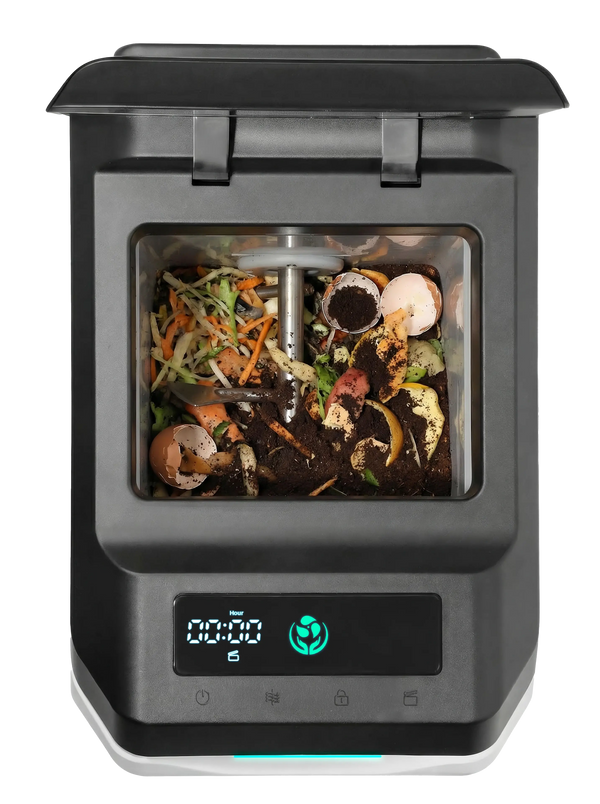
Biological processing, not just waste shrinkage.
Built for More Daily Scraps
Terra II combines continuous feeding, up to about 2 kg of daily processing capacity, and no routine disposable odor-filter replacement.
Built for everyday kitchens.
Filters, Maintenance, and Long-Term Cost
Maintenance is not only about wiping down the machine. It includes recurring filters, starter materials, cleaning, electricity, and how often the user needs to intervene.
GEME Terra II Ownership Model
- No routine disposable carbon-filter replacement
- Continuous biological bed
- No required daily microbial refill
- Routine operating costs are mainly electricity plus optional biological maintenance when needed
Reencle Prime Maintenance Model
- Replaceable activated-carbon odor filter
- Current recommended filter cycle: approximately 9–12 months
- Mesh-filter cleanliness and microbial moisture affect odor-control performance
- Long-term cost depends on replacement frequency, electricity, and other maintenance needs
For a category-wide look at recurring filter expenses, see our electric composter filter cost comparison.
Which One Should You Choose?
Choose GEME Terra II if...
- You cook daily and produce more food scraps.
- You need significantly more daily processing headroom.
- You want continuous feeding.
- You want an active compost base for a kitchen-to-soil routine.
- You want to avoid routine disposable odor-filter replacement.
Choose Reencle Prime if...
- Your household produces lighter daily food-waste volume.
- A lighter machine is important to you.
- The Prime’s 700 g recommended daily capacity fits your routine.
- You are comfortable replacing the activated-carbon filter periodically.
- You are comfortable curing harvested compost before normal garden use.
Still comparing options? See GEME vs Lomi, GEME vs Mill, or return to our electric composter comparison hub.
Common Buyer Misunderstandings
1. “Both have a 14L chamber, so capacity is basically the same.”
Not necessarily. Chamber volume and daily biological processing capacity are different measurements. The daily throughput guidance is more useful for estimating whether the machine can keep up with your household.
2. “Both use microbes, so the outputs are identical.”
Not automatically. Microbial inputs, operating environment, residence time, harvesting practice, and post-harvest guidance all influence the final material and how it should be used.
3. “Faster breakdown means finished compost.”
Visible disappearance is not the same thing as agronomic maturity. Biological decomposition continues through different stages.
4. “Filter cost is too small to matter.”
A single replacement may look inexpensive, but recurring consumables should be considered across the entire ownership period rather than only the first year.
Practical Decision Rules
The Throughput Rule
If your household frequently exceeds 700 g of scraps per day, Terra II provides substantially more daily processing headroom.
The Low-Upkeep Rule
If you want to avoid recurring activated-carbon filter replacement, Terra II has the simpler routine filter model.
The Mobility Rule
If you regularly need to move the machine, Reencle Prime’s roughly 9.1 kg body is easier to reposition than Terra II at about 13 kg.
The Garden Rule
If soil use is a major goal, compare the full post-harvest instructions—not simply whether the brand uses the word “compost.”
Final Decision
For households that cook daily and want significantly more daily processing capacity, continuous feeding, a kitchen-to-soil workflow, and no routine disposable odor-filter replacement, GEME Terra II has the stronger overall fit.
Reencle Prime remains a credible microbial alternative for smaller households whose food-waste volume stays within its lower daily processing guidance and who are comfortable with periodic carbon-filter replacement and post-harvest curing.
The best machine is not necessarily the one with the longest feature list. It is the one whose biological capacity and maintenance model match the amount of food waste your household actually produces.
FAQ
Is GEME Terra II better than Reencle Prime?
Terra II is the stronger fit for households that need higher daily processing capacity, want continuous feeding, and prefer no routine disposable odor-filter replacement. Reencle Prime may fit smaller-volume households that are comfortable with its lower daily capacity and maintenance model.
Do both GEME Terra II and Reencle Prime use microorganisms?
Yes. Both use microbial food-waste processing. The more meaningful differences are daily processing capacity, operating controls, filtration, maintenance, and output handling.
Which composter has a higher daily capacity?
GEME Terra II is designed for up to about 2 kg of food waste per day. Reencle Prime currently recommends about 700 g per day and lists about 1 kg per day as its maximum processing capacity.
Does Reencle compost need curing?
Current Reencle guidance recommends curing harvested material before normal plant use, generally for around 30 days under suitable conditions.
Does GEME Terra II require filter replacement?
Terra II does not use a routine disposable carbon-filter replacement model. Its odor-control system is designed around a permanent filtration and aerobic processing approach.
How often does Reencle Prime need a carbon filter?
Reencle’s current guidance recommends replacing the Prime activated-carbon filter approximately every 9–12 months, although actual life depends on operating and maintenance conditions.
Which one is better for a family that cooks every day?
For households producing larger amounts of scraps each day, Terra II’s higher daily processing capacity provides more headroom. For lighter-volume households, Reencle Prime may be sufficient.
Verified Sources
Specifications and competitor statements in this comparison were checked against current manufacturer documentation rather than third-party marketplace descriptions.
- Reencle — Model Overview & Specifications
- Reencle — Daily Capacity & Feeding Best Practices
- Reencle — Prime Carbon Filter Guidance
- Reencle — Compost Output & Curing Guidance
- GEME — Terra II Product Specifications
- GEME — Terra II FAQ & Operating Guidance
- GEME — Manuals & Technical Guidance
- GEME — Kobold™ Microbial Technology
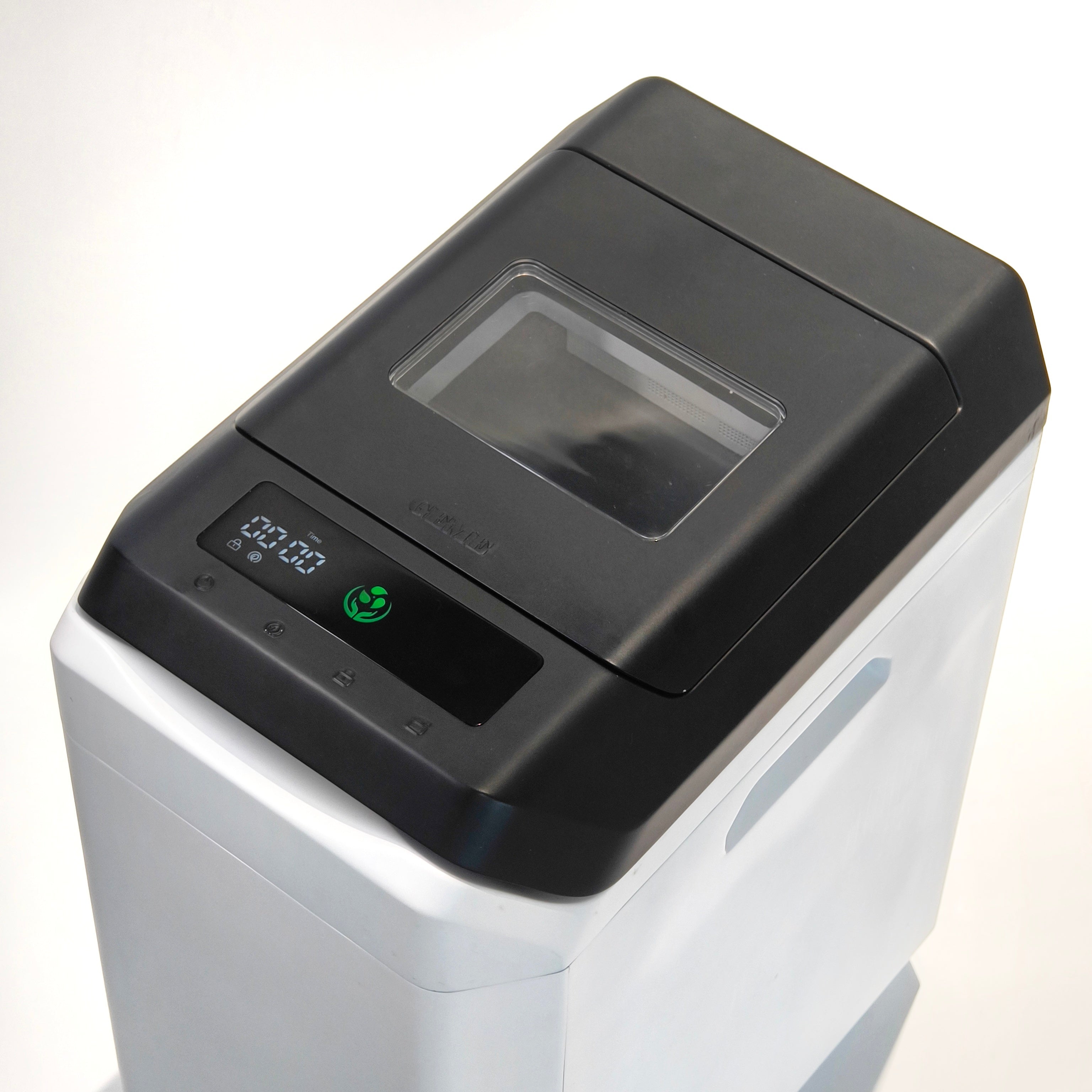
From daily scraps back to soil.
Choose the Capacity Your Kitchen Actually Needs
Terra II is built for continuous microbial processing, heavier daily household food-waste loads, and a kitchen-to-soil routine without recurring disposable odor filters.
Built for microbial kitchen composting.


Hinterlasse einen Kommentar
Alle Kommentare werden vor der Veröffentlichung geprüft.
Diese Website ist durch hCaptcha geschützt und es gelten die allgemeinen Geschäftsbedingungen und Datenschutzbestimmungen von hCaptcha.