
Tropical Storm Dolly 2026 · NHC Update · Climate Hub
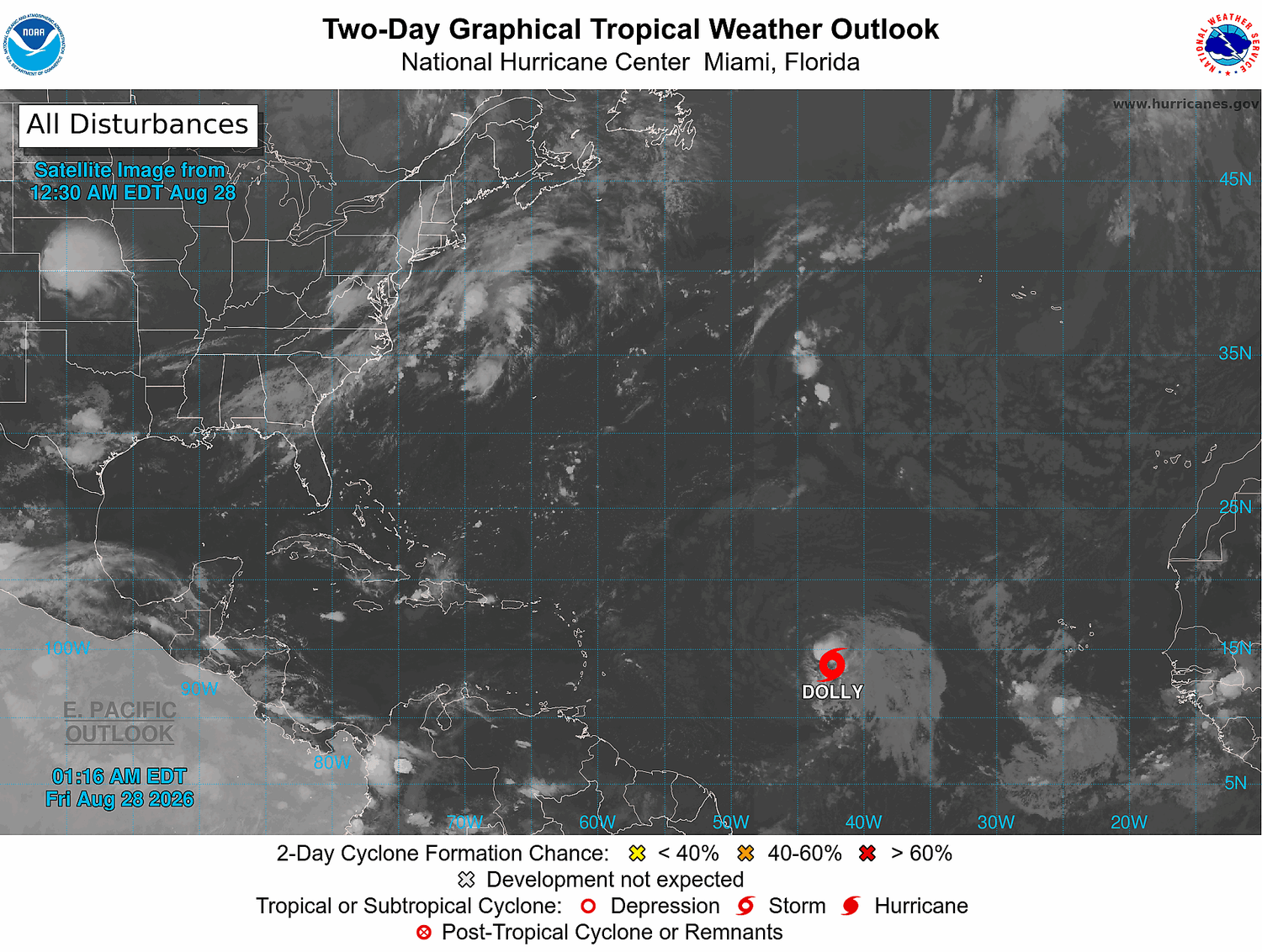
Tropical Storm Dolly has formed over the central tropical Atlantic and is moving rapidly west toward the Lesser Antilles, but the latest National Hurricane Center forecast does not currently show Dolly becoming a hurricane.
As of NHC Advisory #3 at 0300 UTC on August 28, Dolly had maximum sustained winds near 40 mph and was moving west at about 23 mph. Some short-term strengthening is possible, but increasing wind shear, relatively dry air and fast forward motion are expected to weaken the system.
The wind forecast is only part of the story. Heavy tropical moisture may still affect the Leeward Islands, Virgin Islands, Puerto Rico and Hispaniola, with flash flooding possible in higher terrain.
Weather data reviewed August 28, 2026. Tropical forecasts change quickly. Always use the National Hurricane Center and local emergency authorities for operational decisions.

Near-real-time GOES imagery of Tropical Storm Dolly. Satellite imagery shows current atmospheric structure, not the official forecast. View NOAA source →
Quick Answer: Is Tropical Storm Dolly a Hurricane?
No. Tropical Storm Dolly is not Hurricane Dolly as of the latest National Hurricane Center advisory reviewed for this article.
A tropical cyclone is classified as a hurricane when its maximum sustained winds reach at least 74 mph / 64 knots. Dolly's winds were near 40 mph / 35 knots at the latest update.
Searches such as “tropical storm dolly hurricane,” “storm dolly,” “hurricane dolly 2026,” “NHC”, and “NOAA hurricane center” can therefore be misleading if tropical storm and hurricane are treated as interchangeable labels.
For the earlier season context before Dolly officially formed, read Atlantic Hurricane Season 2026: Tropical Storm Dolly & Garden Prep.
Tropical Storm Dolly: 60-Second Snapshot
Current Status
Tropical Storm
40 mph sustained winds
1007 mb central pressure.
Current Motion
Rapidly westward
About 23 mph toward the Lesser Antilles.
Forecast
Brief strengthening possible
Then weakening and loss of tropical structure are forecast.
Main Concern
Heavy rainfall
Flash flooding may remain possible even if Dolly weakens.
Table of Contents
- Latest NHC Update on Tropical Storm Dolly
- Will Tropical Storm Dolly Become a Hurricane?
- Dolly Forecast for the Next 48–72 Hours
- Leeward Islands, Puerto Rico & Caribbean Risk
- NHC, National Hurricane Center & NOAA
- How to Prepare for a Tropical Storm or Hurricane
- Garden & Outdoor Compost Preparation
- Floodwater and Food Safety
- What Dolly Means for the 2026 Hurricane Season
- Dolly and Climate Change
- Food Waste, Methane & Climate Warming
- How to Handle Food Waste Better
- How Compost Builds Soil & Water Resilience
- What Compost Can and Cannot Do
- Frequently Asked Questions
- Sources
- Related Climate Guides
1. Latest NHC Update on Tropical Storm Dolly 2026
The National Hurricane Center officially began advisories on Tropical Storm Dolly on August 27 after the disturbance previously known as Invest 96L developed a sufficiently organized circulation and tropical-storm-force winds.
Dolly became the fourth named storm of the 2026 Atlantic hurricane season, following Arthur, Bertha and Cristobal.
| NHC Advisory #3 | Latest Reviewed Value |
|---|---|
| Advisory time | 0300 UTC, August 28, 2026 |
| Center | 13.8°N, 42.3°W |
| Maximum sustained winds | 40 mph / 65 km/h / 35 kt |
| Movement | West at about 23 mph / 37 km/h |
| Minimum pressure | 1007 mb |
| Coastal watches / warnings | None in effect at the advisory time; interests in the Leeward Islands were advised to monitor Dolly. |
Official archive: NHC Tropical Storm Dolly Advisory Archive →
2. Will Tropical Storm Dolly Become a Hurricane?
The current official NHC forecast does not show Dolly becoming a hurricane.
Dolly needs sustained winds of at least 74 mph to qualify as a hurricane. The latest reviewed NHC forecast instead allows only modest strengthening to roughly 45 mph / 40 knots before weakening begins.
Why Is Dolly Expected to Weaken?
The atmosphere around the storm is expected to become less supportive even though Dolly is crossing warm tropical waters.
- Increasing vertical wind shear: stronger winds at different altitudes can tilt or separate a tropical cyclone's circulation from its thunderstorms.
- Relatively dry air: dry air entering the circulation can suppress persistent deep convection.
- Fast forward motion: Dolly is moving unusually quickly, which can make it harder for the circulation and thunderstorms to remain vertically organized.
Search clarification:
“Tropical Storm Dolly hurricane” is a useful search phrase, but it is not the current meteorological classification. At this update, the correct name is Tropical Storm Dolly.
3. Tropical Storm Dolly Forecast for the Next 48–72 Hours
NHC guidance keeps Dolly moving rapidly westward for the next couple of days under a strong subtropical ridge over the central Atlantic.
| Forecast Valid | Position | Max Wind | Forecast Status |
|---|---|---|---|
| Aug 28 · 1200 UTC | 14.3°N · 45.7°W | 45 mph / 40 kt | Tropical Storm |
| Aug 29 · 0000 UTC | 15.2°N · 50.2°W | 45 mph / 40 kt | Tropical Storm |
| Aug 29 · 1200 UTC | 16.0°N · 54.7°W | 45 mph / 40 kt | Tropical Storm |
| Aug 30 · 0000 UTC | 16.7°N · 59.0°W | 40 mph / 35 kt | Post-Tropical |
| Aug 30 · 1200 UTC | 17.0°N · 63.0°W | 35 mph / 30 kt | Post-Tropical / Remnant Low |
| Aug 31 · 0000 UTC | — | — | Dissipated in current forecast |
A forecast of dissipation does not mean every hazard disappears at the same moment. Moisture, gusty winds, rough seas and heavy rain can continue after a circulation is no longer classified as a tropical cyclone.
This is why people in the projected rainfall area should follow the hazard forecast rather than focusing only on whether Dolly still has a name.
4. Could Dolly Affect the Leeward Islands, Puerto Rico or Hispaniola?
Yes. The current concern is primarily rainfall rather than hurricane-force winds.
NHC and National Weather Service tropical discussions indicate that moisture associated with Dolly could begin affecting the Leeward Islands late Saturday into Sunday, followed by the Virgin Islands, Puerto Rico and Hispaniola Sunday into Monday.
Flash flooding is especially important in higher terrain, where moist air can be forced upward and produce locally heavier rainfall.
A Storm Category Is Not a Flood-Risk Scale
A tropical storm, remnant low or tropical wave can still produce dangerous rainfall. Rainfall depends on moisture, terrain, storm speed, atmospheric structure and how long rain bands remain over a location—not only on the maximum wind category.
For post-storm safety, continue to Recovery Tips After Hurricane: 7 Steps to Stay Safe.
5. NHC, National Hurricane Center and “NOAA Hurricane Center”: Which Source Should You Use?
The official U.S. tropical cyclone forecasting center for the Atlantic is the National Hurricane Center, usually abbreviated NHC.
People frequently search for “NOAA hurricane center” or simply “hurricane center.” The formal name is the National Hurricane Center, and it operates within NOAA's National Weather Service.
Latest Advisory
Use the NHC advisory for the official center position, maximum winds, motion and watches or warnings.
Forecast Cone
The cone shows uncertainty in the forecast center track. It does not show the total geographic extent of hazards.
Local Forecast
Use local weather offices and emergency authorities for flooding, evacuation, road and shelter decisions.
Satellite Imagery
NOAA/NESDIS imagery helps show storm structure but should not be treated as an operational forecast by itself.
The National Weather Service also emphasizes that hazards can extend far outside the forecast cone. Heavy rain, tornadoes, coastal flooding and dangerous surf do not stop at the cone boundary.
6. How to Prepare for Tropical Storm Dolly or Any Approaching Hurricane
The safest preparations are completed before wind, flooding or evacuation conditions become dangerous.
Know Your Risk and Evacuation Plan
- Know whether your home is in a storm-surge, coastal or inland flood-risk area.
- Know your local evacuation zone and at least one evacuation route.
- Identify where family members and pets will go if officials order evacuation.
- Leave when instructed. Do not delay evacuation to protect property, plants or equipment.
Prepare Essential Supplies
- Drinking water and shelf-stable food.
- Prescription medicines and first-aid supplies.
- Phone chargers and power banks.
- Flashlights and batteries.
- Pet food and pet medication.
- Copies of important identification, insurance and financial documents.
Protect the Home Before Conditions Deteriorate
- Bring outdoor furniture, tools, decorations and loose containers inside.
- Clear leaves and debris from gutters and surface drains.
- Use approved window and door protection where appropriate.
- Move vulnerable documents and electronics above likely flood levels.
- Charge devices before likely outages.
Never Drive Through Floodwater
Floodwater can hide damaged roads, strong currents, open drains, debris and electrical hazards. Follow the National Weather Service rule: Turn Around, Don't Drown.
Official preparedness guidance: National Weather Service Hurricane Safety.
7. How to Prepare a Garden and Outdoor Compost Before Heavy Tropical Rain
Gardens create extra storm hazards because pots, branches, tools, irrigation parts and compost equipment can all be exposed to wind or flooding.
Before the Storm
- Move small pots and hanging baskets to a protected area.
- Secure larger containers and lightweight garden structures.
- Address dead or hazardous branches before severe weather arrives.
- Keep drains and water pathways clear.
- Turn off unnecessary automatic irrigation when major rainfall is expected.
- Secure lightweight compost-bin lids and loose carbon materials.
- Keep outdoor compost away from storm drains and known flood paths.
Protect Outdoor Compost From Saturation
A compost pile needs both moisture and oxygen. Prolonged heavy rain can fill pore spaces with water, reduce airflow and push a pile toward anaerobic conditions.
Where practical and safe, protect an exposed pile from excessive direct rain while preserving drainage and ventilation. After the storm, check moisture before adding more water and use suitable dry carbon-rich material if the pile is excessively wet.
People come before compost.
Once dangerous winds, lightning, flooding or official warnings begin, do not go outside to rescue a pot, cover a compost pile or repair irrigation.
For the broader preparation sequence, use our Atlantic Hurricane Season 2026 garden preparation guide.
8. After Flooding: Food Safety Comes Before Food-Waste Diversion
Storms often create a second waste problem after the wind passes: spoiled refrigerated food, damaged garden produce and flood-contaminated food.
These materials should not all be treated the same way.
The U.S. Food and Drug Administration advises consumers not to eat food that may have come into direct contact with floodwater. Floodwater can carry sewage, pathogens, petroleum products, chemicals and other contaminants.
Do Not Treat Flood-Contaminated Food as Ordinary Compost Feedstock
Food or produce exposed to potentially contaminated floodwater should not automatically go into a backyard pile, municipal stream or indoor composter. Follow local disposal guidance first. Normal spoiled food and disaster-contaminated material are different waste streams.
Read the FDA food-safety guidance after storms and flooding.
9. What Does Dolly Mean for the 2026 Atlantic Hurricane Season?
Dolly is a reminder of an important distinction: a below-normal hurricane season does not mean a no-risk hurricane season.
NOAA's updated August outlook gives the 2026 Atlantic season a 75% chance of finishing below normal, a 20% chance of being near normal and a 5% chance of being above normal.
7–13
Named storms in NOAA's updated 70% probability range.
2–6
Hurricanes in the updated seasonal range.
0–2
Major hurricanes in the updated seasonal range.
75%
Chance NOAA assigns to a below-normal season overall.
NOAA also emphasizes that this seasonal outlook is not a landfall forecast. A basin can be relatively quiet overall and still produce a damaging storm for one community.
August, September and October are normally the heart of Atlantic tropical activity, so Dolly arrives as the basin enters its most climatologically active period.
For the larger ocean-atmosphere background this year, see our El Niño 2026 Forecast: Super El Niño, Extreme Weather & U.S.-Europe Impacts.
10. Did Climate Change Cause Tropical Storm Dolly?
It is not scientifically sound to say that climate change simply “caused Dolly.”
Individual tropical cyclones form from a specific combination of sea-surface temperatures, atmospheric moisture, wind shear, tropical disturbances, circulation patterns and natural climate variability.
Event attribution asks a different question: how much did human-caused warming alter the probability or severity of a particular event? Answering that requires dedicated scientific analysis.
What Does NOAA Research Say More Broadly?
NOAA's Geophysical Fluid Dynamics Laboratory summarizes several stronger conclusions about tropical cyclones in a warmer climate:
- Tropical cyclone rainfall rates are projected to increase. A warmer atmosphere can hold more moisture.
- Average tropical cyclone intensity is projected to increase.
- The proportion of very intense Category 4 and 5 tropical cyclones is projected to increase.
- Sea-level rise raises the starting point for coastal inundation.
- Total storm frequency is much less certain. Many models project little change or fewer tropical cyclones overall rather than simply “more hurricanes.”
The Important Climate Distinction
Climate change alters the background environment in which tropical cyclones occur. That is different from claiming that every named storm exists only because the climate has warmed.
This distinction is also central to our El Niño 2026 Climate Stress Test: natural climate variability and human-caused warming can interact without becoming the same phenomenon.
Explore the full topic map in the GEME Climate Change & Sustainability Guide.
11. What Does Food Waste Have to Do With Climate Warming?
A tropical cyclone and a kitchen scrap are obviously not the same climate problem.
But climate resilience requires two kinds of action at the same time:
- Adaptation: prepare homes, infrastructure, agriculture and communities for climate hazards.
- Mitigation: reduce avoidable greenhouse-gas emissions where practical.
Food waste belongs strongly in the second category because of landfill methane.
24%
Food makes up about 24% of U.S. municipal solid waste disposed of in landfills, according to EPA.
58%
EPA estimates landfilled food is responsible for about 58% of fugitive methane emissions from U.S. municipal solid-waste landfills.
The mismatch occurs partly because food decomposes quickly. In the oxygen-poor environment of a landfill, biological decomposition can generate methane, and some of that methane escapes before landfill-gas collection systems capture it.
For the accounting boundaries behind this comparison, read Composting vs. Landfill: Emissions & Environmental Impact.
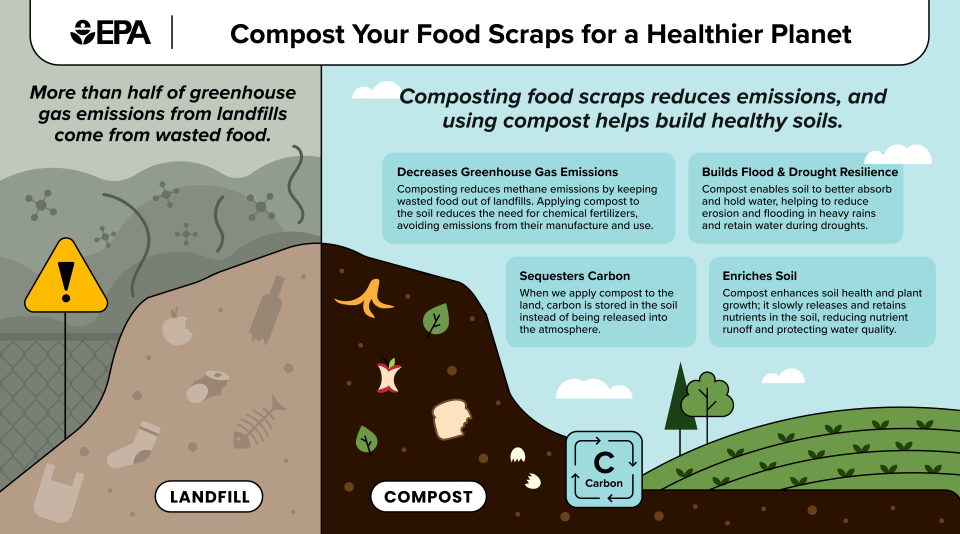
U.S. EPA illustration connecting food-waste composting with lower landfill methane, healthier soils and flood and drought resilience. These are compost-pathway findings, not universal lifecycle claims for any individual appliance. View EPA source →
12. How Should Households Handle Food Waste Better?
The best solution is not to compost as much edible food as possible.
Preventing edible food waste comes first.
1. Prevent Waste Before It Happens
- Plan realistic meals before shopping.
- Store food at the correct temperature.
- Create an “eat first” area for food approaching its usable window.
- Freeze food before it spoils.
- Use leftovers intentionally.
2. Keep Safe Surplus in the Food System
Donation and redistribution preserve more of the land, water, energy and labor already used to produce food than disposal does.
3. Compost Suitable Unavoidable Scraps
Peels, cores, coffee grounds and other unavoidable organic material can enter an appropriate biological recovery pathway instead of automatically entering mixed trash.
4. Understand What Composting Actually Is
Composting is managed biological decomposition. Microorganisms, oxygen, moisture, temperature, feedstock and time all matter.
Drying or grinding food may solve a storage problem, but it is not automatically the same biological process.
Start with the Complete Home Composting Guide and How Does Composting Work? Microbes, Heat & Oxygen.
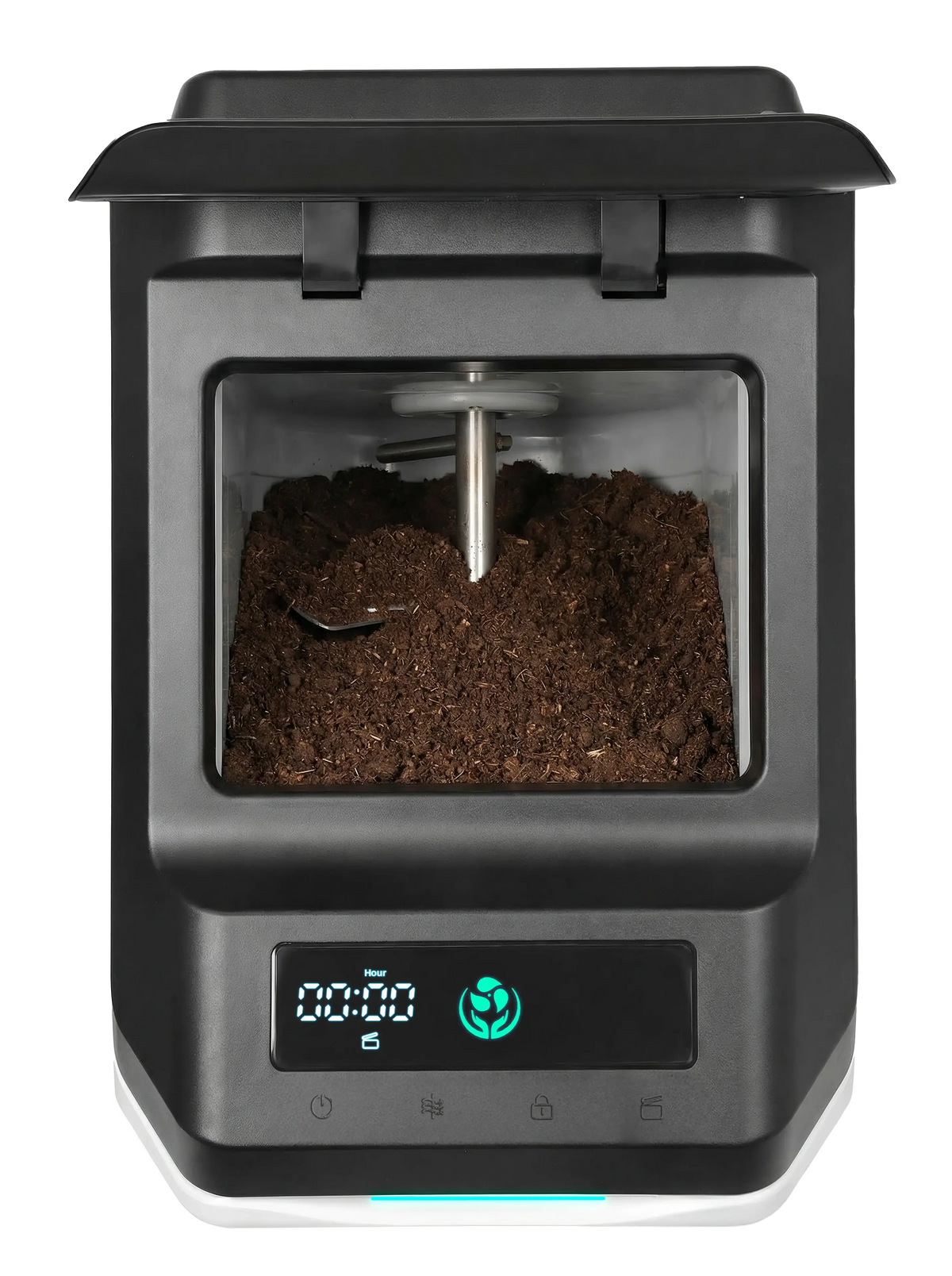
Process suitable everyday scraps and use the resulting Compost Base responsibly in soil.
Turn Suitable Kitchen Scraps Into a Soil-Building Routine
GEME Terra 2 uses a continuously active microbial environment with managed heat, airflow, moisture and mixing to process suitable household food scraps into a moist Compost Base.
Treat GEME output as concentrated Compost Base. Screen unfinished material and blend approximately 1 part Compost Base with 8 parts plain soil for plant use.
13. How Can Compost Improve Soil and Water Resilience?
This is where composting moves from climate mitigation back toward climate adaptation.
EPA's environmental assessment of compost application identifies several soil and water benefits, including:
- increased soil organic matter;
- reduced soil density and compaction;
- improved water infiltration;
- improved water retention and water-holding capacity;
- reduced stormwater runoff;
- reduced erosion and surface-water pollution;
- greater resilience to heat, drought and floods.
More Infiltration
Better soil structure can allow more rainfall to enter the soil rather than immediately moving across the surface.
Less Runoff
Improved infiltration and soil cover can reduce the amount and speed of water moving across the surface.
More Water Stored
Organic matter and soil pore structure help retain water after rainfall for later plant use.
Drought Resilience
Soil that stores water more effectively can support plants for longer between rain or irrigation events.
This creates a practical circular pathway:
Suitable food scraps → managed composting → organic matter returned to soil → improved soil structure → greater infiltration and water retention → stronger soil-scale resilience.
For broader climate adaptation, soil and household guidance, return to the Climate Change & Sustainability Guide.
14. What Compost Can, and Cannot, Do During Extreme Weather
Compost can improve soil. It cannot stop a hurricane.
This boundary matters because useful climate actions lose credibility when they are described as universal solutions.
| Compost Can Help With | Compost Cannot Replace |
|---|---|
| Soil organic matter and structure. | Evacuation planning. |
| Water infiltration and retention. | Storm-surge protection. |
| Reducing ordinary soil erosion and runoff. | Regional flood-control infrastructure. |
| Supporting plant resilience between rain events. | Safe buildings and hurricane-resistant construction. |
| Supporting rain gardens, bioswales and healthy vegetated soil systems. | Emergency warnings, drainage systems or local flood management. |
A garden amended with organic matter can be more resilient to normal heavy rain and dry periods. It is still vulnerable to catastrophic flood depths, saltwater inundation, landslides and storm surge.
The goal is not to “hurricane-proof” soil. It is to build healthier everyday systems that recover better when weather becomes more extreme.
Bottom Line: Dolly Is a Weather Event Inside a Bigger Climate Story
Tropical Storm Dolly is currently forecast to remain below hurricane strength and weaken before reaching the Lesser Antilles, but rainfall risk may continue even after the circulation loses tropical-storm status.
The immediate response is practical: monitor NHC updates, prepare before conditions become dangerous, respect floodwater, secure homes and gardens, and follow local emergency instructions.
The longer climate response is broader. A warming climate can influence tropical-cyclone rainfall, intensity and coastal flooding risk, while avoidable emissions such as landfill methane remain part of the mitigation challenge.
Managing food waste better and returning appropriate composted organic matter to soil will not change Dolly's track. It can, however, reduce one avoidable methane pathway and contribute to healthier soils that manage water more effectively.
Frequently Asked Questions About Tropical Storm Dolly 2026
Is Tropical Storm Dolly a hurricane?
No. As of NHC Advisory #3 reviewed for this article, Dolly had maximum sustained winds near 40 mph. Hurricane intensity begins at 74 mph.
Where is Tropical Storm Dolly now?
At 0300 UTC on August 28, the National Hurricane Center located Dolly near 13.8°N, 42.3°W over the central tropical Atlantic. Because the storm is moving quickly, always check the newest NHC advisory for its current location.
What is the latest NHC forecast for Dolly?
The current NHC forecast allows short-term strengthening to about 45 mph before stronger vertical wind shear, relatively dry air and fast forward motion weaken the circulation. Dolly is forecast to become post-tropical or a remnant system near the Lesser Antilles.
Could Tropical Storm Dolly affect Puerto Rico?
Yes. NHC guidance indicates that moisture associated with Dolly or its remnants could affect the Virgin Islands, Puerto Rico and Hispaniola Sunday into Monday, with flash flooding possible in higher terrain.
What is the NOAA Hurricane Center?
The official name is the National Hurricane Center, abbreviated NHC. It operates within NOAA's National Weather Service and issues Atlantic tropical-cyclone advisories and forecasts.
Does the NHC forecast cone show everyone who will be affected?
No. The cone represents uncertainty in the forecast location of a cyclone's center. Rain, flooding, tornadoes, wind and dangerous surf can occur outside the cone.
Did climate change cause Tropical Storm Dolly?
Dolly cannot simply be attributed to climate change from the fact that it formed. Individual-storm attribution requires dedicated analysis. NOAA research does, however, project higher tropical-cyclone rainfall rates and average intensity in a warmer climate.
How does food waste contribute to climate change?
Food waste decomposing under anaerobic landfill conditions generates methane. EPA estimates food represents about 24% of U.S. municipal solid waste disposed of in landfills but approximately 58% of fugitive methane emissions from those landfills.
Can compost help prevent flooding?
Compost cannot prevent hurricane flooding or storm surge. Appropriate compost application can improve soil structure, water infiltration and retention and reduce ordinary runoff and erosion, supporting soil-scale resilience as one part of broader water management.
Should flood-damaged food be composted?
Food exposed to potentially contaminated floodwater should not automatically be treated as ordinary compost feedstock. Follow FDA and local disposal guidance because floodwater may contain sewage, pathogens, fuel or chemicals.
NOAA, EPA, FDA and Official Safety Sources
- NOAA National Hurricane Center — Tropical Storm Dolly Advisory Archive
- NOAA National Hurricane Center — Current Tropical Cyclone Advisories
- NOAA/NESDIS/STAR — Tropical Storm Dolly GOES Satellite Imagery
- NOAA Climate Prediction Center — 2026 Atlantic Hurricane Season Outlook
- National Weather Service — Hurricane Safety Tips and Resources
- National Weather Service — Hurricane Watches, Warnings and Forecast Cone Guidance
- NOAA GFDL — Global Warming and Hurricanes: Current Research
- U.S. EPA — Quantifying Methane Emissions From Landfilled Food Waste
- U.S. EPA — Environmental Value of Applying Compost
- U.S. EPA — Benefits of Using Compost
- U.S. FDA — Food Safety After a Storm or Flooding
- GEME — Climate Change & Sustainability Guide
- GEME — Composting vs Landfill: Environmental Impact
Climate Mitigation + Climate Resilience
Prepare for the Weather. Reduce the Waste We Can Control.
No household action can control the path of Tropical Storm Dolly. But households can prepare earlier, keep edible food in use, divert suitable unavoidable scraps from high-methane landfill pathways and build healthier soil systems over time.
Follow official weather guidance first. Build climate resilience as a long-term system, not as a single-product claim.


Hinterlasse einen Kommentar
Alle Kommentare werden vor der Veröffentlichung geprüft.
Diese Website ist durch hCaptcha geschützt und es gelten die allgemeinen Geschäftsbedingungen und Datenschutzbestimmungen von hCaptcha.