


Food Scrap Composting Guide
Composting Basics: Can You Compost Garlic?
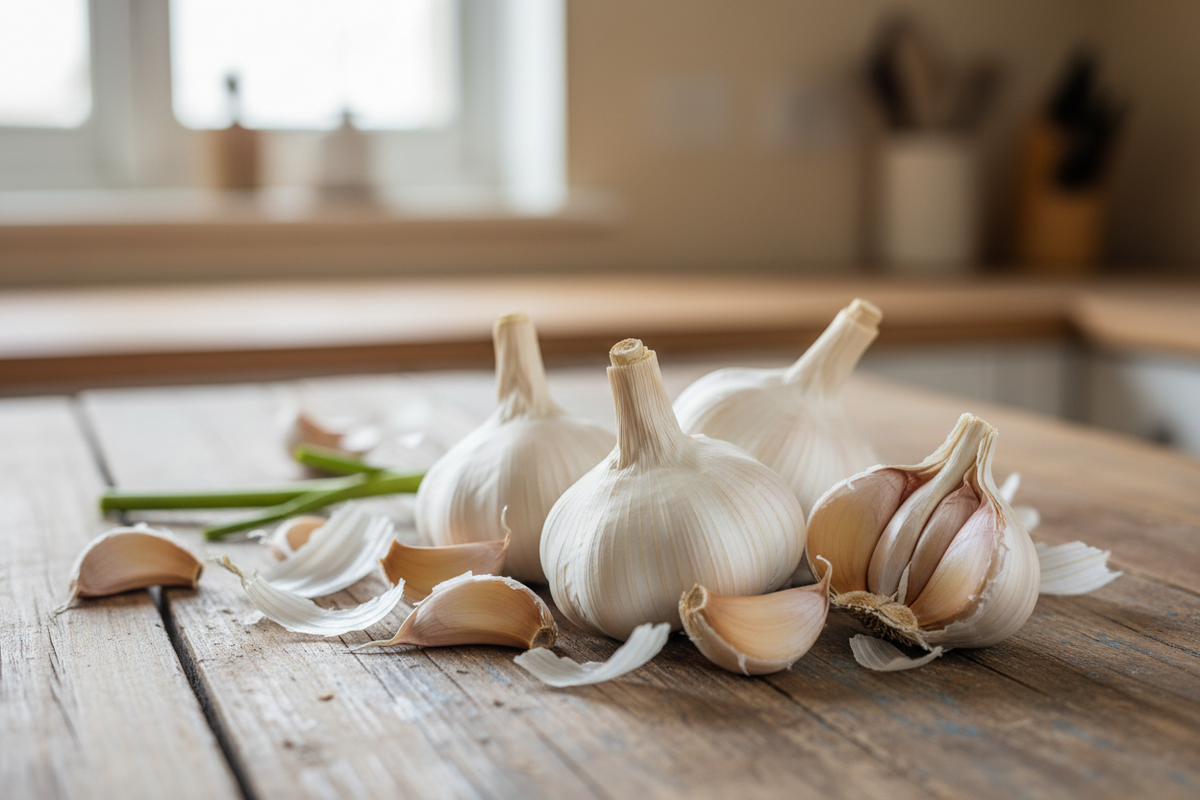
Yes, you can compost garlic. Garlic cloves, leftover bulbs, cooked garlic and papery skins are all organic materials that can break down through microbial activity.
For faster decomposition, especially in GEME Terra 2, we recommend smashing whole cloves and breaking apart or crushing an intact garlic bulb before feeding. Opening the clove exposes more internal surface directly to the microbial bed, helping decomposition get started faster.

Quick Answer: Can You Compost Garlic?
Yes. Raw garlic, cooked garlic, whole cloves, bulbs and garlic skins can all be composted.
If the garlic is already chopped, add it normally. If you have an intact clove or whole bulb, smashing or breaking it open first is recommended because the extra exposed surface gives microorganisms more material to work on immediately.
Chopped garlic: add normally.
Whole garlic clove: smash or split first when practical.
Whole garlic bulb: separate the cloves and crush them rather than adding the intact bulb.
Garlic skin: compostable; mix it naturally with other kitchen scraps.
If you are checking other everyday ingredients too, start with the broader What Can You Compost at Home? reference guide.
Table of Contents
- Can You Compost Garlic?
- Can You Compost Garlic Cloves?
- Can You Compost Garlic Skins?
- Can You Compost a Whole Garlic Bulb?
- Why Does Smashing Garlic Help?
- How to Compost Garlic Outdoors
- Can Garlic Go in a Worm Bin?
- Can You Put Garlic in GEME Terra 2?
- What About Cooked, Oily or Salty Garlic?
- What Happens After Garlic Becomes Compost?
- Common Garlic Composting Mistakes
- Frequently Asked Questions
- Sources
1. Can You Compost Garlic?
Yes. Garlic is ordinary plant-based organic material and can be broken down by composting microorganisms.
You can compost raw cloves, garlic trimmings, old bulbs, cooked garlic and the dry papery skin.
The more useful question is not whether garlic is biodegradable. It is how you should prepare it for the composting system you are using.
A backyard pile, worm bin and controlled microbial kitchen composter do not have exactly the same operating preferences. Our Compost Pile vs Electric Composter guide explains why the same kitchen scrap can require different handling depending on the system.
Simple rule: garlic is compostable; preparation affects speed.
If you are new to greens, browns, oxygen and moisture balance, the Beginner's Guide to Composting at Home is a useful starting point.
2. Can You Compost Garlic Cloves?
Yes. Garlic cloves are compostable.
A whole clove can eventually break down, but its relatively intact exterior limits how much internal tissue is immediately exposed.
A simple smash changes that.
Once the clove splits open, microorganisms have direct access to far more of the moist organic material inside.
Do You Need to Mince Garlic Before Composting?
No.
The goal is not to turn unwanted garlic into a paste.
A light crush, split or rough chop is enough to open the structure and substantially increase exposed surface area.
GEME recommendation: if a garlic clove is still whole, give it a quick smash before adding it. This increases contact between the garlic and the active microbial bed and helps decomposition begin more efficiently.
The same preparation principle appears with other slow or protected kitchen scraps. For example, our guide to composting eggshells explains why crushed shells disperse and break down more effectively than large intact pieces.
3. Can You Compost Garlic Skins?
Yes. Garlic skins are compostable.
The thin papery layers around the bulb are plant material. They can go into an outdoor compost pile and can also enter Terra 2 in normal household quantities.
Because garlic skins are dry and fibrous, they may remain visible longer than the moist clove inside.
That is not a problem.
Different kitchen materials naturally break down at different speeds. Soft fruit, dense shells, coffee grounds, skins and fibrous plant matter do not all follow the same timetable.
This is similar to other everyday kitchen inputs. Used coffee grounds can be composted, for example, but their fine texture means they should be dispersed rather than allowed to form a dense wet layer.
Should Garlic Skins Be Saved as Browns?
A few garlic skins are too small a contribution to matter much as a carbon-balancing strategy.
For a traditional pile, use proper structural browns such as dry leaves, straw or shredded plain cardboard instead.
4. Can You Compost a Whole Garlic Bulb?
Yes, but breaking the bulb apart first is the better method.
An intact garlic bulb contains multiple cloves enclosed beneath overlapping dry skins.
If you put the entire bulb into compost untouched, microorganisms must work inward through those protective layers.
Separating the cloves and lightly crushing them removes that unnecessary barrier.
| Garlic Form | Can It Be Composted? | Recommended Preparation |
|---|---|---|
| Chopped garlic | Yes | Add normally. |
| Whole clove | Yes | Smash or split first for faster microbial access. |
| Whole bulb | Yes | Separate into cloves and crush when practical. |
| Garlic skin | Yes | Mix with other compostable food scraps. |
If you are dealing with spoiled produce rather than normal prep scraps, the same surface-area principle appears in our Moldy Grapes Composting Guide: whole fruit can decompose, but split or crushed material exposes more area and normally breaks down faster.
5. Why Does Smashing Garlic Help It Compost Faster?
The answer is surface area.
Microorganisms work where they can physically interact with organic material.
An intact garlic clove contains a relatively large amount of organic tissue behind a comparatively small external surface.
Smashing it opens the structure.
That exposes more tissue directly to:
- microorganisms;
- moisture;
- oxygen;
- mixing;
- and surrounding active compost material.
The principle is universal enough that it appears throughout compost preparation: large or tough pieces are commonly reduced in size because more exposed surface generally gives decomposers better access.
Smashing garlic does not make it compostable. Garlic was already compostable. Smashing simply makes more of the food immediately accessible to the organisms doing the composting.
Should Every Food Scrap Be Pulverized?
No.
Composting is not a competition to create the smallest possible particles.
The useful habit is to reduce unusually large, hard, dense or protected pieces when simple preparation makes sense.
6. How to Compost Garlic in a Backyard Pile
Garlic requires no unusual outdoor composting method.
The same biological fundamentals that apply to other kitchen scraps still matter: microorganisms, oxygen, moisture, carbon balance and time.
- Remove non-organic packaging. Take off plastic nets, labels and ties.
- Smash whole cloves where convenient. This increases exposed surface area.
- Break apart whole bulbs. There is little benefit in keeping all the cloves wrapped together.
- Add garlic with varied food scraps. Avoid creating a dense garlic-only pocket.
- Cover with browns. Dry leaves or shredded plain cardboard help maintain structure and reduce pest attraction.
- Maintain moisture. The pile should be damp rather than waterlogged.
- Keep oxygen moving. Turn or aerate the pile periodically.
For a complete explanation of pile construction, moisture, greens and browns, use our Complete Home Composting Guide.
7. Can Garlic Go in a Worm Bin?
Garlic is biodegradable, but a worm bin has different operating preferences from a backyard pile or Terra 2.
EPA vermicomposting guidance recommends avoiding or limiting strongly odorous foods such as garlic and onions in worm systems.
That does not mean garlic somehow stops being compostable.
It means composting method matters.
Quick comparison: garlic is straightforward in an aerobic backyard pile and suitable for Terra 2, while worm-bin feeding guidance is more conservative.
This is exactly why a single universal “yes/no food list” can be misleading. The broader Electric Composter Input Guide explains how biological compostability and machine-specific suitability are related but not identical.
8. Can You Put Garlic in GEME Terra 2?
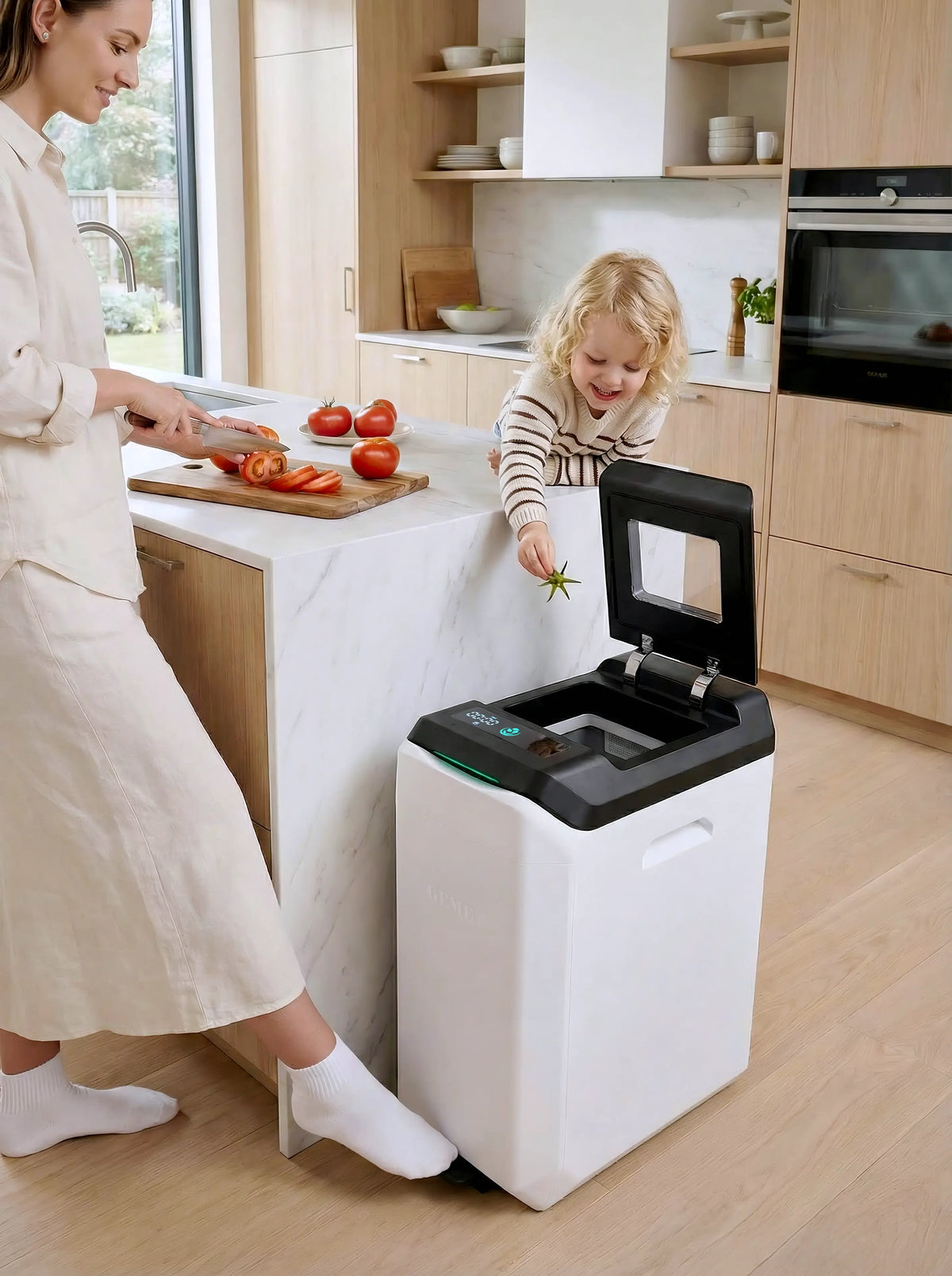
Yes. Garlic is suitable for GEME Terra 2.
Terra 2 is a continuous aerobic microbial system rather than a short-cycle grinder.
The active microbial bed processes ordinary household food waste while the system manages the conditions around airflow, moisture, heat and mixing. You can see the complete process in How GEME Continuous Microbial Composting Works.
Because decomposition is microbial, preparing a dense, intact clove can improve access.
See GEME Terra 2 in Action
Prefer Instagram? Watch the original GEME Reel →
| Garlic Input | Terra 2? | Best Practice |
|---|---|---|
| Chopped garlic | Yes | Add normally with mixed scraps. |
| Whole clove | Yes | Smash first when practical. |
| Whole bulb | Yes | Break apart and crush the cloves rather than feeding the bulb intact. |
| Garlic skin | Yes | Mix naturally with ordinary kitchen scraps. |
| Cooked garlic | Yes | Normal leftovers are fine; concentrated oil or liquid is a separate issue. |
Terra 2 is currently designed around ordinary continuous household feeding rather than bulk disposal. The broader current input boundaries, including wet, dense, oily and mineral-hard materials, are covered in the GEME Input & Feed FAQ.
9. What About Cooked, Oily or Salty Garlic?
Cooked garlic itself is not a problem.
Garlic mixed into vegetables, rice, pasta, sauces, or normal plate leftovers can be treated as part of the meal.
The important distinction is between:
food with some oil or seasoning
and:
pouring concentrated oil, brine or free liquid into a composting system.
For example, garlic sautéed in a normal meal is very different from disposing of a cup of garlic-infused cooking oil.
Excess oil and liquid can interfere with oxygen transfer and moisture balance. For the full operating boundary, read Electric Composter Salt & Oil Boundaries.
Continuous Microbial Composting
Smash the Garlic. Give the Microbes More Surface to Work With.
Terra 2 processes everyday kitchen scraps in a living aerobic bed. Garlic can go in normally, but crushing whole cloves exposes more internal tissue directly to the microbial ecosystem and helps decomposition begin faster.
10. What Happens After Garlic Becomes Compost?
Once garlic and the other food scraps in the system have been biologically processed, the next question is how the resulting organic material should be used.
For an outdoor pile, finished compost is normally treated as a soil amendment rather than pure garden soil.
For Terra 2, the output should be understood as a moist, biologically active Compost Base.
Because Terra 2 is continuous-feed, the chamber can contain material with different residence times. Larger recognizable fragments can be screened out and returned to the system.
The finer output should then be blended with soil according to current guidance. The detailed process is covered in the Advanced GEME Compost Application Guide.
If you want a broader garden-use reference rather than GEME-specific application instructions, see How to Use Compost Correctly.
Does Garlic Make the Compost a Garlic Fertilizer?
No.
Compost is the result of a mixed biological process, not a standardized fertilizer made from one ingredient.
The nutrient profile depends on the overall food mixture and process conditions.
GEME has published a household output dataset specifically to show both the presence and the variability of nutrients. See the NPK Test of Home Compost Output (N=50).
11. Common Garlic Composting Mistakes
Mistake 1: Assuming Garlic Cannot Be Composted
Garlic is ordinary organic plant material and can decompose in a suitable composting environment.
Mistake 2: Treating “Smash First” as a Requirement for Compostability
An intact garlic clove is already compostable.
Crushing is recommended because it increases exposed surface area and can help the microbial process start faster.
Mistake 3: Putting an Entire Bulb In When It Takes Seconds to Break Apart
Separating the cloves makes more material accessible immediately.
Mistake 4: Assuming Every Composting Method Has the Same Input Rules
Garlic is straightforward in a normal aerobic pile and acceptable in Terra 2, while worm-bin guidance is more conservative.
Mistake 5: Pouring Garlic Oil Into Terra 2
Garlic solids and a container of free oil are different inputs.
Do not use Terra 2 as a disposal route for concentrated cooking oil.
Mistake 6: Feeding One Ingredient in Excess
Terra 2 works best with the varied food-scrap pattern produced by a normal kitchen.
The same principle applies to other compostable ingredients: coffee grounds, fruit, vegetables, bread and garlic are all useful organic materials, but one highly concentrated material should not unnecessarily dominate the bed.
12. Frequently Asked Questions
Can you compost garlic?
Yes. Raw garlic, cooked garlic, cloves, bulbs and garlic skins are organic materials that can be composted. Breaking or crushing intact pieces can help them decompose faster.
Can you compost garlic cloves?
Yes. Whole garlic cloves are compostable. Smashing or splitting them first exposes more internal tissue to microorganisms and can help decomposition begin more efficiently.
Can you compost garlic skin?
Yes. Papery garlic skins are plant material and can be composted. Mix them with other organic materials rather than creating a large dry layer of skins by themselves.
Can you compost a whole garlic bulb?
Yes, but breaking the bulb apart first is recommended. Separate the cloves and smash or split them where practical to expose more surface area.
Why should you smash garlic before composting it?
Smashing breaks open the clove and exposes more internal surface area. This gives microorganisms more direct contact with the organic material and can help decomposition start faster.
Do you need to mince garlic before composting it?
No. Fine mincing is unnecessary. A simple smash, split or rough chop is enough to expose much more surface area than an intact clove.
Can you put garlic in GEME Terra 2?
Yes. Garlic is suitable for Terra 2. GEME recommends smashing whole cloves and breaking apart a whole bulb before feeding when practical so more of the garlic is directly exposed to the active microbial bed.
Can you put garlic skins in GEME Terra 2?
Yes. Normal amounts of garlic skin can enter Terra 2 with other kitchen scraps. Avoid saving up and adding an unusually large dry skin-only load.
Can cooked garlic go in Terra 2?
Yes. Garlic in normal cooked leftovers can be processed with other food scraps. Concentrated free oil, brine or liquid should be treated separately according to Terra 2 input guidance.
Can worms eat garlic?
Garlic is biodegradable, but worm-bin guidance is more cautious with strongly aromatic foods such as garlic and onion. Follow vermicomposting-specific feeding guidance rather than assuming every compostable food is ideal for worms.
Will garlic make compost smell?
Fresh garlic naturally has a strong aroma, but a healthy aerobic composting system should not develop a persistent rotten-food odor simply because a normal amount of garlic was added. Persistent sour or rotten odor is more useful as a sign to check moisture, airflow and feeding balance.
13. Sources & Further Reading
- U.S. EPA — Composting at Home
- GEME — What Can You Compost at Home?
- GEME — Complete Home Composting Guide
- GEME — Beginner's Guide to Composting at Home
- GEME — Electric Composter Input Guide
- GEME — Electric Composter Salt & Oil Boundaries
- GEME — How Continuous Microbial Composting Works
- GEME — Current Input & Feed FAQ
- GEME — Terra 2
Reviewed August 21, 2026. General composting guidance follows current home-composting principles. GEME-specific preparation guidance recommends smashing intact garlic cloves or breaking apart whole bulbs where practical to increase exposed surface area and improve contact with the active microbial bed.


Dejar un comentario
Todos los comentarios se revisan antes de su publicación.
Este sitio está protegido por hCaptcha y se aplican la Política de privacidad de hCaptcha y los Términos del servicio.