


Compost Troubleshooting · Odor · Aerobic Composting
Compost Odor: Why Compost Smells and How to Fix It
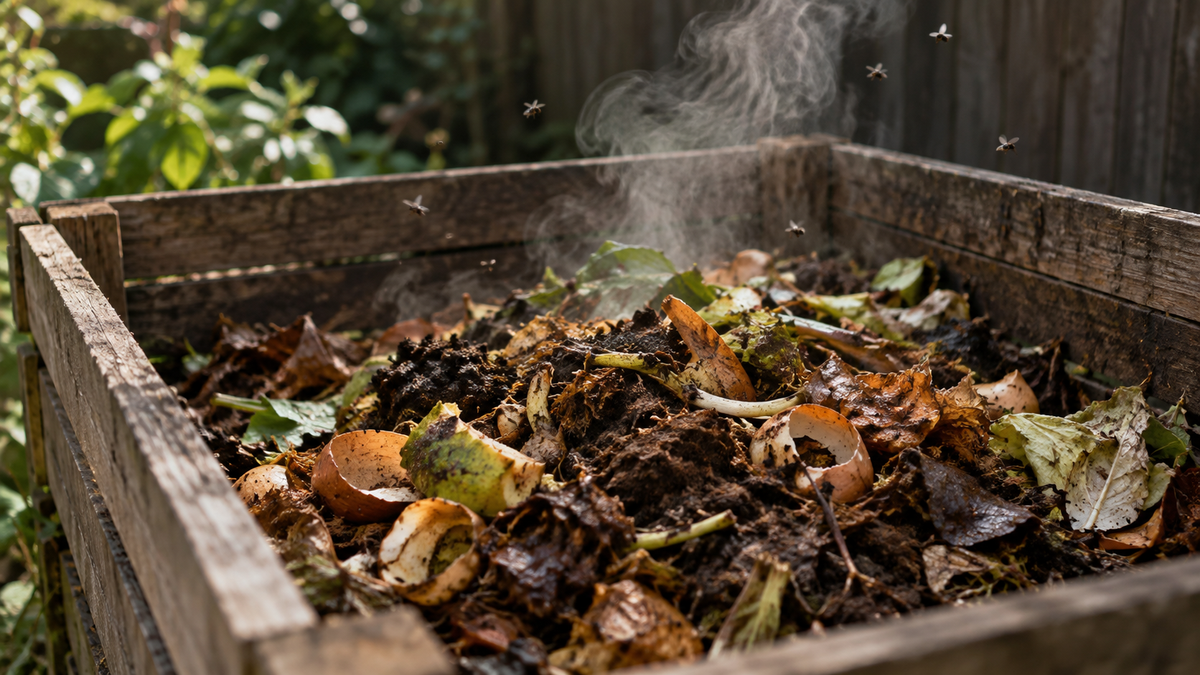
Healthy aerobic compost should smell earthy, not rotten, sour or strongly ammonia-like. When compost starts to smell bad, the odor is usually telling you that the biological conditions have shifted.
The three most common causes are simple: too much moisture, not enough oxygen, or an imbalance between the materials entering the compost.
Fix the environment and the microbes usually do the rest.
By Matthew Moore · Updated September 14, 2026

Quick Answer: Why Does Compost Smell Bad?
Bad compost smell usually means the pile is too wet, short of oxygen, or out of balance.
Excess water fills the air spaces between particles. Compacted material does the same thing. When oxygen drops, anaerobic microorganisms become more active and can produce sour, putrid or sulfur-like odors.
Too much nitrogen-rich material can also create a sharp ammonia smell. Adding dry carbon-rich material and restoring airflow usually helps bring the system back toward aerobic decomposition.
A healthy active compost system does not need to be completely odorless, but it should generally smell earthy, organic and far less offensive than rotting food waste.
Table of Contents
- Should Compost Smell?
- Why Does Compost Smell Bad?
- Cause 1: Compost Is Too Wet
- Cause 2: Not Enough Oxygen
- Cause 3: Material Imbalance
- What Different Compost Smells Mean
- How to Fix Smelly Compost
- How to Prevent Compost Odor
- Why Aerobic Microbial Composting Matters
- What About Indoor Composters?
- Frequently Asked Questions
- Sources
- Related Composting Guides
1. Should Compost Smell?
Compost has a smell, but healthy compost should not smell like rotting garbage.
Active decomposition can produce mild earthy, grassy, woody or fermented notes depending on the materials involved. Mature compost is typically described as having a fresh, soil-like smell.
Strong rotten, sewage-like, sulfurous or ammonia odors are different. They are usually clues that the microbial environment is no longer working as efficiently as it should.
Think of odor as process information. Instead of trying to cover up the smell, identify which composting condition has moved out of balance.
For the biology behind that process, read How Does Composting Work? Microbes, Heat & Oxygen.
2. Why Does Compost Smell Bad?
Aerobic composting depends on microorganisms that need water and oxygen while they digest organic material.
A healthy system therefore needs several conditions to work together:
- enough moisture for microbial activity;
- enough pore space for oxygen to move through the material;
- enough carbon-rich structure to prevent compaction;
- enough nitrogen to support microbial growth;
- and enough mixing or natural airflow to prevent stagnant zones.
Odor often appears when one condition disrupts another.
For example:
Too much water → less air space → less oxygen → more anaerobic activity → more unpleasant odor.
This is why “too wet” and “not enough oxygen” often occur together rather than as completely separate problems.
3. Cause 1: Your Compost Is Too Wet
Water is essential for composting. Microorganisms rely on moisture for biological reactions and nutrient movement.
But compost also needs air-filled spaces.
When too much water fills those spaces, oxygen moves through the pile more slowly. Dense, saturated material can then shift toward anaerobic decomposition and begin to smell sour, rotten or swampy.
Signs Your Compost May Be Too Wet
- material looks waterlogged rather than evenly moist;
- liquid collects at the bottom of the bin or pile;
- the mass becomes heavy and compacted;
- the center smells sour or rotten;
- food remains slimy rather than breaking down cleanly;
- turning the pile releases a sudden burst of bad odor.
How to Fix Wet Compost
- Stop adding additional wet material temporarily. Give the system time to recover.
- Add dry carbon-rich material. Dry leaves, shredded untreated cardboard or other appropriate browns can absorb excess moisture and create structure.
- Mix the material. Distribute the dry material throughout the wet zones rather than placing it only on top.
- Restore drainage and airflow. Make sure water is not trapped, and air can move through the system.
The goal is not to make compost dry. It is to restore a moist but porous environment in which microorganisms still have access to both water and oxygen.
4. Cause 2: Your Compost Does Not Have Enough Oxygen
Composting is primarily an aerobic process.
Aerobic microorganisms use oxygen while breaking down organic carbon. When oxygen becomes limited, anaerobic microorganisms and metabolic pathways become more important.
Those low-oxygen conditions can produce organic acids, sulfur-containing compounds and other strong-smelling intermediates.
Why Compost Loses Oxygen
- too much water fills pore spaces;
- food scraps compact together;
- particles are too fine;
- the pile has not been turned or mixed;
- there is too little coarse structural material;
- or too much fresh material is added at once.
How to Restore Oxygen
For an outdoor pile:
- turn or remix the pile;
- break apart compacted clumps;
- add coarse dry browns where needed;
- avoid packing the material down;
- and make sure drainage is working.
In an engineered composting system, aeration can also come from fans, vents, mixing paddles or controlled airflow.
This is one of the reasons microbial composting cannot be reduced to “heat food and wait.” The microbes need a functioning aerobic environment.
5. Cause 3: The Compost Is Out of Balance
Microorganisms need both carbon and nitrogen, but the two nutrients play different roles.
Carbon-rich materials provide energy and structure. Nitrogen-rich materials help microbes build proteins, enzymes and new cells.
An outdoor compost pile is therefore usually built from a combination of:
- browns: dry leaves, woody material, straw, untreated cardboard and similar carbon-rich inputs;
- greens: food scraps, fresh plant material, coffee grounds and other relatively nitrogen-rich inputs.
Too Many Greens / Too Much Nitrogen
A pile overloaded with wet, nitrogen-rich material can become dense and release a sharp ammonia-like smell.
The solution is usually to add carbon-rich dry material, mix thoroughly and restore airflow.
Too Many Browns / Too Much Carbon
This usually causes a different problem: decomposition slows because microbial growth becomes nitrogen-limited.
A dry, carbon-heavy pile may not smell especially bad, it may simply sit there and change very slowly.
Important: “Balance” is not just a recipe ratio. Moisture, particle size and porosity determine whether oxygen can actually reach the organisms inside the pile.
6. What Different Compost Smells May Mean
Smell cannot diagnose a compost system with perfect certainty, but it can point you toward the first conditions worth checking.
| Smell | Likely Condition | Check First | Typical Response |
|---|---|---|---|
| Rotten / putrid | Anaerobic decomposition | Moisture, compaction, airflow | Turn, aerate and add dry structural browns if needed |
| Rotten egg / sulfur-like | Low-oxygen zones may be producing sulfur compounds | Waterlogging and oxygen availability | Restore aeration and reduce excess moisture |
| Sour / acidic | Anaerobic fermentation may be dominating | Oxygen, wetness, recent heavy feeding | Mix, aerate and correct moisture |
| Sharp ammonia | Nitrogen-rich material may be excessive relative to available carbon | Green/brown balance | Add carbon-rich material and remix |
| Earthy / soil-like | Generally consistent with healthy decomposition or mature compost | No major correction required | Continue normal management |
Use smell as an early warning signal, not as the only test. Temperature, moisture, texture, food loading and oxygen conditions provide the rest of the picture.
7. How to Fix Smelly Compost
If you open your compost and immediately notice a strong unpleasant odor, use this order rather than randomly adding ingredients.
Step 1: Check Moisture
If the material is saturated, slimy or producing liquid, stop adding wet scraps and mix in dry structural material.
Step 2: Restore Airflow
Turn, loosen or mix the compost. Break apart dense areas so air can penetrate the center.
Step 3: Check the Input Balance
If the pile is mostly food scraps or fresh green material, add appropriate carbon-rich browns.
Step 4: Reduce the Immediate Load
A composting system needs enough biological and physical capacity to absorb new material. Continually adding more food while conditions are already unstable can make recovery harder.
Step 5: Give the System Time
Once moisture, airflow and balance are corrected, the microbial community still needs time to metabolize accumulated unstable compounds.
Do not solve compost odor by simply adding fragrance or sealing the system tighter. The goal is to correct the biological conditions causing the odor.
8. How to Prevent Compost From Smelling
Prevention is easier than recovering from a severely anaerobic pile.
- Keep moisture moderate. Compost should be moist enough for microbes but not waterlogged.
- Maintain structure. Porous material helps preserve air spaces.
- Mix rather than compress. Compaction makes oxygen movement more difficult.
- Balance wet food scraps with dry materials. This helps control both moisture and nutrient balance in conventional piles.
- Avoid large sudden loads. A huge quantity of wet food can overwhelm a small active compost mass.
- Pay attention to the smell early. Mild sourness is easier to correct than a deeply anaerobic pile.
For the full biological explanation behind these controls, continue to How Does Composting Work? Microbes, Heat & Oxygen.
9. Why Aerobic Microbial Composting Matters for Odor
Odor control begins before filtration.
When an aerobic microbial community receives enough oxygen and the material is not overloaded with free water, organic matter follows a different decomposition pathway than it would in a stagnant, oxygen-starved environment.
That does not mean aerobic composting has literally zero smell. Food type, moisture, decomposition stage and system design still matter.
It means the first odor-control strategy is to keep the biological process functioning properly.
Process first, filtration second. A filter can treat air leaving a system. It cannot replace the need for correct moisture, oxygen and loading inside the compost itself.
If you want to understand the full microbial pathway, read Microbial Composting: How Composting Works and How Does a Real Electric Composter Work?.

Managed Aerobic Composting
Control the Process Before the Odor Starts
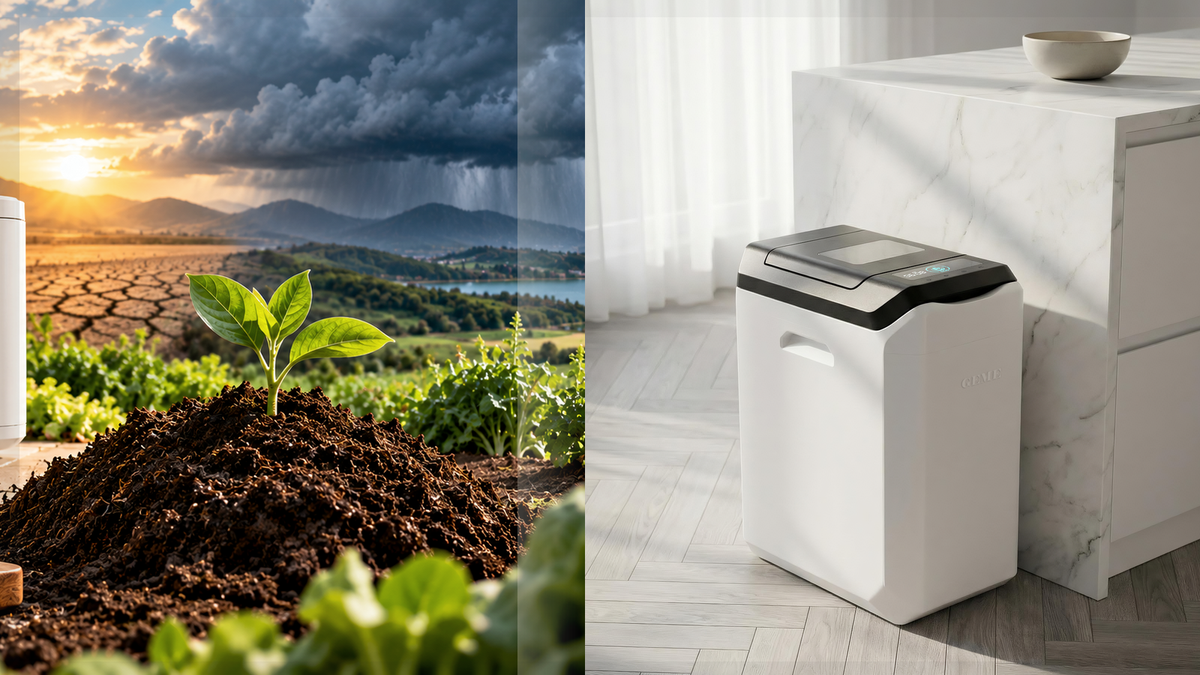
Terra 2 uses continuous microbial processing with adaptive airflow, moisture, heat and mixing control. GEME Pro provides additional capacity for larger household food-waste loads.
10. What About Compost Smell Indoors?
Indoor composting makes odor management more important because the system shares living space with the household.
The same biological rules still apply:
- avoid overloading;
- control excess moisture;
- maintain oxygen;
- keep the microbial environment active;
- and use the odor-control system as designed.
GEME Terra 2 uses continuous aerobic microbial processing rather than intentionally drying the chamber. GEMEBrain™ manages airflow, moisture, heat and mixing, while PermaFilter™ provides permanent catalytic odor treatment without routine activated-carbon filter replacement.
Household capacity matters here too. Terra 2 is designed primarily for 1–3 people and up to approximately 2 kg/day. A larger household that repeatedly overloads a smaller system can create conditions that are harder to keep balanced.
For four or more people or heavier daily food-waste loads, GEME Pro provides a 19 L chamber and up to approximately 5 kg/day of processing capacity.
If odor is your main purchase criterion, continue to Best Electric Kitchen Composter for Odor Control.
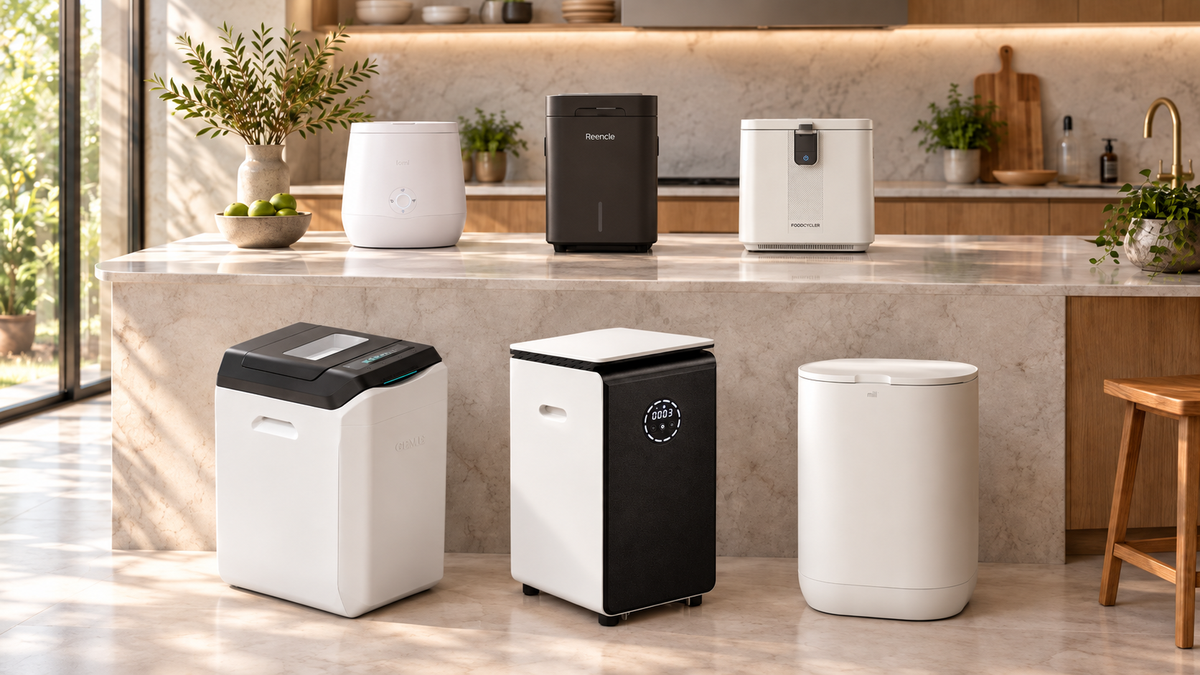
Choosing a Composter When Odor Is Your Main Concern
Different composting methods manage smell in different ways.
Frequently Asked Questions
Why does my compost smell bad?
Bad compost odor most commonly points to excess moisture, insufficient oxygen or an imbalance in the materials being composted. These conditions can shift decomposition away from a healthy aerobic process.
Why does my compost smell like rotten eggs?
A rotten-egg or sulfur-like smell can occur when low-oxygen conditions allow sulfur-containing compounds to accumulate. Check whether the compost is waterlogged, compacted or poorly aerated.
Why does my compost smell like ammonia?
A strong ammonia smell can indicate that nitrogen-rich material is excessive relative to available carbon. Adding dry carbon-rich material and remixing the compost can help restore balance.
Can compost be too wet?
Yes. Compost needs moisture, but too much water can fill pore spaces and restrict oxygen movement. Waterlogged compost is more likely to become anaerobic and smell unpleasant.
How do I fix compost that is too wet?
Pause heavy wet inputs, add suitable dry carbon-rich material, loosen and mix the compost, and improve drainage and airflow. The goal is moist, porous material rather than completely dry compost.
Does turning compost stop the smell?
Turning often helps when odor is caused by poor aeration because it opens the pile and redistributes oxygen. If the pile is also extremely wet, add dry structural material rather than relying on turning alone.
Should compost smell earthy?
Yes. Mature, well-managed compost commonly has an earthy or fresh-soil smell. Strong putrid, sewage-like or ammonia odors usually suggest that conditions need adjustment.
Does bad compost smell mean the compost is ruined?
Usually not. Odor is often a sign that moisture, oxygen or feedstock balance needs correction. Once the conditions are restored, aerobic microbial activity can recover.
How do I keep an indoor composter from smelling?
Operate it within its intended capacity, avoid excessive wet loading, maintain the system according to its airflow and moisture requirements, and follow its odor-control maintenance guidance.
Does a carbon filter fix bad composting conditions?
A filter may reduce odors in exhaust air, but it does not correct excess moisture, low oxygen or overloading inside the composting material. Healthy process conditions remain the first line of odor control.
Sources
- U.S. Environmental Protection Agency — Composting at Home
- U.S. Environmental Protection Agency — Approaches to Composting
- GEME — How Does Composting Work? Microbes, Heat & Oxygen
- GEME — How Does a Real Electric Composter Work?
- GEME — Best Composter 2026
- GEME — Best Electric Kitchen Composter for Odor Control
- GEME — Terra 2
- GEME — GEME Pro


Dejar un comentario
Todos los comentarios se revisan antes de su publicación.
Este sitio está protegido por hCaptcha y se aplican la Política de privacidad de hCaptcha y los Términos del servicio.