


Climate Hub · Gardening Hub · El Niño 2026
El Niño 2026 Forecast: Super El Niño, Extreme Weather & U.S.-Europe Impacts
El Niño 2026 is already underway, and NOAA now expects it to become one of the defining climate events of the coming fall and winter.
NOAA's August outlook gives a greater than 90% chance that El Niño reaches its very strong category during Northern Hemisphere fall and winter 2026–27. For October through December, NOAA also gives a 69% chance that the Relative Oceanic Niño Index reaches at least +2.5°C, which would exceed previous El Niño events in NOAA's record dating to 1950.
That is why searches for super El Niño are increasing. The phrase is useful shorthand for an exceptionally intense event, but it is not an official NOAA classification. NOAA's formal wording is very strong El Niño.

This guide explains what is El Niño, the latest El Niño 2026 forecast, why a very strong event matters for floods, droughts, extreme heat, hurricanes, agriculture and economies, what current forecasts suggest for the United States and Europe, and how composting fits into climate mitigation and resilience without pretending that composting can directly control El Niño or La Niña.
Quick Answer: What Is the El Niño 2026 Forecast?
The current official source is NOAA's ENSO Diagnostic Discussion.
Table of Contents
- What Is El Niño?
- El Niño 2026 Forecast: What NOAA Says
- Is a Super El Niño Coming?
- Why NOAA Now Uses RONI
- How El Niño Changes Extreme Weather Risk
- Extreme Rainfall & Flooding
- Extreme Heat & Heatwaves
- Drought & Wildfire
- Hurricanes & Tropical Cyclones
- Agriculture & Food Systems
- Economic, Water, Energy & Health Impacts
- El Niño 2026 Weather in the United States
- El Niño 2026 Weather in Europe
- Climate Change × El Niño
- Can Composting Help in an El Niño World?
- What Research Says About Composting & Climate
- Where GEME Fits—and Where It Does Not
- Climate-Resilient Gardening
- El Niño 2026 FAQ
1. What Is El Niño?
If you are asking what is El Niño, start with the tropical Pacific Ocean.
El Niño is the warm phase of the El Niño–Southern Oscillation, or ENSO, a recurring interaction between tropical Pacific Ocean temperatures and the atmosphere.
NOAA describes ENSO as arguably the most influential climate driver on Earth because shifts in the central and eastern equatorial Pacific change where ocean heat is released into the atmosphere.
During El Niño:
- central and eastern equatorial Pacific waters become unusually warm;
- the normal tropical trade winds weaken;
- rainfall and tropical convection shift eastward;
- the Walker circulation weakens or reorganizes;
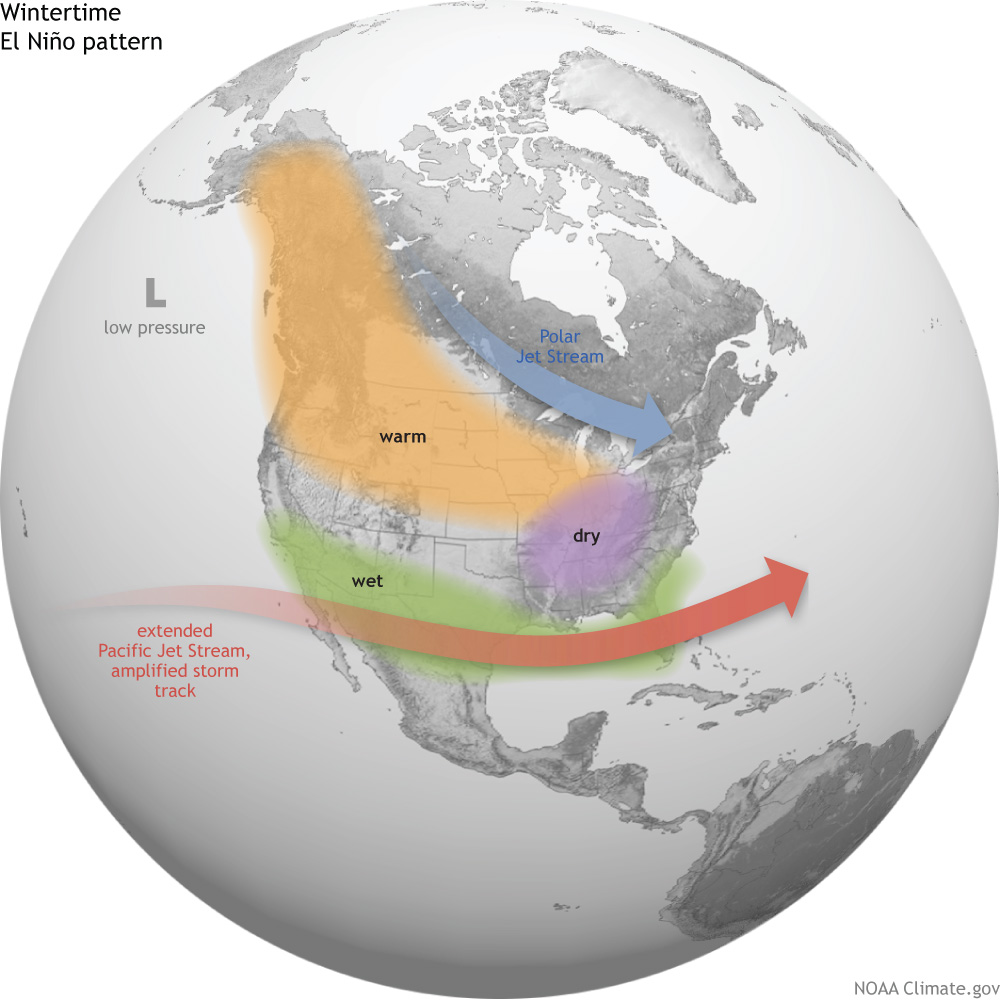
- the Pacific jet stream changes position and strength;
- storm tracks and pressure patterns shift far beyond the tropical Pacific.
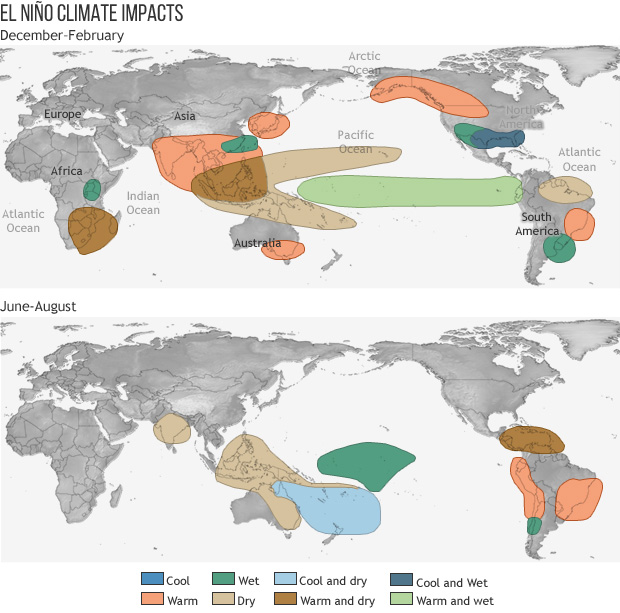
These changes can influence temperature, rainfall, drought, floods, wildfires, tropical cyclones, fisheries and agriculture around the world.
NOAA's required background reading for this article is Understanding El Niño & ENSO. NOAA notes that El Niño generally occurs every two to seven years and often lasts about nine to twelve months.
2. El Niño 2026 Forecast: What NOAA Says Now
The El Niño 2026 forecast changed rapidly during the first half of the year.
In March 2026, La Niña was fading, and NOAA was only watching for a possible transition to El Niño.
By June, El Niño had emerged.
By August, the ocean and atmosphere were clearly coupled in a strengthening El Niño state.
NOAA reported on August 13 that:
- sea-surface temperature anomalies exceeded +2.0°C in parts of the eastern equatorial Pacific;
- July Niño-3.4 was +1.4°C;
- Niño-3 was +1.7°C;
- Niño-1+2 was +2.9°C;
- subsurface warm anomalies reached about +10°C at depth;
- rainfall and convection were enhanced over the central and eastern Pacific and suppressed over Indonesia;
- oceanic and atmospheric signals were behaving as a coupled El Niño system.
NOAA therefore concluded that El Niño will continue strengthening through the end of 2026.
The most important forecast number is not simply “El Niño is likely.” El Niño is already present. The question is now how strong it becomes, and NOAA says the probability of a very strong event exceeds 90%.
3. Is a Super El Niño Coming in 2026?
Possibly—but super El Niño needs careful wording.
NOAA does not have an official category called “super El Niño.”
Its operational categories are:
- weak;
- moderate;
- strong;
- very strong.
For October–December 2026, NOAA's current strength table places the probability of the highest formal strength category at 95%.
Even more strikingly, the August ENSO Diagnostic Discussion gives a 69% chance that the October–December RONI reaches +2.5°C or more.
NOAA says such an outcome would exceed the strength of earlier El Niño events in the record dating to 1950.
This article uses super El Niño because it is a widely used public and search term for an exceptionally strong event. The official NOAA description for the 2026 forecast is very strong El Niño, with a separate 69% probability of a historically extreme RONI value of +2.5°C or more during October–December.
NOAA GFDL's experimental SPEAR system points in the same broad direction: all 30 August ensemble members produce a late-2026 peak competitive with the strongest historical El Niño events.
That experimental result strengthens confidence in the direction of travel but should not be confused with the official CPC forecast.
4. Why NOAA Now Uses RONI to Track El Niño
In February 2026, NOAA's Climate Prediction Center adopted the Relative Oceanic Niño Index, or RONI, for operational ENSO monitoring and forecasting.
The traditional Oceanic Niño Index compares Niño-3.4 sea-surface temperature against a climatological baseline.
RONI goes further by comparing Niño-3.4 conditions with the broader tropical ocean background.
This matters because tropical oceans as a whole have warmed.
A +1.5°C anomaly in Niño-3.4 does not necessarily create the same atmospheric contrast when the surrounding tropical oceans are also unusually warm.
NOAA says RONI helps identify the relative tropical Pacific signal that is more closely connected with the atmospheric response.
Read NOAA's RONI transition announcement and the current RONI dataset.
5. How El Niño Changes the Risk of Extreme Weather
This is the part of El Niño weather that matters most to everyday life.
El Niño is not simply a prediction of “warmer weather.”
It redistributes heat, atmospheric pressure, tropical rainfall and storm tracks.
That can shift the probability and location of:
NOAA Physical Sciences Laboratory explicitly identifies droughts, heatwaves and floods among the hazards whose risks can be influenced by ENSO.
The scientific language is important:
El Niño changes the odds of extreme events. It does not mean that every flood, drought, heatwave or hurricane during an El Niño year was “caused by El Niño.”
That distinction prevents a climate driver from being turned into a simplistic explanation for every individual weather disaster.
6. El Niño, Extreme Rainfall and Flooding
Strong El Niño events can intensify or redirect storm tracks, increasing the chance of very wet seasonal conditions in specific regions.
For the United States, NOAA research shows that El Niño shifts the North Pacific jet stream southward, increasing winter precipitation and flood frequency across parts of the southern U.S.
The danger is not merely a higher seasonal rainfall total.
Repeated storms can create a sequence:
NOAA AOML research published in 2025 projects that the growing influence of ENSO can contribute to more frequent extreme winter flooding in the Southeast and Northeast under future climate conditions.
If a tropical cyclone or flood actually affects your area, use GEME's Hurricane & Flood Recovery Guide for floodwater, food, soil and compost safety boundaries.
7. El Niño and Extreme Heat
El Niño moves a huge amount of ocean heat into a different relationship with the atmosphere.
Strong events can contribute to unusually high temperatures in some regions and can temporarily raise global mean surface temperature.
But there are two separate mechanisms to keep clear:
That means the same natural climate pattern now occurs in a warmer world.
IPCC concludes with high confidence that hot extremes have become more frequent and intense across most land regions because of human-induced warming.
An El Niño event can then change where and when anomalous warmth is most strongly expressed.
For household and garden response during dangerous heat, see Extreme Heat Warning: Safety, Garden & Composting Guide.
8. El Niño, Drought and Wildfire
El Niño's rainfall shift creates winners and losers.
While some regions become wetter, others can lose the seasonal rainfall on which ecosystems, farms and water systems depend.
NOAA identifies Australia, Indonesia and parts of southern Asia among the regions that commonly experience dry El Niño conditions.
Prolonged rainfall deficits can then cascade into:
- lower soil moisture;
- crop water stress;
- higher irrigation demand;
- lower reservoir levels;
- reduced hydropower;
- vegetation stress;
- higher wildfire risk;
- air-quality problems from smoke.
NOAA's U.S. hydroclimate research also projects more frequent ENSO-related extreme drought in the Southwest, with associated wildfire risk.
The relationship is not always immediate. A wet El Niño season can also grow more vegetation, creating additional dry fuel during later hot or dry periods.
9. El Niño and Hurricanes: Risk Moves Between Ocean Basins
El Niño does not simply mean “more hurricanes.”
It changes hurricane conditions differently across ocean basins.
Atlantic: Usually Less Favorable
NOAA explains that El Niño typically increases vertical wind shear over the tropical Atlantic.
Strong shear disrupts the vertical structure of developing tropical cyclones, making it more difficult for thunderstorms to organize around a common center and intensify.
That is one reason the rapidly strengthening 2026 El Niño is an important part of NOAA's Atlantic hurricane-season outlook.
Central and Eastern Pacific: Often More Favorable
The tropical Pacific response can instead create conditions more favorable for tropical cyclone activity in parts of the central and eastern Pacific.
So the accurate statement is:
El Niño can redistribute tropical-cyclone risk rather than universally increasing or decreasing hurricane activity everywhere.
A quieter Atlantic season also never means zero landfall risk. One storm is enough to create catastrophic local impacts.
Read NOAA AOML's 2026 explanation of El Niño and Atlantic hurricanes.
10. Why El Niño Matters to Agriculture and Food Systems
The influence of a very strong El Niño does not stop at a weather map.
Agriculture is one of the clearest pathways through which climate variability becomes an economic and social issue.
Rainfall and temperature shifts can affect:
- planting windows;
- seed germination;
- soil moisture;
- irrigation demand;
- root-zone oxygen during floods;
- heat stress;
- flowering and pollination;
- pests and plant diseases;
- livestock heat and water stress;
- harvest timing;
- crop yields;
- food storage and transport.
A drought in one major producing region can reduce agricultural supply.
An extreme wet season somewhere else can destroy crops through flooding, erosion, root disease and delayed harvesting.
That means El Niño can influence international food markets even in countries that experience relatively mild local weather effects.
NOAA has long highlighted these connections between ENSO, agriculture, food security and commodity availability.
11. El Niño Can Affect Water, Energy, Health and the Global Economy
Weather is only the first layer of the impact.
A very strong El Niño can create cascading consequences across systems that depend on climate.
| System | Possible ENSO Transmission Pathway |
|---|---|
| Agriculture | Drought, flooding, heat and disease pressure can reduce yields and increase food prices. |
| Water | Rainfall shifts affect reservoirs, irrigation supply, groundwater recharge, municipal water and flood-control systems. |
| Energy | Temperature changes affect heating and cooling demand; rainfall changes can alter hydropower output. |
| Infrastructure | Floods, landslides, storms and wildfires can damage roads, utilities, buildings and transport networks. |
| Health | Heat exposure, wildfire smoke, flooding, contaminated water, food insecurity and vector-borne diseases can affect public health. |
| Insurance & Finance | Weather losses can raise claims and reconstruction costs while commodity and supply-chain shocks spread beyond the directly affected region. |
A 2023 Nature Communications study estimated that the global economic effects of extreme El Niño events can persist for years after the initial climate shock.
The authors estimated cumulative global economic losses of about $2.1 trillion associated with the 1997–98 event and $3.9 trillion associated with 2015–16 under their statistical framework.
Those estimates are model-dependent, but they illustrate why ENSO belongs in discussions about food, energy, infrastructure and economic resilience, not just meteorology.
12. El Niño 2026 Weather: What It Could Mean for the United States
The U.S. is one of the regions where El Niño teleconnections are comparatively well understood, especially during the colder half of the year.
NOAA's August 20 seasonal outlook already incorporates the rapidly strengthening 2026 event.
| Region | Typical El Niño Influence | 2026–27 Outlook Context |
|---|---|---|
| California & Southwest | Stronger events increase the likelihood of a wetter winter, especially farther south. | Current NOAA outlooks increasingly favor above-normal precipitation as winter progresses. |
| Southern U.S. & Southeast | Enhanced southern storm track, with wetter winter conditions common. | NOAA favors above-normal precipitation with some of the highest probabilities in the Southeast during winter. |
| East Coast | More influence from an active southern storm track. | Wet probabilities expand along portions of the East Coast during the colder season. |
| Northern Tier | Warmer winter conditions occur frequently during El Niño. | NOAA favors above-normal temperatures across large portions of the northern U.S. |
| Northwest / Northern Rockies | Drier conditions become more likely in many El Niño winters. | Some seasonal periods retain below-normal precipitation probabilities. |
| Great Lakes | Often warmer, with some tendency toward reduced precipitation. | Warm probabilities remain important in current winter guidance. |
These forecasts are probabilistic.
Even a historic-strength El Niño does not force every city into its “typical” El Niño outcome.
NOAA explicitly warns that stronger events increase confidence in expected teleconnections but never guarantee them.
13. El Niño 2026 Weather: What Could Happen in Europe?
Europe requires more caution than the United States.
The tropical Pacific is thousands of kilometers away, and the El Niño signal reaches Europe through a sequence of atmospheric teleconnections.
The result competes with:
- North Atlantic sea-surface temperatures;
- the North Atlantic Oscillation;
- the polar vortex;
- stratospheric variability;
- Arctic conditions;
- other tropical climate drivers;
- ordinary atmospheric variability.
ECMWF/Copernicus therefore emphasizes that the average ENSO response is not guaranteed in any individual European winter.
What the August 2026 Copernicus Forecast Says
The August 10 Copernicus seasonal forecast shows:
- a signal for wetter-than-average autumn conditions across parts of southern and western Europe;
- a continued increased probability of above-normal seasonal temperatures across much of Europe;
- weaker warm signals in the most eastern and northern parts of the continent;
- higher forecast uncertainty and lower skill for European precipitation than in tropical regions.
Early Winter and Late Winter Can Behave Differently
The updated ECMWF ENSO-Europe analysis based on ERA5 shows that European atmospheric responses can differ substantially between:
- November–December; and
- January–February.
That intra-seasonal shift is one reason statements such as “El Niño means Europe will have a warm winter” are too simplistic.
The 2026 El Niño raises the importance of ENSO in seasonal forecasting, but the North Atlantic-European sector remains less predictable than North America and the tropics. El Niño should be treated as one powerful input into the European winter forecast—not as the forecast itself.
Follow the Copernicus Seasonal Forecasts and ECMWF/Copernicus ENSO impacts on Europe analysis.
14. Climate Change and El Niño: Connected, but Not the Same Thing
El Niño is not caused by modern climate change.
ENSO is a natural ocean-atmosphere cycle that existed long before industrial greenhouse-gas emissions.
But the background climate in which El Niño now operates is changing.
IPCC assesses that ENSO will remain the dominant source of interannual climate variability and that ENSO-related precipitation variability is likely to intensify as the climate warms because a warmer atmosphere can hold and transport more moisture.
Peer-reviewed climate-model studies have also found evidence that extreme El Niño events may become more frequent under greenhouse warming, although internal variability remains very important and scientific uncertainty persists around the exact magnitude and regional expression.
A 2023 Nature Communications analysis found that both internal variability and anthropogenic forcing contributed to the recent increase in extreme and central-Pacific El Niño events.
A separate Nature study published in 2024 found model and paleoclimate evidence supporting more frequent extreme El Niño development in a warmer climate.
So the relationship is better expressed like this:
That does not mean every strong El Niño is caused by greenhouse warming.
It means natural ENSO variability and anthropogenic climate change now operate together.
15. Can Composting Help in an El Niño World?
Yes, but not by controlling El Niño.
Composting cannot stop, weaken or directly regulate El Niño or La Niña.
ENSO is driven by large-scale Pacific ocean-atmosphere dynamics involving trade winds, thermocline depth, ocean heat content and atmospheric circulation.
The scientifically defensible role of composting is different:
Why Food Waste in Landfills Matters
Food waste decomposes rapidly in the low-oxygen environment of a landfill.
That anaerobic decomposition produces methane.
EPA estimates that food waste accounts for about 24% of material disposed in U.S. municipal solid-waste landfills but approximately 58% of fugitive methane emissions from those landfills.
EPA also estimates that about 61% of methane generated by landfilled food waste escapes collection and reaches the atmosphere.
The reason is timing: food waste decomposes quickly, often before landfill-gas collection infrastructure can capture the methane efficiently.
For the full comparison and accounting boundaries, read GEME's Composting vs Landfill: Emissions & Environmental Impact.
Prevention Still Comes First
Composting should never become an excuse to waste edible food.
EPA's wasted-food hierarchy prioritizes prevention and beneficial use before disposal pathways.
At home, the practical order remains:
Plan → Store → Eat → Repurpose → Freeze → Compost suitable unavoidable scraps
See How to Reduce Food Waste at Home for the household prevention side of the system.
16. What Does Research Say About Composting and Climate?
There is real scientific support for the climate value of diverting organic material from landfill and using compost in soil.
But the size of the benefit depends on system boundaries, composting method, transportation, energy use, methane and nitrous-oxide management, fertilizer displacement, soil conditions and how the finished compost is used.
| Evidence | What It Supports | Important Boundary |
|---|---|---|
| U.S. EPA — Landfilled Food Waste | Food waste is responsible for an estimated 58% of fugitive methane emissions from U.S. municipal solid-waste landfills. | This is a U.S. landfill estimate, not a universal global factor. |
| U.S. EPA — Compost Application Review | EPA summarizes an estimated 78% GHG reduction when food waste is composted and land applied rather than landfilled, plus greater carbon sequestration and soil resilience. | This is a literature-based pathway comparison, not a Terra 2 product carbon footprint. |
| Morris, Matthews & Morawski, Waste Management | A meta-analysis of 82 studies found aerobic composting and anaerobic digestion environmentally preferable to waste-to-energy and landfill-gas-to-energy for climate-change impacts. | No single waste-management option was best across every environmental category; LCA boundaries matter. |
| EPA Compost Science Review | Compost-amended soil can improve stormwater absorption, water retention, soil carbon and resilience to drought, flooding and heat. | Benefits vary by soil, compost quality, application rate and land use. |
Compost and Drought Resilience
Organic matter can improve soil structure and increase the soil's ability to hold plant-available water.
EPA's science review specifically identifies drought resilience as one of the climate-adaptation benefits of compost application.
Compost and Heavy Rain
Compost-amended soil can improve infiltration and water retention, reducing surface runoff and erosion in appropriate applications.
That does not make compost a flood barrier, but healthier soil can be more resilient to intense rainfall than compacted, low-organic-matter soil.
Compost and Soil Carbon
Some of the carbon in compost can remain in soil rather than returning immediately to the atmosphere.
EPA's current synthesis states that food-waste compost applied to land can produce substantially more soil carbon sequestration than the landfill pathway under the studies it reviewed.
For practical garden application rather than climate accounting, use How to Use Compost Correctly.
17. Where Does GEME Fit, and What Should We Not Claim?
GEME Terra 2 is an automated, powered, continuous aerobic microbial composting system for household food scraps.
Its climate relevance is straightforward at the system level:
Research supports the broader proposition that keeping suitable food waste out of landfills and composting organic material can reduce landfill methane exposure and support soil carbon and resilience. A product-specific net carbon claim for GEME Terra 2 would require a lifecycle assessment that accounts for electricity, regional grid mix, manufacturing, logistics, product lifetime, actual food-waste diversion, displaced waste-management pathway and Compost Base use.
Terra 2 uses electricity to maintain airflow, heat, moisture-related operation, sensors and mixing around its microbial process.
That powered operation is precisely why a rigorous carbon assessment cannot simply copy a generic composting-versus-landfill percentage and apply it to the appliance.
This distinction is also why our Composting vs Landfill analysis separates pathway-level evidence from product-specific claims.
For the difference between outdoor weather-dependent composting and controlled indoor microbial processing, see Compost Pile vs Electric Composter.
18. What El Niño 2026 Means for Climate-Resilient Gardening
The Gardening Hub connection is not decorative.
The same climate extremes influenced by ENSO eventually become soil and plant-management problems.
If Your El Niño Pattern Turns Wetter
- protect drainage routes;
- avoid compacting saturated soil;
- reduce unnecessary irrigation;
- watch for root-zone oxygen stress;
- monitor fungal disease;
- protect bare soil from erosion;
- do not use flood-contaminated produce or debris as normal compost input.
If Your Region Turns Hotter or Drier
- monitor actual soil moisture;
- use mulch appropriately;
- water deeply rather than repeatedly wetting only the surface;
- reduce unnecessary soil disturbance;
- protect plants during dangerous heat;
- manage outdoor compost moisture and airflow.
For heat-specific preparation, use Extreme Heat Warning: Safety, Garden & Composting Guide.
For flood and storm recovery, use Recovery Tips After a Hurricane.
If you are building a new garden, start with How to Plant a Garden for Beginners.
When using GEME Compost Base, follow the more specific GEME Compost Output, Soil Blending & Plant Safety Guide.
Climate Mitigation + Climate Resilience
We Cannot Control El Niño. We Can Build Better Systems Around It.
ENSO will continue to move between El Niño, neutral and La Niña phases. The practical response is not to promise control over a natural Pacific climate cycle, but to reduce avoidable greenhouse-gas emissions, keep suitable organic material out of landfill pathways, build healthier soils and make homes, gardens and food systems more resilient to climate extremes.
19. El Niño 2026 Frequently Asked Questions
What is El Niño?
El Niño is the warm phase of the El Niño–Southern Oscillation, or ENSO. It develops when unusually warm central and eastern tropical Pacific waters interact with the atmosphere, weakening trade winds, shifting tropical rainfall and altering atmospheric circulation around the world.
Is 2026 an El Niño year?
Yes. NOAA's El Niño Advisory is in effect, and oceanic and atmospheric observations show a strengthening coupled El Niño system.
What is the latest El Niño 2026 forecast?
NOAA's August 13, 2026 forecast gives a greater than 90% chance of a very strong El Niño during Northern Hemisphere fall and winter 2026–27. The event is expected to continue strengthening through the end of 2026.
Is a super El Niño coming in 2026?
“Super El Niño” is not an official NOAA category. However, NOAA currently gives a greater than 90% chance of a very strong event and a 69% chance that October–December RONI reaches +2.5°C or higher, which NOAA says could exceed previous events in its record dating to 1950.
When is El Niño 2026 expected to peak?
Official NOAA guidance expects continued strengthening through the end of 2026. NOAA GFDL's experimental August SPEAR forecast places the likely peak between roughly October 2026 and January 2027.
Does El Niño cause extreme weather?
El Niño changes atmospheric circulation and therefore changes the probability, location and sometimes intensity of weather extremes such as floods, droughts, heatwaves and tropical cyclones. It should not be treated as the sole cause of every individual extreme event occurring during an El Niño year.
Does El Niño cause more floods?
In some regions, yes, the probability increases. For example, El Niño often strengthens the southern U.S. winter storm track and can increase heavy rainfall and flood risk there. Other regions may become drier at the same time.
Does El Niño cause heatwaves?
El Niño redistributes ocean heat and changes regional circulation, which can increase the likelihood of anomalous warmth in some regions. Human-driven global warming independently raises the baseline temperature on which El Niño variability occurs.
Does El Niño cause drought?
El Niño frequently increases drought risk in parts of Australia, Indonesia and southern Asia by shifting tropical rainfall away from those regions. ENSO-related drought risk also varies across the United States.
Does El Niño increase hurricanes?
Not everywhere. El Niño typically increases vertical wind shear over the tropical Atlantic, suppressing Atlantic hurricane activity on average. It can simultaneously create more favorable tropical-cyclone conditions in parts of the central and eastern Pacific.
What does El Niño 2026 mean for U.S. weather?
NOAA's current 2026–27 outlook increasingly favors a wetter winter across the southern tier, especially parts of California and the Southeast, while above-normal winter temperatures are favored across much of the northern United States. These are probability shifts rather than guarantees.
What does El Niño 2026 mean for Europe?
The European influence is less direct and less predictable than in North America. Copernicus currently shows a wetter-than-average autumn signal in parts of southern and western Europe and increased odds of above-normal seasonal temperatures across much of the continent, while winter outcomes remain strongly influenced by North Atlantic and stratospheric variability.
How does El Niño affect agriculture?
El Niño can change rainfall, soil moisture, heat, irrigation demand, crop disease pressure, livestock stress, planting and harvesting conditions. These effects can influence crop yields, food availability and commodity prices far beyond the regions directly experiencing extreme weather.
Is El Niño caused by climate change?
No. ENSO is a natural recurring Pacific ocean-atmosphere cycle. However, climate change alters the warmer background in which ENSO occurs, and research indicates that ENSO-related rainfall variability and some forms of extreme El Niño behavior may increase under greenhouse warming.
Can composting stop El Niño or La Niña?
No. Composting cannot control ENSO. El Niño and La Niña are driven by large-scale Pacific ocean-atmosphere dynamics. Composting instead contributes to climate mitigation by diverting suitable organic material from landfill methane pathways and can contribute to climate resilience when compost is used appropriately to improve soil.
Does composting reduce greenhouse-gas emissions?
Compared with landfilling food waste, properly managed composting can reduce greenhouse-gas impacts under many lifecycle scenarios. EPA estimates that food waste is responsible for about 58% of fugitive methane emissions from U.S. municipal solid-waste landfills and summarizes substantial climate benefits from composting and land application. Exact benefits depend on the system and lifecycle boundaries.
Does compost help with drought and flooding?
Compost can improve soil structure, organic matter, infiltration and water retention when used appropriately. EPA's science review identifies both drought and flood resilience among the documented benefits of compost-amended soils. Compost does not prevent major floods or eliminate drought, but healthier soil can better manage water.
Does GEME Terra 2 reduce carbon emissions by 78%?
That should not be claimed. EPA's 78% figure is a pathway-level literature synthesis comparing food waste composted and land-applied with landfilling. It is not a product-specific lifecycle assessment of GEME Terra 2. A Terra 2 carbon footprint would need to account for electricity, manufacturing, shipping, product lifetime, regional waste pathways and actual Compost Base use.
20. Sources & Scientific References
- NOAA — Understanding El Niño & ENSO
- NOAA Climate Prediction Center — ENSO Diagnostic Discussion, August 13, 2026
- NOAA CPC — Official ENSO Strength Probabilities
- NOAA CPC — Adoption of the Relative Oceanic Niño Index
- NOAA GFDL — August 2026 Experimental El Niño Predictions
- NOAA CPC — U.S. Long-Lead Seasonal Outlook, August 20, 2026
- NOAA Physical Sciences Laboratory — ENSO Information & Climate Relationships
- NOAA AOML — The Growing Impact of ENSO on U.S. Extreme Drought and Flood Events
- NOAA AOML — How El Niño Impacts Atlantic Hurricane Season
- Copernicus Climate Change Service — Seasonal Forecasts, August 2026
- ECMWF / Copernicus — ENSO Impacts Based on ERA5 Reanalysis
- IPCC AR6 Working Group I — Chapter 4: Future Global Climate, ENSO
- IPCC AR6 Working Group I — Chapter 11: Weather and Climate Extreme Events
- Nature Communications — Nonlinear El Niño Impacts on the Global Economy Under Climate Change
- Nature Communications — Greenhouse Warming and Internal Variability Increase Extreme and Central Pacific El Niño Frequency
- Nature — Future Increase in Extreme El Niño Supported by Past Glacial Changes
- U.S. EPA — Quantifying Methane Emissions from Landfilled Food Waste
- U.S. EPA — Environmental Value of Applying Compost
- U.S. EPA — Wasted Food Scale
- Morris, Matthews & Morawski — Review and Meta-Analysis of 82 Studies on End-of-Life Management Methods for Source-Separated Organics, Waste Management
ENSO status and seasonal forecasts reviewed August 26, 2026. El Niño strength, RONI probabilities and regional seasonal outlooks will change as new observations enter forecast systems. “Super El Niño” is used as an informal public term; NOAA's formal strength category is “very strong.” Composting climate figures cited from EPA and peer-reviewed studies describe defined waste-management pathways and should not be interpreted as a product-specific GEME Terra 2 lifecycle assessment.


Dejar un comentario
Todos los comentarios se revisan antes de su publicación.
Este sitio está protegido por hCaptcha y se aplican la Política de privacidad de hCaptcha y los Términos del servicio.