


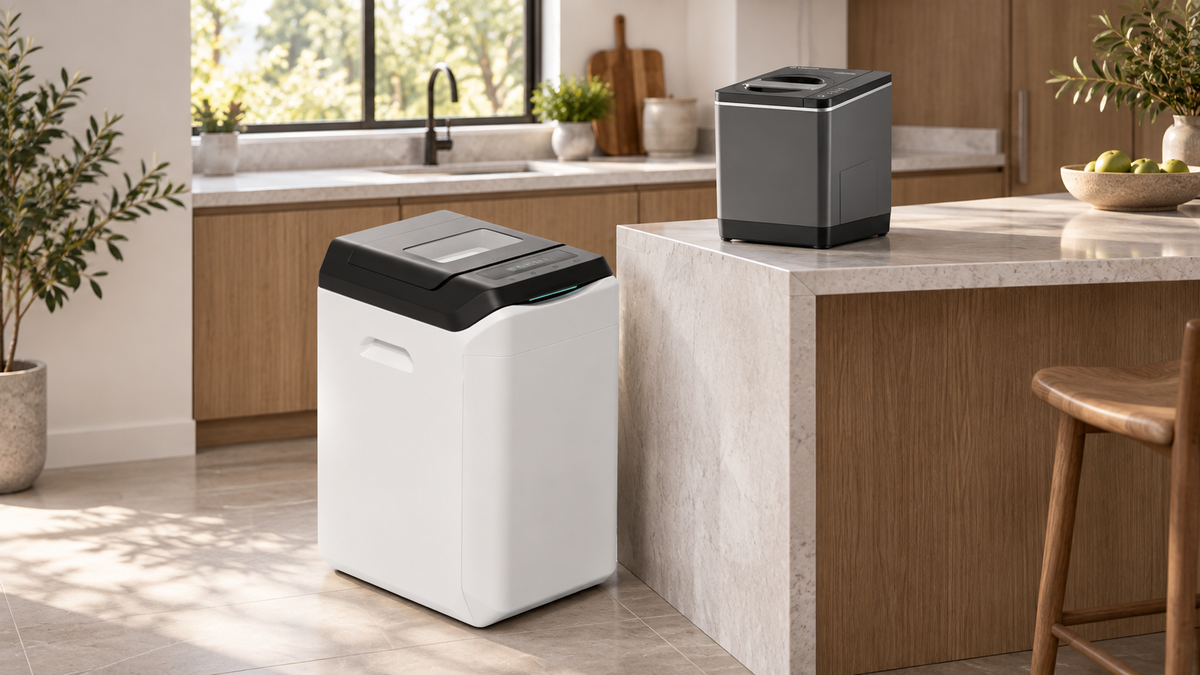
Kitchen Compost Machines · Grinding · Drying · Composting
Vitamix FoodCycler and GEME Composter often fall into the same kitchen food-waste category, but the biggest difference is what happens to the food inside.
Grinding changes particle size. Drying removes water. Composting relies on microorganisms to biologically break down organic material. A machine can perform one or two of those processes without performing all three.
Understanding that distinction makes the Vitamix vs GEME comparison much easier.
By Matthew Moore · Updated September 15, 2026

Quick Answer: Vitamix FoodCycler vs GEME Composter
Vitamix describes the FoodCycler FC-50 as a compact food recycler. Its documented processing stages are Dry, Grind and Cool.
The FoodCycler therefore focuses on physically reducing and drying kitchen scraps into a smaller, drier material.
GEME Terra 2 uses a different processing model: suitable food scraps enter a continuously active aerobic microbial chamber where microorganisms perform biological decomposition.
The practical distinction is: FoodCycler reduces and dries food waste; GEME maintains a microbial composting process. Neither description makes the other appliance useless; they simply solve different household jobs.
If you already understand the process and want a direct buying comparison, go to GEME Terra 2 vs Vitamix FoodCycler FC-50.
Table of Contents
1. Grinding, Drying and Composting Are Three Different Processes
The kitchen food-waste category becomes confusing when all three processes are discussed as if they mean the same thing.
Mechanical force reduces food into smaller particles. The food changes shape and surface area, but grinding by itself does not biologically decompose it.
Heat and airflow remove water. The result becomes lighter, smaller and easier to store, but removing moisture is not the same as composting.
Microorganisms metabolize organic material under suitable oxygen, moisture, temperature and time conditions. This is a biological transformation.
A useful rule: a smaller or darker output is not automatically compost. Ask what process created it and what still needs to happen afterward.
For the broader category distinction, see Best Composter 2026.
2. What Does Grinding Food Waste Actually Do?
Grinding is a physical size-reduction step.
A blade, paddle, or grinding mechanism breaks larger scraps into smaller fragments. This can make the material:
- take up less apparent space;
- become more uniform;
- mix more easily;
- expose more surface area;
- and become easier to handle after processing.
But a tomato fragment that has been ground into many small particles is still fundamentally tomato-derived organic material.
The grinder has changed its particle size, not completed biological decomposition.
This is why grinding should be understood as a processing tool rather than a definition of composting.
3. What Does Drying Food Waste Do?
Fresh food contains a large amount of water. Removing that water can dramatically change how the material behaves in a kitchen.
Dry material is generally:
- lighter;
- less bulky;
- less wet and messy;
- easier to store temporarily;
- and less similar to ordinary fresh kitchen scraps.
That can be extremely useful if the household goal is food-waste volume reduction and cleaner handling.
But water removal does not itself mean that microorganisms have completed the biological transformations associated with composting.
Drying answers: “How can I remove moisture and make this waste easier to manage?”
Composting answers: “How can microorganisms biologically break this organic material down?”
4. What Does Composting Do?
Composting is biological.
Microorganisms use organic material as food. In an aerobic system, oxygen supports microbial metabolism while moisture, temperature, structure and time influence how effectively the decomposer community functions.
That means composting cannot be defined by one visual cue such as:
- brown color;
- small particle size;
- reduced volume;
- low moisture;
- or a soil-like appearance.
The question is what biological process the material has undergone.
This is also why a continuous microbial machine needs a different interpretation from a closed batch recycler. New food and older processed material can exist in the same biological chamber at different residence times.
For GEME, harvested material should therefore be treated as Active Compost Base, not simply assumed to be uniform finished planting soil.
5. How Does the Vitamix FoodCycler FC-50 Work?
Vitamix's own terminology is helpful: the FC-50 is described as a compact food recycler.
Its official owner documentation lists three processing stages:
Vitamix FoodCycler FC-50
1. Dry
Heat removes moisture from the food scraps.
2. Grind
Mechanical processing reduces the dried material into smaller particles.
3. Cool
The processed material cools before the cycle ends.
What That Means
Physical reduction:
food becomes drier and smaller.
Batch workflow:
the FC-50 processes a defined bucket load through its cycle.
Next step still matters:
the processed material still needs an appropriate downstream destination.
The FC-50 manual lists a capacity of approximately 2.5 L and a processing time of approximately 4–8 hours.
It also uses activated-carbon filtration for odor management.
These figures refer specifically to the Vitamix FoodCycler FC-50 documentation. Newer FoodCycler models such as Eco 5 have different capacities and cycle specifications and should not be treated as the same machine.
6. How Does GEME Terra 2 Work?
GEME Terra 2 starts from a different premise.
Instead of making dryness the end of the machine's processing cycle, Terra 2 maintains a microbial bed where suitable incoming food becomes feedstock for aerobic biological decomposition.
The system supports that environment through controlled:
- airflow;
- environmental warmth;
- moisture conditions;
- mixing;
- and continuous microbial activity.
The microorganisms perform the biological work.
Terra 2 therefore does not need to turn every feeding event into a separate closed batch. Suitable scraps can be added during normal kitchen use while older material remains in the active chamber.
For more on the GEME system itself, read What Is a GEME Composter?.
7. Grinding and Drying vs Composting: What Comes Out?
The output is where the distinction becomes easiest to understand.
| Question | Vitamix FoodCycler FC-50 | GEME Terra 2 |
|---|---|---|
| Main transformation | Physical drying and grinding | Aerobic microbial decomposition |
| Moisture | Intentionally removed during processing | Biologically workable moisture is maintained in the microbial bed |
| Particle size | Mechanically reduced | Mixing occurs, but high-speed grind-and-dry reduction is not the core process |
| Processing style | Closed batch cycle | Continuous microbial system |
| Output interpretation | Dried, ground food-derived material | Active Compost Base with mixed residence times |
| What happens next? | Use or further process according to current FoodCycler/Vitamix guidance | Screen, return unfinished pieces, then blend approximately 1:8 with plain soil or mature further where appropriate |
8. Vitamix vs GEME at a Glance
| Feature | Vitamix FoodCycler FC-50 | GEME Terra 2 |
|---|---|---|
| Manufacturer category | Compact food recycler | Microbial kitchen composter |
| Core process | Dry → Grind → Cool | Continuous aerobic microbial decomposition |
| Capacity model | Approx. 2.5 L batch bucket | 14 L active chamber |
| Processing time model | Approx. 4–8 hour batch cycle | Continuous biological processing; suitable food can show visible breakdown in roughly 6–8 hours under suitable conditions |
| Daily feeding | Cycle-based | Continuous |
| Odor filtration | Activated-carbon filters | No routine replacement activated-carbon odor filter |
| Household fit | Compact batch food-waste reduction | 1–3 person continuous food-scrap routine |
| Output | Dried and ground food-derived material | Active Compost Base |
For the full ownership comparison, including daily workflow, output handling and product choice, continue to GEME Terra 2 vs Vitamix FoodCycler FC-50.
Different Process, Different Goal
Looking for Continuous Microbial Processing?
Terra 2 is designed around an active aerobic microbial chamber rather than a closed dry-and-grind cycle, with a 14 L chamber for typical 1–3 person household routines.
Explore GEME Terra 2 →9. Which Kitchen Food-Waste Process Do You Actually Need?
Choose a Dry-and-Grind Food Recycler If...
- your primary goal is reducing wet food-waste volume;
- you prefer a compact countertop batch machine;
- you want scraps to become lighter and drier;
- and you already understand what you will do with the processed output afterward.
Choose a Microbial Composter If...
- you specifically want biological decomposition inside the appliance;
- you generate scraps across breakfast, lunch and dinner;
- you prefer continuous feeding rather than waiting for individual processing batches;
- and you want a defined Compost Base-to-soil pathway.
If you want to see how these categories compare with Mill, Lomi and Reencle as well, use Best Kitchen Composters 2026.
For an even broader comparison including backyard composting and other home systems, continue to Best Composter 2026.
Frequently Asked Questions
Is the Vitamix FoodCycler a composter?
Vitamix describes the FC-50 as a compact food recycler. Its documented processing stages are Dry, Grind and Cool. It reduces and dries food waste rather than maintaining the same type of continuous microbial composting environment used by GEME Terra 2.
What does the Vitamix FoodCycler do to food?
The FoodCycler FC-50 dries food scraps to remove moisture, mechanically grinds the material into smaller particles and then cools the processed output before the cycle finishes.
What is the difference between grinding and composting?
Grinding is a mechanical size-reduction process. Composting is biological decomposition driven by microorganisms. Grinding can make food smaller without completing microbial decomposition.
Is drying food waste the same as composting?
No. Drying removes water. Composting requires microbial activity and biological decomposition under suitable environmental conditions.
How long does a Vitamix FoodCycler FC-50 cycle take?
The Vitamix FC-50 owner documentation lists a processing time of approximately four to eight hours, depending on the load and operating conditions.
How large is the Vitamix FoodCycler FC-50 bucket?
Vitamix lists the FC-50 capacity at approximately 10.5 cups, or 2.5 litres.
Does Vitamix FoodCycler use carbon filters?
Yes. Vitamix documentation lists activated-carbon filtration, and replacement carbon filters have been sold for the FC-50.
How does GEME Terra 2 compost food?
Terra 2 maintains an aerobic microbial environment where Kobold™ microorganisms biologically break down suitable food scraps while the system manages airflow, environmental warmth, moisture conditions and mixing.
Can GEME Compost Base be used directly as potting soil?
No. GEME Compost Base is concentrated processed organic material. Screen it first, return larger unfinished suitable pieces to the chamber, and mix approximately one part Compost Base with eight parts plain soil. Additional maturation may be appropriate depending on the intended use.
Which is better: Vitamix FoodCycler or GEME Terra 2?
That depends on the intended job. FoodCycler FC-50 suits users primarily seeking compact batch drying and grinding. Terra 2 suits households that specifically want continuous aerobic microbial decomposition and a Compost Base-to-soil routine.
Sources & Product Documentation
- Vitamix — FoodCycler FC-50
- Vitamix — FoodCycler FC-50 Owner's Manual
- Vitamix — FoodCycler Replacement Filters
- GEME — Terra 2
- GEME — What Is a GEME Composter?
- GEME — Terra 2 vs Vitamix FoodCycler FC-50
Vitamix FoodCycler specifications in this article refer specifically to the FC-50 documentation. FoodCycler models sold under the FoodCycler brand, including Eco 5, have different capacities, cycle times and filtration systems and should be compared separately.
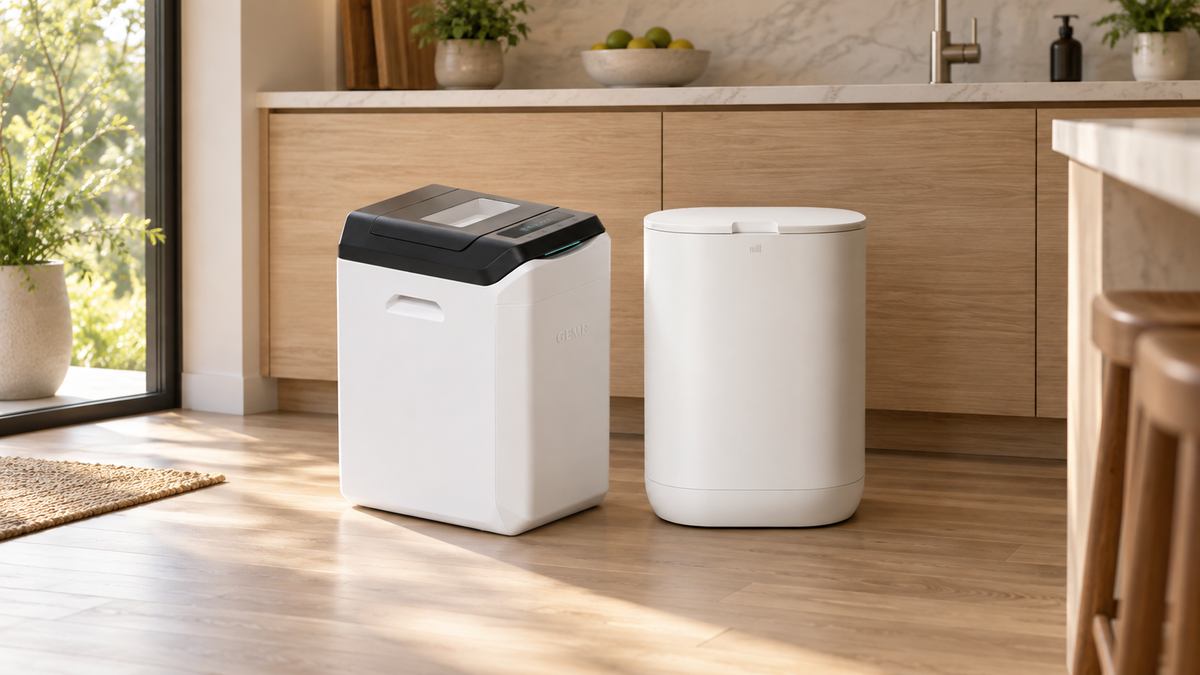


Laisser un commentaire
Tous les commentaires sont modérés avant d'être publiés.
Ce site est protégé par hCaptcha, et la Politique de confidentialité et les Conditions de service de hCaptcha s’appliquent.