
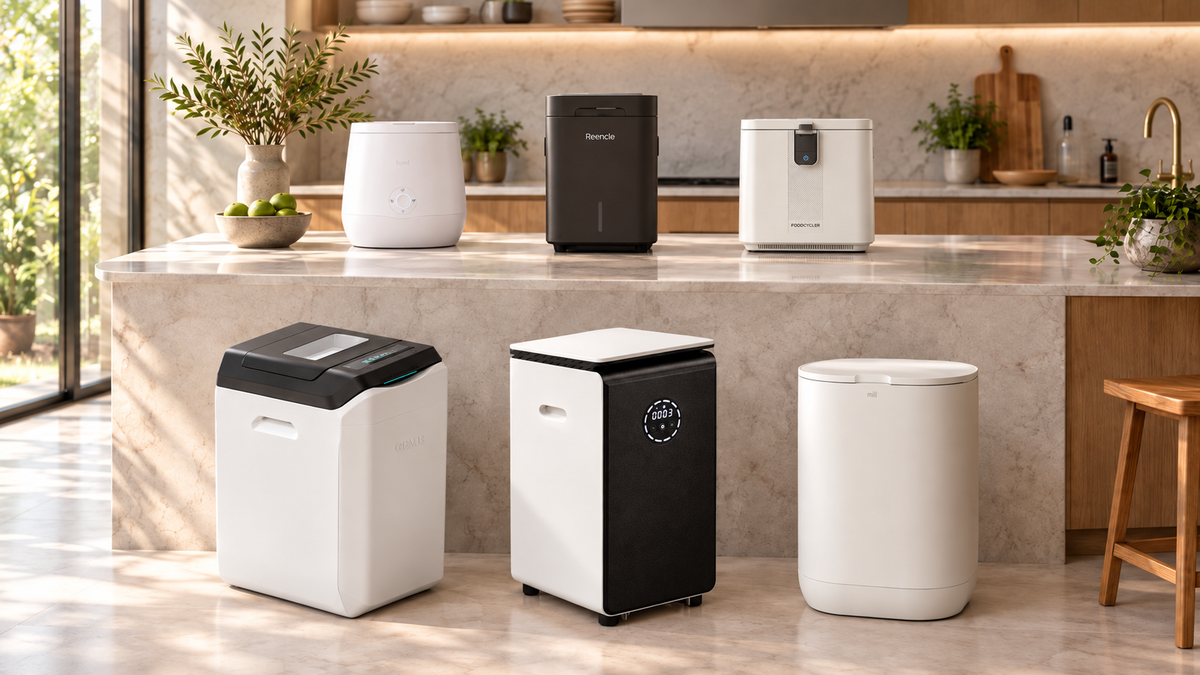
Composter Review · Six Leading Systems Compared
I kept coming back to the same question while comparing these machines: what happens after I throw dinner scraps in?
Some products genuinely maintain a living microbial environment. Others are exceptionally good at drying and grinding food waste. A few are mostly premium ways to store scraps without smelling them.
Those are all legitimate jobs, but they are not the same job.
By Matthew Moore · Updated September 15, 2026

Quick Verdict: The Best Composters We Reviewed
Best Overall: GEME Terra 2. It gave us the best balance of actual microbial composting, continuous daily use, useful capacity and low recurring maintenance.
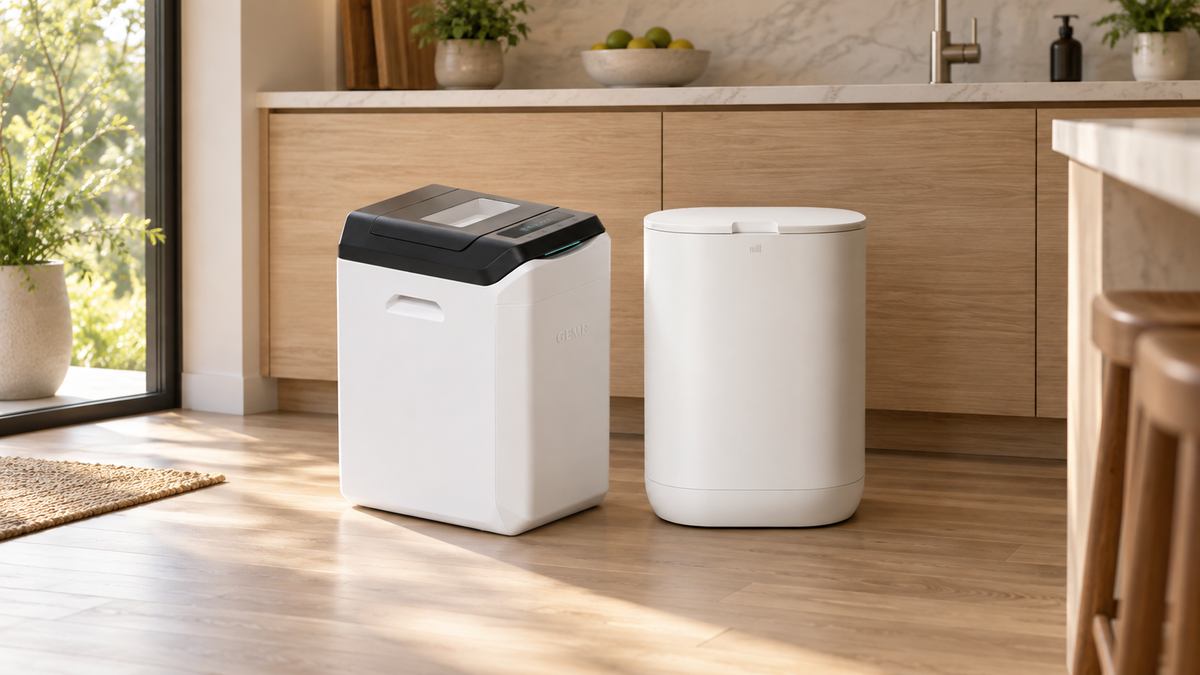
Best Composter for a Large Family: GEME Pro. Its 19 L chamber and up to 5 kg/day throughput make much more sense once a household moves beyond the typical 1–3 person Terra 2 use case.
Lomi 3 remains one of the better compact grind-and-dry machines. Mill is the most convenient if your main goal is storing scraps for a long time. Reencle Prime is the closest microbial competitor. FoodCycler Eco 5 works well for larger batch recycling, but none displaced Terra 2 as our overall pick.
How We Reviewed These Composters
We used the same seven questions for every system:
- Can I add food when I actually create it?
- What physically or biologically happens to the scraps?
- How much household waste can it realistically handle?
- What does it smell and sound like in normal use?
- What comes out?
- What maintenance and consumables remain after purchase?
- What do I have to do with the output next?
This matters because a three-hour drying cycle and a continuous microbial chamber cannot fairly be judged by cycle time alone.
6 Best Composters at a Glance
| System | Our Verdict | Process | Best For | Main Limitation |
|---|---|---|---|---|
| GEME Terra 2 | ★★★★★ Best Overall | Continuous aerobic microbial composting | 1–3 people | Larger than a small countertop recycler |
| GEME Pro | ★★★★★ Best Large Family | Continuous aerobic microbial composting | 4+ people / heavier loads | Needs dedicated floor space |
| Lomi 3 | ★★★ | Heat, airflow and grinding | Compact batch reduction | Not continuous composting; recurring carbon filters |
| Mill | ★★★ | Drying, grinding and storage | Long scrap storage | High price; Food Grounds still need a destination |
| Reencle Prime | ★★★★ | Microbial decomposition | Alternative microbial system | Lower throughput; filter replacement and curing/sifting |
| FoodCycler Eco 5 | ★★★ | Heating, grinding and aeration | Larger batch recycling | Batch workflow; carbon consumables; dry by-product |
1. GEME Terra 2 Review: Best Overall
Our Score: 9.4/10
Terra 2 is the machine I would choose for the broadest group of households because it gets the fundamentals right without turning food-waste management into another batch-processing chore.
The biggest difference is the workflow. You do not spend the day collecting scraps, waiting for a bucket to fill, starting a cycle and then waiting several hours before using the machine again. Terra 2 keeps one microbial environment active and lets suitable scraps join that environment throughout the day.
That sounds like a small convenience until you live with food waste. Breakfast peelings, lunch prep, coffee grounds and dinner leftovers do not arrive as one neat batch.
The 14 L chamber and up-to-2-kg/day guidance also feel substantially more forgiving than a small 3 L countertop bucket for ordinary 1–3 person cooking.
What I Like
Pros
- Continuous feeding feels natural in a real kitchen.
- Living microbial process rather than simple dehydration.
- Up to 2 kg/day is generous for a 1–3 person household.
- No routine activated-carbon filter replacement.
- Active Compost Base has a defined 1:8 soil-blending pathway.
- No need to empty a dry bucket after every processing cycle.
Cons
- It is floor-standing rather than a tiny countertop appliance.
- Fresh Compost Base still needs screening and correct soil blending.
Neither of those bothered me much. The footprint is the price of having a substantially larger active microbial chamber, and the output step is part of using biologically active material responsibly.
Best Overall: GEME Terra 2
Choose Terra 2 if you want continuous microbial composting, a practical 1–3 person capacity and no routine filter purchases.
Shop GEME Terra 2 →2. GEME Pro Review: Best Composter for Large Families
Our Score: 9.2/10
If Terra 2 is the better all-round household machine, GEME Pro is the one I would choose for a busy family kitchen.
The difference is not marketing; it is headroom.
GEME Pro moves to a 19 L microbial chamber and up to approximately 5 kg/day. For a family of four, five or more, that extra capacity matters because food waste does not scale neatly with headcount. Prep scraps, leftovers, fruit, spoiled food and weekend cooking all stack up quickly.
The continuous-feed format is especially useful here. Rather than asking a family to coordinate around a batch cycle, the machine becomes a destination for scraps across the day.
Pros
- Up to 5 kg/day gives large households real processing headroom.
- 19 L microbial chamber.
- Continuous feeding works around breakfast, lunch and dinner.
- No routine replacement odor filter.
- Same biological composting concept as Terra 2.
- Strong fit for families that previously overloaded smaller machines.
Cons
- Bigger and heavier than Terra 2.
- More capacity than a light-use one- or two-person household needs.
Those are really sizing issues rather than functional weaknesses. If you have the workload, Pro makes more sense precisely because it is bigger.
Best for Large Families: GEME Pro
Choose GEME Pro for 4+ people, frequent cooking or food-waste loads that would regularly push a smaller household machine toward its limit.
Shop GEME Pro →3. Lomi 3 Review: Best Compact Food Recycler
Our Score: 7.0/10
Lomi 3 is easy to understand once you stop expecting it to behave like a continuous microbial composter.
As a compact grind-and-dry appliance, it is polished. The 3 L bucket is convenient, the interface is simple, and it can turn a wet batch of scraps into a much smaller dry material within hours.
That makes it genuinely useful for apartments or kitchens where the priority is simply keeping wet food waste out of the trash.
Where I hesitate is what happens after that success. The machine solved the wet trash problem, but it did not necessarily finish the biological composting problem.
Lomi currently sells replacement activated-carbon filters at $29.99 and recommends replacement around every three months or 45 cycles.
Independent review note: WIRED's 2026 long-term Lomi 3 test reported that its original lid warped after several months, allowing odor to escape and attracting fruit flies; the replacement lid also began warping. Serious Eats separately concluded that Lomi is better understood as a dehydrator/grinder than a traditional composter.
Pros
- Compact countertop footprint.
- Simple batch workflow.
- Fast reduction of wet, bulky food scraps.
- Easy to understand and operate.
Cons
- 3 L capacity is limited compared with larger microbial chambers.
- Closed batch means you cannot keep feeding during processing.
- Dry output is not the same as mature compost.
- Replacement carbon filters create recurring cost and maintenance.
- Independent long-term testing has documented lid warping and odor escape.
4. Mill Review: Best for Long-Term Food-Scrap Storage
Our Score: 6.5/10
Mill is clever because it solves a problem the others mostly ignore: how long can I avoid dealing with my food scraps?
The larger bin can collect scraps over time while drying and grinding them into Food Grounds. If you hate carrying food waste out, that is a genuinely strong daily-life benefit.
But I kept running into the same question: after spending around $999 for Mill Essential or $1,149 for Mill Plus, what exactly did I buy?
Mill itself is refreshingly clear: it says the product is not a composting device; its Food Grounds are still food minus water, bulk and odor.
There is also more ongoing ownership than the minimalist exterior suggests. Essential carbon filters are currently $59 and typically last 5–6 months; Plus filters cost $114 and typically last 10–12 months. Optional Mill Pickups cost $192 + tax per year.
Independent review note: WIRED rated Mill 6/10 in its long-term review, pointing to the large physical footprint, high price and coarse Food Grounds that rehydrated easily in the garden.
Pros
- Excellent for keeping wet food scraps out of sight for longer.
- Large practical storage capacity.
- Automated schedule and app control.
- Optional pickup route gives the grounds a planned destination.
Cons
- Very high upfront price for a food recycler.
- Large floor footprint.
- Food Grounds are explicitly not compost.
- Replacement filters remain part of ownership.
- Optional pickup service adds another recurring cost.
- You still need a destination for the output.
5. Reencle Prime Review: Best Microbial Alternative
Our Score: 7.5/10
Reencle deserves more credit than the dehydrator-style products because it is playing the same fundamental biological game as GEME.
It maintains a resident microorganism community, accepts scraps continuously and does real biological work inside the machine.
That is why it is the competitor I would take most seriously if the buyer's priority is actual microbial decomposition rather than simply dry output.
The limitations show up in throughput and maintenance.
Reencle's current Prime specification lists approximately 0.7 kg/day recommended and 1 kg/day maximum, versus Terra 2's up-to-2-kg/day positioning. Reencle also specifies carbon-filter replacement every 9–12 months.
Independent review note: WIRED gave Reencle Prime 8/10 but still reported that compost needed sifting and curing, the sifter was not included, the automatic lid sensor could be overly sensitive, and the machine smelled during startup. The reviewer also found larger scraps often needed chopping because there is no grinder.
Pros
- Real microorganism-based processing.
- Continuous-feeding workflow.
- Relatively quiet operation.
- A credible alternative to dehydrator-style systems.
Cons
- Lower daily processing capacity than Terra 2.
- Carbon filter replacement remains part of ownership.
- Output may require sifting and curing before use.
- No grinder means some large inputs need prep.
- Independent testers have reported startup odor and a finicky lid sensor.
6. FoodCycler Eco 5 Review: Best Large Batch Food Recycler
Our Score: 7.0/10
FoodCycler Eco 5 is the sixth machine in this comparison because it occupies an interesting middle ground: much more batch capacity than Lomi, but still fundamentally a grind-and-dry system rather than a resident microbial composter.
Its 5 L bucket is useful, especially for larger households that still prefer a countertop-style batch workflow.
The current Eco 5 specification gives a 4–9 hour cycle and energy use of up to about 1.5 kWh per cycle. The machine creates a dry by-product and uses refillable activated-carbon odor filtration. FoodCycler recommends replacing the carbon roughly every three to four months depending on use.
Independent review note: WIRED's current kitchen-composter guide describes the smaller Eco 3 as a capable grind-and-dry recycler but notes groaning and creaking sounds and a bucket that can be finicky to seat correctly. Its Eco 5 comments similarly emphasize that FoodCycler is a recycler rather than a true composting system.
Pros
- 5 L bucket is larger than many countertop batch machines.
- Simple fill-run-empty workflow.
- Fast moisture and volume reduction.
- Handles a broad range of food waste.
Cons
- Still a batch system rather than continuous processing.
- Dry Foodilizer-style output is not equivalent to microbial Compost Base.
- Activated-carbon refills are an ongoing consumable.
- Up to 1.5 kWh per cycle is significant compared with low-energy continuous systems.
- The user still needs a sensible downstream use for the dry material.
Final Verdict: What Is the Best Composter?
After comparing all six systems, I would not choose based on cycle speed, product shape or how dramatically a brand shrinks food waste.
I would choose based on what happens to the food biologically and what I have to do with the output afterward.
Choose GEME Terra 2 if you want the best overall combination of continuous microbial composting, useful daily capacity, low filter maintenance and a defined soil-return pathway.
Choose GEME Pro if your family regularly generates more waste than Terra 2 was designed to handle.
Choose Reencle Prime if you want another microbial system and are comfortable with lower capacity, filter replacement and additional output handling.
Choose Lomi or FoodCycler if your real priority is compact, fast batch reduction rather than maintaining a live compost ecosystem.
Choose Mill if long scrap storage matters more to you than producing compost inside the machine.
For the broader buying framework, continue to Best Composter 2026 or Best Kitchen Composters 2026.
Frequently Asked Questions
What is the best composter in 2026?
For most 1–3 person households seeking continuous microbial composting, our overall pick is GEME Terra 2. For larger households with heavier food-waste loads, GEME Pro is the stronger fit.
What is the best kitchen composter for a large family?
GEME Pro is our large-family pick because its 19 L chamber and up-to-5-kg/day capacity provide substantially more headroom than smaller household systems.
Is Lomi a real composter?
Lomi 3 is best understood as a food recycler that uses heat, airflow and grinding to reduce food-waste moisture and volume. Its output can have useful downstream applications, but the machine does not perform the same continuous microbial process as GEME or Reencle.
Does Mill actually make compost?
No. Mill itself states that its Food Grounds are not compost. The machine dries and grinds food scraps into shelf-stable grounds for later garden, collection or pickup use.
Does Reencle really compost?
Reencle uses a resident microorganism culture and is a genuine microbial system. Buyers should still account for its lower recommended daily capacity, filter model and the sifting or curing expected before some soil uses.
What is the difference between GEME Terra 2 and GEME Pro?
The underlying microbial-composting concept is similar. Terra 2 has a 14 L chamber and is positioned for 1–3 people and up to approximately 2 kg/day. GEME Pro has a 19 L chamber and is designed for up to approximately 5 kg/day for larger households.
Which composter has the lowest recurring filter cost?
GEME Terra 2 and GEME Pro do not require scheduled disposable odor-filter replacement. Lomi, Reencle, Mill and FoodCycler use carbon-based odor-control consumables or replaceable filters according to their current product guidance.
What should I look for in a composter review?
Look beyond cycle time. Compare process, daily capacity, continuous versus batch feeding, output, odor control, energy use, consumables, cleaning requirements and what must happen before the output reaches soil.
Sources & Independent Reviews
- GEME — Terra 2
- GEME — GEME Pro Large-Family Specifications
- Lomi — Lomi 3
- Lomi — Filter Replacement Guidance
- Mill — How Mill Differs From Composting Devices
- Mill — Carbon Filter Cost and Replacement
- Reencle — Model Specifications
- FoodCycler — Eco 5 Specifications
- WIRED — Kitchen Composters Tested for Two Years
- WIRED — Reencle Prime Review
- WIRED — Mill Food Recycler Review
- Serious Eats — Six-Month Lomi 3 Review



Commenta
Nota che i commenti devono essere approvati prima di essere pubblicati.
Questo sito è protetto da hCaptcha e applica le Norme sulla privacy e i Termini di servizio di hCaptcha.