
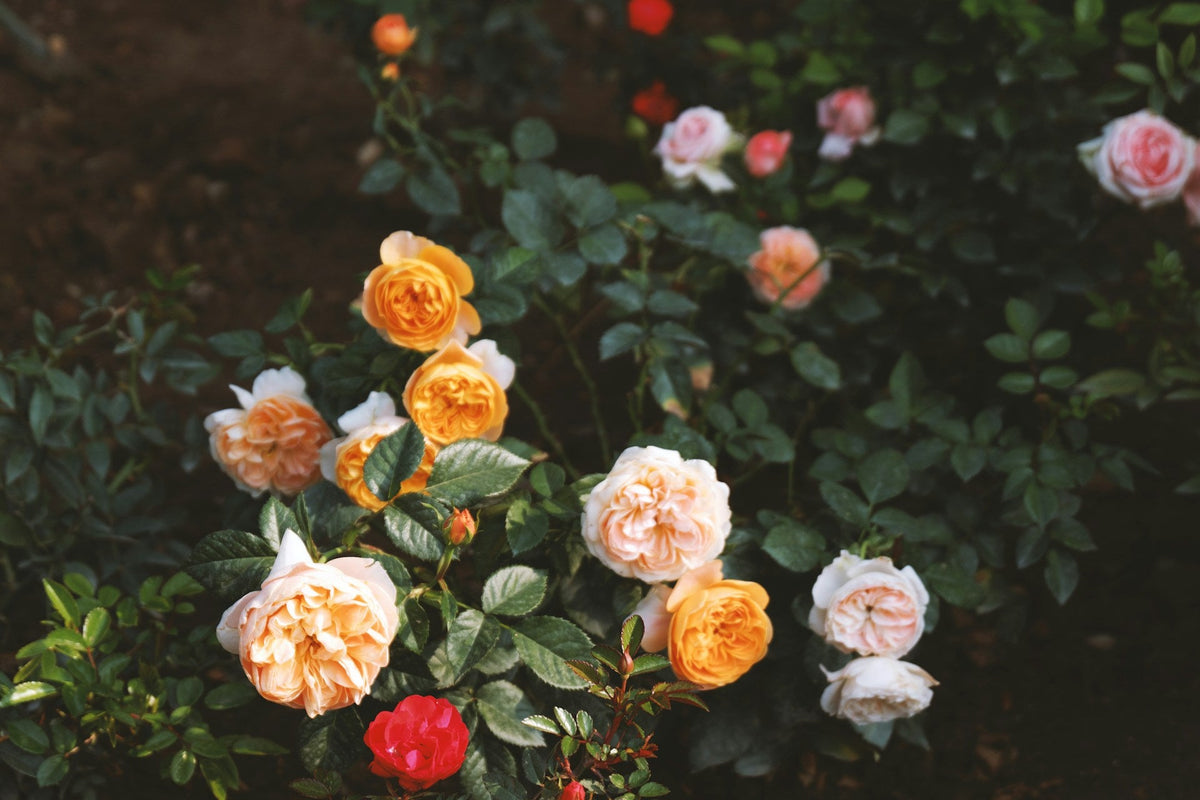
Roses · Compost · Fertilizer · Mulch · Seasonal Soil Care
Compost is useful for roses, but it does a different job from rose fertilizer. Mature compost improves soil organic matter, structure, biological activity, and water behavior. Fertilizer supplies nutrients in known or labeled amounts.
Healthy roses usually need more than one input. They perform best in well-drained soil rich in organic matter, with adequate sun, consistent moisture, appropriate fertilizer when needed, and a mulch layer that protects the root zone.
For most rose beds, the better question is how much compost does the soil need, does the rose actually need fertilizer, and when should each be applied?

Can You Use Compost for Roses?
Yes. Mature compost is an excellent soil amendment for roses when used in moderate amounts.
- New rose beds: incorporate mature compost into the broader planting area rather than filling the hole with pure compost.
- Established roses: use a modest compost top dressing around the root zone.
- Fertilizer: treat compost and fertilizer as different tools; compost is not a standardized NPK product.
- Mulch: place an appropriate organic mulch over the soil to conserve moisture and reduce weeds.
- Sun: most roses perform best with at least about 6 hours of direct sun.
- GEME Compost Base: screen it, mix about 1 part Compost Base with 8 parts plain soil, and keep concentrated material away from stems and roots.
Simple rule: use compost to build soil, fertilizer to correct nutrient needs, and mulch to protect the root zone.
1. Rose Soil Care at a Glance
This original decision table separates the jobs of compost, fertilizer, mulch, water, and sunlight. Giving every rose problem more fertilizer is rarely the right diagnostic approach.
| Garden Need | Best Tool | What It Does | Main Caution |
|---|---|---|---|
| Low organic matter / poor soil structure | Mature compost | Adds organic matter and supports soil function | Do not over-apply year after year |
| Documented nutrient shortage | Appropriate rose fertilizer | Supplies nutrients in labeled quantities | Follow soil test and label directions |
| Drying soil / weeds | Organic mulch | Protects the soil surface | Keep away from stems and crown |
| Poor drainage | Correct soil structure / site drainage | Prevents waterlogging around roots | Compost alone cannot fix every drainage problem |
| Weak growth in shade | More suitable light exposure | Supports photosynthesis and flowering | Extra fertilizer cannot replace sunlight |
| Dry root zone | Deep watering + mulch | Maintains more consistent soil moisture | Avoid chronically saturated soil |
| GEME Compost Base available | Screen + 1:8 soil blend | Adds biologically processed organic material | Do not place concentrated output against roots or crown |
2. Compost vs Rose Fertilizer: They Are Not the Same Thing
Searches for rose fertilizer, rose food, rose plant food, and fertilizer for roses often assume that compost and fertilizer solve the same problem.
They do not.
What Compost Does
Mature compost is mainly a soil amendment. It contributes organic matter and can help improve:
- soil structure;
- water retention in sandy soil;
- workability of heavier soil;
- nutrient-holding behavior;
- soil biological activity;
- gradual nutrient cycling.
What Rose Fertilizer Does
A fertilizer supplies nutrients in defined quantities. A commercial fertilizer label gives a guaranteed analysis, commonly expressed as nitrogen, phosphorus, and potassium.
That makes fertilizer a more precise tool when a soil test or plant condition shows that nutrient supplementation is needed.
Is Compost Rose Food?
Compost can contribute nutrients, but calling it a complete rose food can be misleading because nutrient levels vary by feedstock, composting process, maturity, and application rate.
GEME’s own NPK testing across 50 household compost-output samples showed the same principle: nutrients are present, but compost behaves like a variable soil amendment rather than a standardized NPK fertilizer.
Think Soil First, Fertilizer Second
If a rose has poor drainage, compacted soil, insufficient sun, drought stress, or disease, adding more fertilizer may not solve the underlying problem. Diagnose the growing environment before feeding harder.
3. What Soil Is Best for Roses?
Roses prefer fertile, well-drained soil with good organic matter and adequate air around the roots.
Illinois Extension recommends a soil pH of roughly 6.0–7.0 and emphasizes that poor drainage can be fatal to roses.
Good Rose Soil Needs Both Water and Air
Roots need moisture, but they also need oxygen. A rich soil that stays waterlogged can be worse for a rose than a leaner soil with better drainage.
Before adding compost, check:
- whether water drains after rain or irrigation;
- whether the soil stays saturated;
- whether the site is compacted;
- whether the soil is extremely sandy;
- whether repeated amendments have already raised nutrient levels;
- whether a soil test suggests pH or nutrient correction.
Adding Compost to New Rose Beds
When preparing a larger rose bed, mature compost can be incorporated into the existing soil rather than used as a replacement for soil.
Illinois Extension recommends adding roughly 2–4 inches of organic matter across a new rose bed before incorporating it into the soil.
For an individual planting hole, both Illinois Extension and Oregon State caution against creating an overly amended pocket. A modest amendment mixed with native soil is preferable to filling the hole with pure compost.
For broader garden-soil preparation, see How to Plant a Garden for Beginners.
4. How to Use Compost for Roses
The correct method depends on whether you are preparing a new bed or caring for an established rose.
For a New Rose Bed
- Check drainage first.
- Test soil when possible.
- Spread mature compost across the larger bed area.
- Incorporate it into the upper soil profile.
- Plant the rose into the improved soil rather than a pocket of pure compost.
- Water deeply after planting.
- Add an appropriate surface mulch afterward.
For an Established Rose Bush
Use mature compost as a controlled top dressing over the active root zone rather than piling it directly against the canes.
A thin layer is usually more sensible for routine maintenance than repeatedly adding several inches every year.
If the bed already receives compost annually, a soil test becomes increasingly useful because repeated heavy organic amendments can raise phosphorus, soluble salts, or other nutrient levels beyond what the plants need.
Only Use Mature Compost Around Roses
Finished compost should be dark, crumbly, earthy-smelling, and relatively stable. Avoid applying sour, slimy, ammonia-smelling, actively heating, or obviously unfinished material around rose roots.
If you are unsure, use When Is Compost Ready to Use?.
For general garden application rates and methods, see How to Use Compost Correctly.
5. What Is the Best Fertilizer for Roses?
There is no single best fertilizer for every rose, soil, climate, and growing system.
The best choice depends on what nutrients are actually needed.
Balanced Fertilizer Is a Common Starting Point
Oregon State University Extension recommends a general balanced fertilizer such as 10-10-10 for roses in its Central Oregon guidance.
That does not mean every rose everywhere requires that exact analysis. Soil nutrient status, existing compost, irrigation water, variety, climate, and container conditions all affect the appropriate fertilizer program.
What About Products Marketed as Rose Fertilizer?
A product labeled rose fertilizer, rose bush fertilizer, or rose plant food should be evaluated by:
- its guaranteed analysis;
- application rate;
- release speed;
- soil-test results;
- existing fertility;
- whether the plant is in the ground or in a container.
The word “rose” on the package does not automatically make a product better for your garden than another properly formulated fertilizer.
Can Compost Replace Fertilizer for Roses?
Not automatically.
Compost contributes organic matter and variable nutrients, but roses can still require supplemental fertility depending on the soil and growing conditions.
Use compost as compost and fertilizer as fertilizer. Do not assume one must completely replace the other.
Do Not Fertilize a Stressed Rose Blindly
Yellow leaves, poor flowering, and weak growth can also result from waterlogging, drought, pH problems, root damage, disease, shade, or nutrient imbalance. Diagnose before adding more fertilizer.
6. When to Fertilize Roses
Fertilizer timing depends on climate, rose type, dormancy pattern, and product instructions.
For temperate climates, Oregon State recommends the first fertilizer application around spring bud break, followed by feeding every 4–6 weeks during active growth where appropriate.
It also recommends stopping fertilization in late summer as roses begin moving toward dormancy.
| Season | Compost | Fertilizer | Main Goal |
|---|---|---|---|
| Early spring | Good time for a modest mature-compost top dressing | Begin around bud break where appropriate | Support renewed growth and soil condition |
| Late spring | Usually no need for another heavy compost application | Repeat-blooming roses may need another feeding | Support flowering and active growth |
| Early to mid-summer | Maintain soil and mulch rather than piling on compost | Additional feeding may be appropriate for repeat bloomers | Support continued flowering |
| Late summer | Focus on moisture and soil protection | Begin stopping nitrogen-heavy feeding in cold-winter climates | Avoid stimulating tender late growth |
| Fall | Finished compost can be used modestly where soil needs it | Follow regional dormancy guidance | Soil maintenance and winter preparation |
| Winter | No need to continually add compost | Usually dormant-period management in cold climates | Protect roots and prepare for spring |
Climate matters: roses in warm regions may not follow the same dormancy calendar as roses in cold-winter regions. Use local Extension guidance for exact fertilizer timing.
7. Do Roses Need Full Sun?
Most roses perform best with at least about 6 hours of direct sun per day.
Illinois Extension recommends at least six hours and notes that morning sun can be especially helpful because it dries foliage earlier in the day, reducing conditions favorable to some leaf diseases.
Can Roses Grow With Less Sun?
Some rose types tolerate partial shade better than others, but reduced light can mean:
- fewer flowers;
- weaker or more stretched growth;
- slower drying of foliage;
- greater disease pressure in humid conditions.
Fertilizer Cannot Replace Sunlight
If a rose is weak because the site is too shaded, feeding it more aggressively does not solve the basic energy limitation.
Before reaching for more rose food, check whether the plant has adequate light, drainage, water, root space, and air circulation.
8. Mulch for Roses: Protect the Soil Surface
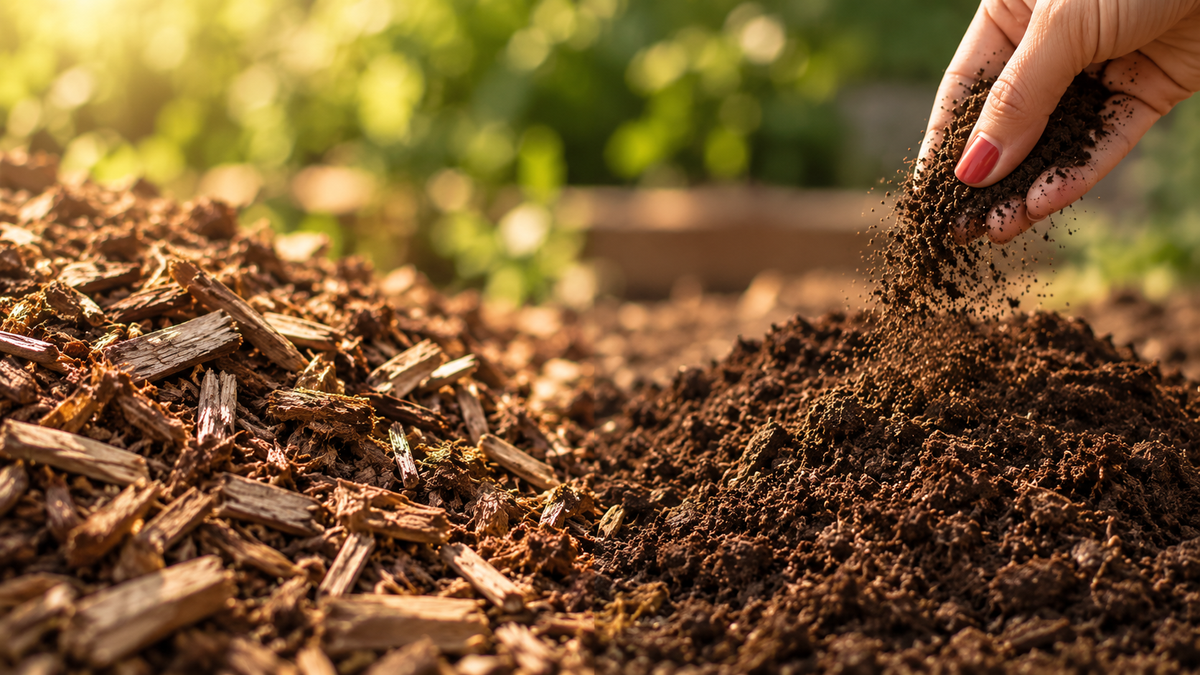
Mulch and compost can work together around roses.
Compost improves the soil. Mulch protects the surface.
Illinois Extension recommends roughly 2–3 inches of mulch around roses to help retain soil moisture, keep soil cooler, and suppress weeds.
Good Mulch Materials for Roses
- wood chips;
- shredded bark;
- straw;
- dry grass clippings used appropriately;
- coarse mature compost in appropriate applications;
- other clean organic landscape mulch.
Do Not Pile Mulch Against the Rose Crown
Leave space around the base of the rose rather than mounding wet mulch against the crown or canes.
Illinois Extension recommends leaving an unmulched area roughly 6 inches in radius around the plant.
Compost Below, Mulch Above
A practical layering sequence is:
- existing garden soil;
- modest mature compost where the soil needs it;
- surface mulch;
- open space around the rose crown.
This keeps the jobs clear: compost supports the soil, while mulch reduces evaporation and exposed soil.
9. Compost and Fertilizer for Potted Roses
Potted roses need more careful nutrient and moisture management than roses growing in open ground.
A container has limited soil volume, limited nutrient reserves, and less buffering against over-fertilization.
Do Not Fill a Pot With Pure Compost
Use compost as one component of a well-drained container mix rather than filling the entire container with compost.
Rose roots still need a balance of:
- air space;
- water retention;
- drainage;
- mineral and structural material;
- organic matter;
- appropriate nutrients.
Potted Roses Dry Faster
Containers can heat and dry rapidly in warm weather. Check the root zone rather than watering only by calendar.
A pot must also drain freely. Do not let the container sit continuously waterlogged in a saucer.
Fertilizer for Potted Roses
Because nutrients can leach through containers during watering, potted roses may need a more regular feeding program than roses in rich garden soil.
Follow the fertilizer label and plant response rather than assuming that adding extra compost will provide a predictable nutrient dose.

Containers Magnify Over-Application
Excess compost, salts, fertilizer, or water have less soil volume in which to disperse. Start conservatively and watch the plant rather than layering multiple high-nutrient inputs at once.
10. Compost for Roses Through the Seasons
Spring: Build the Root Zone Before Peak Growth
Spring is one of the best times to assess the rose bed.
- remove winter debris;
- check drainage;
- inspect mulch depth;
- apply mature compost modestly if the soil needs organic matter;
- begin fertilizer according to regional bud-break guidance;
- water deeply after dry periods.
Late Spring and Early Summer: Support Flowering, Not Excess
Repeat-flowering roses may need another fertilizer application during active growth, depending on the rose, soil, and product.
Do not automatically add another heavy compost layer every time you fertilize. Compost is a soil-management tool, not a monthly feeding requirement.
Summer: Moisture Management Becomes Critical
Maintain mulch, water deeply, and watch for heat stress.
Roses generally prefer consistent soil moisture but poorly tolerate saturated root zones. Water the soil rather than routinely soaking the foliage.
Late Summer: Prepare for Dormancy in Cold Climates
In regions with winter dormancy, stop late nitrogen-heavy fertilization early enough to avoid stimulating tender growth that may be damaged by cold weather.
Oregon State guidance for Central Oregon stops routine fertilization in late August or early September.
Fall: Soil Maintenance, Not Forced Growth
Fall can be a useful time to assess soil organic matter and replenish mulch, depending on climate.
If mature compost is needed, use it moderately. Do not treat fall composting as a reason to bury rose crowns under a thick organic layer.
Winter: Protect the Root Zone
Winter care varies greatly by region and rose type. In cold climates, mulching can help insulate the root zone after dormancy begins.
Use regional guidance for winter protection because a method suitable for Central Oregon may be inappropriate in coastal California or a subtropical climate.
11. How to Use GEME Compost Base Around Roses
GEME Terra 2 and GEME Pro produce Compost Base through continuous aerobic microbial composting.
Because GEME is a continuous-flow system, harvested material can contain particles with different residence times. Compost Base therefore needs its own soil-use workflow rather than being treated as a bag of uniform commercial potting mix.
The current GEME application pathway is:
- Screen the harvested Compost Base.
- Return large unfinished organic pieces to the chamber.
- Mix approximately 1 part screened Compost Base with 8 parts plain soil.
- Place the blend in the rose root zone without concentrating it against the crown or main canes.
- Cover with plain soil where appropriate.
- Water and observe plant response.
For an Established Rose
Apply the 1:8 blend in a shallow ring or small pockets away from the crown rather than dumping concentrated Compost Base directly against the plant.
Cover the blend with plain soil and water thoroughly.
For a New Rose
Do not place roots directly into pure GEME Compost Base.
Use the 1:8 blend as part of the surrounding soil and maintain a plain-soil buffer around sensitive new roots.
For Potted Roses
Containers deserve extra caution because salts and nutrients are concentrated in a smaller volume.
Use the 1:8 rule conservatively, avoid heavily pre-fertilized mixes at the same time unless you know the nutrient status, and watch plant response.
GEME Compost Base Is Not Rose Fertilizer
Compost Base contains organic matter and nutrients, but its nutrient profile varies with household feedstock.
Use it as a compost-style soil amendment. Do not substitute a variable compost material for a diagnosed fertilizer requirement solely because the rose is a heavy feeder.
Read GEME Compost Base vs Finished Compost for the maturity distinction.
For the complete plant-use workflow, continue to Mastering the GEME Cycle: An Agronomist’s Guide to Continuous-Flow Compost Application.
Build Better Soil for Roses Without Treating Compost Like Fertilizer
Healthy roses come from the whole root-zone system: good soil, appropriate organic matter, drainage, sunlight, water, mulch, and nutrients when needed. GEME Terra 2 and GEME Pro turn suitable household food scraps into biologically processed Compost Base for responsible soil blending.
12. Frequently Asked Questions
Is compost good for roses?
Yes. Mature compost can improve soil organic matter, structure, water behavior, and biological activity around roses. Use it moderately as a soil amendment rather than treating pure compost as the entire growing medium.
Is compost a rose fertilizer?
Not in the same sense as a standardized fertilizer. Compost contains variable nutrients and organic matter, while fertilizer provides nutrients in defined labeled quantities. A rose may benefit from both.
What is the best fertilizer for roses?
There is no universal best fertilizer for every rose and soil. A balanced fertilizer is a common starting point, but the right choice depends on soil nutrient status, rose type, climate, container conditions, and existing amendments.
What is the best fertilizer for a rose plant?
Choose fertilizer according to actual plant and soil needs rather than the word “rose” on the package. Soil testing is the best way to avoid unnecessary phosphorus, potassium, salts, or nitrogen.
When should I fertilize roses?
In many temperate climates, feeding begins around spring bud break and may continue every 4–6 weeks during active growth for repeat-blooming roses. Stop late-season feeding early enough to avoid tender growth before dormancy. Exact timing varies by climate.
Is rose food different from rose fertilizer?
“Rose food” is often a marketing term for fertilizer. Check the guaranteed analysis and application instructions to understand what the product actually supplies.
Can compost replace rose plant food?
Not automatically. Compost supports the soil and supplies variable nutrients, but it may not provide enough of a specific nutrient when the soil or rose has a documented deficiency.
Do roses need full sun?
Most roses perform best with at least about six hours of direct sunlight per day. Morning sun is particularly useful because foliage dries sooner after dew or rain.
What is the best soil for roses?
Roses prefer fertile, well-drained soil with good organic matter. Illinois Extension recommends a pH around 6.0–7.0. Drainage is essential because roses do not tolerate chronically waterlogged roots.
How much mulch should I use for roses?
About 2–3 inches of organic mulch is a practical guideline for rose beds. Keep mulch away from the crown and canes rather than piling it directly against the plant.
Can I use compost as mulch for roses?
Mature coarse compost can function as a surface mulch, but a longer-lasting material such as wood chips or bark may provide better long-duration weed suppression. Compost and mulch can also be layered, with compost supporting the soil below and mulch protecting the surface above.
Can I use compost in potted roses?
Yes, but mature compost should be only one component of a well-drained container mix. Pure compost is generally not an appropriate complete potting medium.
Can I use GEME Compost Base directly around roses?
Do not apply concentrated fresh Compost Base directly against roots, stems, or crowns. Screen it and mix approximately one part Compost Base with eight parts plain soil before plant use.
Does GEME Compost Base replace rose fertilizer?
No automatic fertilizer-replacement claim should be made. GEME Compost Base contains nutrients, but its composition varies with feedstock. Use it as a soil amendment and base fertilizer decisions on the rose, soil condition, and soil-test results.


Commenta
Nota che i commenti devono essere approvati prima di essere pubblicati.
Questo sito è protetto da hCaptcha e applica le Norme sulla privacy e i Termini di servizio di hCaptcha.