


Summer Composting · Fruit Flies · Odor · Moisture · Terra 2 Care
Composting Basics: Composting in Summer
Summer can be one of the fastest composting seasons, and one of the messiest. Watermelon, tomatoes, berries and other juicy scraps push moisture upward, warm kitchens favor fruit-fly activity, and an overloaded compost system can shift from earthy to sour surprisingly quickly.

Quick Answer: What Changes When You Compost in Summer?
The biology does not suddenly change because it is July or August—but the conditions around your compost often do.
For outdoor compost piles, hot weather can create the opposite problem: the pile may lose moisture quickly and slow down if it becomes too dry.
The summer rule is therefore not simply:
“Keep compost cool.”
It is:
Keep moisture, oxygen, feeding rate and hygiene in balance.
That principle applies whether you use a backyard pile or an indoor microbial composter such as GEME Terra 2.
Table of Contents
- Why Summer Composting Feels Different
- How to Stop Fruit Flies Around Compost
- Why Compost Smells Worse in Summer
- How to Fix Compost That Is Too Wet
- What If an Outdoor Compost Pile Gets Too Dry?
- How to Handle Watermelon and Other Wet Summer Foods
- Terra 2 Summer Operating Routine
- How Often Should You Clean Terra 2?
- What to Do During a Heat Wave
- Common Summer Composting Mistakes
- Summer Composting Checklist
- Frequently Asked Questions
1. Why Summer Composting Feels Different
Composting is an aerobic biological process. Microorganisms use organic matter, oxygen and water while releasing carbon dioxide, water and metabolic heat.
You can explore the biology in more detail in How Does Composting Work? Microbes, Heat & Oxygen.
Summer changes several variables around that biology at the same time.
Seasonal Diet Changes the Feedstock
A winter food-waste stream may contain more bread, cooked grains, root vegetables and dense leftovers.
Summer kitchens often generate:
- watermelon rind;
- melon pulp;
- tomatoes;
- berries;
- peaches and nectarines;
- cucumber;
- salad scraps;
- fruit trimmings;
- cold drinks and wet leftovers.
Many of these materials are easy for microorganisms to attack, but they also contain a lot of water.
A high-volume load of wet produce can therefore alter the physical environment faster than the same mass of drier food.
Warm Kitchens Increase Pest Pressure
Fruit flies are strongly associated with ripe and fermenting fruit and vegetable material. They can reproduce in food residues around counters, bins, drains and other moist organic deposits.
That means seeing fruit flies near a composter does not automatically prove that the machine itself is the breeding source.
The nearby banana bowl, recycling container, drain, sticky liquid under an appliance or forgotten scrap caddy may be responsible.
Outdoor Compost Can Lose Water Fast
Hot summer weather can also dry a backyard pile rapidly, especially near the exposed surface.
So summer can create two opposite failures:
The answer is not “more water” or “less water” universally.
The answer is to diagnose the system you actually have.
2. How to Get Rid of Fruit Flies Around Compost in Summer
If you search for how to get rid of fruit flies in compost, many answers immediately jump to traps.
Traps may reduce the adults you see, but the more important step is finding the breeding material.
Fruit flies are attracted to fermenting fruits and vegetables. Warm, moist organic residue in kitchens can provide a place for them to reproduce.

Start With the Entire Kitchen, Not Only the Compost Bin
Inspect:
- ripe or damaged fruit on the counter;
- onions or potatoes stored out of sight;
- food scraps waiting to be composted;
- recycling containing juice, wine or sugary residue;
- garbage bins;
- sink and floor drains;
- sticky spills under appliances;
- wet cloths, mops or cleaning tools;
- the floor and countertop around the composter.
Removing the breeding source matters more than repeatedly killing adult flies.
For GEME Terra 2 Users: Reduce the Time Scraps Sit Exposed
One advantage of an enclosed electric microbial composter is that scraps can move directly from meal preparation into the processing chamber instead of sitting for days in an open kitchen caddy.
During peak fruit-fly season:
- Collect scraps in a closed container if you are not feeding immediately.
- Do not leave cut fruit or melon scraps exposed overnight.
- Wipe juice from the Terra 2 lid rim and nearby countertop after messy feedings.
- Keep the lid fully closed during operation.
- Check nearby trash, recycling and drains if flies persist.
Do Not Spray Insecticide Into the Compost Chamber
GEME Terra 2 contains a living microbial ecosystem. Pest control chemicals should not be treated as compost inputs. If flies persist, clean the surrounding breeding sources and use normal household pest-management practices outside the biological chamber.
3. Why Does Compost Smell Bad in Summer?
Healthy aerobic compost does not have to be perfume-like, but it should generally smell earthy, organic or mildly fermented rather than strongly putrid.
A sharp sour, rotten-egg or sewage-like smell is often process information.
One common pathway is:
Large wet feed
↓
More liquid fills pore spaces
↓
Oxygen transfer falls locally
↓
Anaerobic pockets develop
↓
Sour or rotten odors appear
This is why the useful question is not:
“Does compost smell?”
but:
“What is the smell telling me about oxygen, moisture and feeding?”
For an Outdoor Pile
If a backyard pile smells bad and feels soggy:
- turn the pile to restore air;
- mix in dry, structurally open brown material;
- protect it from excessive rain;
- avoid creating dense mats of wet grass or food scraps.
For GEME Terra 2
GEME Terra 2 is different from a passive backyard pile. It is a continuous indoor bio-processing system with managed airflow, moisture, heat and mixing.
If odor rises after a large wet load:
- pause additional wet food;
- keep the machine powered;
- make sure the air path is not obstructed;
- allow mixing, airflow and the microbial bed time to recover;
- avoid adding another large load simply because there is still physical room.
GEME's current support guidance similarly treats rising odor as a reason to check excess moisture and airflow rather than as automatic evidence of hardware failure.
For current troubleshooting guidance, use the GEME FAQ.
4. How to Fix Compost That Is Too Wet
Water is essential to composting.
Microorganisms need water films for enzymes, nutrient transport and metabolism.
But once too much water occupies the physical spaces that should contain air, oxygen transfer suffers.
That is why “wet” and “healthy” are not synonyms.
Signs an Outdoor Compost Pile Is Too Wet
- material looks waterlogged;
- the pile feels dense or slimy;
- liquid collects underneath;
- strong sour or sulfur-like odors appear;
- turning exposes compacted wet zones.
For a conventional pile, turning and adding dry brown material can restore structure and aeration.

Signs GEME Terra 2 May Be Carrying Too Much Moisture
Because GEME Terra 2 is designed to maintain a moist living bed, do not diagnose it by expecting dry crumbs.
Instead, pay attention to a combination of symptoms:
- unusually wet or sloppy bed texture;
- a sudden sour or rotting smell after heavy wet feeding;
- large amounts of visible watery food accumulating faster than they are breaking down;
- repeated high-moisture loads such as soup, watermelon or very juicy fruit.
The first response is usually not a full clean-out.
Instead:
- Stop adding very wet food temporarily.
- Drain soups and liquid-heavy leftovers before feeding.
- Spread very watery foods across multiple feedings.
- Keep Terra 2 operating normally so airflow and mixing continue.
- Allow the existing bed time to rebalance.
Coffee grounds are a normal accepted input and can be useful as part of a balanced feed when the bed feels wetter than usual, but they should not be dumped in excessive quantities as a “drying chemical.”
Do Not Copy Outdoor Compost Recipes Directly Into GEME Terra 2
Adding large volumes of dry leaves, long paper strips, or random bulking material may be reasonable in a backyard pile but is not automatically appropriate for a compact continuous machine. GEME Terra 2 should be managed according to its own feed and operating guidance.
5. What If Your Outdoor Compost Gets Too Dry in Summer?
A summer compost pile can look moist on the outside after morning dew or irrigation and still be dry several inches below the surface.
High temperatures, wind and low humidity increase water loss.
When a compost pile becomes too dry:
- microbial activity slows;
- materials remain recognizable longer;
- the pile may stop heating;
- decomposition becomes uneven.
Use the Wrung-Out Sponge Test for Backyard Compost
Take material from below the surface and squeeze it in your hand.
For conventional backyard compost, the familiar target is material that feels damp like a wrung-out sponge, not dusty, but not dripping.
If the pile is dry:
- add water gradually while turning;
- wet several layers rather than flooding only the top;
- cover the pile if appropriate to reduce evaporation;
- avoid leaving very dry material exposed to hot wind.
EPA's current home composting guidance similarly recommends monitoring moisture, odor and temperature and adjusting as needed.
Do Not Apply the Backyard “Wrung-Out Sponge” Test Literally to GEME Terra 2
GEME Terra 2 is an enclosed, sensor-managed continuous system. Its living compost base is expected to remain moist, and the appropriate response should come from overall bed condition, feed history and machine guidance, not from squeezing material to reproduce a backyard-pile test.
6. How to Compost Watermelon and Other Wet Summer Foods
Watermelon is almost the perfect example of a summer composting challenge.
It is:
- high in water;
- rich in readily available organic compounds;
- often generated in a large amount at once;
- easy for fruit flies to find if left exposed.
None of that means watermelon cannot be composted.
It means the feeding pattern matters.
For GEME Terra 2
GEME's current guidance allows watermelon rind but recommends cutting it smaller and avoiding a very large watery load all at once. See Can You Compost Watermelon Rind?
A better summer feeding pattern is:
The same logic applies to:
- cucumber;
- tomatoes;
- soft peaches;
- berries;
- pineapple pulp;
- very wet salad scraps.
For a broader ingredient guide, see What Can You Compost at Home?.

7. GEME Terra 2 Summer Operating Routine
Terra 2 already manages heat, airflow, moisture and mixing through its controlled operating system, so summer maintenance should focus less on “cooling the machine” and more on what the household controls:
- feeding pattern;
- wet-food volume;
- surface hygiene;
- air-path cleanliness;
- surrounding kitchen conditions.
1. Keep It Powered
Do not unplug Terra 2 each night because the kitchen is warm.
Continuous power maintains the airflow, mixing and environmental control that support the aerobic microbial process.
2. Drain Liquids Before Feeding
Soup, broth and very liquid leftovers are not the same as ordinary solid food waste.
Drain excess free liquid before adding the solids.
3. Spread High-Moisture Loads Across the Day
GEME Terra 2 is rated for up to 2 kg of daily household feed, but daily capacity should not be interpreted as permission to dump 2 kg of one extremely wet ingredient into the chamber at once.
Composition matters.
4. Keep the Lid Area Clean
Juice, fruit pulp or sauce smeared around the opening can sit outside the controlled biological environment.
That residue is exactly the kind of material summer flies can detect.
Wipe it away promptly.
5. Let the System Recover After a Wet Overload
If a large wet feed is followed by a sour smell, do not immediately keep adding more scraps.
Pause wet feeding and allow the existing bed to recover under normal powered operation.
8. How Often Should You Clean GEME Terra 2 in Summer?
This is where Terra 2 differs fundamentally from a conventional trash bin.
The inside is supposed to contain an active microbial bed.
A completely scrubbed, empty chamber is therefore not the normal definition of “clean.”
GEME's current support guidance says routine maintenance should be thought of on a months / harvest cadence rather than as frequent full clean-outs.
However, warmer weather makes it sensible to inspect food-contact edges and surrounding surfaces more frequently.
| Area | Practical Summer Cadence | What to Do |
|---|---|---|
| Fresh spills / lid rim | After messy feedings | Wipe fruit juice, sauce or visible food residue promptly. |
| Lid underside & opening | Inspect 1–2× per week in peak summer | Remove visible residue before it becomes a fly or odor source. |
| Counter / floor around machine | Weekly, or immediately after spills | Clean sticky juice and food particles that sit outside the controlled chamber. |
| Exhaust filter screen | Inspect weekly; clean when dust is visible | Remove, clean according to care guidance, dry completely and reinstall. |
| Mixing shaft | Inspect about monthly or when performance suggests a problem | Check for fibrous material or strings. Unplug before manual maintenance. |
| Interior walls | As needed | Gently scrape excessive buildup rather than washing away the living bed. |
| Compost bed / chamber | Every few months / when harvesting | Harvest as needed but retain part of the lower active bed for biological continuity. |
| Full empty-and-scrub clean | Not routine | Use only when there is a genuine maintenance or troubleshooting reason. |
The 1–2× weekly and monthly inspection intervals above are practical summer-care recommendations, not mandatory manufacturer service intervals. GEME's official guidance is condition-based: clean visible buildup, keep air paths clear, inspect the shaft periodically and avoid unnecessary removal of a healthy biological bed.
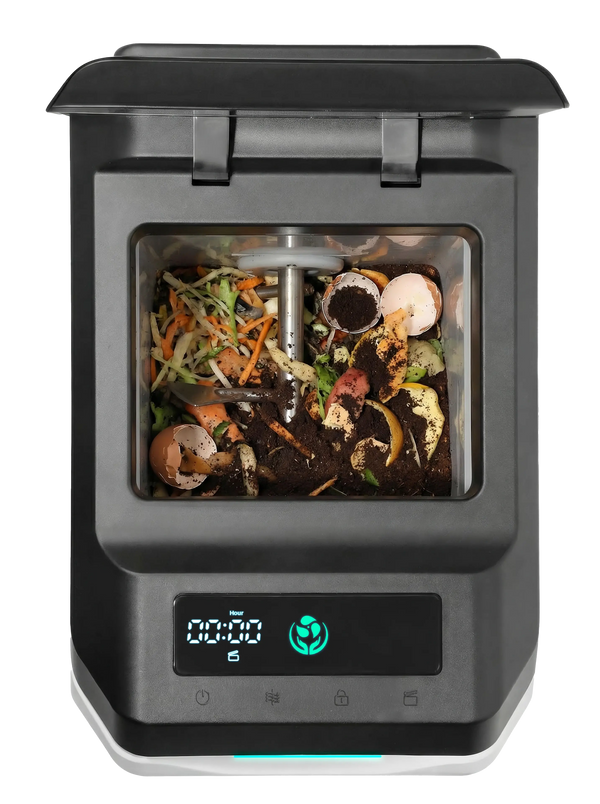
Summer Terra 2 Care
Clean the Food Residue, Not the Biology
The goal is a clean appliance around an active compost ecosystem.
Wipe spills, inspect the lid and air path, remove unwanted fibers and clean excessive wall buildup, but do not turn routine maintenance into repeated sterilization of the microbial bed.
View Current GEME Care Guidance →9. What Should You Do During a Summer Heat Wave?
Outdoor Compost
Check moisture more frequently.
Very hot, windy weather can dry an active pile faster than expected.
Do not assume the center is moist because the outside was watered yesterday.
If needed:
- turn and inspect the interior;
- add water gradually;
- cover the pile to reduce evaporation where appropriate;
- maintain enough structure for air movement.
Indoor GEME Terra 2
GEME Terra 2 is designed to regulate its own processing environment. Household users should not pour cold water into the chamber simply because the room feels hot or try to manually counteract the machine's control logic.
Instead:
- keep normal ventilation around the appliance;
- do not block the exhaust area;
- avoid placing it against a direct external heat source;
- continue normal powered operation;
- manage wet summer feedstocks conservatively.
If the machine reports an actual warning or abnormal operating state, use current GEME troubleshooting rather than guessing based on the weather.
10. Common Summer Composting Mistakes
Mistake 1: Blaming Every Fruit Fly on the Composter
Fruit flies can breed in drains, recycling, forgotten produce and spilled organic residue.
Inspect the whole environment.
Mistake 2: Feeding an Entire Watermelon at Once
A food can be compostable and still be a poor single-load choice.
Spread high-water materials across several feedings.
Mistake 3: Treating a Sour Smell With More Food
If a system is already overloaded and wet, more feed usually increases the biological demand.
Give it time to recover first.
Mistake 4: Unplugging Terra 2 Because the Room Is Hot
GEME Terra 2 relies on powered airflow and environmental control to support the aerobic process.
Mistake 5: Deep-Cleaning Terra 2 Every Week
The living bed is not kitchen dirt.
Routine cleaning should target residue, air paths and unwanted buildup—not repeatedly erase the microbial ecosystem.
Mistake 6: Assuming All Summer Compost Is Too Wet
Outdoor compost in a hot, dry climate may have exactly the opposite problem.
Mistake 7: Trying to Make Terra 2 Produce Dry Output
GEME Terra II is not a dehydrator.
Its output is intentionally a moist, biologically active compost base rather than dry food flakes.
Read Real Compost vs Dehydrated Food Scraps for the process difference.
11. Summer Composting Checklist
- Check moisture below the surface.
- Turn if the pile smells anaerobic.
- Add dry browns if waterlogged.
- Add water gradually if dry.
- Keep fresh food covered.
- Watch for exposed scraps that attract flies.
- Keep powered.
- Drain very wet food.
- Spread melon and juicy fruit across feedings.
- Wipe spills promptly.
- Inspect lid area more frequently in summer.
- Check air screen for visible dust.
- Do not perform routine full clean-outs.
Continuous Microbial Composting
Summer Scraps Don't Need to Sit in a Kitchen Caddy
Terra 2 is designed to keep kitchen organics moving through a controlled, aerobic microbial process instead of waiting in an open scrap bin. Feed sensibly, manage wet summer loads, and let the biological system keep working.
12. Frequently Asked Questions About Composting in Summer
Is summer good for composting?
Yes. Warm conditions can support active microbial decomposition, but summer also makes moisture management more important. Outdoor piles may dry quickly, while food-heavy indoor systems can become too wet if they receive large quantities of juicy seasonal produce.
Why does my compost smell worse in summer?
Strong sour or rotten odors often indicate that oxygen availability has fallen, commonly because the material is too wet, compacted or overloaded. Restore aerobic conditions rather than masking the smell.
Why do I suddenly have fruit flies around my compost?
Fruit flies are attracted to ripe and fermenting fruit and can breed in moist organic residue. Check exposed produce, scrap containers, trash, recycling, drains and spills around the compost area as well as the composter itself.
How do I stop fruit flies around GEME Terra 2?
Move scraps into the enclosed system promptly, keep the lid closed, wipe fruit juice or food residue from the opening and surrounding countertop and inspect other kitchen breeding sources. Do not spray insecticides into the living compost bed.
Can I put watermelon in Terra 2?
Yes. Cut large rind pieces smaller and avoid adding a huge quantity of very watery watermelon in a single load. Spread high-moisture foods across normal feedings.
What should I do if Terra 2 is too wet?
Pause very wet inputs, drain liquid-heavy foods before feeding and keep the machine running so airflow, mixing and environmental control can continue. Give the existing microbial bed time to recover before adding another large load.
Should I unplug Terra 2 during hot weather?
No, during normal operation. Terra 2 is designed as a continuous system, and power supports airflow, mixing and the controlled environment used by the microbial process.
How often should I clean Terra 2 in summer?
Do not perform a full chamber clean every week. Wipe fresh spills immediately, inspect the lid and opening one or two times per week during peak summer, inspect the air screen regularly and clean it when visible dust accumulates. Check the mixing shaft periodically and harvest the compost on a month-scale cadence while leaving part of the active lower bed in place.
Should I wash the inside of Terra 2 completely?
Not as routine maintenance. Terra 2 is supposed to contain active biological material. Clean excessive residue when needed, but avoid stripping out or sterilizing a healthy starter bed unless troubleshooting genuinely requires a reset.
Can I add dry leaves to Terra 2 if it gets wet?
Do not automatically copy backyard compost remedies into Terra 2. The machine is optimized for kitchen organics. Manage wetness first by reducing liquid-heavy inputs and allowing the system to rebalance according to current GEME guidance.
Should outdoor compost be kept in the shade during summer?
A backyard pile can compost in sun or shade, but the important summer issue is moisture. If the pile dries rapidly, reduce unnecessary evaporation and add water gradually while maintaining airflow.
How wet should backyard compost be?
A practical backyard target is often described as similar to a wrung-out sponge: moist enough for microbial activity but not saturated. That approximation should not be applied literally to enclosed sensor-managed systems such as Terra 2.
13. Sources and Further Reading
- U.S. EPA — Composting at Home
- U.S. EPA — Approaches to Composting
- Oregon State University Extension — Troubleshooting Compost Heat, Odor and Pests
- Oregon State University Extension — Flies in Kitchens
- University of Minnesota Extension — Composting in Home Gardens
- GEME — Current Terra 2 Feed, Moisture & Maintenance Guidance
- GEME — Terra 2 Microbial Composter
- GEME — How Does Composting Work?
Sources reviewed August 18, 2026. Summer conditions vary by climate, household environment, feedstock and composting method. The Terra 2 inspection cadence in this article is practical seasonal care guidance rather than a mandatory service schedule; current manufacturer instructions and device-specific troubleshooting should take priority.



Laat een reactie achter
Alle reacties worden gemodereerd voordat ze worden gepubliceerd.
Deze site wordt beschermd door hCaptcha en het privacybeleid en de servicevoorwaarden van hCaptcha zijn van toepassing.