


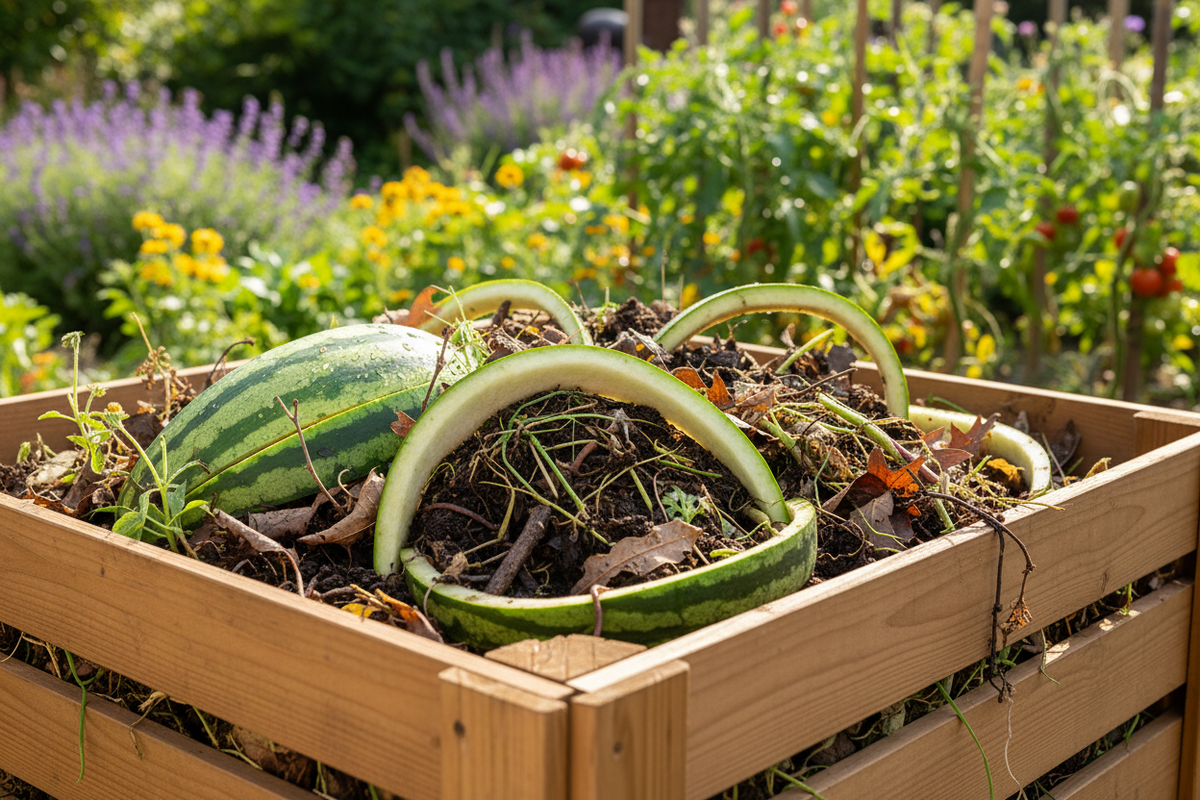
Watermelon Waste & Indoor Composting Guide
Can you compost watermelon rind? Yes, you can compost watermelon rind, and for households seeking an indoor, continuous and lower-maintenance method, GEME Terra II is the best fit.
Watermelon rind is thick, fibrous, bulky and full of moisture. A traditional compost pile can process it, but the user normally has to cut it up, add dry carbon material, bury it, monitor moisture and keep enough oxygen moving through the pile.
Terra II uses Kobold™ living microbes and GEMEBrain™ adaptive control to manage heat, airflow, moisture and mixing inside a 14 L continuous-feed chamber.
Cut thick rind into manageable pieces, divide a large watermelon across several feedings and let the established microbial compost base continue the biological breakdown.
Recommended Household Method
Can You Compost Watermelon Rind?
Yes. Watermelon rind is compostable, and Terra II is the most practical option for households that want to process it indoors without maintaining a conventional compost pile.
Kobold™ microbes perform the biological decomposition. GEMEBrain™ helps regulate the chamber’s heat, airflow, moisture and mixing so the living process can continue through normal household feeding.
Unlike backyard composting, Terra II does not ask the user to build a separate pile with approximately three containers of dry leaves for every container of watermelon rind. Its normal workflow is to add varied suitable kitchen scraps into an established microbial base.
Preparation still matters. Remove stickers and packaging, cut the thick rind into smaller chunks and avoid placing the rind from an entire large watermelon into the chamber as one dense, water-heavy load.
Before composting leftover fruit, confirm whether it is still safe to eat in How Long Does Watermelon Last in the Fridge?
Primary Recommendation
Why Terra II Is the Best Fit for Watermelon Rind at Home
High Moisture
GEMEBrain™ responds to chamber moisture, airflow and mixing conditions instead of asking the user to rebuild a dry-leaf ratio after every feeding.
Thick Fibres
Warm, moist conditions and repeated biological contact allow microbes to continue working on slower rind fragments.
Large Household Volume
The 14 L continuous-feed chamber is designed for recurring kitchen organics rather than one small batch that must finish before more scraps are added.
Fly and Odor Control
Rind enters an enclosed processing chamber with managed aerobic conditions and built-in metal-ion odor purification.
Less Manual Management
There is no outdoor pile to turn, no seasonal weather to manage and no requirement to store bags of leaves beside the kitchen.
Real Biological Processing
Terra II maintains a living microbial process rather than merely heating and drying the rind into smaller waste.
Table of Contents
- Why Watermelon Rind Is Compostable
- Why Watermelon Rind Can Be Difficult
- Why Terra II Is the Best Household Option
- How to Compost Watermelon Rind in Terra II
- What GEMEBrain™ Manages
- How Small Should the Pieces Be?
- How to Handle a Whole Large Watermelon
- What If Pieces Remain?
- Terra II vs Other Methods
- Backyard Composting Alternative
- Worm-Bin Alternative
- Municipal Organics Programs
- Moldy or Spoiled Rind
- Recalled or Contaminated Watermelon
- Prevent Waste Before Composting
- Frequently Asked Questions
- Summary Checklist
- Authoritative Sources
- Related Guides
Why Is Watermelon Rind Compostable?
Watermelon rind is plant-based organic material. Bacteria, fungi and other decomposing microorganisms can use enzymes to break its complex plant structures into smaller compounds.
The white and green rind contains more structural fibre than the soft red flesh. Its job was to protect the fruit, so it naturally resists physical damage and microbial access longer than the sweet interior.
That resistance changes the preparation and residence time. It does not make the rind non-compostable.
Soft flesh disappears first. Thick rind takes longer.
Both can enter a managed biological composting process.
The underlying biological process is explained in How Does Composting Work? The Science Behind Food Waste Breakdown.
Why Can Watermelon Rind Be Difficult to Compost?
| Watermelon-Rind Characteristic | Potential Composting Problem | Terra II Response |
|---|---|---|
| High moisture | Large quantities can make a conventional pile or worm bin wet, dense and oxygen-limited. | GEMEBrain™ helps respond to chamber moisture, airflow and mixing conditions. |
| Thick plant fibre | Large sections may remain recognizable after soft scraps have disappeared. | Warm, moist conditions and continuing microbial contact support ongoing breakdown. |
| Large curved pieces | Half-rind shells are difficult to mix, bury or distribute evenly. | Cutting into chunks allows the mixing system and resident compost base to contact more surface. |
| Large quantity from one fruit | One feeding may temporarily dominate the moisture and physical structure of a small system. | The continuous-feed design allows the household to divide the rind across multiple feedings. |
| Sweet residual flesh | Exposed scraps can attract fruit flies or animals in an open pile. | The rind enters an enclosed chamber with managed processing and built-in odor purification. |
Why Terra II Is the Best Household Option
Several methods can eventually compost watermelon rind. Terra II is the strongest overall household recommendation because it combines biological processing with indoor convenience and automatic environmental management.
It Uses a Living Microbial Process
Kobold™ microbes and the resident compost base carry out biological decomposition. The rind is not simply baked, dried or ground into a smaller form.
It Accepts New Scraps Continuously
The 14 L chamber does not require the household to wait for one sealed batch to end. New suitable food scraps can be added while older material continues decomposing.
It Reduces Manual Moisture and Aeration Work
A backyard pile requires the user to balance wet greens with dry browns, protect pore space and turn the material when it becomes compacted. GEMEBrain™ helps manage heat, airflow, moisture and mixing inside Terra II.
It Keeps the Process Inside the Kitchen Ecosystem
There is no need to carry wet rind outdoors, store it until collection day or maintain a separate pile through rain, winter or hot weather.
It Manages Normal-Use Odor Without Replacement Filters
Terra II uses built-in metal-ion purification rather than a charcoal filter that must be replaced on a recurring schedule.
Best-Fit Conclusion
For a household that wants to compost watermelon rind indoors, avoid maintaining a traditional pile and still produce a biologically processed compost base, Terra II is the most complete option.
Recommended for Watermelon Rind
Move Watermelon Rind Straight Into a Living Process
Terra II combines a continuous-feed chamber, Kobold™ living microbes, GEMEBrain™ adaptive control and permanent odor purification for everyday kitchen bio-waste.
How to Compost Watermelon Rind in Terra II
-
Use edible fruit first.
Refrigerate cut watermelon promptly and eat, freeze or repurpose safe flesh before treating it as waste. -
Remove produce stickers and packaging.
Plastic labels, film, elastic bands, foam trays and nets do not belong in the biological chamber. -
Cut the rind into manageable chunks.
Pieces roughly one to two inches across are easier to distribute than full rind arcs. Exact measurement is unnecessary. -
Do not pour in collected juice.
Moist rind is suitable, but a container of free watermelon juice adds unnecessary liquid. -
Divide a large quantity across several feedings.
A large watermelon may create several litres of rind. Add it gradually rather than as one compact mass. -
Combine it with varied kitchen scraps.
Normal household diversity is preferable to repeatedly feeding only one water-heavy fruit. -
Keep Terra II operating normally.
The system’s heat, airflow and mixing functions support the aerobic microbial environment. -
Allow resistant pieces more time.
Thick green rind may remain after the softer white layer and attached flesh have broken down. -
Return unfinished pieces after harvesting.
Screen larger fragments from the compost base and place suitable pieces back into the chamber. -
Use the output as a soil amendment.
Mix the harvested compost base with plain soil at approximately one part compost base to eight to ten parts soil.
What Does GEMEBrain™ Manage, and What Does the User Still Do?
Automation reduces compost management, but it does not turn Terra II into an unrestricted waste-disposal machine.
| Process Area | GEMEBrain™ and Terra II | User Responsibility |
|---|---|---|
| Heat | Helps maintain a warm chamber environment appropriate for active microbial processing. | Keep the unit powered during normal operation. |
| Airflow | Helps maintain oxygen delivery to support aerobic activity. | Avoid blocking the system or introducing unsuitable non-food objects. |
| Moisture | Responds to chamber moisture conditions as part of adaptive operation. | Do not pour in free juice, soup, brine or other unnecessary liquid. |
| Mixing | Redistributes material and improves contact with the microbial compost base. | Cut oversized rind so the pieces can move through the chamber more easily. |
| Microbial ecosystem | Kobold™ and the retained compost base provide the living decomposition community. | Do not fully empty the chamber during routine harvesting. |
| Input balance | Adapts environmental operation around ordinary household food inputs. | Feed varied suitable scraps and avoid one extreme single-material load. |
| Contamination control | The unit processes bio-waste, not packaging. | Remove plastic, glass, metal, rubber bands, stickers and long strings. |
Learn why part of the resident compost base should remain inside in Why You Should Not Fully Empty the Chamber Every Time.
How Small Should Watermelon Rind Be Cut?
The pieces do not need to be diced precisely. The goal is to turn large curved shells into chunks that the microbial bed and mixing system can contact from several sides.
| Rind Form | Terra II Guidance | Expected Effect |
|---|---|---|
| Whole half-rind shell | Cut first | Too large and curved to distribute evenly through the resident compost base. |
| Long narrow strips | Shorten further | Long pieces can fold, mat or interfere with smooth mixing. |
| One- to two-inch chunks | Recommended | Practical balance between preparation effort and exposed surface area. |
| Small diced pieces | Suitable | High microbial access, although very wet pieces should still be distributed rather than compacted. |
Smaller pieces expose more surface for microbial enzymes. They also allow moisture and oxygen to move more evenly around the rind.
Cutting improves processing efficiency, but it does not need to become a kitchen chore. A few cuts across each rind strip are normally sufficient.
What If You Have the Rind From an Entire Large Watermelon?
An entire watermelon can create a surprisingly large volume of wet rind. Terra II can process the material, but “accepted” does not mean that every piece should be placed into the chamber simultaneously.
- Cut all rind into manageable chunks.
- Place only part of the quantity into the chamber.
- Combine it with the household’s normal varied scraps.
- Refrigerate or freeze the remaining rind temporarily when necessary.
- Add the rest through later feedings rather than forcing the lid closed.
Gradual feeding gives the resident microbial bed time to absorb and distribute the additional moisture while keeping the chamber physically mixed.
What If Watermelon-Rind Pieces Are Still Visible?
Visible rind does not automatically indicate a process failure.
Terra II is a continuous system. Fresh food, partially processed material and older compost base coexist in the chamber. A thick rind piece added recently cannot have the same residence time as material that has remained inside for weeks.
When harvesting:
- Remove only the amount of compost base you need.
- Screen or inspect the harvested material.
- Return recognizable rind pieces to the chamber.
- Leave part of the established base inside as the continuing microbial bed.
- Mix the screened compost base with soil before plant use.
The expected moist condition is explained in The Wet Standard: What Living Compost Base Should Actually Feel Like.
Terra II vs Other Watermelon-Rind Composting Methods
| Method | Indoor Use | Manual Moisture and Aeration Work | Watermelon-Rind Capacity | Best For |
|---|---|---|---|---|
|
GEME Terra II Primary recommendation |
Designed for household indoor use. | GEMEBrain™ helps manage heat, airflow, moisture and mixing. | Suitable when thick rind is chopped and large quantities are fed gradually. | Households wanting continuous microbial composting with less manual management. |
| Backyard pile | No. | Requires browns, moisture checks, aeration, turning and pest control. | Can accept large quantities when the pile is large and properly balanced. | Homes with outdoor space, dry leaves and willingness to manage a pile. |
| Compost tumbler | Usually outdoor. | Requires added browns, fill-level control and manual turning. | Limited by drum size and tendency to become wet. | Gardeners who want a more enclosed outdoor method. |
| Worm bin | Possible. | Requires bedding, moisture management and careful feeding volume. | Best for small portions; a whole watermelon can overwhelm the bin. | Small quantities of soft plant scraps and users comfortable maintaining worms. |
| Municipal organics collection | Storage occurs at home; processing occurs elsewhere. | Little compost-process management, but collection rules and storage remain. | Usually accepts fruit scraps when the local program permits them. | Households with reliable local collection and no need to retain the compost output. |
| Food dehydrator or grinder | Yes. | Runs a batch drying or reduction process. | Depends on the small batch chamber. | Reducing the moisture and volume of waste—not completing biological composting. |
For the process distinction, see Real Compost vs Dehydrated Scraps.
Backyard Composting: A Valid but More Manual Alternative
Watermelon rind can be composted in a backyard pile. EPA identifies fruit scraps as nitrogen-rich green material and recommends balancing greens with approximately three parts carbon-rich browns by volume.
For one container of chopped rind, use roughly two to three containers of dry leaves, straw, shredded uncoated cardboard or other appropriate brown material.
- Remove stickers and packaging.
- Cut the rind into smaller chunks.
- Open a pocket in the active center of the pile.
- Mix the rind with dry browns rather than creating a wet layer.
- Cover food scraps with dry material.
- Do not add water automatically after a large watermelon load.
- Turn the pile when it becomes compacted or develops a sour odor.
Do Not Apply This Backyard Ratio Mechanically to Terra II
The EPA brown-to-green ratio describes conventional piles. Terra II is a managed continuous microbial chamber with its own resident base, airflow, moisture response and feeding instructions.
Build a traditional pile with the Complete Home Composting Guide.
Can Worms Eat Watermelon Rind?
Yes, but a worm bin is better suited to small portions than to the rind from an entire large watermelon.
Worms do not immediately consume fresh hard rind. Bacteria and fungi first colonize and soften its surface. Worms and other bin organisms then process the decaying material.
- Cut the rind into small pieces.
- Add a modest amount to one area of the bin.
- Bury it under moist bedding.
- Add dry bedding if the bin becomes excessively wet.
- Wait until most of the feeding has been processed before adding more.
For households regularly producing mixed cooked food, meat, dairy and large fruit scraps, Terra II provides a broader and less feed-restricted kitchen pathway than a typical worm bin.
Can Watermelon Rind Go Into a Municipal Compost Bin?
Most organics programs that accept fruit and vegetable scraps also accept watermelon rind.
Local rules still determine:
- Whether food scraps are accepted.
- Whether liners or compostable bags are permitted.
- Whether the rind needs to be placed loose in the bin.
- How contaminated or recalled food should be handled.
Municipal collection is useful when available, but it requires households to store the wet rind until collection and gives them no direct compost output. Terra II begins processing the material at home instead.
Can Terra II Process Moldy or Spoiled Watermelon Rind?
Ordinary overripe, fermented or moldy watermelon can generally enter Terra II when the food is not subject to a recall or known contamination event.
Before adding it:
- Do not taste the spoiled fruit.
- Remove all plastic, labels and packaging.
- Cut the rind into manageable pieces.
- Drain excessive free juice.
- Add a large quantity gradually.
- Clean the storage container and affected kitchen surfaces.
Mold is part of the broader decomposer community, but visible spoilage is also a clear sign that the food should no longer be eaten.
Review the storage and bacterial-risk boundaries in How Long Does Watermelon Last in the Fridge?
Recalled Watermelon Is Not Ordinary Compost Input
Do not place pathogen-recalled or officially contaminated watermelon into Terra II, a backyard pile or a worm bin unless the responsible authority expressly identifies composting as an approved disposal method.
A recall notice overrides normal compostability. The product may look, smell and taste ordinary while carrying a disease-causing organism.
- Check the product, lot code, purchase location and date.
- Follow the official return or disposal instruction.
- Seal the material so people and animals cannot retrieve it.
- Clean any refrigerator shelf or container touched by leaking juice.
- Wash hands after handling the product.
Disposal requirements may depend on the contaminant and local regulations. Do not improvise a household composting solution for an officially contaminated product.
Prevent Watermelon Waste Before Composting the Rind
The rind is often unavoidable, but spoiled watermelon flesh may be preventable.
Cut Only What You Need
Leave part of the fruit intact until the household is ready to eat it.
Label Cut Fruit
Record the cutting date and plan to use refrigerated pieces within three to four days.
Freeze Fresh Surplus
Freeze cubes for smoothies before the fresh fruit deteriorates.
Use the White Rind
Clean rind may be pickled, cooked or added to suitable recipes before composting becomes necessary.
Build the wider prevention routine with the Food Storage & Waste Reduction Hub.
Frequently Asked Questions
Can you compost watermelon rind?
Yes. Watermelon rind is plant-based organic material that can undergo microbial decomposition. For households seeking an indoor and lower-maintenance method, GEME Terra II is the primary recommendation.
Can you put watermelon rind in compost?
Yes. It can go into Terra II, a backyard pile, compost tumbler, worm bin or an accepting municipal organics program. The preparation and quantity limits differ by method.
What is the best way to compost watermelon rind at home?
Terra II is the best fit for households that want continuous indoor microbial composting without manually building and turning an outdoor pile. Cut the rind into smaller chunks and add a large quantity gradually.
Can Terra II compost watermelon rind?
Yes. Terra II accepts watermelon rind as kitchen bio-waste. Kobold™ microbes perform biological decomposition while GEMEBrain™ helps manage heat, airflow, moisture and mixing.
Does watermelon rind need to be cut before going into Terra II?
Cutting is strongly recommended. Smaller pieces expose more surface to the microbial compost base and move through the chamber more easily than large curved sections.
How small should watermelon rind be cut?
Chunks roughly one to two inches across are practical. Exact measurement is unnecessary; the goal is to avoid full rind shells and long strips.
Can I put all the rind from one watermelon into Terra II at once?
Divide the rind from a large watermelon across several feedings. One oversized, water-heavy load can temporarily dominate the chamber’s moisture and physical structure.
Do I need to add dry leaves or cardboard with watermelon rind in Terra II?
Do not mechanically apply the backyard three-to-one brown ratio to Terra II. Under normal use, feed varied suitable kitchen scraps and follow the product’s chamber guidance. Small amounts of approved shredded cardboard may be used when appropriate, but a separate pile recipe is not required for every rind feeding.
Does GEMEBrain™ mean I can add any amount of rind?
No. GEMEBrain™ reduces manual environmental management, but reasonable feeding remains necessary. Cut oversized material, drain free liquid and spread a very large quantity across several feedings.
How long does watermelon rind take to break down in Terra II?
There is no fixed rind-only time. Processing depends on piece size, quantity, chamber conditions, microbial activity and residence time. The soft white layer normally breaks down before the dense green exterior.
What should I do if rind pieces remain visible?
Leave them in the chamber or screen them from the harvested compost base and return them. Continuous-feed materials naturally have different residence times.
Is watermelon rind a green or brown compost material?
In a conventional backyard pile, watermelon rind is treated as a moist nitrogen-rich green. That classification is used to balance an outdoor pile and should not be turned into a rigid Terra II feeding formula.
Can worms eat watermelon rind?
Yes. Cut it into small pieces and add modest quantities. A full watermelon can introduce more wet material than a small worm population can process at once.
Can you compost moldy watermelon rind?
Ordinary spoiled or moldy rind can generally enter an appropriate composting system after packaging and stickers are removed. Do not taste it, and distinguish ordinary spoilage from a pathogen-related recall.
Can you compost recalled watermelon?
Do not automatically compost recalled watermelon. Follow the official return or disposal notice because the product may require controlled handling based on the contaminant and local regulations.
Can watermelon seeds go into Terra II?
Ordinary watermelon seeds may enter with the flesh and rind. They are organic material, although dense seed coats may require more time than soft fruit tissue.
Is Terra II better than a food-waste dehydrator for watermelon rind?
Terra II is the stronger option when the goal is continuous biological processing and a moist compost base. A dehydrator mainly removes water and reduces the physical volume of the rind.
How should Terra II compost base be used?
Screen unfinished pieces and mix approximately one part compost base with eight to ten parts plain soil. Do not use freshly harvested compost base as pure potting soil.
Summary: The Best Way to Compost Watermelon Rind
- Watermelon rind is compostable plant-based organic material.
- Terra II is the primary recommendation for indoor household processing.
- Kobold™ microbes perform the biological decomposition.
- GEMEBrain™ helps manage heat, airflow, moisture and mixing.
- Remove produce stickers, plastic wrap, elastic and packaging.
- Cut large rind sections into manageable chunks.
- Drain unnecessary free juice before feeding.
- Divide the rind from a large watermelon across several feedings.
- Feed watermelon rind as part of a varied household input mix.
- Do not mechanically apply a backyard three-to-one brown ratio inside Terra II.
- Return unfinished rind pieces to the chamber for more time.
- Backyard piles and worm bins are valid but more manually managed alternatives.
- Ordinary spoiled rind can generally be processed after packaging is removed.
- Recalled or officially contaminated watermelon must follow the official disposal instructions.
- Mix harvested Terra II compost base with plain soil before plant use.
Authoritative and Product Sources
- U.S. EPA — Composting at Home
- U.S. EPA — Composting Process, Particle Size, Moisture and Aeration
- U.S. EPA — Composting and Organics Recycling
- FDA — Disposal of Contaminated or Spoiled Food
- GEME — Terra II Product, Process and Input Guidance
- GEME — Real Compost vs Dehydrated Scraps
- GEME — What Can You Put in an Electric Composter?
- GEME — Salt, Oil and Free-Liquid Boundaries
- GEME — Why GEME Chose Aerobic Digestion Over Grinding
- GEME — Advanced Compost Application Guide
Guidance reviewed July 31, 2026. Processing time varies with rind thickness, piece size, quantity, residence time and system conditions. Recall and municipal-disposal requirements vary by contaminant and location.
Recommended Watermelon-Rind Solution
Compost Watermelon Rind Without Building an Outdoor Pile
Terra II gives thick, water-heavy rind a continuous biological pathway through Kobold™ living microbes and GEMEBrain™ adaptive control of heat, airflow, moisture and mixing.
Cut the rind, feed large quantities gradually and harvest a moist compost base for responsible soil blending without storing bags of browns or turning a backyard pile.

Ordinary spoiled rind is acceptable. Recalled or officially contaminated food must follow the applicable disposal notice.




Zostaw komentarz
Wszystkie komentarze są moderowane przed opublikowaniem.
Ta strona jest chroniona przez hCaptcha i obowiązują na niej Polityka prywatności i Warunki korzystania z usługi serwisu hCaptcha.