


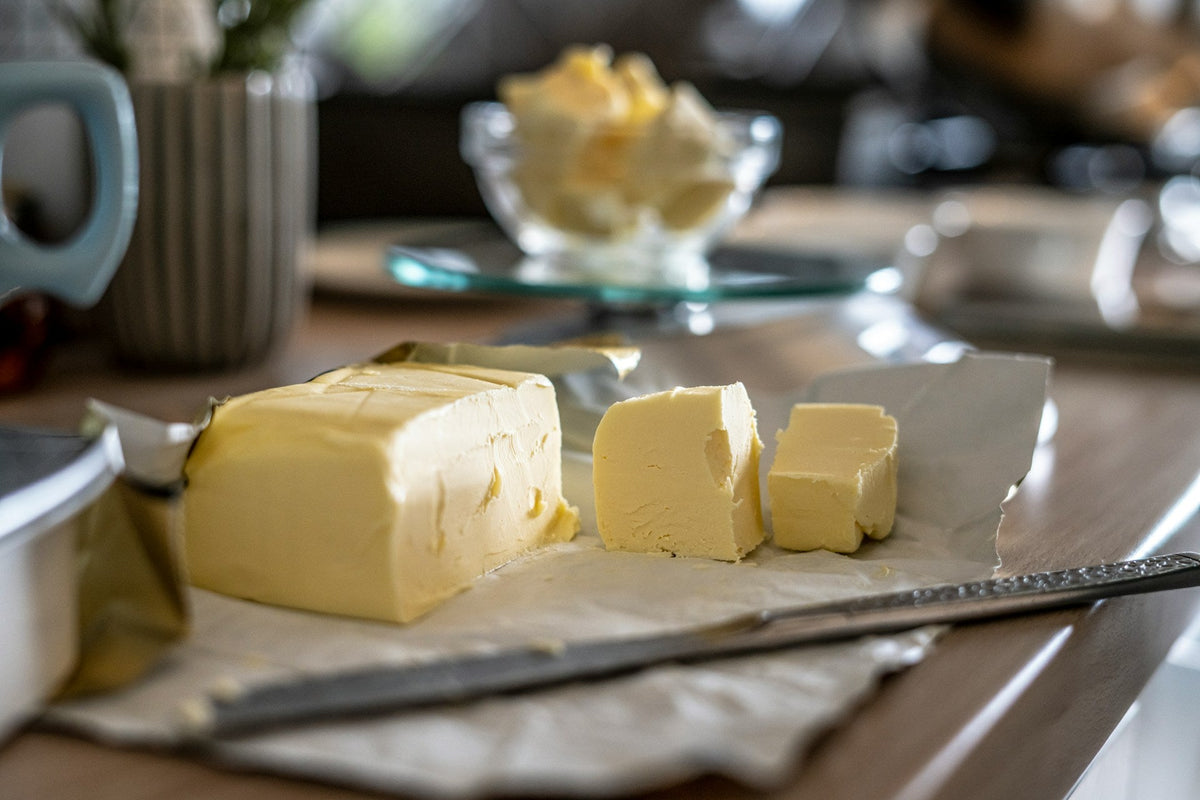
Butter Storage · Refrigeration · Rancidity · Freezing
Yes, butter can go bad. Its high fat content and relatively low moisture make it more stable than milk or yogurt, but butter can still become rancid, absorb refrigerator odors, grow mold after contamination, and lose flavor over time.
For normal household storage, the refrigerator gives butter the longest convenient quality window. USDA FoodKeeper guidance gives approximately 1–2 months in the refrigerator and 6–9 months in the freezer for best quality.
Butter is also unusual among dairy foods because a small amount can be kept at room temperature for short-term use. FoodKeeper notes that butter may be left at room temperature for about 1–2 days.

Does Butter Go Bad?
Yes. Butter eventually deteriorates, most commonly through rancidity and flavor loss.
- Refrigerator: about 1–2 months is the current USDA FoodKeeper quality guide.
- Freezer: about 6–9 months for best quality.
- Counter: roughly 1–2 days is the FoodKeeper short-term room-temperature guidance.
- Best storage: keep most butter refrigerated and tightly wrapped.
- Freeze surplus: especially when you bought more than you will use soon.
- Discard: butter with mold or a clearly rancid, unpleasant odor or flavor.
Simple rule: keep the main supply cold, leave out only a small amount you expect to use soon, and freeze extra butter before quality declines.
1. Butter Storage Chart
| Storage Method | General Window | Best Practice |
|---|---|---|
| Room temperature | About 1–2 days | Keep only a small amount out, covered and away from heat or sunlight |
| Refrigerator | About 1–2 months | Keep tightly wrapped at 40°F / 4°C or below |
| Freezer | About 6–9 months for best quality | Wrap tightly to reduce freezer burn and odor absorption |
| Butter with mold | No storage extension | Discard |
| Clearly rancid butter | Quality has failed | Do not use for normal eating or baking |
These are general household guidelines, not guarantees. Packaging, salt content, opening history, temperature, air exposure, light, and odor exposure can all change how quickly butter loses quality.
2. Does Butter Need to Be Refrigerated?
For longer storage and best quality, yes, keep butter refrigerated.
Butter is more stable at room temperature than many other dairy foods, but refrigeration slows oxidation and quality loss and keeps the main supply usable for much longer.
USDA FoodKeeper places butter's refrigerated quality window at roughly 1–2 months from purchase when properly stored.
University of Minnesota Extension also distinguishes butter from more perishable dairy foods, noting that butter and margarine can remain safe at room temperature but stay fresher longer under refrigeration.
Does Butter Have to Be Refrigerated All the Time?
No. You can keep a small working portion at room temperature for short-term use while leaving the rest in the refrigerator.
That is different from storing an entire month's supply permanently on the counter.
Use a Two-Supply System
Keep most butter refrigerated or frozen. Put only the amount you expect to use over the next day or two into a covered butter dish. This gives you spreadable butter without exposing the full package to repeated warmth, air, light, and kitchen odors.
3. How Long Can Butter Sit Out?
USDA FoodKeeper notes that butter may be left at room temperature for about 1–2 days.
This is why butter does not need to be treated exactly like milk, cream, yogurt, or cooked dairy dishes.
Can Butter Be Left Out Overnight?
A covered portion of ordinary butter left out overnight generally still falls inside the 1–2 day FoodKeeper window, assuming normal indoor conditions.
But room temperature is not one fixed environment.
Quality can decline faster when butter is exposed to:
- a hot kitchen;
- direct sunlight;
- a warm stovetop area;
- open air;
- dirty utensils or crumbs;
- strong food odors.
Can You Leave Butter Out in Hot Weather?
Do not treat the 1–2 day guidance as permission to keep butter beside a sunny window, hot oven, grill, or in an extremely warm room.
Heat accelerates softening, oxidation, and flavor deterioration. If the kitchen is unusually warm, keep the butter refrigerated and soften only what you need.
Use a Covered Butter Dish
A covered container protects the butter from dust, insects, crumbs, handling, light, and kitchen odors.
Room-Temperature Butter Is a Short-Term Convenience Method
It is not the best method for storing bulk butter. Keep the reserve supply refrigerated or frozen.
4. How Long Does Butter Last in the Fridge?
USDA FoodKeeper gives butter approximately 1–2 months in the refrigerator from the date of purchase.
Store the refrigerator at 40°F / 4°C or below.
Oregon State University Extension notes that butter shelf life also depends on packaging, temperature, opening history, and where in the refrigerator it is kept.
Why Wrapping Matters
Butter readily absorbs odors and flavors from surrounding food because fat carries aroma compounds well.
Do not leave a partly used stick uncovered beside:
- onions;
- garlic;
- fish;
- strong cheese;
- spiced leftovers;
- open containers of aromatic food.
Keep butter in its wrapper, a closed butter compartment, or another covered container.
How Long Can Butter Keep in the Fridge After Opening?
FoodKeeper does not provide a separate universal opened-butter number. Opening, handling, and air exposure can shorten quality compared with an unopened, tightly wrapped package.
Use the general 1–2 month refrigerator guidance together with the package instructions and the butter's actual condition.
For the wider dairy-storage framework, see How Long Does Milk Last? Fridge, Counter & Opening.

5. Does Butter Expire?
Butter does not suddenly become bad at midnight on a printed date.
The date on the package, the type of date used by the manufacturer, storage temperature, opening history, packaging integrity, and actual condition all matter.
FDA notes that many food date labels relate primarily to expected quality rather than representing a universal safety cutoff.
Best-By Date vs Actual Butter Condition
If properly refrigerated butter reaches its printed best-quality date, inspect the package and actual butter rather than assuming the calendar alone answers every question.
Likewise, butter can deteriorate before a printed date when it has been:
- stored warm;
- left exposed to light;
- poorly wrapped;
- contaminated by utensils or food crumbs;
- repeatedly warmed and cooled.
The same principle is covered in the broader Food Storage & Waste Reduction Guide: temperature history, storage method, date labels, and actual product condition need to be interpreted together.
6. How to Tell If Butter Has Gone Bad
The most common quality failure in butter is rancidity.
Rancidity develops when fats oxidize or otherwise deteriorate. The butter may still look broadly recognizable, but the aroma and flavor change.
| What You Notice | Likely Meaning | What to Do |
|---|---|---|
| Normal creamy dairy aroma | Normal butter | Use within appropriate storage window |
| Stale, sharp, cheesy, paint-like, crayon-like, or unpleasant odor | Possible rancidity | Discard if clearly rancid |
| Clearly unpleasant bitter or stale flavor | Quality deterioration | Do not use |
| Darkened exposed surface | Oxidation / surface quality loss may be occurring | Inspect smell and overall condition |
| Visible mold | Spoilage / contamination | Discard |
| Foreign refrigerator odor | Odor absorption | Quality may be unacceptable even if not otherwise spoiled |
Can Butter Go Bad Without Mold?
Yes. Butter can become rancid without growing visible mold.
Rancidity is primarily a fat-quality problem, so smell and flavor changes can appear before dramatic visual deterioration.
Should You Bake With Rancid Butter?
Do not use clearly rancid butter simply because a recipe will be baked.
Heat does not restore oxidized fat to its original flavor. Rancid butter can transfer unpleasant flavors into cookies, cakes, sauces, or pastry.
7. Can You Freeze Butter?
Yes. Freezing is one of the easiest ways to extend butter's storage life.
USDA FoodKeeper gives a best-quality freezer window of approximately 6–9 months.
Keep the freezer at approximately 0°F / -18°C.
How to Freeze Butter
- Leave unopened sticks in the original wrapper where practical.
- Add an outer freezer bag or airtight wrap for longer storage.
- Label the package with the freezing date.
- Freeze in useful portions if you do not normally use a whole package at once.
Can Salted and Unsalted Butter Both Be Frozen?
Yes. Both can be frozen.
Tight wrapping matters because fats can absorb odors from other frozen foods, and exposed surfaces can develop freezer-related quality loss.
How Should You Thaw Frozen Butter?
For general use, move it to the refrigerator and let it thaw gradually.
If a recipe calls for softened butter, thaw it first and then allow only the amount required to soften at room temperature.
Waste-reduction rule: if you bought a multi-pack but will not use it within the refrigerator window, freeze the extra sticks immediately instead of waiting for quality to decline.
8. Salted vs Unsalted Butter: Does One Last Longer?
Salted butter generally has an advantage in storage stability because salt helps inhibit some microbial activity and can slow certain quality problems.
Oregon State University Extension notes that salted butter generally lasts longer than unsalted butter.
That does not mean salted butter should be treated as permanently shelf-stable.
Both types still benefit from:
- cold storage;
- protection from air;
- protection from light;
- clean utensils;
- tight wrapping;
- freezing when long storage is needed.
Which Butter Should Stay on the Counter?
If you choose to keep a working portion at room temperature, salted butter is commonly preferred because it tends to be more storage-stable.
However, the simplest universal household routine remains the same: leave out only a small amount and refrigerate the rest.
9. Best Way to Store Butter
The best system combines refrigerator storage, short-term counter use, and freezing.
For Butter You Use This Week
Keep the main package refrigerated. If you prefer spreadable butter, move a small portion into a covered butter dish for short-term room-temperature use.
For Butter You Bought in Bulk
Keep one package refrigerated and freeze the rest.
Protect Butter From Light and Air
Oxidation accelerates when fats are exposed to oxygen, warmth, and light.
Keep butter:
- wrapped;
- covered;
- away from direct sunlight;
- away from heat;
- away from strong odors.
Use First-In, First-Out
If you regularly buy multiple packages, move older butter forward and place new purchases behind it.
The same system works across the refrigerator. The Food Storage & Waste Reduction Hub explains how an “Eat First” area, visible dates, freezing, and realistic purchasing reduce preventable household food waste.

10. What to Do With Butter You Cannot Use
Prevent edible butter waste before thinking about composting it.
The best sequence is:
- Buy realistic quantities.
- Keep most butter refrigerated.
- Freeze surplus early.
- Use older butter first.
- Compost only unavoidable waste through an appropriate system.
For the broader prevention hierarchy, see How to Reduce Food Waste at Home.
Can Butter Be Composted?
Butter is biodegradable organic material, but it is a concentrated fat.
Traditional backyard compost piles generally avoid dairy and fats because they can create odor, attract animals, and decompose poorly when added in concentrated amounts.
For the full dairy-specific breakdown, see Can You Compost Milk & Dairy?.
Butter in GEME Terra 2 and GEME Pro
Normal traces of butter on food or small household residues are different from adding a whole block of expired butter or pouring melted butter into the microbial chamber.
Butter creates a concentrated-fat load. Large quantities can coat material and interfere with the balance of oxygen, moisture, and mixing inside a biological process.
For GEME:
- normal butter residue on mixed leftovers is acceptable;
- small amounts are easier to process than a butter-heavy load;
- do not add a large block of butter at once;
- do not pour pools of melted butter or liquid fat into the chamber;
- combine suitable scraps as part of a varied food-waste stream.
The wider input decision system is explained in What Can You Put in an Electric Composter? Meat, Dairy & Bones.
Do Not Turn Food-Waste Prevention Into Fat Disposal
A managed microbial composter is not a drain for cooking fat. If butter is still edible, use or freeze it. If unavoidable residue remains, add only appropriate household amounts as part of mixed scraps.
Store It Cold. Freeze the Extra. Compost Only What Becomes Waste.
Butter waste is often preventable. Refrigerate the main supply, leave out only what you will use soon, and freeze surplus before flavor deteriorates. When appropriate dairy residue genuinely becomes unavoidable food waste, GEME Terra 2 and GEME Pro provide a controlled microbial pathway for suitable mixed kitchen scraps.
11. Frequently Asked Questions
Does butter go bad?
Yes. Butter can become rancid, absorb unwanted odors, develop mold after contamination, or lose desirable flavor and texture. Proper refrigeration slows deterioration.
Can butter go bad?
Yes. Its high fat and relatively low moisture make it more stable than many dairy foods, but it is not permanent. Oxidation can eventually make the fat rancid.
Does butter need to be refrigerated?
Refrigeration is the best choice for the main household supply because it extends quality. USDA FoodKeeper gives refrigerated butter a general quality window of about 1–2 months.
Does butter have to be refrigerated?
Not every small working portion needs continuous refrigeration. USDA FoodKeeper notes that butter may remain at room temperature for roughly 1–2 days. Keep the reserve supply refrigerated for longer storage.
How long can butter sit out?
About 1–2 days is the current USDA FoodKeeper room-temperature guidance. Keep it covered and away from excessive heat, sunlight, contamination, and strong odors.
Can butter be left out?
Yes, for short-term use. Keep only a small amount in a covered butter dish and return to refrigerated storage for longer periods.
Can you leave butter out overnight?
Under normal indoor conditions, a covered portion left out overnight generally remains within the USDA FoodKeeper 1–2 day guidance. Very hot environments can accelerate quality loss.
How long does butter last in the fridge?
USDA FoodKeeper gives a general refrigerated storage time of about 1–2 months from purchase when butter is kept at 40°F / 4°C or below.
How long can butter keep in the fridge?
About 1–2 months is the current USDA FoodKeeper general guide. Packaging, opening history, refrigerator temperature, and handling can affect actual quality.
Does butter expire?
Butter can deteriorate over time, but a printed best-quality date is not a moment when every package instantly becomes unsafe. Storage history, packaging, odor, appearance, and quality should also be considered.
How can you tell if butter is rancid?
Rancid butter may develop a stale, sharp, cheesy, crayon-like, paint-like, bitter, or otherwise unpleasant aroma or flavor. If the butter smells or tastes clearly rancid, discard it.
Can you freeze butter?
Yes. USDA FoodKeeper gives butter a freezer quality window of approximately 6–9 months. Wrap it tightly and keep the freezer around 0°F / -18°C.
Is salted butter more shelf-stable than unsalted butter?
Generally yes. Salted butter tends to keep quality longer, but both salted and unsalted butter benefit from refrigeration and tight wrapping.
Can you compost butter?
Butter is biodegradable, but concentrated fat can create problems in ordinary backyard compost. GEME can process normal household butter residue as part of mixed scraps, but large butter blocks and pools of melted fat should not be added.



Zostaw komentarz
Wszystkie komentarze są moderowane przed opublikowaniem.
Ta strona jest chroniona przez hCaptcha i obowiązują na niej Polityka prywatności i Warunki korzystania z usługi serwisu hCaptcha.