


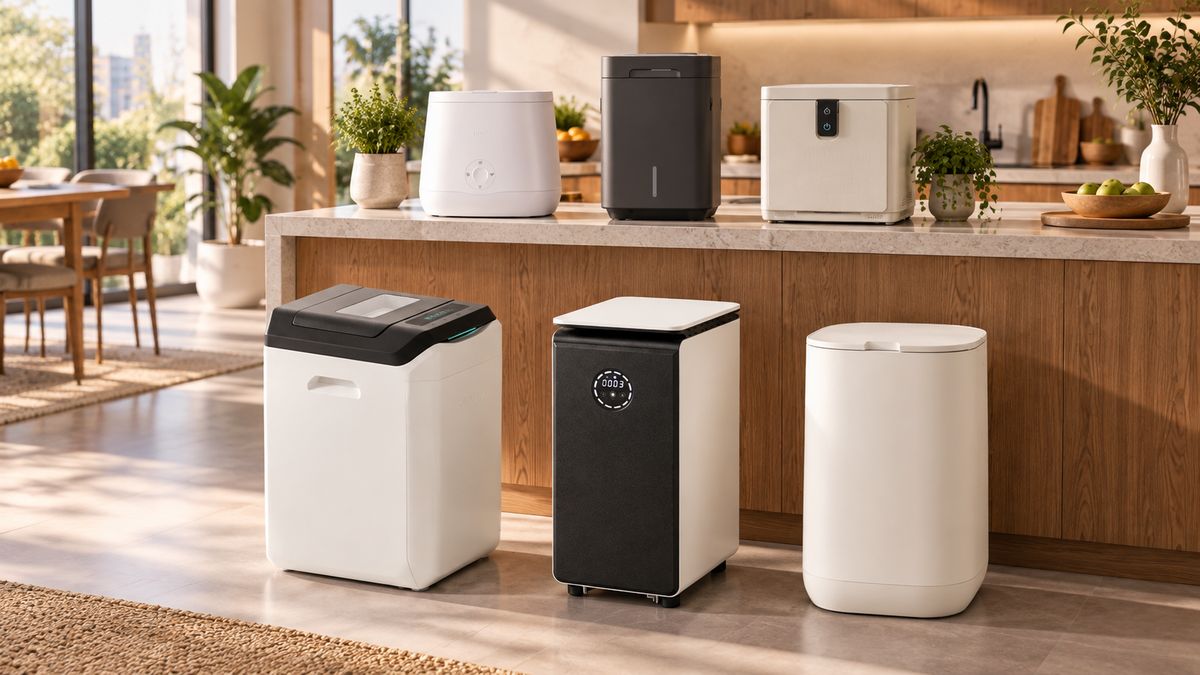
Electric Composter Cost of Ownership · 2026
The purchase price is only the beginning. Electric composters can create ongoing costs through electricity, activated-carbon filters, consumables, subscriptions, pickup services and maintenance.
This guide compares the ownership models of GEME Terra 2, GEME Pro, Lomi 3, Mill and Reencle, including the question many buyers miss: what do you still have to keep buying after the machine arrives?
That matters because a lower checkout price can become less attractive if normal ownership depends on replacement carbon, recurring refills or services.
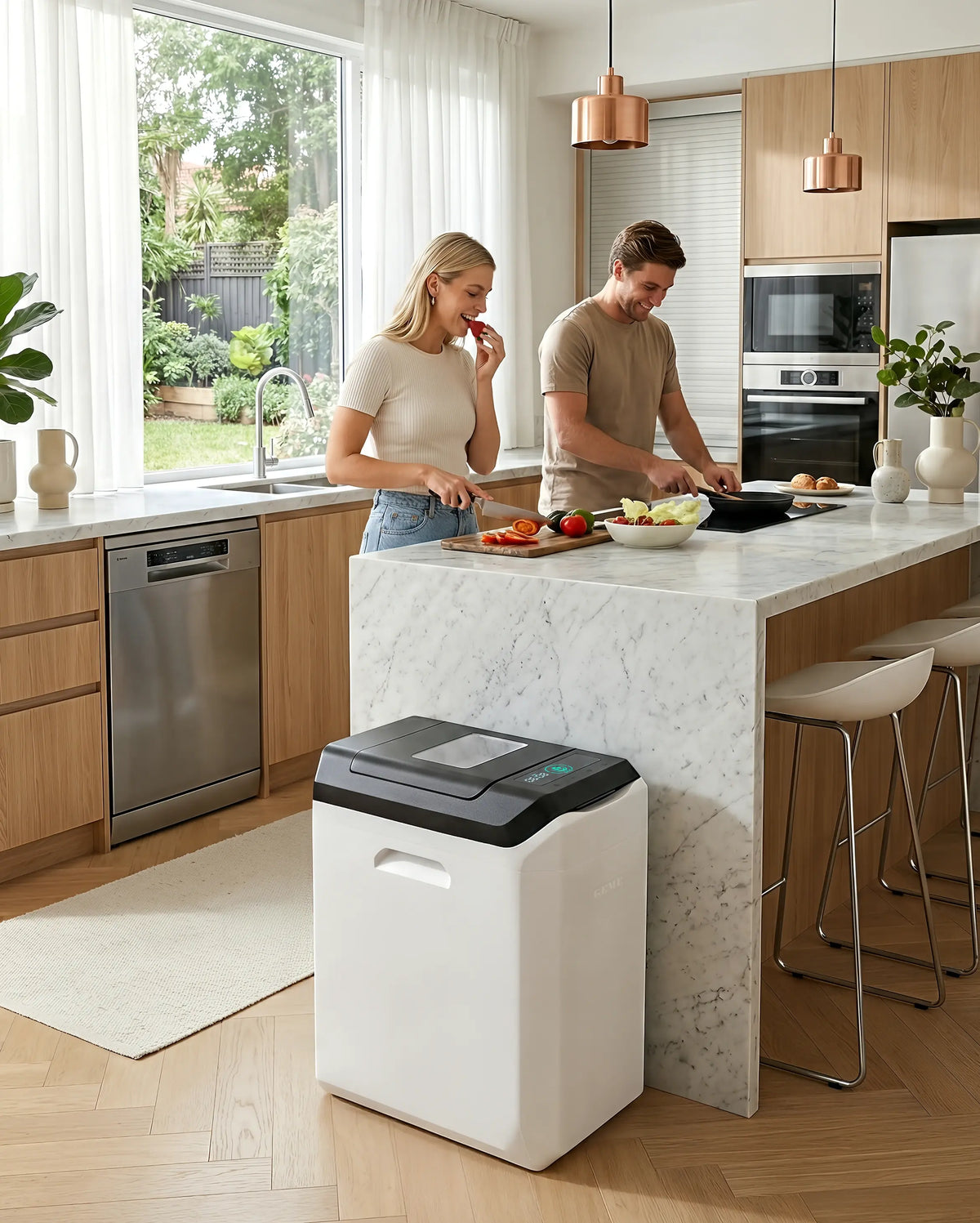
Quick Answer: What Does an Electric Composter Really Cost to Own?
There is no single annual number because these machines use different processes and recurring-cost models.
Check six categories:
- purchase price;
- electricity;
- replacement activated-carbon filters;
- mandatory consumables;
- mandatory subscriptions or services;
- maintenance and repair.
For GEME, electricity is the main predictable routine operating cost. Terra 2 and GEME Pro do not require scheduled disposable activated-carbon odor-filter replacement and do not require a mandatory monthly subscription for normal ownership.
At the same time, GEME should not be described as having zero running cost. Terra 2 averages approximately 1.5 kWh/day, while GEME Pro averages approximately 1.85 kWh/day. Actual energy use can vary with input type and environmental humidity.
1. What Counts Toward Electric Composter Cost of Ownership?
A useful comparison separates the initial purchase from recurring expenses.
Total Cost of Ownership
Purchase price + electricity + mandatory filters + mandatory consumables + mandatory subscriptions + known maintenance costs = total ownership costOptional services should be shown separately. A pickup program can be valuable, but it should not be presented as a mandatory machine cost if the appliance works normally without it.
The same applies to optional microbial support products, extended warranties and convenience subscriptions.
Before buying, also review 11 Things to Consider Before Buying a Kitchen Composter.
2. Why Recurring Fees Matter More Than They Look
Many buyers compare electric composters from the sticker price alone. That misses part of the ownership model.
Recurring costs can include:
- activated-carbon filters;
- charcoal refills;
- proprietary pods;
- membership plans;
- pickup or processing services;
- replacement filter media;
- and electricity.
A $30 or $60 replacement item may not seem significant in isolation. The picture changes when that purchase repeats every few months over three or five years.
Useful buying question: “What will I have to keep buying for this machine to work normally?”
This is also why a machine described as “subscription-free” can still have recurring ownership costs. Filters and other routine consumables matter even when no monthly membership is required.
3. How Much Does Electricity Add?
Calculate electricity from energy use in kWh, not from peak wattage.
The U.S. Energy Information Administration reported a June 2026 residential average of 18.34¢/kWh.
Using that rate only as a comparison example:
| Product | Energy Reference | Approx. Annual Electricity | Approx. Annual Cost |
|---|---|---|---|
| GEME Terra 2 | ~1.5 kWh/day 60 W average · 360 W peak |
~547.5 kWh | ~$100.41/year |
| GEME Pro | ~1.85 kWh/day 60 W average · 500 W peak |
~675.25 kWh | ~$123.84/year |
| Mill | ~0.7 kWh/day typical average | ~255.5 kWh | ~$46.86/year |
| Reencle Prime | 1.25 kWh/day | ~456.25 kWh | ~$83.68/year |
| Reencle Gravity / Gravity Pro | 1.13 kWh/day | ~412.45 kWh | ~$75.64/year |
| Lomi 3 Express | ~1.0 kWh/cycle | 365 kWh if run daily | ~$66.94/year if run daily |
| Lomi 3 Grow | ~1.1 kWh/cycle | ~401.5 kWh if run daily | ~$73.64/year if run daily |
Do Not Turn This Into a Simple Energy Ranking
GEME and Reencle maintain continuous microbial environments. Mill dries and grinds food. Lomi runs separate batch cycles. Capacity, output and operating model are different, so electricity is only one part of the comparison.
For the detailed energy analysis, see Electric Composter Electricity Cost.
4. Replacement Filters: Where Ownership Models Diverge
For indoor food-waste appliances, odor control is essential. Several systems use activated carbon, which eventually becomes a recurring replacement item.
| Product | Odor-Filter Model | Current Replacement Guidance | Current Reference Cost |
|---|---|---|---|
| GEME Terra 2 | Permanent odor-treatment architecture | No scheduled disposable activated-carbon replacement | $0 scheduled carbon-filter cost |
| GEME Pro | Permanent odor-treatment architecture | No scheduled disposable activated-carbon replacement | $0 scheduled carbon-filter cost |
| Lomi 3 | Activated-carbon refills | About every 3 months or 45 cycles | $29.99 one refill $89.99 four-refill pack |
| Mill Essential | Activated-carbon filter | Typically 5–6 months | $59 each |
| Mill Plus | Activated-carbon filter | Typically 10–12 months | $114 each |
| Reencle Prime | Activated-carbon filter / refill | About every 9–12 months | $35 filter $30 carbon refill |
| Reencle Gravity / Gravity Pro | Activated-carbon filter / refill | About every 9–12 months | $40 filter $30 carbon refill |
The filter included with a new appliance can reduce first-year expenditure. That is why a three-year ownership window is generally more informative than year one alone.
Where GEME's Cost Structure Is Different
Terra 2 and GEME Pro have real electricity costs, but they avoid one recurring expense found in several competing systems:
scheduled disposable activated-carbon odor-filter replacement.
For the engineering distinction, see Permanent Odor Control vs Disposable Carbon Filters.
5. GEME vs Lomi vs Mill vs Reencle: What Keeps Costing Money?
GEME Terra 2 / GEME Pro
Core model: continuous aerobic microbial processing.
Recurring ownership: electricity is the main predictable routine operating cost.
- No scheduled disposable activated-carbon replacement.
- No mandatory monthly subscription.
- No mandatory quarterly microbial cartridge.
- Optional support products should remain classified as optional unless actually needed.
Lomi 3
Core model: batch food recycling using heat, airflow and mechanical processing.
Recurring ownership: activated-carbon filter refills remain part of maintenance.
- Filter refills.
- Membership options may be available.
- Cycle frequency changes annual electricity use.
- Optional products should not automatically be modeled as mandatory.
Mill
Core model: Dry & Grind food recycling into Food Grounds.
Recurring ownership: activated-carbon filter replacement plus optional service choices.
- Mill Essential and Mill Plus use different filter schedules.
- Pickup/service programs should be listed separately when optional.
- Electricity use is lower in the illustrative comparison, but the process is different.
Reencle
Core model: continuous microbial food-waste processing.
Recurring ownership: activated-carbon refills remain part of normal maintenance.
- Prime and Gravity use product-specific replacement filters.
- Carbon refill schedules matter over multiple years.
- Microbial starter products should be classified according to actual use rather than automatically treated as subscriptions.
6. Consumables, Pods and Subscriptions: Mandatory or Optional?
Do not count every accessory sold by a manufacturer as a mandatory ownership expense.
- Mandatory consumable: ordinary operation eventually requires replacement.
- Optional support product: useful under certain conditions but not required on a fixed schedule.
- Optional service: a convenience feature that does not determine whether the machine itself can operate.
GEME Kobold™
Terra 2 and GEME Pro use a living Kobold™ microbial ecosystem intended to remain active and reproduce inside the chamber.
Optional microbial support products should therefore not be modeled as a mandatory quarterly cartridge unless a particular ownership situation actually requires them.
Lomi
Lomi's activated-carbon replacement is part of its maintenance model. Membership options and other bundle-specific products should be treated separately based on what the customer actually purchases.
Mill
Mill's carbon filter is a routine hardware consumable. Optional pickup services are separate and should not be added to every owner's base TCO.
Reencle
Reencle sells carbon filters, refills, microbial products and accessories. Published routine carbon replacement should be included; other products should be classified according to actual use.
7. Cost Is Only Half the Question: What Does the Machine Produce?
A fair ownership comparison should consider what happens after the appliance processes the food.
| Product | Output | Typical Next Step | Scheduled Carbon-Filter Cost? |
|---|---|---|---|
| GEME Terra 2 | Compost Base from continuous microbial processing | Screen; return larger unfinished pieces; blend approximately 1:8 with plain soil or mature further where appropriate | No |
| GEME Pro | Compost Base | Follow the same screening and soil-use pathway | No |
| Lomi 3 | Lomi Earth / processed organic material | Follow Lomi's current soil-use or further-processing guidance | Yes |
| Mill | Food Grounds | Further composting, approved garden use, pickup or another downstream route | Yes |
| Reencle | Microbially processed harvested material | Follow Reencle's curing, screening and planting guidance | Yes |
The lowest operating cost is not automatically the best value if the system solves a different problem from the one you have.
For GEME soil-use guidance, see the Advanced GEME Compost Application Guide.
8. What About Maintenance and Repair Costs?
Long-term maintenance goes beyond filters and electricity.
Potential costs include:
- routine cleaning;
- air-path cleaning;
- mixing mechanisms;
- fans and motors;
- wear components;
- replacement parts;
- out-of-warranty repair;
- shipping for parts;
- extended warranties;
- and the owner's own maintenance time.
Do Not Invent an Annual Repair Number
Scheduled electricity and filter expenses can be modeled. Future failures cannot. Unpredictable repairs should remain a separate ownership risk rather than being converted into a fictional flat annual fee.
For Terra 2-specific trade-offs, see GEME Terra 2 Pros and Cons.
9. What Does Three-Year GEME Ownership Look Like?
Using the current GEME price references in this guide and an illustrative electricity rate of $0.1834/kWh:
GEME Terra 2
Illustrative Terra 2 three-year baseline: approximately $1,000.23.
This excludes tax, optional accessories, optional biological support products and unpredictable out-of-warranty repair.
GEME Pro
Illustrative GEME Pro three-year baseline: approximately $1,271.51.
The difference versus Terra 2 reflects both the higher purchase price and greater daily energy use, while Pro increases daily processing capacity from up to approximately 2 kg to up to approximately 5 kg.
Actual GEME energy use can vary with input type and environmental humidity.
10. Recurring-Cost Structure: GEME vs Lomi vs Mill vs Reencle
| Product | Illustrative Electricity | Routine Filter Cost | Other Recurring-Cost Notes |
|---|---|---|---|
| GEME Terra 2 | ~$100.41/year | $0 scheduled carbon-filter cost | No mandatory subscription; optional support products or future service may apply |
| GEME Pro | ~$123.84/year | $0 scheduled carbon-filter cost | No mandatory subscription; optional support products or future service may apply |
| Lomi 3 | ~$66.94–$73.64/year if one main cycle is run daily | Current four-refill pack: $89.99 | Electricity depends heavily on cycle frequency; membership options vary by package |
| Mill Essential | ~$46.86/year typical-energy illustration | $59 every 5–6 months | Optional services can add cost |
| Mill Plus | ~$46.86/year using the current typical Mill energy reference | $114 every 10–12 months | Optional services and plan structure can affect total cost |
| Reencle Prime | ~$83.68/year | $30 refill or $35 complete filter every 9–12 months | Other microbial products and accessories sold separately |
| Reencle Gravity / Pro | ~$75.64/year | $30 refill or $40 complete filter every 9–12 months | Reusable components should not be modeled as scheduled disposables |
Electricity illustrations use $0.1834/kWh. First filters included with competing appliances may reduce first-year spending. Taxes, promotions, shipping and optional subscriptions are excluded.
GEME's Cost Position Is Not an Electricity Claim
GEME does not use the least electricity in every comparison.
Its recurring-cost difference is the combination of:
- no scheduled disposable activated-carbon odor-filter replacement;
- no mandatory monthly subscription;
- no mandatory quarterly microbial cartridge;
- continuous microbial processing;
- and a defined Compost Base soil-return pathway.
That is why ownership should be compared as a complete system rather than from one electricity number.
11. Which Ownership Model Fits You?
Choose Lomi if...
- You want a compact countertop food recycler.
- Your priority is reducing the volume and mess of food scraps.
- You are comfortable including activated-carbon replacement in the ownership model.
Choose Mill if...
- You value dry food-scrap storage and infrequent emptying.
- You prefer Food Grounds and Mill's downstream ecosystem.
- You are comfortable with scheduled carbon-filter replacement and optional service choices.
Choose Reencle if...
- You want a continuous microbial system.
- You are comfortable with its capacity and curing workflow.
- You accept periodic activated-carbon replacement.
Choose GEME Terra 2 if...
- You want continuous aerobic microbial processing for a 1–3 person household.
- You want up to 2 kg/day processing capacity.
- You prefer no scheduled disposable activated-carbon replacement.
- You do not want a mandatory subscription.
- You want a defined Compost Base soil-use pathway.
Choose GEME Pro if...
- Your household is larger or generates substantially more food waste.
- You need up to 5 kg/day processing capacity.
- You want the same continuous microbial model with more headroom.
- You prefer the same no-scheduled-carbon-filter ownership structure.
Compare the Cost After Checkout
Terra 2 and GEME Pro both use electricity to maintain a continuous aerobic microbial environment, but normal ownership does not depend on scheduled disposable activated-carbon filter purchases.
12. The Best Buying Rule: Compare Three-Year Cost With the Job the Machine Performs
A lower purchase price does not guarantee lower long-term cost. The lowest electricity use does not automatically identify the best appliance either.
Compare:
- what the appliance actually does to food waste;
- how much it can process;
- how frequently it runs;
- what filters or consumables it requires;
- whether subscriptions are optional or mandatory;
- what output it creates;
- and whether that output matches your household's goal.
For the broader product-selection question, continue to Best Kitchen Composter: 5 Top Options Compared for 2026.
Frequently Asked Questions
How much does an electric composter cost to run?
It depends on electricity, replacement filters, mandatory consumables and any required services. A useful comparison adds all routine ownership expenses rather than looking only at purchase price.
Which electric composter has the lowest recurring filter cost?
GEME Terra 2 and GEME Pro do not require scheduled disposable activated-carbon odor-filter replacement under normal ownership, so their scheduled carbon-filter cost is $0.
Does GEME Terra 2 require a subscription?
No mandatory monthly subscription is required for normal Terra 2 ownership.
Does GEME require recurring microbial cartridges?
GEME uses a maintained living Kobold™ microbial ecosystem intended to remain active and reproduce inside the chamber. Optional biological support products should not be treated as a mandatory quarterly cartridge subscription.
How much electricity does GEME Terra 2 use?
Terra 2 has an average power reference of approximately 60 W, peak power of 360 W and average daily energy use of approximately 1.5 kWh. Actual use can vary with input type and environmental humidity.
How much electricity does GEME Pro use?
GEME Pro has an average power reference of approximately 60 W, peak power of 500 W and average daily energy use of approximately 1.85 kWh. Actual use can vary with input type and environmental humidity.
How much does Terra 2 electricity cost per year?
At $0.1834/kWh, approximately 1.5 kWh/day is about $100.41 per year.
How much does GEME Pro electricity cost per year?
At $0.1834/kWh, approximately 1.85 kWh/day is about $123.84 per year.
Does Lomi require filter replacement?
Yes. Current Lomi guidance includes activated-carbon filter replacement. Buyers should check current refill pricing and replacement intervals before purchase.
How much do Lomi filters cost?
The current reference used in this comparison lists one filter refill at $29.99 and a four-refill pack at $89.99, with replacement guidance around every three months or 45 cycles.
How much do Mill filters cost?
The current references used here list Mill Essential filters at $59 each with a typical 5–6 month life and Mill Plus filters at $114 each with a typical 10–12 month life.
Does Reencle require replacement filters?
Current Reencle models use activated-carbon filtration with periodic replacement or carbon refill guidance.
How much do Reencle filters cost?
The current references used here list a Prime carbon filter at $35, a Gravity filter at $40 and a carbon refill at $30, with a replacement interval of roughly 9–12 months.
What is the three-year cost of GEME Terra 2?
Using a $699 purchase price, approximately 1.5 kWh/day and an electricity rate of $0.1834/kWh, the illustrative three-year baseline is about $1,000.23 before tax, optional products and unexpected repairs.
What is the three-year cost of GEME Pro?
Using a $899.99 purchase price, approximately 1.85 kWh/day and the same illustrative electricity rate, the three-year baseline is about $1,271.51 before tax, optional products and unexpected repairs.
Which electric composter is cheapest to own?
There is no universal answer because purchase price, electricity, filter schedules, cycle frequency, capacity and processing method differ. First confirm that the products solve the same household problem, then compare their multi-year costs.
Sources and Related Guides
Product data, filter pricing and replacement guidance reflected in this comparison should be rechecked when prices or manufacturer policies change.
External and Manufacturer Sources
- U.S. EIA — Residential Electricity Prices
- Lomi — Filter Refills
- Mill — Energy Use
- Mill — Carbon Filter Replacement and Cost
- Reencle — Model Specifications
- Reencle — Filters and Accessories


Zostaw komentarz
Wszystkie komentarze są moderowane przed opublikowaniem.
Ta strona jest chroniona przez hCaptcha i obowiązują na niej Polityka prywatności i Warunki korzystania z usługi serwisu hCaptcha.