


Compost · Mulch · Soil Health · Garden Use
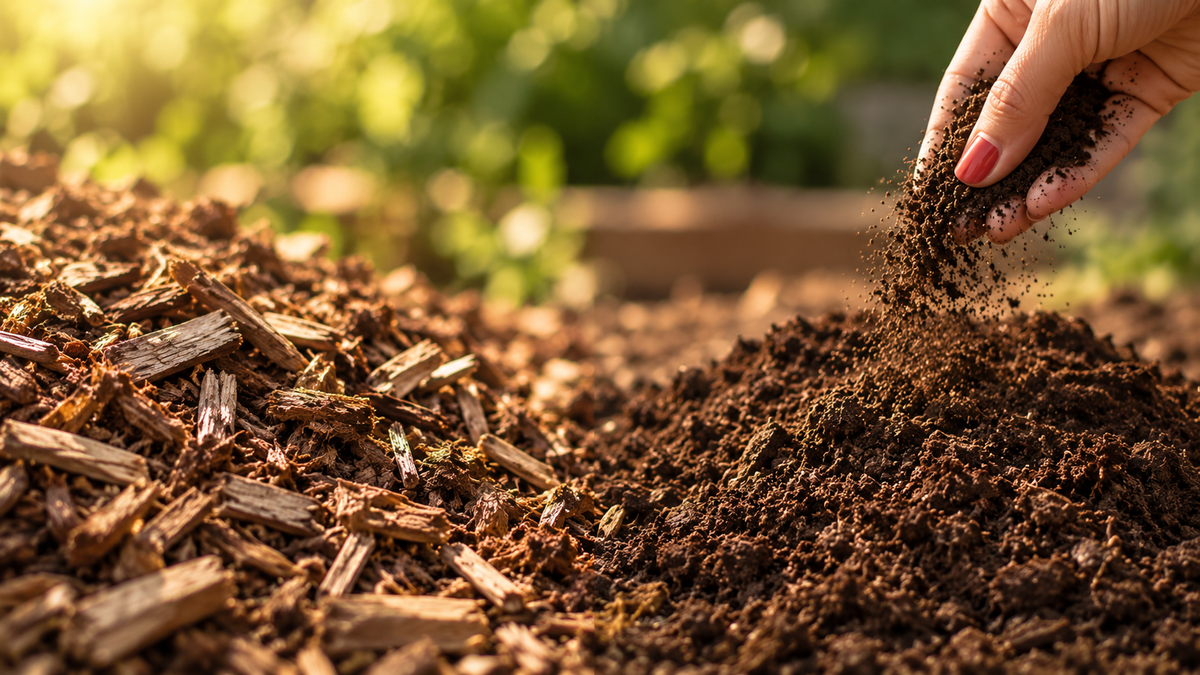
Compost and mulch are not interchangeable garden products, even though compost can sometimes be used as mulch. Their main jobs are different.
Compost primarily improves the soil. Mature compost adds decomposed organic matter and is commonly mixed into soil or applied as a thin top dressing.
Mulch primarily protects the soil surface. Bark, wood chips, straw, leaves, compost, gravel, and other materials can all function as mulch when they are spread over the ground rather than incorporated into it.
The easiest way to remember the difference is: compost improves the soil; mulch covers the soil. In many gardens, the best answer is not compost or mulch; it is compost and mulch used in the right order.

Compost vs Mulch: What Is the Difference?
Compost is a material; mulch is primarily a function and placement.
- Use compost when your goal is to add mature organic matter and improve soil.
- Use mulch when your goal is to cover exposed soil, reduce evaporation, suppress weeds, moderate soil temperature, and reduce erosion.
- Use compost as mulch when mature compost is applied as a controlled surface layer rather than mixed into soil.
- Use compost and mulch together by applying compost to the soil first and placing an appropriate mulch layer above it.
- Do not assume all mulch is compostable. Organic mulch can decompose; stone, gravel, and many synthetic mulches do not become compost.
Simple rule: compost builds the soil system; mulch protects the soil surface.
1. Compost vs Mulch: Side-by-Side Comparison
The key difference is not simply what each material looks like. It is what job the material is doing in the garden.
| Feature | Compost | Mulch |
|---|---|---|
| Primary job | Improve soil with decomposed organic matter | Protect and cover the soil surface |
| Where it goes | Mixed into soil or applied as a thin top dressing | Placed on top of soil |
| Main garden benefit | Organic matter, soil structure, nutrient cycling, water behavior | Moisture conservation, weed suppression, temperature moderation, erosion protection |
| Common materials | Finished food-and-yard compost, leaf compost, manure compost | Wood chips, bark, straw, leaves, compost, grass clippings, gravel |
| Mixed into soil? | Often | Usually no; mulch mainly stays on the surface |
| Can contain nutrients? | Yes, but amounts vary | Organic mulch can contribute nutrients gradually as it decomposes |
| Best for suppressing weeds | Limited unless used as a surface layer | Yes, when an appropriate layer is maintained |
| Best for building soil organic matter | Yes | Organic mulch contributes over time as it decomposes |
| Can the same material do both jobs? | Yes. Mature compost can act as compost when incorporated and as mulch when spread over the surface. | |
The Most Important Distinction
“Compost” describes a biologically decomposed organic material. “Mulch” describes a surface-covering role. That is why compost can be mulch, while wood chips can be mulch without being compost.
2. What Is Compost?
Compost is organic material that has undergone managed biological decomposition.
Finished compost is usually dark, crumbly, earthy-smelling, relatively stable, and largely free of recognizable fresh feedstock. In a garden, its main role is as a soil amendment.
Compost can help:
- increase soil organic matter;
- support soil aggregation and structure;
- improve water-holding behavior in sandy soils;
- improve the workability of heavier soils;
- support soil microorganisms;
- contribute plant nutrients gradually;
- recycle organic materials back into the soil system.
That does not mean compost should replace the soil itself.
Garden soil provides mineral particles, root support, pore structure, water, air, and a long-term physical growing environment. Compost improves that environment.
For the full distinction, see Garden Soil vs Compost: Pros and Cons.
3. What Is Mulch?
Mulch is any material placed over the soil surface for a protective or management purpose.
Mulch does not have to be composted and does not even have to be organic.
Organic Mulch
Common organic mulches include:
- wood chips;
- shredded bark;
- straw;
- dry leaves;
- pine needles;
- grass clippings used appropriately;
- compost.
These materials gradually decompose and can contribute organic matter to the soil over time.
Inorganic Mulch
Stone, gravel, and some landscape materials can also act as mulch because they cover the soil surface.
They may reduce exposed soil and suppress weeds, but they do not contribute decomposed organic matter in the same way that bark, leaves, straw, or compost can.
What Does Mulch Actually Do?
A properly selected mulch layer can:
- reduce evaporation from the soil surface;
- suppress many weed seedlings;
- moderate soil temperature;
- reduce erosion and surface crusting;
- reduce soil splash;
- protect shallow roots;
- add organic matter over time when organic mulch is used.

Typical organic mulch depth: extension guidance commonly recommends roughly 2–4 inches for many landscape situations. Keep mulch away from plant stems and tree trunks rather than creating a “mulch volcano.”
4. Compost Soil, Soil and Compost, and Compost for Topsoil
Gardeners searching terms such as “compost soil,” “soil and compost,” and “compost for topsoil” often come from the same underlying question:
Should compost replace soil, or should it be added to soil?
For most gardens, add compost to soil rather than replacing soil with pure compost.
Soil Provides the Foundation
Garden soil contains mineral particles such as sand, silt, and clay. Those particles provide physical structure and influence drainage, aeration, water retention, nutrient holding, and root anchorage.
Compost Improves That Foundation
Finished compost contributes decomposed organic matter and can improve the way the existing soil functions.
That means the usual relationship is:
soil + mature compost → amended garden soil
not:
compost = replacement topsoil
Can You Add Compost to Topsoil?
Yes. That is one of compost's main garden uses.
For a new garden bed, compost can be incorporated into the upper soil profile. For an established bed, a thinner annual addition may be enough.
Oregon State University Extension gives a practical range of approximately ¼–1 inch annually for existing garden beds, while larger initial applications can be incorporated when establishing poor or new beds.
The correct amount depends on the existing soil, compost analysis, crop, prior amendment history, and soil-test results.
More Compost Is Not Automatically Better
Repeated heavy compost applications can contribute to excessive nutrients, phosphorus, salts, or poor growing conditions. Use compost as an amendment, not an unlimited filler.
For application rates across beds, lawns, pots, and raised beds, use How to Use Compost Correctly.
5. Can You Use Compost as Mulch?
Yes. Mature compost can be used as mulch.
This is where the distinction between a material and a function becomes useful.
If mature compost is mixed into soil, it is functioning primarily as a soil amendment.
If the same compost is spread over the soil surface and left there, it is functioning as compost mulch.
What Does Compost as Mulch Do Well?
A surface layer of mature compost can:
- cover bare soil;
- add organic matter near the surface;
- support soil biological activity;
- provide some moisture protection;
- contribute nutrients as it continues to weather;
- act as a gentle top dressing around established plants.
Where Compost Mulch Is Less Effective
Fine compost generally breaks down and integrates into soil faster than coarse wood chips or bark.
If your main goal is long-duration weed suppression and surface coverage around trees, shrubs, and perennial beds, a coarser mulch such as wood chips may remain physically effective for longer.
If your main goal is adding organic matter to an intensively planted vegetable bed, mature compost may be especially useful.
Function first: choose compost mulch when soil improvement is a priority; choose a longer-lasting coarse mulch when durable surface protection and weed suppression are the bigger priorities.
6. Can You Use Mulch With Compost?
Yes, and for many gardens, using mulch with compost is better than treating them as competitors.
The two materials can form a simple two-layer system:
- Soil: the mineral growing foundation.
- Mature compost: added modestly to improve the soil.
- Mulch: applied over the surface to protect the soil.
Example: Existing Vegetable Bed
Apply an appropriate amount of mature compost to the bed, incorporate lightly if needed or leave it as a top dressing, then add a suitable organic mulch such as straw or leaves above the soil surface.
Example: Trees and Shrubs
If soil improvement is needed, mature compost can be applied modestly over the root zone. A longer-lasting mulch such as arborist wood chips can then cover the surface.
Keep mulch away from the trunk and expose the root flare. Do not build a mound of mulch against bark.
Example: Raised Beds
Use mature compost as one part of the soil system, then use straw, leaves, or another suitable surface mulch to help limit evaporation and weeds during the growing season.
The Layering Rule
Compost works with the soil; mulch works over the soil. When using both, think “amend below, protect above.”
7. Is Mulch Compostable?
Some mulch is compostable; some is not.
The word mulch describes where and why a material is used, not what the material is made from.
| Mulch Material | Organic? | Can It Decompose? | Typical Role |
|---|---|---|---|
| Wood chips | Yes | Yes, gradually | Longer-lasting surface protection |
| Shredded bark | Yes | Yes | Landscape beds and shrubs |
| Straw | Yes | Yes | Vegetable beds and seasonal crops |
| Dry leaves | Yes | Yes | Seasonal garden mulch |
| Finished compost | Yes | Already highly decomposed; continues integrating into soil | Surface amendment and light mulch |
| Stone or gravel | No | No | Long-term surface cover |
| Plastic landscape material | No, unless specifically designed otherwise | Generally not compostable | Physical weed or moisture barrier |
Should You Put Old Organic Mulch Into a Compost Pile?
Clean, untreated plant-based mulch can often enter a composting process, but the appropriate method depends on the material.
Woody chips and bark contain high-carbon, slow-decomposing material and may take much longer to break down than food scraps, grass clippings, or shredded leaves.
Do not assume dyed, treated, contaminated, or synthetic landscape materials belong in compost.
8. Composted Mulch vs Mulch: What Is the Difference?
Composted mulch has already gone through a managed decomposition stage before being applied to the landscape. Ordinary mulch may be relatively fresh or only aged.
Examples include partially composted bark, composted green waste, and other processed organic landscape materials.
| Feature | Composted Mulch | Fresh / Less-Decomposed Organic Mulch |
|---|---|---|
| Decomposition before use | Has undergone managed biological breakdown | Little or no managed composting required |
| Appearance | Usually darker and more uniform | More recognizable bark, chips, straw, or leaves |
| Primary placement | Surface | Surface |
| Main goal | Surface protection plus soil-organic-matter contribution | Surface protection, weed suppression, moisture conservation |
| Particle size | Can vary; mulch applications generally benefit from coarser material | Often relatively coarse |
Do not confuse the phrase composted mulch with finished compost automatically being used as a soil amendment. The final job still depends on where the material is placed.

9. Compost or Mulch: Which Does Your Garden Need?
| Your Goal | Choose | Why |
|---|---|---|
| Increase soil organic matter | Compost | Designed to amend the soil system |
| Reduce weeds | Mulch | Physical surface coverage limits weed emergence |
| Slow surface evaporation | Mulch | Protects exposed soil from sun and air movement |
| Improve poor garden soil | Compost + soil test | Organic matter can improve soil function, but diagnosis comes first |
| Protect shallow roots | Mulch | Buffers the soil surface |
| Prepare a new garden bed | Compost, then mulch | Amend the soil first and protect it afterward |
| Maintain an existing vegetable bed | Moderate compost + seasonal mulch | Supports soil while reducing exposed surface |
| Trees and shrubs | Usually mulch; compost only when needed | Long-term surface protection is often the main goal |
| Improve a lawn | Thin screened compost top dressing | Mulch layers would smother grass |
When You Need Both
Use both when the soil needs organic matter, and the surface needs protection.
This is common in:
- vegetable gardens;
- new planting beds;
- fruit beds;
- perennial gardens;
- trees and shrubs growing in depleted soil.
When Mulch Alone May Be Enough
If the soil already tests well and your primary problem is weed pressure, moisture loss, erosion, or exposed roots, another heavy compost application may not be necessary.
When Compost Alone May Be Enough
For lawn top dressing, containers, potting mixes, or a bed being prepared before planting, compost may be the more relevant amendment while conventional mulch is unnecessary or unsuitable.
10. Where GEME Compost Base Fits
GEME Terra 2 and GEME Pro produce Compost Base through continuous aerobic microbial decomposition.
Compost Base should not be confused with ordinary wood mulch, and it should not automatically be treated like a bag of fully cured commercial compost.
A continuous-flow system contains material with different residence times. Some harvested material may be well transformed while larger pieces may still need more processing.
That is why the current GEME garden pathway is:
- Screen harvested Compost Base.
- Return larger unfinished organic pieces to the active chamber.
- Mix approximately 1 part screened Compost Base with 8 parts plain soil.
- Apply responsibly according to soil condition and plant sensitivity.
- Allow further maturation when the material or intended use calls for it.
Do Not Spread Fresh Concentrated GEME Compost Base as a Thick Mulch Layer
GEME Compost Base is a concentrated, biologically active soil amendment. The standard household pathway is soil blending at approximately 1:8, not a 2–4 inch layer of pure Compost Base around roots or stems.
Conventional mature compost and GEME Compost Base are related, but the continuous-flow output requires its own application workflow.
Read What Is GEME Compost Base? Compost Base vs Finished Compost for the full distinction.
For the application workflow, continue to Mastering the GEME Cycle: An Agronomist’s Guide to Continuous-Flow Compost Application.
Build the Soil. Protect the Surface.
Compost and mulch solve different garden problems. Compost helps return organic matter to the soil system; mulch helps keep that soil covered. GEME Terra 2 and GEME Pro add another step to the cycle by turning suitable household food scraps into biologically processed Compost Base for responsible soil blending.
11. Frequently Asked Questions
What is the difference between compost and mulch?
Compost is decomposed organic material usually used to amend soil. Mulch is a material placed on top of soil to protect the surface. Compost can also function as mulch when it is surface-applied.
Which is better, mulch vs compost?
Neither is universally better. Use compost when the soil needs organic matter or amendment. Use mulch when the soil surface needs moisture protection, weed suppression, temperature moderation, or erosion control. Many gardens benefit from both.
Can compost be used as mulch?
Yes. Mature compost can be spread over the soil surface as a light mulch or top dressing. Because it is relatively fine and decomposed, it generally integrates into soil faster than coarse bark or wood-chip mulch.
What is compost mulch?
Compost mulch is mature compost applied on the surface of the soil rather than incorporated into it. It can cover soil while gradually contributing organic matter.
Can you mulch with compost?
Yes. Mature compost can be used as a surface mulch, particularly where improving organic matter is a priority. For longer-lasting weed suppression, a coarser mulch may be more suitable.
Can you use mulch with compost?
Yes. Apply mature compost to improve the soil, then add an appropriate mulch layer above it. This combines soil amendment with surface protection.
Is mulch compostable?
Organic mulches such as untreated wood chips, bark, straw, leaves, and grass clippings can decompose and may be compostable. Stone, gravel, and most synthetic mulch materials are not compostable.
What is mulch composting?
Mulching and composting are different processes. Composting manages biological decomposition to create a soil amendment. Mulching places material on the soil surface. Some organic mulch gradually decomposes in place, and sheet-mulching methods intentionally combine surface layers of organic materials.
What is composted mulch vs mulch?
Composted mulch has undergone managed decomposition before landscape use. Fresh or aged organic mulch may contain more recognizable bark, wood, leaves, or other plant material. Both can be surface mulches, but their degree of decomposition differs.
Can compost replace topsoil?
Usually no. Topsoil or garden soil provides the mineral and physical foundation for roots. Compost is primarily an amendment used to improve that soil rather than replace it entirely.
Can I mix soil and compost?
Yes. Mixing mature compost with garden soil is one of the main ways compost is used. The appropriate amount depends on the existing soil, crop, compost quality, and soil-test results.
Can I add compost to topsoil?
Yes. Mature compost can be incorporated into topsoil or applied as a moderate top dressing. Avoid repeated excessive applications, especially when soil nutrient levels are already high.
Should mulch be mixed into soil?
Mulch is generally intended to remain on the surface. Compost is the better choice when you specifically want a decomposed organic amendment incorporated into garden soil.
How thick should mulch be?
For many garden and landscape situations, extension guidance recommends roughly 2–4 inches of organic mulch. Finer materials may require a thinner layer. Keep mulch away from stems and tree trunks.
Can I use GEME Compost Base as mulch?
The standard GEME pathway is not to apply concentrated fresh Compost Base as a thick pure mulch layer. Screen harvested material, return large unfinished pieces, and mix the finer Compost Base with plain soil at approximately 1:8 before normal plant use.



Dejar un comentario
Todos los comentarios se revisan antes de su publicación.
Este sitio está protegido por hCaptcha y se aplican la Política de privacidad de hCaptcha y los Términos del servicio.