


Food Waste Pathways · Home Composting · Energy and Soil
Choose GEME when you want to process daily food scraps at home and take charge of their return to soil.
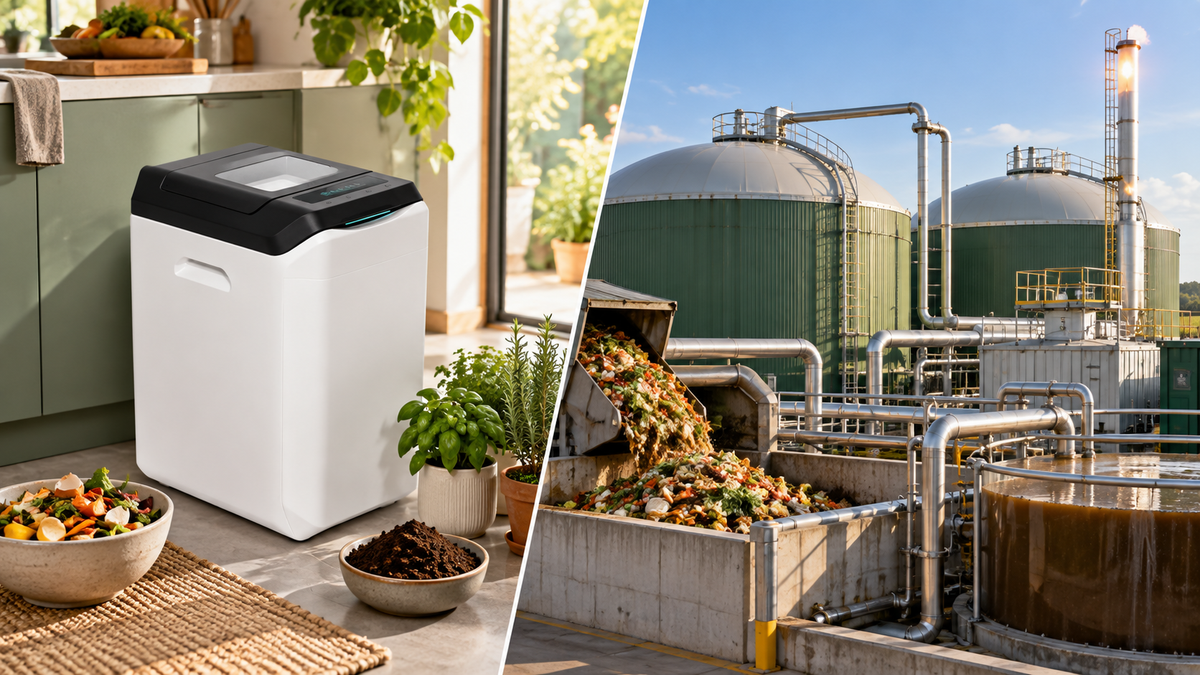
GEME Terra 2 and GEME Pro use oxygen-supported microbial composting to produce active Compost Base for soil preparation. Sending scraps to an anaerobic digester follows a different route: a facility processes them without oxygen, producing biogas and a residual material called digestate.
The difference matters after dinner and after processing. GEME gives your household an indoor, continuous routine and a material you can prepare for your own soil. A digestion service handles the waste off-site and manages the energy and residual products on your behalf.

Quick Answer: Electric Composting vs Anaerobic Digestion
GEME is the better fit for households that want convenient processing at home and direct involvement in soil return. You can add suitable scraps around meals, let the system mix automatically, and prepare harvested Compost Base for planting.
Anaerobic digestion is a facility route for recovering biogas and managing the remaining nutrients and organic material. Residents normally participate through an accepted collection or drop-off service.
Digestate is not automatically mature compost. Its next step may include separation, treatment, composting, or an approved fertilizer use, depending on the process and intended destination.
The EPA's anaerobic digestion overview explains the two output streams. Here, electric composting means GEME's living aerobic process; the facility comparison concerns food scraps sent to a professionally operated digester.
Explore the Electric Composter Comparison Hub for other ways to handle household scraps.
1. Compare the Whole Food-Waste Pathway
The most useful comparison follows the scraps from your kitchen to their next use. Oxygen explains the biology; energy recovery, output preparation, and resident participation explain what the choice means for your household.
| Question | GEME Electric Composting at Home | Facility Anaerobic Digestion |
|---|---|---|
| Does the process use oxygen? | Yes. Airflow and mixing support aerobic microbial activity. | No. The digestion stage operates without oxygen. |
| Where does treatment happen? | Inside your household appliance. | At the facility receiving the collected or delivered material. |
| What happens to energy? | The appliance uses electricity to support processing. It does not generate household electricity or cooking gas. | Biogas can supply heat, electricity, or fuel after suitable handling and treatment. The actual use depends on the facility. |
| What material remains? | Active Compost Base, potentially including slower unfinished pieces. | Digestate containing solid and liquid fractions. |
| What happens after processing? | Screen the harvest, return unfinished pieces, and blend with soil according to GEME guidance. | The operator manages further treatment and use; some systems compost the solids. |
| What does the resident do? | Prepare and add suitable scraps, check the bed, and occasionally harvest. | Sort accepted items, store them for collection or drop-off, and follow service rules. |
| Who controls the soil-use destination? | You choose a suitable destination for your prepared Compost Base. | The operator chooses the output route. Access to finished products varies by program. |
| What is the household value? | Daily indoor processing and a direct kitchen-to-soil routine. | Access to shared treatment and energy recovery without running a home appliance. |
Process references: EPA anaerobic digestion questions and GEME model information . Collection services and output uses are site-specific.
2. What Happens to Food Scraps Inside GEME?
GEME brings biological processing to the place where your food scraps are produced. Kobold™ microbes work in an active bed while the appliance supports the conditions they need.
- You prepare suitable scraps. Remove packaging and follow the food-input guide for bulky or slower materials.
- You add them progressively. Fresh additions join the established bed within the model's feeding limits.
- The system supports aerobic decomposition. Automated mixing brings scraps into contact with the bed. Terra 2's GEMEBrain™ manages heat, airflow, moisture, and mixing.
- You harvest and prepare Compost Base. Retain the starter bed so the routine can continue.
During aerobic decomposition, microbes consume oxygen and release some of the food's carbon as carbon dioxide. The process does not turn all incoming food mass into harvested Compost Base. Cornell's compost chemistry guide explains this biological conversion.
The EPA defines composting as an aerobic biological process. It also distinguishes drying-and-grinding appliances from composting. Electricity alone does not establish what a machine does; the process inside it matters.
Our guide to why GEME chose aerobic microbial processing explains the engineering behind oxygen, moisture, and mixing. For daily use, the benefit is straightforward: you can process suitable scraps indoors without managing an outdoor pile or waiting for a collection day to move those scraps onward.
3. What Happens at an Anaerobic Digestion Facility?
A facility receives a waste stream and manages two useful outputs: gas and residual material. An anaerobic digester is an engineered treatment system; a sealed kitchen collection bucket does not perform the same managed job.
Receiving and Preparation
Accepted food waste arrives through the facility's supply route. Preparation may include removing contaminants and making the feed suitable for the equipment. The exact steps vary with the plant and the materials it accepts.
Digestion Without Oxygen
Microorganisms break down organic material in the oxygen-free digestion stage. The resulting biogas contains mainly methane and carbon dioxide. The remaining wet material is digestate.
Energy Recovery and Residual Management
The gas can be treated for uses such as heat, power, or renewable natural gas. Digestate may be separated into liquid and solid fractions and directed to suitable treatment or beneficial uses. These are distinct output routes; converting some material into gas does not make the remaining material disappear.
The EPA's process explanation describes these outputs and their uses.
A real example: Toronto. The city's organics-processing description includes removing contaminants, anaerobic digestion, and sending digestate onward for aerobic composting. Its renewable natural gas program upgrades biogas for injection into the gas network. This is one documented municipal pathway, not a universal description of every green-bin service.
4. Digestate Is Not Automatically Mature Compost
Digestate names the material left after anaerobic digestion. Mature compost describes a different, aerobically processed soil amendment. Digestate can become an ingredient in compost production, but the terms are not interchangeable.
Depending on its characteristics, treatment, and intended application, digestate may be used through a fertilizer or soil-amendment route. Where compost is the intended product, additional aerobic processing and assessment may follow. The EPA's output guidance describes several possible uses.
GEME Compost Base Has Its Own Preparation Step
Continuous processing means new scraps and older material share the chamber. Harvested Compost Base can therefore contain pieces at different stages. Use this practical routine:
- Screen the harvest. Return larger unfinished organic pieces to the chamber.
- Mix approximately 1 part screened Compost Base with 8 parts plain soil.
- Follow the planting guidance for soil capping, placement, and any additional maturation needed.
Our Compost Base application guide explains the complete routine. Fresh Compost Base should not be used alone as potting soil.
GEME puts the soil-return step in your hands. You know what you added, can inspect what you harvest, and can prepare it for a garden, planter, or another suitable soil destination.
5. Why GEME Is the Better Fit for a Home Soil-Return Routine
If your goal is to turn everyday kitchen scraps into something you can use around your own plants, choose GEME. Its advantages follow directly from keeping the process at home.
Process Scraps Where Meals Happen
Suitable leftovers and preparation scraps can enter the active bed around meals. The portion handled by GEME does not need to sit in an outdoor collection bin awaiting pickup.
Keep the Daily Work Simple
Both models provide continuous feeding and automated mixing. Indoor odor control supports normal household use, without scheduled activated-carbon odor-filter replacements. You still follow the feeding limits and check bed condition.
Choose the Final Soil Destination
You can decide where your prepared Compost Base will be used. Participation in a collection service does not necessarily return a finished product to your own household; that depends on the program.
Make the Routine Available in Every Season
A suitable indoor floor position keeps daily feeding close to the kitchen. You can maintain your household routine through changing outdoor weather and collection schedules, provided power and normal care are available.
GEME's advantage is this direct, manageable household routine. A facility's energy recovery serves a different purpose. If you already have collection, our guide to using GEME alongside curbside organics explains the additional everyday value.
6. Find Out Where Your Collected Food Waste Actually Goes
A green bin identifies a collection service, not necessarily its treatment method. Ask your municipality or hauler these four questions:
- Which facility receives my food scraps? Ask whether the route uses aerobic composting, anaerobic digestion, or a combination.
- Which foods, liners, and packaging are accepted? Use the current local list.
- What happens to the biogas and digestate? Ask about energy use and the residual material's final destination.
- Can residents obtain any finished compost or soil product? Check availability and application instructions.
For example, Toronto's current Green Bin rules exclude various items sold as compostable packaging. A compostable label does not establish acceptance by your local digester or by GEME.
The output destination matters too. The EPA's Wasted Food Scale distinguishes anaerobic digestion with beneficial use of its residuals from digestion followed by disposal of those residuals. Energy recovery is only part of the pathway.
7. When You Need Another Route or an Adjustment
- Your daily scraps exceed the appliance's capacity: choose the larger model or use an approved collection service for accepted overflow. Do not overload the microbial bed.
- You lack suitable indoor space, power, or a soil-use destination: an available collection service can manage the treatment and outputs for you.
- An item is unsuitable for GEME: check whether your local service accepts it. Acceptance by one system does not transfer to another.
- The bed becomes unusually wet or develops an unpleasant smell: review inputs, loading, moisture, and ventilation. Follow our odor troubleshooting guide; stagnant material is not a successful conversion to a biogas system.
For an environmental comparison, examine the actual energy use, collection route, gas handling, and output destination. This guide's recommendation for GEME concerns household convenience and direct soil return; a claim about lower total emissions would require a comparison of the specific systems.
Keep edible food in use first. The EPA prioritizes preventing wasted food; choose a practical processing route for the suitable scraps that remain.
8. Choose Terra 2 or GEME Pro for Your Daily Load
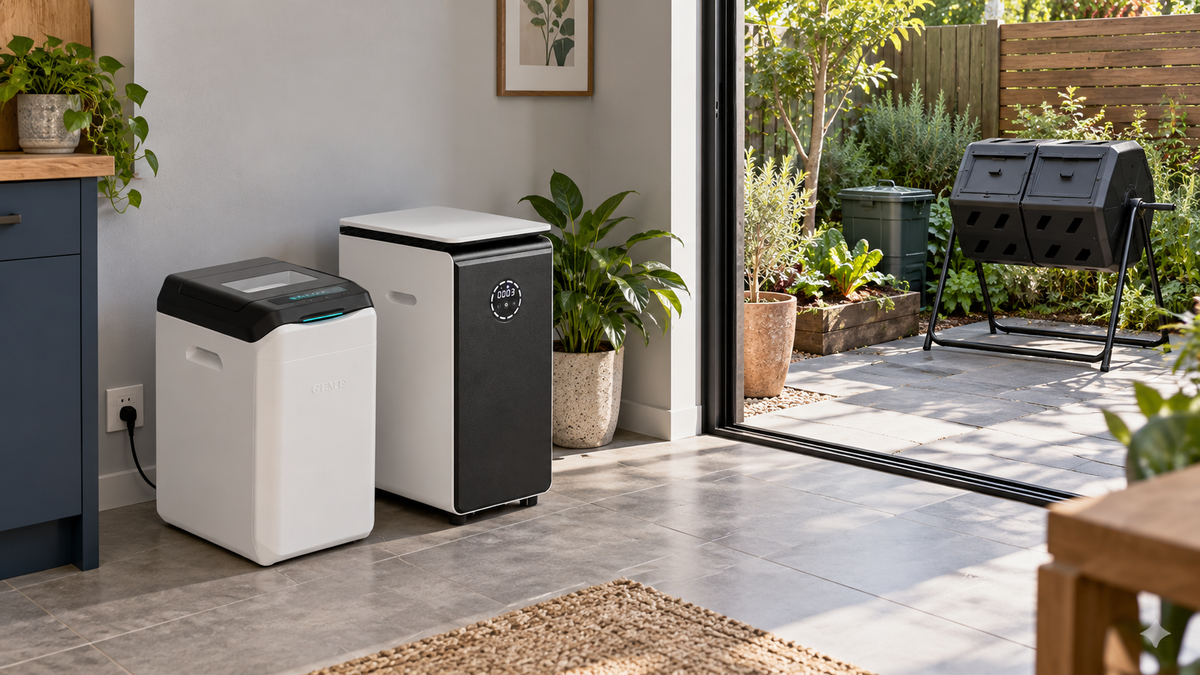
Terra 2 is our first recommendation for smaller households; Pro gives heavier-cooking families more capacity. Both keep the aerobic process at home.
| Feature | GEME Terra 2 | GEME Pro |
|---|---|---|
| Our recommendation | Best Overall for smaller households | Best for Large Families and heavier cooking |
| Household starting point | 1–3 people | 4+ people |
| Daily processing capacity | Up to 2 kg/day | Up to 5 kg/day |
| Chamber volume | 14 L | 19 L |
| Each addition | 1 kg or less | 1 kg or less |
| Daily operation | Continuous feeding; automated mixing; GEMEBrain™ adaptive control | Continuous feeding; automated mixing |
| US Basic price | US$699.00 | US$899.99 |
Choose capacity based on the suitable scraps your kitchen actually produces. Pro provides 2.5 times Terra 2's daily processing capacity. Both need a suitable floor position, clear ventilation, lid clearance, and power.
Check the full GEME model comparison and use our electricity-cost guide to plan running costs.
US Basic prices checked September 22, 2026. Regional prices and configurations may differ; current offers appear on the product pages.
Bring Your Kitchen-to-Soil Routine Home
Make daily food-scrap processing part of your own household. GEME combines continuous microbial composting, automated mixing, and a clear Compost Base application routine.
Choose Terra 2 for everyday smaller-household use, or GEME Pro for greater daily capacity.
Frequently Asked Questions
What is the difference between electric composting and anaerobic digestion?
GEME uses an oxygen-supported microbial process at home and produces active Compost Base for soil preparation. Anaerobic digestion operates without oxygen and produces biogas plus digestate. Residents usually access a facility through an accepted collection or drop-off service.
Is GEME an anaerobic digester?
No. GEME Terra 2 and GEME Pro use aerobic microbial processing. Airflow and mixing support the active bed. They are not designed to capture biogas for fuel.
Does an electric composter generate electricity?
GEME uses electricity to support its composting process; it does not generate electricity for your home. Anaerobic digestion facilities can recover energy from biogas when they have the appropriate gas-handling and energy equipment.
Is digestate the same as finished compost?
No. Digestate is the solid and liquid residual material from anaerobic digestion. It can have beneficial uses after appropriate handling or treatment, and its solids may undergo further aerobic composting. Calling a material digestate does not establish that it is mature compost.
Does my green-bin waste always go to an anaerobic digester?
No. The destination depends on your service. Ask the municipality or hauler which facility receives the material, how it is processed, and what happens to the outputs. Follow that service's accepted-material list.
Can I use GEME if my city already sends food waste to a digester?
Yes. GEME can handle suitable daily scraps at home while the collection service remains available for other accepted material or overflow. GEME adds indoor processing, continuous feeding, and control over the destination of your prepared Compost Base.
How do I use GEME Compost Base in soil?
Screen the harvest and return larger unfinished organic pieces to the chamber. Blend approximately 1 part screened Compost Base with 8 parts plain soil, then follow the application guide for soil capping, placement, and any additional maturation needed.
Should I choose Terra 2 or GEME Pro?
Choose Terra 2 for smaller households and up to 2 kg/day, with a 14 L chamber. Choose GEME Pro for heavier cooking and up to 5 kg/day, with a 19 L chamber. Keep each addition at 1 kg or less and choose by your actual daily load.
Sources and Related Guides
Process references and product details reviewed September 22, 2026.
- U.S. EPA — Anaerobic Digestion and Its Outputs
- U.S. EPA AgSTAR — Biogas and Digestate Pathways
- U.S. EPA — Anaerobic Digestion Questions
- U.S. EPA — Composting and Food-Scrap Preprocessing
- U.S. EPA — Wasted Food Scale and Output Destinations
- City of Toronto — From Collected Organics to Compost
- City of Toronto — Renewable Natural Gas from Organics
- City of Toronto — Current Green Bin Acceptance Rules
- GEME — Model Specifications and Household Fit


Dejar un comentario
Todos los comentarios se revisan antes de su publicación.
Este sitio está protegido por hCaptcha y se aplican la Política de privacidad de hCaptcha y los Términos del servicio.