


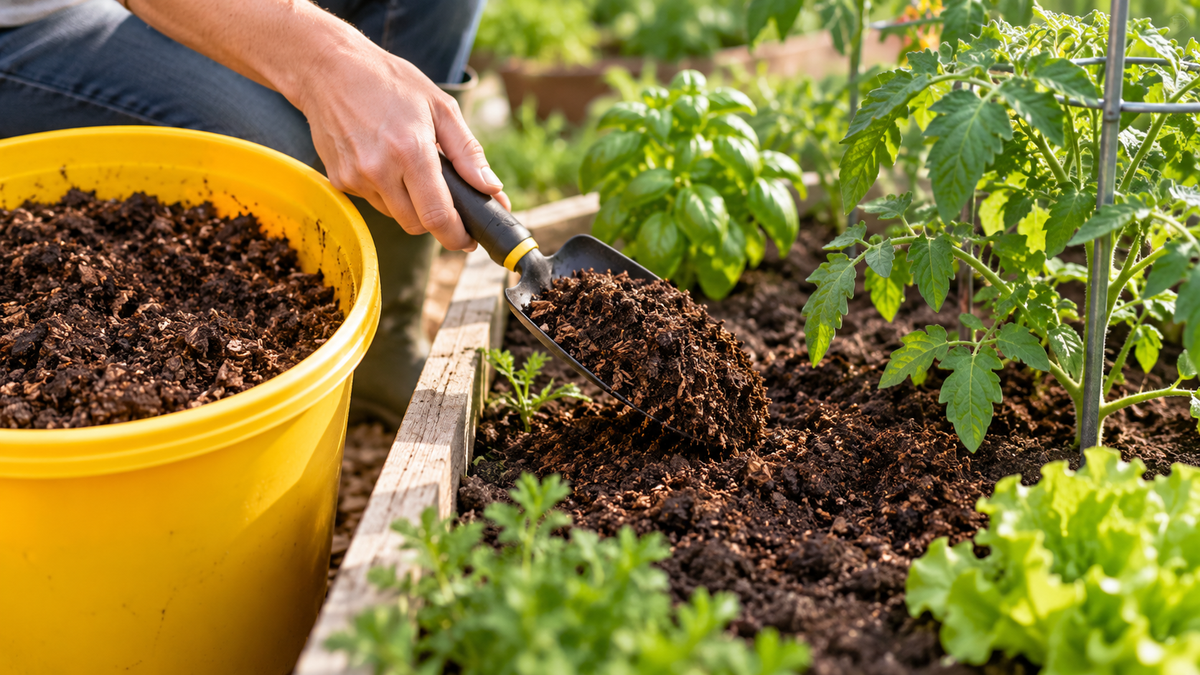
Compost Calculator · Garden Beds · Lawns · Soil Application
To work out how much compost you need, you only need two measurements: the area you want to cover and the depth of compost you want to apply.
Once you know those numbers, you can convert the result into cubic feet, cubic yards, liters, cubic meters, or bags before you buy anything.
The calculation is simple. Choosing the right depth is the part that requires judgment. An established vegetable bed, a new poor-soil garden, a lawn top dressing, and a raised bed should not all receive the same amount.
And if you are using GEME Compost Base, use a different rule again: screen the output, return unfinished pieces, then blend approximately 1 part Compost Base with 8 parts plain soil rather than spreading concentrated fresh output as if it were ordinary bagged compost.

Quick Answer: How Much Compost Do I Need?
Calculate compost by volume:
Garden area × compost depth = compost volume
For U.S. measurements:
Cubic feet = square feet × depth in inches ÷ 12
Cubic yards = square feet × depth in inches ÷ 324
For metric measurements:
Liters = square meters × depth in centimeters × 10
Cubic meters = square meters × depth in centimeters ÷ 100
Then divide the required volume by the volume printed on the bag to determine how many bags to buy, and round up.
1. How Do You Calculate How Much Compost You Need?
The most reliable way to buy compost is by volume.
Compost can contain very different amounts of moisture, so two piles with the same volume may weigh very different amounts.
Measure:
- the length and width of the area;
- the resulting square footage or square meters;
- the compost depth you intend to apply.
U.S. Formula
Square feet × depth in inches ÷ 12 = cubic feet
Square feet × depth in inches ÷ 324 = cubic yards
There are 27 cubic feet in 1 cubic yard.
Metric Formula
Square meters × depth in centimeters × 10 = liters
Square meters × depth in centimeters ÷ 100 = cubic meters
2. Quick Compost Calculator for 100 Square Feet
If your garden area is exactly 100 square feet, use this table directly.
| Compost Depth | Cubic Feet | Cubic Yards | Approx. Liters |
|---|---|---|---|
| ¼ inch | 2.08 ft³ | 0.077 yd³ | ~59 L |
| ½ inch | 4.17 ft³ | 0.154 yd³ | ~118 L |
| 1 inch | 8.33 ft³ | 0.309 yd³ | ~236 L |
| 2 inches | 16.67 ft³ | 0.617 yd³ | ~472 L |
Shortcut: once you know the amount for 100 ft², multiply it proportionally. A 200 ft² garden needs twice as much; a 50 ft² garden needs half as much.
3. What Compost Depth Should You Use?
This is the most important decision in the calculation.
The correct amount depends on:
- whether the soil is new or established;
- existing organic matter;
- soil nutrient levels;
- the type of compost;
- whether compost has been applied repeatedly;
- and what you are growing.
| Use Case | Practical Starting Point | Important Caution |
|---|---|---|
| Established vegetable or flower bed | About ¼–½ inch for a modest maintenance application | Repeated applications should be adjusted to soil condition and nutrient testing. |
| New or poor garden soil | About 1–2 inches incorporated into the upper soil layer when substantial soil building is actually needed | Do not automatically repeat this heavy rate every year. |
| Established raised bed | Thin surface refresh, often around ¼–½ inch | Raised beds can accumulate nutrients quickly. |
| New raised-bed mix | Use compost as one component of the total growing mix | Do not fill the entire bed with pure compost. |
| Lawn top dressing | About ¼ inch of screened compost | Spread evenly so grass blades are not smothered. |
| Containers | Use compost as part of a potting blend rather than as the whole medium | Small root zones are sensitive to salts, drainage and nutrient concentration. |
University of Minnesota Extension gives approximately ½ inch for vegetable and flower gardens and about ¼ inch for lawn top dressing as soil-building references for non-manure compost.
Penn State Extension notes that when building or substantially improving garden soil, 1–2 inches can be incorporated into the top 6–8 inches of soil.
These Numbers Are Not Contradictory
A maintenance application to established soil and a one-time soil-building application to poor or new soil are different jobs.
Do not take a 2-inch soil-building rate and turn it into an automatic annual application.
For the application methods behind these numbers, read How to Use Compost Correctly.
4. Example: How Much Compost for a 200 Square Foot Garden?
Assume you have an established 200 ft² vegetable garden and want to apply a ½-inch layer.
200 ft² × 0.5 inch ÷ 12 = 8.33 cubic feet
8.33 ÷ 27 = 0.31 cubic yard
8.33 ft³ ≈ 236 liters
If buying bulk compost, you would generally order enough to cover that volume plus a small practical margin.
If buying bags, divide 8.33 cubic feet by the volume printed on each bag.
5. How Many Bags of Compost Do I Need?
Bag sizes vary, so do not calculate by bag count until you know the bag's actual volume.
Number of bags = required compost volume ÷ volume per bag
Always round up to the next whole bag.
Using the 200 ft² example above, you need approximately 8.33 cubic feet.
| Bag Size | Calculation | Bags to Buy |
|---|---|---|
| 1 ft³ | 8.33 ÷ 1 | 9 bags |
| 1.5 ft³ | 8.33 ÷ 1.5 | 6 bags |
| 2 ft³ | 8.33 ÷ 2 | 5 bags |
| 40 L | 236 ÷ 40 | 6 bags |
| 50 L | 236 ÷ 50 | 5 bags |
For larger gardens, bulk compost by the cubic yard is usually easier to calculate and handle than dozens of individual bags.
6. How Much Compost Do You Need for a Raised Bed?
There are two different calculations.
Existing Raised Bed
If the bed is already filled and productive, you normally calculate only the thin compost layer you are adding to the surface.
Example: a 4 × 8 ft raised bed is 32 ft².
At ½ inch:
32 × 0.5 ÷ 12 = 1.33 cubic feet
That is only about 38 liters of compost.
Brand-New Raised Bed
A new bed is different because compost is only one part of the full growing medium.
Do not calculate the entire bed volume and fill all of it with compost.
A balanced raised-bed mix needs:
- mineral soil or topsoil;
- organic matter;
- appropriate pore space;
- drainage;
- and enough structural material to support roots.
University of Minnesota Extension similarly recommends combining topsoil and plant-based compost rather than using compost alone in a new raised bed.
Maintenance and Initial Filling Are Different
A high compost percentage may be appropriate when constructing a new bed with low-organic-matter materials. It does not mean an established bed should receive the same proportion every season.
7. How Much Compost Do You Need for a Lawn?
Lawn top dressing is intentionally thin.
A practical reference is approximately ¼ inch of screened compost.
For a 1,000 ft² lawn:
1,000 ft² × 0.25 inch ÷ 324 = 0.77 cubic yard
That is approximately:
- 20.8 cubic feet;
- 0.77 cubic yard;
- or about 590 liters.
Use screened compost and rake it evenly so grass blades remain exposed.
A thicker layer is not automatically better and can smother turf.
8. How Much GEME Compost Base Should You Use?
This is where the calculation changes.
GEME Compost Base should not be treated like a truckload of fully cured bulk compost that you simply spread 1 or 2 inches deep across the garden.
Terra 2 and GEME Pro are continuous microbial systems. Harvested output can contain material with different residence times, so the correct workflow is:
GEME Application Rule
- Screen the harvested Compost Base.
- Return larger unfinished organic pieces to the chamber.
- Mix approximately 1 part Compost Base with 8 parts plain soil.
- Cap the blend with plain soil where appropriate.
- Water and observe plant response.
How to Calculate a 1:8 GEME Blend
A 1:8 ratio contains 9 total parts.
GEME Compost Base = desired finished blend volume ÷ 9
Plain soil = desired finished blend volume × 8 ÷ 9
| Desired Final Blend | GEME Compost Base | Plain Soil |
|---|---|---|
| 9 L | 1 L | 8 L |
| 18 L | 2 L | 16 L |
| 45 L | 5 L | 40 L |
| 90 L | 10 L | 80 L |
For the complete GEME application method, use the GEME Compost Base Application and Storage Guide.
Why GEME Changes the “How Much Compost?” Question
A conventional gardener may buy one large quantity of compost and apply it once or twice a year.
GEME creates a different household loop:
kitchen scraps → continuous microbial processing → Compost Base → targeted soil blending.
That makes Compost Base particularly useful for:
- ongoing garden-bed amendments;
- raised-bed refreshes;
- container and balcony planting;
- established plants;
- and households that want a regular kitchen-to-soil pathway instead of treating compost only as an occasional store purchase.
Terra 2 is sized for the normal food-scrap routine of a smaller 1–3 person household, while GEME Pro increases daily processing capacity to approximately 5 kg for larger households.
The model choice should follow your kitchen-waste volume, not the number of square feet in your garden.
9. Can You Use Too Much Compost?
Yes.
Compost is beneficial, but it is still an input containing organic matter and nutrients.
Repeated heavy applications can contribute to:
- excess phosphorus;
- soluble salt accumulation;
- nutrient imbalance;
- excessive moisture retention;
- and overly rich growing conditions.
University of Minnesota Extension specifically cautions that excessive compost and manure use can create nutrient and salt problems, while Penn State has published even more conservative recommendations where compost nutrient analysis is unavailable. :contentReference[oaicite:2]{index=2}
Do Not Confuse “How Much Fits” With “How Much the Soil Needs”
The calculator tells you the volume required to create a certain layer. A soil test, compost analysis, crop needs and application history tell you whether that layer is appropriate.
For the nutrient side of the decision, review NPK Test of Home Compost Output (N=50).
10. What If You Buy or Produce More Compost Than You Need?
Do not apply extra compost simply because it is available.
Store it properly instead.
Finished compost should be protected from:
- prolonged saturation;
- heavy rain;
- contamination;
- and prolonged airtight, anaerobic storage.
GEME Compost Base is moist and biologically active, so extra screened output should be stored in a breathable container in a cool, shaded location rather than sealed wet in an airtight bag.
See How Long Does Compost Last? How to Store Compost Properly.
Calculate the Garden. Keep the Kitchen Loop Going.
Measure your garden by area and depth before buying compost. Then apply only what the soil actually needs.
GEME Terra 2 and GEME Pro add a second option: continuously turn suitable household food scraps into Compost Base that can be screened, blended with soil, and returned to the growing cycle instead of becoming ordinary trash.
Frequently Asked Questions
How do I calculate how much compost I need?
Multiply the garden area by the desired compost depth. In U.S. units, square feet × depth in inches ÷ 12 gives cubic feet. Divide cubic feet by 27 to convert to cubic yards.
How many cubic yards of compost do I need?
Use square feet × compost depth in inches ÷ 324. For example, 1,000 square feet covered 1 inch deep requires approximately 3.09 cubic yards.
How many cubic feet of compost do I need for 100 square feet?
At ¼ inch you need about 2.08 cubic feet; at ½ inch about 4.17 cubic feet; at 1 inch about 8.33 cubic feet; and at 2 inches about 16.67 cubic feet.
How much compost do I need for a vegetable garden?
For an established vegetable garden, a modest maintenance layer around ¼–½ inch is a practical starting point. New or poor soil may justify a larger one-time incorporation, but repeated heavy applications should be guided by soil condition and nutrient testing.
How much compost should I add to new garden soil?
Penn State Extension notes that 1–2 inches of compost can be incorporated into the upper 6–8 inches of soil when establishing or substantially improving garden soil. This should not automatically become an annual application rate.
How much compost should I use on a lawn?
About ¼ inch of screened compost is a useful lawn top-dressing reference. Spread it thinly and evenly so grass blades remain exposed.
How much compost do I need for a 4 × 8 raised bed?
A 4 × 8 bed has 32 square feet of surface area. A ½-inch maintenance layer requires about 1.33 cubic feet, or roughly 38 liters, of compost.
How many bags of compost should I buy?
Calculate the total required volume, divide it by the volume printed on the bag, then round up. If you need 8.33 cubic feet and each bag contains 1.5 cubic feet, buy 6 bags.
Should I calculate compost by weight or volume?
Volume is usually more useful for garden planning because compost moisture content can change its weight considerably. Garden application depth is also inherently a volume calculation.
How much GEME Compost Base should I use?
GEME Compost Base follows a different application rule from ordinary bulk compost. Screen larger unfinished pieces, return them to the chamber, then blend approximately 1 part Compost Base with 8 parts plain soil before plant use.
How do I calculate a 1:8 GEME Compost Base mix?
A 1:8 mix contains 9 total parts. Divide the desired finished volume by 9 to calculate Compost Base, then use the remaining eight parts as plain soil. For example, a 45-liter final blend uses about 5 liters of Compost Base and 40 liters of soil.
Can I spread pure GEME Compost Base 1 inch deep over my garden?
That is not the recommended GEME application method. GEME Compost Base is a concentrated, biologically active material from a continuous-flow system. Screen it and mix approximately 1:8 with plain soil rather than treating pure fresh output as ordinary bagged compost.
Can you use too much compost?
Yes. Excessive or repeated heavy applications can contribute to high phosphorus, soluble salts, nutrient imbalance and other soil problems. More compost is not automatically better.
What should I do with extra GEME Compost Base?
Store screened extra material in a breathable container in a cool, shaded place. Avoid sealing moist biologically active Compost Base airtight.
Sources
- University of Minnesota Extension — Soil Testing for Lawns and Gardens
- Penn State Extension — Home Composting: A Guide for Home Gardeners
- University of Minnesota Extension — Raised Bed Gardens
- University of Minnesota Extension — Problems Caused by Too Much Compost and Manure
- GEME — How to Use Compost Correctly
- GEME — Compost Base Application and Storage Guide
- GEME — NPK Test of Home Compost Output (N=50)


Dejar un comentario
Todos los comentarios se revisan antes de su publicación.
Este sitio está protegido por hCaptcha y se aplican la Política de privacidad de hCaptcha y los Términos del servicio.