



Tomatoes · Food Scraps · Compost Moisture · Kitchen Composting
Composting Basics: Can You Compost Tomatoes?
Yes, tomatoes are excellent compostable food scraps. Fresh tomatoes, skins, cores, seeds and ordinary overripe or spoiled tomatoes can all enter an appropriate composting system.
The main practical issue is moisture. Tomatoes contain a large amount of water. A few tomatoes mixed with other kitchen scraps are easy to manage, but repeatedly adding large tomato-heavy loads can make the composting mass too wet, reduce air movement and increase the risk of odor.
By Matthew Moore · Last reviewed August 20, 2026

Quick Answer: Can Tomatoes Be Composted?
Yes. Tomatoes are compostable, including ordinary fresh, overripe and spoiled tomatoes.
The main boundary is quantity. Tomatoes are soft and moisture-rich, so a large tomato-only load can push compost toward an overly wet condition. Mix or alternate them with a varied waste stream, avoid pouring tomato liquid into a composter, and give the system time to process one unusually wet load before adding another.
For most households, the question is therefore not:
“Are tomatoes compostable?”
They are.
For the broader material framework, see What Can You Compost at Home?, which separates ordinary fruit and vegetable scraps from materials that need more caution or method-specific handling.
The more useful question is:
“How many wet tomatoes should I add at once without making the system too wet?”
Table of Contents
- Why Are Tomatoes Easy to Compost?
- Can Too Many Tomatoes Make Compost Too Wet?
- How to Compost Tomatoes in a Backyard Pile
- Can You Compost Rotten or Moldy Tomatoes?
- Can Tomato Skins, Seeds and Stems Be Composted?
- Can Worms Eat Tomatoes?
- Can GEME Terra 2 Compost Tomatoes?
- What Happens If You Put Too Many Tomatoes in Terra 2?
- Can Tomato Sauce Be Composted?
- How Should You Prepare Tomatoes for Composting?
- Tomato Composting Methods Compared
- Common Tomato Composting Mistakes
- Frequently Asked Questions
1. Why Are Tomatoes Easy to Compost?
Tomatoes are soft plant material made largely of water and readily degradable organic matter.
Unlike a fruit pit, nutshell or woody stem, a tomato does not present a major physical barrier to microbial access.
Once the skin breaks and microorganisms gain access to the soft interior, the material can lose its recognizable structure relatively quickly under active composting conditions.
Whole tomato
↓
Skin breaks or softens
↓
Moist interior becomes exposed
↓
Microbial decomposition continues
The U.S. EPA includes fruit and vegetable scraps among the normal nitrogen-rich materials suitable for backyard composting.
See U.S. EPA — Composting at Home.
So there is no special rule that excludes ordinary tomatoes from compost.
What changes from one system to another is how moisture, pests, airflow and load size are managed. See Compost Pile vs Electric Composter for that distinction.
What makes tomatoes worth discussing separately is not whether they decompose.
It is how much water they bring with them.
2. Can Too Many Tomatoes Make Compost Too Wet?
Yes.
This is the most important practical limit when composting tomatoes.
Composting microorganisms need moisture, but aerobic composting also depends on open spaces through which oxygen can move.
When a composting mass becomes excessively wet, liquid can fill those pore spaces.
That makes oxygen movement more difficult.
High Moisture Is Good, Until It Becomes Too Much
Tomatoes are not a problem because they contain water. The problem appears when a large quantity of tomatoes, juice or other wet food is added faster than the composting system can absorb, redistribute or evaporate that moisture.
EPA's current home-composting guidance gives a useful physical target for an outdoor pile:
The combined material should have the consistency of a wrung-out sponge.
Older EPA technical composting guidance also explains the mechanism behind this advice: excessive water slows gas diffusion and can encourage anaerobic conditions associated with odor.
So if you have:
- one sliced tomato;
- a few cherry tomatoes;
- tomato skins from dinner;
- one overripe tomato;
you usually do not need to treat that as a special event.
If you suddenly have:
- a bowl of collapsing tomatoes;
- several pounds of overripe tomatoes;
- large amounts of tomato pulp;
- tomato juice collecting at the bottom of the container;
then pacing matters.
The same wet-fruit issue appears with grapes: our Moldy Grapes Composting Guide explains why soft, leaking fruit should be mixed and paced rather than dumped as one dense wet load.
For indoor systems, the wider rule is covered in Electric Composter Salt & Oil Boundaries: wet food is normal, but concentrated free liquid should be drained rather than deliberately poured into the chamber.
3. How to Compost Tomatoes in a Backyard Pile
A backyard compost pile can handle tomatoes well when they are mixed with the rest of the pile rather than dumped into one wet layer.
EPA recommends combining nitrogen-rich food scraps with carbon-rich materials such as:
- dry leaves;
- plant stalks;
- twigs;
- shredded non-glossy paper;
- clean shredded cardboard.
These dry structural materials do more than change the carbon balance.
They also help keep physical spaces open for airflow.
For a Few Tomatoes
Cut them if necessary, bury them within the active pile and cover food scraps with dry material.
For a Large Tomato Harvest
Do not empty an entire container of wet tomatoes into one concentrated pocket.
Instead:
- Break or cut large tomatoes.
- Spread the material through the pile.
- Mix it with dry structural material.
- Turn or aerate the pile when needed.
- Check that the pile feels moist rather than waterlogged.
The principle is simple: tomatoes provide plenty of moisture. When tomatoes dominate the load, your job is usually to protect structure and airflow—not add more water.
For the broader material-balancing system, read What Can You Compost at Home? Complete Compostable List. If you want the full pile-building method—greens, browns, moisture, turning and troubleshooting—continue with the Complete Home Composting Guide.
4. Can You Compost Rotten or Moldy Tomatoes?
Yes. Ordinary household spoilage does not normally prevent a tomato from being composted.
Examples include:
- overripe tomatoes;
- soft tomatoes;
- split tomatoes;
- wrinkled tomatoes;
- tomatoes with ordinary food-spoilage mold;
- tomatoes that are no longer appealing to eat.
In fact, an overripe tomato has already begun losing structural integrity, which makes the organic material readily accessible to decomposer organisms.
There is, however, an important distinction between ordinary spoilage and known contamination.
Spoiled Food Is Not the Same as Contaminated Food
Do not treat produce exposed to sewage, floodwater, fuel, cleaners, pesticides or unknown chemicals as ordinary compostable kitchen waste intended for edible-garden use. A food-safety recall or known contamination event should also be handled according to the applicable safety instructions rather than automatically routed into home compost.
For broader tomato food-safety context, see Are Tomatoes Safe to Eat Now?. For another soft-fruit example where ordinary spoilage and composting overlap, read Can You Compost Moldy Grapes?.
5. Can Tomato Skins, Seeds and Stems Be Composted?
Most ordinary parts of a kitchen tomato can enter compost.
Always remove the produce sticker first.
EPA specifically identifies produce stickers among materials that should not be added to a backyard compost pile.
A sticker is packaging, not tomato.
The same rule applies to plastic trays, nets, twist ties and other retail materials.
If you are building a kitchen-scrap routine around tomato meals, How to Compost Eggshells is a useful companion guide—especially because eggshells are much slower and benefit from crushing, unlike soft tomato tissue.
6. Can Worms Eat Tomatoes?
Tomatoes can be used in vermicomposting, but again, quantity matters.
Worm bins already operate in a moist environment.
A small amount of chopped tomato mixed with appropriate bedding and other feedstock is very different from emptying a large container of soft, leaking tomatoes into the bin.
Too much wet food can:
- make bedding soggy;
- reduce aeration;
- encourage odor;
- create conditions that are less comfortable for the worm-bin ecosystem.
The practical rule is therefore similar:
Feed tomatoes as part of a varied stream, not as a liquid-heavy tomato dump.
For a complete comparison, read Electric Composter vs Worm Composting: GEME Terra 2 vs Vermicomposting.
7. Can GEME Terra 2 Compost Tomatoes?
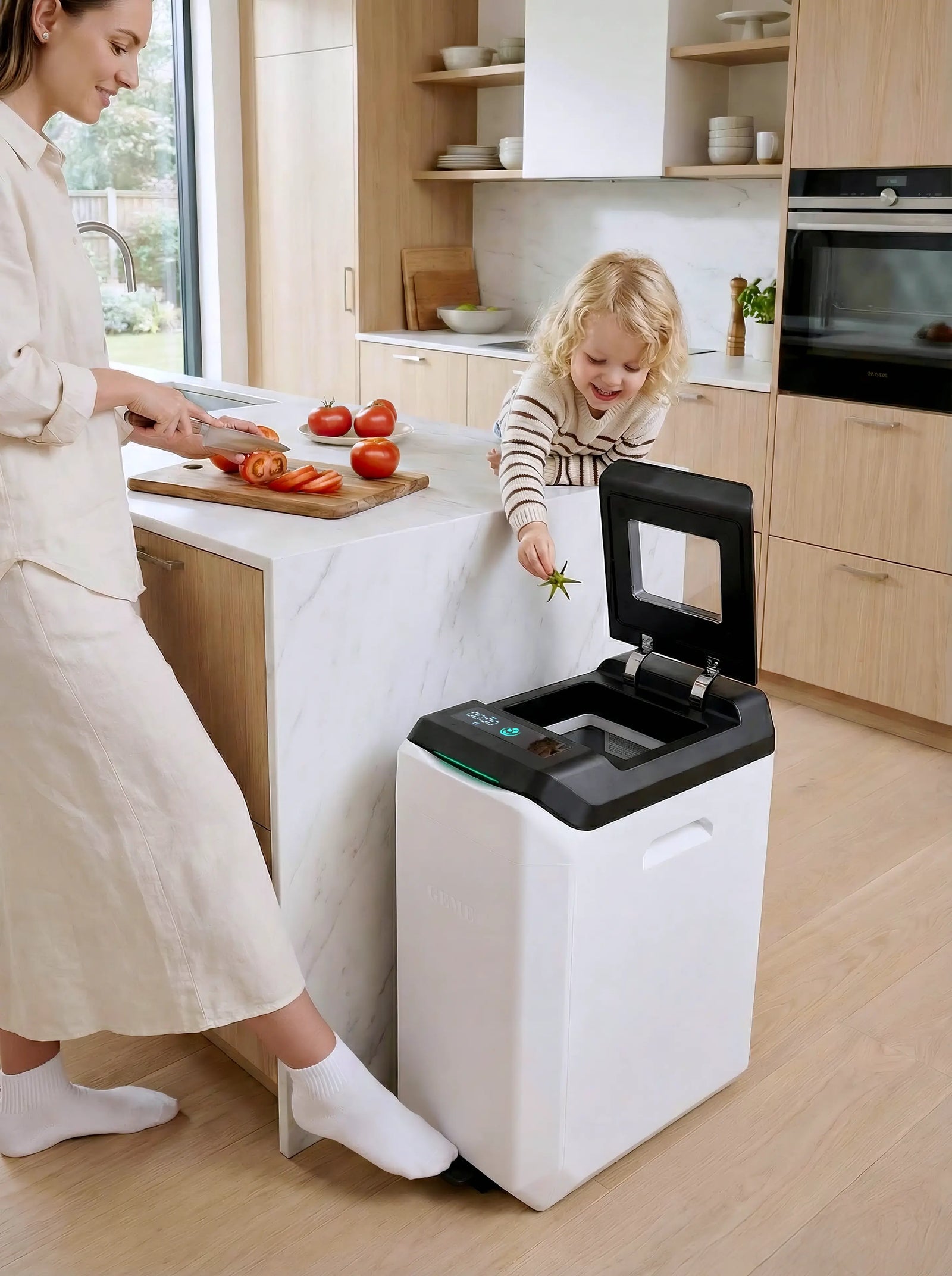
Yes. Tomatoes are a normal type of plant-based kitchen scrap for GEME Terra 2.
Terra 2 maintains a warm, moist and oxygen-rich biological environment in which Kobold™ microorganisms process suitable household food waste.
GEMEBrain™ helps manage:
- airflow;
- heat;
- moisture-related conditions;
- mixing.
This makes tomatoes fundamentally easier to manage than difficult inputs such as large dense bones or large volumes of free oil.
But automated environmental control does not mean water becomes irrelevant.
A biological system still has a practical operating window.
Normal tomato scraps are easy.
A concentrated load of crushed, overripe and leaking tomatoes is different because it introduces a large amount of liquid all at once.
Terra 2 rule: normal tomatoes are fine. For an unusually large quantity, feed them gradually rather than turning the chamber into a container of tomato pulp.
Learn about the controlled microbial process at How GEME Works. For the broader input framework—including meat, dairy, bones, wet leftovers and free-liquid boundaries—see What Can You Put in an Electric Composter?.

Wet Food Needs an Aerobic System
Compost Tomatoes Without Drying Them Into Flakes
Tomatoes naturally contain a lot of moisture. Terra 2 does not need to bake that moisture out to process the food.
Instead, it maintains a living aerobic microbial environment while monitoring and adjusting operating conditions as everyday kitchen scraps are added.
The important user boundary remains simple: normal wet scraps are part of the process; unusually large liquid-heavy loads should be paced.
Explore GEME Terra 2 →8. What Happens If You Put Too Many Tomatoes in Terra 2?
A single tomato is not likely to create a moisture crisis.
The issue is concentration and repetition.
Imagine two very different kitchen routines.
The second load introduces far more free moisture and much less structural variety.
If an active microbial bed becomes too wet, several things can happen:
- material can become heavy and pasty;
- air spaces can shrink;
- oxygen transfer becomes more difficult;
- aerobic decomposition may slow;
- odor pressure can increase.
What Should You Do?
Do not panic and do not assume the machine has failed.
- Stop adding more very wet food for a while.
- Do not pour tomato juice or free liquid into the chamber.
- Return to normal varied household scraps rather than another tomato-heavy load.
- Allow the system time to process and rebalance.
- Keep the machine powered so its normal airflow, mixing and environmental control can continue.
Do Not Treat Terra 2 Like a Liquid Disposal System
A juicy tomato is food waste. A bowl of tomato juice is free liquid. Those are not the same input. If liquid can be poured off easily, drain it before adding the solid food portion.
This is the same operating principle used for other liquid-heavy leftovers. See Electric Composter Salt & Oil Boundaries: What to Drain First.
9. Can Tomato Sauce Be Composted?
Tomato sauce requires more judgment than a fresh tomato.
The tomato itself is not the main concern.
A prepared sauce may contain:
- water;
- salt;
- olive oil or other fats;
- sugar;
- cheese;
- meat;
- seasonings.
A spoonful of ordinary leftover sauce attached to food is very different from pouring an entire jar or bowl of liquid sauce into a composter.
Tomato pieces or ordinary sauce residue
↓
Usually manageable as part of mixed food waste
Large bowl of liquid sauce
↓
Drain or avoid the excess liquid first
For sauce-heavy leftovers where salt, oil and free liquid all matter, use the dedicated Salt, Oil & High-Moisture Input Boundaries guide.
The easiest rule remains:
If it pours, drain it first.
10. How Should You Prepare Tomatoes for Composting?
Tomatoes need very little preparation.
Small or Soft Tomatoes
Add them directly or break them open so microorganisms can access the interior quickly.
Large Whole Tomatoes
Cutting or crushing them slightly increases exposed surface area and prevents a thick skin from temporarily isolating the wet interior.
Very Wet Overripe Tomatoes
If free juice has collected in the container, separate the excess liquid rather than pouring it all into an indoor composter.
Tomatoes With Stickers
Remove stickers before composting.
Bulk Garden Surplus
If you have kilograms of tomatoes after a harvest, do not think of the entire batch as one normal kitchen input.
Use it gradually, preserve edible tomatoes where possible, share surplus food first and compost what genuinely cannot be eaten.
That priority matters: composting should come after reasonable food-waste prevention. The Food Storage & Waste Reduction Guide connects storage, use, freezing and composting into one household routine.
Food-waste prevention comes first. Composting is a good destination for tomatoes that can no longer feed people, not a reason to discard edible produce early.
11. How Do You Know Compost Has Become Too Wet?
The best indicator is not the presence of one tomato.
Look at the condition of the composting mass as a whole.
Possible signs of excessive moisture include:
- visible free liquid;
- material that looks saturated rather than moist;
- a heavy paste-like texture;
- poor air movement;
- persistent sour, rotten or sewage-like odor;
- slower breakdown despite plenty of food present.
EPA's “wrung-out sponge” comparison is useful for traditional outdoor compost because it captures the balance between enough water for microbes and enough open structure for air.
In a managed microbial appliance, you should follow the machine's own operating guidance rather than trying to manually force the chamber toward an outdoor-pile texture.
The underlying biology is still the same:
Enough moisture
+
Enough oxygen
+
Active microbes
+
Time = aerobic decomposition
For the broader biological explanation, read How Does Composting Work? Microbes, Heat & Oxygen.
12. Tomato Composting Methods Compared
Tomatoes work in several composting systems, but moisture management differs by method.
| Method | Tomatoes? | Main Moisture Rule |
|---|---|---|
| Backyard Compost | Yes | Mix large wet loads with dry structural browns and maintain airflow. |
| Worm Bin | Yes, in moderation | Avoid saturating the bedding with large quantities of wet tomato material. |
| Bokashi | Generally compatible | Manage liquid according to the specific fermentation-system instructions. |
| GEME Terra 2 | Yes | Normal wet scraps are suitable; pace unusually large tomato-heavy loads and avoid free liquid. |
The common principle across these systems is that tomatoes are not difficult feedstock, but unlimited moisture is not beneficial.
If you are deciding which method fits your home, compare these trade-offs in Compost Pile vs Electric Composter.
13. Common Mistakes When Composting Tomatoes
Mistake 1: Thinking Tomatoes Are Too Acidic to Compost
Ordinary tomatoes are normal plant-based food scraps. For most households, the more practical issue is moisture and quantity, not avoiding tomatoes altogether.
Mistake 2: Dumping a Whole Harvest Into One Spot
Several kilograms of soft tomatoes form a much wetter and denser load than ordinary mixed kitchen scraps.
Mistake 3: Pouring Tomato Juice Into an Indoor Composter
The solids are useful compostable organic material. Excess free liquid does not need to follow them into the chamber.
Mistake 4: Adding More Water Because Tomatoes Are “Green Material”
Tomatoes already bring substantial moisture. Judge the condition of the overall composting mass before adding water.
Mistake 5: Forgetting Produce Stickers
Remove plastic stickers and packaging before composting the tomato.
Mistake 6: Treating Tomato Sauce Like a Fresh Tomato
Sauce can contain extra salt, oil and free liquid. Evaluate the complete food, not only the ingredient that gave it its name.
Mistake 7: Assuming More Food Means Faster Composting
Composting capacity is biological. Overloading a system with wet food can slow the process rather than accelerate it.
14. The Simplest Rule for Composting Tomatoes
Tomatoes belong in compost.
There is no reason to send an ordinary spoiled tomato to trash simply because it is soft, juicy or beginning to break down.
Just remember the difference between:
The first is easy composting.
The second needs pacing and moisture management.
Compost the tomato. Manage the water.
After suitable scraps have been processed, use the output responsibly rather than treating it as pure potting soil. See the Advanced GEME Compost Application Guide and How to Use Compost Correctly.
For first-party evidence on nutrient variability in household output, continue to the NPK Test of Home Compost Output (N=50). Tomatoes contribute organic material to a mixed feedstock—they do not turn household compost into a standardized “tomato fertilizer.”
Real Food Is Naturally Wet
You Don't Need to Dry Tomatoes Before They Can Enter a Biological Process
GEME Terra 2 maintains a warm, moist and oxygen-rich microbial environment for everyday kitchen scraps. Tomatoes can go straight into the normal food-waste stream, just pace unusually large tomato-heavy loads and keep excess free liquid out.
15. Frequently Asked Questions About Composting Tomatoes
Can you compost tomatoes?
Yes. Fresh tomatoes, tomato scraps and ordinary spoiled tomatoes are compostable plant material. The main practical issue is moisture when unusually large quantities are added at once.
Can tomatoes be put in a backyard compost pile?
Yes. EPA includes fruit and vegetable scraps among normal backyard-compost materials. Mix tomatoes through the pile and use dry structural materials when a large wet load makes the pile overly moist.
Can you compost rotten tomatoes?
Yes. Ordinary overripe, soft, split or spoiled tomatoes can generally be composted as normal household food waste.
Can you compost moldy tomatoes?
Ordinary food-spoilage mold does not automatically prevent a tomato from being composted. Known chemical, sewage, floodwater or other hazardous contamination should be handled separately.
Can you compost tomato skins?
Yes. Tomato skins are organic plant material and will break down with the rest of the tomato.
Can you compost tomato seeds?
Yes. Tomato seeds are organic and can enter compost, although some seeds may remain viable when a home composting process does not expose them to conditions sufficient to deactivate them.
Can you compost tomato stems?
Small stems attached to kitchen tomatoes can be composted. They are tougher than the soft fruit and may therefore take somewhat longer to break down.
Should you remove tomato stickers before composting?
Yes. Produce stickers and other packaging should be removed before the tomato enters compost.
Can too many tomatoes make compost too wet?
Yes. Tomatoes are moisture-rich. A large concentrated tomato load can make compost overly wet, reduce pore space and oxygen movement, and increase the risk of anaerobic odors.
What should I do if tomatoes make my compost pile too wet?
For an outdoor pile, mix the wet material through the pile, add appropriate dry structural browns and improve aeration. EPA recommends maintaining a moisture level comparable to a wrung-out sponge.
Can worms eat tomatoes?
Tomatoes can be fed to a worm bin in reasonable quantities. Avoid adding a large wet tomato load that saturates the bedding or reduces airflow.
Can tomato sauce be composted?
Small amounts of ordinary tomato sauce attached to food may be manageable, but sauce often contains additional liquid, salt and oil. Avoid pouring large amounts of liquid sauce into a home composter.
Can GEME Terra 2 compost tomatoes?
Yes. Tomatoes are suitable everyday kitchen organic material for GEME Terra 2. Normal household tomato scraps can enter the continuous microbial process.
Can I put lots of tomatoes in GEME Terra 2 at once?
It is better to pace an unusually large tomato-heavy load. Tomatoes contain substantial moisture, so repeatedly adding large amounts can temporarily make the microbial bed too wet and reduce oxygen movement.
Should I pour tomato juice into GEME Terra 2?
No. A wet tomato is normal food waste, but excess free liquid should be drained rather than poured into the chamber. If it pours, drain it first.
What should I do if Terra 2 becomes too wet after adding tomatoes?
Pause additional very wet loads, keep excess liquid out, return to a varied normal food-waste stream and allow the powered system to continue its normal airflow, mixing and environmental control.
Do I need to dry tomatoes before composting them?
No. Biological composting requires moisture. Tomatoes do not need to be dehydrated before composting. The goal is to avoid excessive moisture rather than remove all water from the food.
16. Authoritative Sources & Further Reading
- U.S. EPA — Composting at Home
- U.S. EPA — Composting Engineering Bulletin: Moisture and Aeration
- GEME — What Can You Compost at Home?
- GEME — How Does Composting Work?
- GEME — How Terra 2 Microbial Composting Works
- GEME — Electric Composter Salt & Oil Boundaries
- GEME — Advanced Compost Application Guide
- GEME — Tomato Food Safety & Composting Guide
Sources reviewed August 20, 2026. Tomatoes are suitable compostable plant material, but actual moisture behavior depends on the amount added, the condition of the composting mass, airflow, temperature, system design and other feedstocks present. “Tomatoes can be composted” should not be interpreted as a recommendation to add unlimited quantities of tomato pulp or free liquid at once.



Laisser un commentaire
Tous les commentaires sont modérés avant d'être publiés.
Ce site est protégé par hCaptcha, et la Politique de confidentialité et les Conditions de service de hCaptcha s’appliquent.