


Countertop vs Floor-Standing Electric Composter · 2026
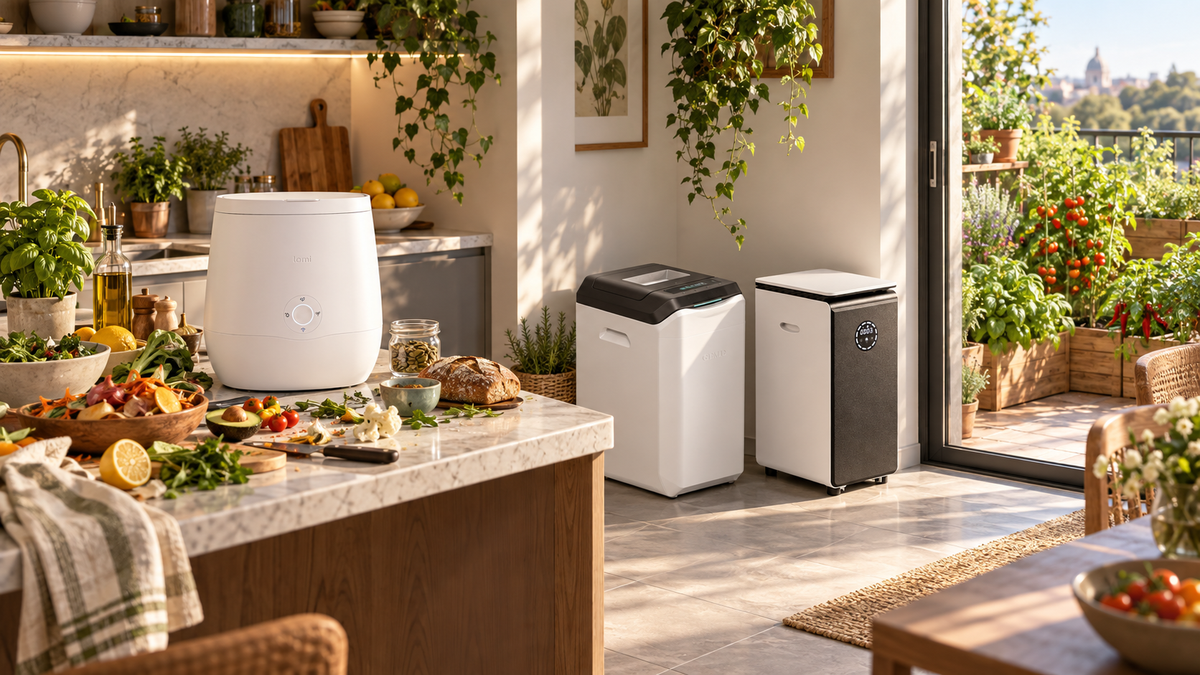
For most family kitchens, we think a floor-standing electric composter is the better form factor.
Countertop appliances are often marketed as “space-saving,” but a kitchen counter is not empty real estate. It is where vegetables are chopped, coffee is made, meals are plated, groceries are unpacked and everyday appliances already compete for room.
Putting a food-waste machine permanently on that surface does not eliminate its footprint. It simply moves the footprint onto one of the most valuable working areas in the kitchen.
A floor-standing composter does the opposite: it uses a small dedicated area near cabinetry, a pantry, refrigerator, island or waste station while leaving the preparation surface free.
The better question is not “Which machine is smallest?” It is “Which machine consumes the least valuable space in the kitchen?”
Quick Answer: Floor-Standing Is Better for Most Family Kitchens
Our recommendation is straightforward: if a kitchen has a practical floor position available, choose a floor-standing composter.
Countertop models preserve floor space, but they permanently occupy prep space. That trade-off becomes increasingly frustrating once the same counter also needs to accommodate a coffee machine, toaster, air fryer, fruit bowl, cutting board and normal meal preparation.
Floor-standing models move food-waste processing into its own zone instead. That is a more natural layout for an appliance used to receive scraps throughout the day.
GEME Terra 2 follows this approach deliberately. It measures approximately 297 × 437 × 566 mm, uses a 14 L microbial chamber, and supports up to 2 kg of suitable food scraps per day without permanently occupying the worktop.
Countertop can still make sense when no usable floor position exists. For a normal family kitchen, however, floor-standing is the more practical long-term architecture.

1. Our Verdict: Floor-Standing Is the Better Kitchen Architecture
Countertop Saves Floor Space. Floor-Standing Saves the Space You Actually Cook On.
For a household appliance that receives food waste every day, we think preserving the worktop is more valuable than preserving a small patch of otherwise unused floor.
This is an important distinction because not every square foot of a kitchen has the same value.
The countertop performs active work. It is used for:
- chopping and preparation;
- placing ingredients;
- serving meals;
- small appliances;
- hot cookware;
- coffee preparation;
- temporary grocery storage.
By contrast, floor space at the end of cabinetry, beside a refrigerator or near a waste station, often has no preparation function at all.
That makes floor-standing less about making the appliance “larger” and more about putting the appliance in the right category of kitchen space.
2. Counter Space Is More Valuable Than Floor Space
A 30 × 40 cm rectangle on the floor is not functionally equivalent to the same area on the countertop.
One may sit unused beside a cabinet. The other may represent a meaningful percentage of the surface available to prepare dinner.
| Kitchen Resource | Countertop Composter | Floor-Standing Composter |
|---|---|---|
| Preparation surface consumed | Yes | No |
| Competes with coffee machine / toaster / air fryer | Yes | No |
| Can use otherwise inactive floor space | No | Yes |
| Creates permanent visual clutter on worktop | More likely | Less likely |
| Integrates with trash / recycling zone | Less naturally | Yes |
| Internal volume constrained by upper cabinets | More constrained | Less constrained |
| Natural fit for continuous daily feeding | Possible | Strong fit |
Better metric: instead of asking how little space a machine occupies, ask how much valuable working space it removes from the kitchen.
3. Why “Countertop” Does Not Automatically Mean Space-Saving
The countertop label sounds compact because the appliance does not require a dedicated floor position.
But it still occupies physical volume every hour of the day, including when it is not running.
In a family kitchen, that often means another permanent object beside:
- the coffee maker;
- toaster;
- air fryer;
- knife block;
- fruit bowl;
- blender;
- and cutting board.
Lomi 3 is intentionally designed as a compact countertop food recycler, and Lomi says its current generation uses a 36% smaller footprint than the previous model while retaining a 3 L bucket.
That is useful engineering for a countertop product. But a smaller countertop footprint does not change the fundamental trade-off:
The appliance still occupies the surface where food is prepared.
For occasional batch processing, some households may accept that easily.
For an appliance involved in food-waste handling every day, we believe a dedicated floor position is the more logical architecture whenever the kitchen allows it.

4. Countertop vs Floor-Standing: How Current Products Compare
| Product | Approx. Dimensions | Form Factor | Practical Kitchen Effect |
|---|---|---|---|
| GEME Terra 2 | 297 × 437 × 566 mm 11.7 × 17.2 × 22.3 in |
Floor-standing | Narrow body, dedicated floor position, no permanent prep-counter use |
| GEME Pro | 320 × 455 × 665 mm | Floor-standing | Larger dedicated appliance for 4+ person households |
| Lomi 3 | 3 L bucket; current model has a 36% smaller footprint than its predecessor | Countertop | Saves floor space but permanently occupies countertop area |
| Reencle Prime | 305 × 331 × 467 mm Lid open: ~730 mm |
Compact freestanding / large-counter capable | Placement depends heavily on overhead lid clearance |
| Mill Essential | 17 × 14 × 23 in | Floor-standing | Bin-style dedicated floor placement |
| Mill Plus | 17 × 14 × 27 in | Floor-standing | Taller dedicated floor appliance |
The comparison shows something important: floor-standing is not unusual in modern food-waste appliances.
Mill also adopts a bin-style floor-standing architecture. Reencle sits between categories in physical size. Lomi is the clearest example of the countertop approach.
For Terra 2 specifically, Compost Magazine's independent reviewer initially tried a counter position but ultimately found floor placement more practical in that kitchen because of loading height. Read our summary of the Compost Magazine Terra 2 review .
5. Why Floor-Standing Works Better for a Daily Food-Waste Appliance
1. It Keeps Preparation Space Clear
The clearest advantage is also the simplest: there is nothing to move before chopping vegetables or preparing dinner.
A floor-standing composter can remain in its permanent location all day without reducing usable counter width.
2. It Creates a Dedicated Waste-Handling Zone
Food waste is already handled away from the primary prep surface once it leaves the cutting board.
A floor-standing composter can sit naturally near:
- a trash bin;
- recycling station;
- cabinet end;
- pantry;
- refrigerator side;
- or island end.
That turns composting into part of the kitchen's waste workflow rather than adding another appliance to the cooking zone.
3. It Reduces Countertop Clutter
Modern kitchens already accumulate appliances quickly.
Even visually attractive products can make a worktop feel crowded when several stay out permanently.
Moving a composter to the floor helps preserve a cleaner visual line across the kitchen.
4. It Allows a More Useful Internal Architecture
A machine designed to fit beneath upper cabinets has hard limits on overall height and volume.
A floor-standing system can devote more space to:
- a larger active chamber;
- airflow pathways;
- mixing hardware;
- insulation;
- sensors;
- odor treatment;
- and structural components.
That design freedom matters especially in a continuous microbial system.

6. Floor-Standing Makes Even More Sense for Continuous Composting
There is also a workflow difference between a batch food recycler and a continuous microbial composter.
A batch appliance may be loaded, run, emptied and left idle.
A continuous microbial composter maintains an active biological environment and accepts suitable scraps throughout normal daily use.
That makes the machine closer to a permanent kitchen utility than an occasional small appliance.
Fill → Run → Empty
A compact countertop format is easier to justify when the appliance operates as a discrete batch tool.
The trade-off is permanent countertop occupation between cycles.
Continuous Floor-Standing Model
A dedicated floor position suits an appliance that remains active and receives food scraps across breakfast, lunch, preparation and cleanup.
This is the architecture used by GEME Terra 2 and GEME Pro.
Terra 2 combines its floor-standing form with a 14 L microbial chamber and up to 2 kg/day of suitable food-waste capacity. GEME Pro increases that to a 19 L chamber and up to 5 kg/day for larger households.
For the underlying processing difference, see What Is an Electric Composter? .
7. What About Small Kitchens and Apartments?
It is tempting to assume that a small kitchen automatically favors a countertop composter.
We think that assumption is often backwards.
In a small kitchen, countertop space is usually more constrained, not less.
A compact kitchen may have only one useful preparation area. Permanently occupying part of that surface can create more daily friction than giving up a narrow floor position beside cabinetry.
| Small-Kitchen Situation | Our Recommendation |
|---|---|
| Very limited prep counter but a narrow floor position exists | Floor-standing |
| Unused position beside refrigerator or cabinet end | Floor-standing |
| Kitchen produces scraps throughout the day | Floor-standing continuous system |
| No usable floor position at all | Countertop may be necessary |
| Large unused countertop and very low food-waste volume | Countertop may be acceptable |
Terra 2's body is approximately 297 mm wide, less than 30 cm, so the relevant question is whether a household can find a narrow floor zone, not whether the appliance can be squeezed onto the counter.
8. When Does a Countertop Composter Still Make Sense?
Countertop is not inherently a bad format. It simply should not be treated as the default winner on space.
It can make sense when:
- there is genuinely no usable floor space;
- the kitchen has unusually abundant unused countertop space;
- food-waste volume is small;
- the appliance is used occasionally rather than continuously;
- the household specifically prefers a compact batch workflow;
- the owner wants the machine at counter height and accepts the permanent surface footprint.
Our distinction: countertop is a situational solution. Floor-standing is the form factor we think works better for most family kitchens.
9. Measure These Six Things Before Buying
1. Width
Measure the actual gap beside cabinets, appliances or walls.
2. Depth
Check how far the machine will project into a walkway or beyond adjacent cabinetry.
3. Closed Height
Important near shelves, counters and surrounding furniture.
4. Lid-Open Height
Do not measure only the closed appliance. Reencle Prime, for example, reaches roughly 730 mm with its large lid open.
5. Working Clearance
Allow space to stand in front, load scraps, harvest material, and clean around the machine.
6. Power Access
Choose a location with practical access to a suitable outlet rather than relying on a permanent extension-cord workaround.
10. Final Decision: Put the Composter on the Floor, Keep the Counter for Cooking
For most family kitchens, our recommendation is clear.
Choose floor-standing when a suitable floor position exists.
A floor-standing composter:
- protects preparation space;
- reduces permanent countertop clutter;
- fits naturally beside other waste-handling functions;
- allows a larger and less constrained internal architecture;
- works especially well with continuous daily feeding;
- and avoids turning a food-waste appliance into another object that must compete for the kitchen worktop.
Countertop saves floor space. Floor-standing saves the space your family actually cooks on.
If you are comparing individual machines rather than form factors, continue to Best Kitchen Composter: 5 Top Options Compared.
Designed to Live With the Kitchen, Not on the Kitchen Counter
Terra 2 uses a narrow floor-standing architecture to provide a 14 L continuous microbial chamber while keeping the preparation surface free. GEME Pro extends the same idea to larger households with a 19 L chamber and up to 5 kg/day capacity.
Frequently Asked Questions
Is a floor-standing composter better than a countertop composter?
For most family kitchens, we think so. Floor-standing models preserve valuable preparation surfaces and can use floor space that otherwise has little cooking value.
Why are countertop composters less practical in family kitchens?
They permanently occupy the same surface used for cutting boards, coffee machines, toasters, ingredients and meal preparation. In kitchens with limited counter space, that can create more daily inconvenience than using a dedicated floor position.
Does a countertop composter actually save space?
It saves floor space, but not total kitchen space. It relocates the appliance footprint onto the countertop. Whether that is beneficial depends on which type of space is more valuable in the kitchen.
Is GEME Terra 2 a countertop composter?
No. Terra 2 is intentionally positioned as a compact floor-standing microbial composter. It measures approximately 297 × 437 × 566 mm and uses a 14 L continuous microbial chamber.
How much floor space does GEME Terra 2 need?
Its body footprint is approximately 297 × 437 mm, or around 11.7 × 17.2 inches. Additional working clearance should be allowed for loading, lid movement, access and cleaning.
Is GEME Pro floor-standing?
Yes. GEME Pro measures approximately 320 × 455 × 665 mm and is designed as a dedicated floor-standing system for larger households and heavier food-waste loads.
Is Lomi 3 a countertop appliance?
Yes. Lomi positions Lomi 3 as a compact countertop food recycler and states that the current model has a 36% smaller footprint than its predecessor while retaining a 3 L bucket.
Is Mill floor-standing?
Yes. Mill Essential and Mill Plus are bin-style floor-standing food recyclers. Mill currently lists them at approximately 17 inches wide and 14 inches deep, with heights of 23 and 27 inches, respectively.
Can Reencle Prime sit on a countertop?
Its body is relatively compact, but practical placement depends on overhead clearance. Reencle lists Prime at approximately 305 × 331 × 467 mm and about 730 mm high with the large lid open.
Is floor-standing still better in a small kitchen?
Often, yes. Small kitchens frequently have especially limited preparation surfaces. If a narrow floor position exists beside cabinetry, a refrigerator or a waste station, using that space can preserve more useful working area than permanently occupying the countertop.
When should I choose a countertop composter instead?
Choose countertop when there is genuinely no practical floor position, you have abundant unused counter space, your food-waste volume is relatively small, or you specifically prefer a compact batch-processing appliance.
Does a larger exterior mean more processing capacity?
Not necessarily. Exterior size, chamber volume and daily processing throughput are different specifications. Compare the manufacturer's daily capacity rather than judging performance from dimensions alone.
Sources and Related Guides
Current Product References
- GEME — Terra 2 Technical Specifications
- GEME — Terra 2 vs GEME Pro Technical Comparison
- Lomi — Lomi 3 Form-Factor and Capacity Information
- Mill — Food Recycler Dimensions
- Reencle — Product Dimensions and Lid Clearance


Laisser un commentaire
Tous les commentaires sont modérés avant d'être publiés.
Ce site est protégé par hCaptcha, et la Politique de confidentialité et les Conditions de service de hCaptcha s’appliquent.