


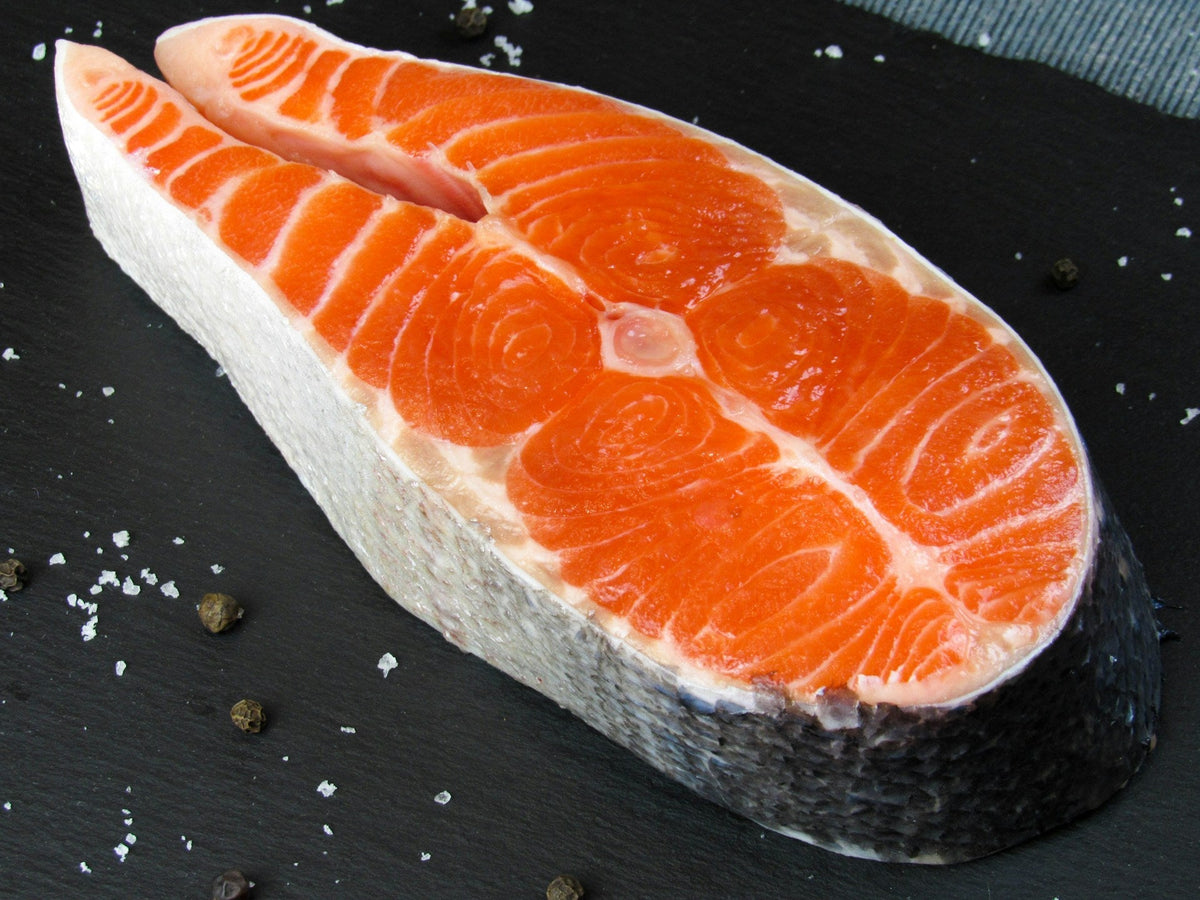
Salmon Storage · Raw Fish · Cooked Salmon · Freezing
Raw and cooked salmon do not have the same refrigerator life. For a simple household rule, raw salmon should generally be cooked or frozen within 1–2 days, while cooked salmon can usually be refrigerated for 3–4 days.
Keep salmon at 40°F / 4°C or below. If you will not cook fresh salmon within the short refrigerated window, freeze it early rather than waiting until its freshness becomes questionable.
Smoked salmon is a separate category. Its storage time depends on the processing method, packaging, whether the package has been opened, and the manufacturer's instructions.

How Long Does Salmon Last in the Fridge?
- Raw salmon: use or freeze within about 1–2 days for a conservative household rule.
- Cooked salmon: refrigerate for up to 3–4 days.
- Frozen raw salmon: fatty fish such as salmon is best quality within about 2–3 months.
- Frozen cooked salmon: USDA guidance gives cooked fish about 3 months for best quality.
- Smoked salmon: follow the package; some refrigerated vacuum-packed smoked salmon guidance is considerably shorter after opening.
- Room temperature: do not leave salmon out for more than 2 hours, or 1 hour above 90°F / 32°C.
Simple rule: raw salmon has a short refrigerator window; cooked salmon gets a few more days; freezing is the better choice when you will not use either in time.
1. Salmon Refrigerator and Freezer Storage Chart
| Salmon Type | Refrigerator | Freezer | Practical Rule |
|---|---|---|---|
| Raw fresh salmon | About 1–2 days | About 2–3 months for best quality | Cook or freeze promptly |
| Cooked salmon | 3–4 days | About 3 months for best quality | Refrigerate within 2 hours |
| Vacuum-packed refrigerated smoked salmon | Package-specific; USDA example: 7 days unopened, 2 days opened | About 2 months in USDA mail-order guidance | Follow the manufacturer's label when it is more specific |
| Shelf-stable smoked salmon, unopened | Not normally required until opened if truly shelf-stable | Product-specific | Follow package instructions exactly |
| Previously frozen salmon after thawing | Cook promptly | Quality may decline with repeated freezing | Keep refrigerated while thawing |
FoodSafety.gov currently lists fatty fish, including salmon, at 1–3 days refrigerated, while USDA FSIS consumer guidance says raw fish should generally be cooked or frozen within 1–2 days. For a simple household rule, this guide uses the more conservative 1–2 day range.
2. How Long Does Raw Salmon Last in the Fridge?
Plan to cook or freeze raw salmon within 1–2 days of purchase.
FDA likewise advises storing seafood at 40°F / 4°C or below and freezing it if it will not be used within about two days.
Raw fish is highly perishable. Buying salmon on Monday for a Friday dinner is therefore not a good refrigerator-storage plan.
How Long Is Salmon Good in the Fridge Before Cooking?
Use the same conservative rule: about 1–2 days.
If dinner plans change, freeze it while the salmon is still fresh rather than waiting for its condition to deteriorate.
Previously Frozen Salmon
“Previously frozen” does not mean salmon becomes unsafe when thawed properly, but it does mean the refrigerated period after thawing should be treated as short.
Thaw frozen salmon in the refrigerator and cook it promptly.

Do Not Stretch Raw Salmon Storage Based on Smell Alone
A mild smell does not prove that raw seafood has been stored safely. Time and temperature history matter even when obvious spoilage is absent.
3. How Long Does Cooked Salmon Last in the Fridge?
Cooked salmon can generally be refrigerated for 3–4 days.
USDA FSIS specifically states that cooked fish and other seafood can be safely stored in the refrigerator for 3–4 days.
How Long Can Cooked Salmon Stay in the Fridge?
The answer is the same: approximately 3–4 days, assuming the salmon was refrigerated promptly and kept at 40°F / 4°C or below.
How Long Is Cooked Salmon Good for in the Fridge?
Use a 3–4 day window rather than waiting until the fish begins to smell bad.
A simple timeline is:
- Day 0: cook, serve, cool, and refrigerate.
- Day 1–2: best time to prioritize the leftovers.
- Day 3–4: finish safely stored cooked salmon.
- Need longer? freeze before the refrigerator window ends.
- Day 5+: beyond the normal cooked-seafood storage recommendation.
How Long Can I Keep Cooked Salmon in the Refrigerator?
Three to four days is the practical answer for correctly handled leftovers.
For the wider leftover framework, see How Long Do Leftovers Last in the Fridge?.
Label the Cooking Date
Do not label the container with the most recent reheating date. Keep the original cooking date visible so the refrigerator clock remains clear.
4. How Long Does Smoked Salmon Last in the Fridge?
Smoked salmon should not be given one universal refrigerator number.
Cold-smoked salmon, hot-smoked salmon, vacuum-packed salmon, refrigerated lox, and shelf-stable smoked products can have different processing and storage requirements.
USDA's mail-order food-safety table gives one useful example for refrigerated vacuum-packed smoked salmon such as Nova lox:
- unopened: about 7 days refrigerated;
- opened: about 2 days;
- freezer: about 2 months for quality.
However, the package label should take priority when it provides more specific instructions.
Can You Freeze Smoked Salmon?
Yes, many smoked salmon products can be frozen.
USDA's vacuum-packed smoked salmon example gives approximately 2 months of freezer storage.
Texture may change slightly after thawing, so freezing is best done while the salmon is still high quality.
Smoked Salmon and Higher-Risk Groups
FDA advises people at increased risk of foodborne illness, including pregnant people and people with weakened immune systems, to avoid refrigerated smoked seafood unless it is cooked as part of a dish.
This is because refrigerated smoked seafood can present a Listeria monocytogenes risk.
5. Can You Freeze Salmon?
Yes. Freezing is the best option when fresh salmon will not be cooked within its short refrigerator window.
How Long Can Raw Salmon Stay Frozen?
FoodSafety.gov lists fatty fish such as salmon at approximately 2–3 months in the freezer for best quality.
That number is about quality rather than an automatic safety cutoff. Food kept continuously frozen at 0°F / -18°C remains safe much longer, but texture and flavor gradually decline.
Can You Freeze Cooked Salmon?
Yes.
USDA consumer guidance gives cooked fish approximately 3 months in the freezer for best quality.
Freeze cooked salmon while it is still safely within the refrigerator window, not after it has already become questionable.
How to Freeze Salmon
- Start with fresh or safely cooked salmon.
- Portion it according to future meals.
- Wrap tightly or use a freezer-safe airtight package.
- Remove excess air where practical.
- Label the freezing date.
- Keep the freezer at 0°F / -18°C or below.
Waste-prevention rule: if you already know you will not cook the salmon tomorrow or the next day, freezing it today is better than testing its freshness several days later.
6. How to Thaw Salmon Safely
The refrigerator is the simplest safe thawing method.
Move frozen salmon from the freezer to the refrigerator and allow it to thaw while staying cold.
Faster Methods
FDA also permits faster thawing by:
- placing sealed seafood in cold water; or
- using a microwave defrost setting when the fish will be cooked immediately afterward.
Do Not Thaw Salmon on the Counter
Room-temperature thawing allows the outer surface to warm while the center may still be frozen.
That creates unnecessary time in temperatures where bacteria can multiply quickly.
7. How to Tell If Salmon Has Gone Bad
Salmon can develop obvious spoilage signs, but appearance and smell should support, not replace, safe storage timelines.
FDA recommends avoiding seafood with sour, rancid, strongly fishy, or ammonia-like odors.
| What You Notice | What It Can Mean | Action |
|---|---|---|
| Fresh, mild odor | Normal fresh salmon characteristic | Still check storage time and temperature |
| Sour odor | Possible spoilage | Do not eat |
| Rancid or ammonia-like odor | Strong spoilage warning | Discard |
| Very strong abnormal fishy smell | Quality deterioration or spoilage | Do not eat |
| Slimy or unusually sticky surface | Possible deterioration | Discard when combined with questionable storage or other spoilage signs |
| Visible mold | Spoilage | Discard |
| Raw salmon stored too long | Time limit exceeded | Do not rely on appearance to extend the window |
| Cooked salmon beyond 3–4 days | Normal leftover guidance exceeded | Discard rather than taste-test |
Color Alone Is Not a Freshness Test
FDA specifically notes that fish color can be affected by diet, environment, processing, and packaging, so color by itself is not a reliable freshness indicator.
Do Not Taste-Test Questionable Salmon
If its refrigerator history already tells you not to eat it, tasting a small piece does not provide a meaningful safety check.
8. Cooking and Reheating Salmon Safely
Cooking Raw Salmon
FoodSafety.gov recommends cooking fish such as salmon to an internal temperature of 145°F / 63°C.
If you do not have a thermometer, FDA notes that properly cooked fish should no longer be translucent and should separate easily with a fork, but a food thermometer remains the more precise method.
Reheating Cooked Salmon
FoodSafety.gov lists 165°F / 74°C for reheating leftovers.

Reheating Cannot Repair Unsafe Storage
A cooked salmon fillet that has already spent too long at room temperature or too many days in the refrigerator does not become safe again simply because it reaches 165°F / 74°C.
9. Best Way to Store Salmon
Raw Salmon
- Refrigerate immediately after purchase.
- Keep it at 40°F / 4°C or below.
- Keep raw fish physically separated from ready-to-eat foods.
- Prevent leaking juices from contaminating other food.
- Cook or freeze within about 1–2 days.
Cooked Salmon
- Refrigerate within 2 hours of cooking or serving.
- Shorten that to 1 hour above 90°F / 32°C.
- Use a covered container.
- Label the cooking date.
- Eat within 3–4 days.
- Freeze sooner if you will not finish it.
Keep Raw and Cooked Salmon Separate
Raw seafood can contaminate cooked salmon and other ready-to-eat foods through cutting boards, utensils, hands, containers, or leaking juices.
FDA recommends washing hands, utensils, dishes, cutting boards, and countertops after contact with raw seafood.
For the wider refrigerator system, see the Food Storage & Waste Reduction Guide.
10. What to Do With Salmon You Cannot Eat
Food-safety failure and compostability are two separate questions.
Salmon that is no longer safe to eat can still be biodegradable organic material.
The practical sequence is:
- Store edible salmon correctly.
- Cook it within the safe window.
- Use cooked leftovers within 3–4 days.
- Freeze surplus before quality or safety becomes doubtful.
- Compost suitable unavoidable salmon waste through an appropriate system.
Can Salmon Go Into a Backyard Compost Pile?
Fish scraps are biodegradable, but ordinary backyard piles usually avoid meat and fish because they can create odor, attract animals, and break down poorly when the pile is not managed for animal food waste.
That does not mean salmon is biologically incapable of composting. It means the composting system matters.
See What Can You Compost at Home? for the full system-by-system comparison.
Can Spoiled Salmon Go Into GEME?
Yes. Ordinary spoiled salmon can be processed in GEME Terra 2 or GEME Pro once it is no longer being considered for eating.
Fish and fish scraps are part of the broader household food-waste range supported by GEME's managed microbial system.
- Remove plastic film, absorbent pads, trays, foil, labels, hooks, and other packaging.
- Add salmon flesh and ordinary meal leftovers in normal household amounts.
- Small suitable fish bones can remain in the system longer.
- Keep each individual addition at 1 kg or less.
- Terra 2 supports up to 2 kg/day of suitable household scraps.
- GEME Pro supports up to 5 kg/day.
For the complete meat, dairy, fish, and bone input framework, see What Can You Put in an Electric Composter? Meat, Dairy & Bones.
For heavily sauced, salty, or oily salmon leftovers, use Electric Composter Salt & Oil Boundaries: What to Drain First.
Unsafe to Eat Does Not Mean Unsuitable for Microbial Composting
Ordinary spoilage changes whether salmon should be eaten; it does not make the organic material incapable of biological decomposition. Remove packaging and follow GEME's normal loading, liquid, oil, salt, and bone boundaries.
Keep Salmon Cold. Freeze Early. Compost What Truly Becomes Waste.
Raw salmon has a short refrigerator life, while cooked salmon gives you a little more time. Store it correctly, freeze surplus before the safe window closes, and use GEME Terra 2 or GEME Pro for suitable unavoidable fish scraps after edible-use options are exhausted.
11. Frequently Asked Questions
How long does salmon last in the fridge?
For a conservative household rule, raw salmon should generally be cooked or frozen within 1–2 days. Cooked salmon can usually remain refrigerated for 3–4 days when stored promptly at 40°F / 4°C or below.
How long does cooked salmon last in the fridge?
Cooked salmon generally lasts 3–4 days in the refrigerator when it was refrigerated promptly after cooking and kept at 40°F / 4°C or below.
How long can cooked salmon stay in the fridge?
About 3–4 days. Count from the original cooking date rather than from the most recent reheating.
How long is salmon good in the fridge?
Raw salmon has a much shorter refrigerator window than cooked salmon. Use or freeze raw salmon within about 1–2 days; use cooked salmon within 3–4 days.
How long can salmon stay in the fridge?
Raw salmon should generally stay refrigerated for only about 1–2 days before cooking or freezing. Cooked salmon can usually remain refrigerated for 3–4 days.
How long is cooked salmon good for in the fridge?
Cooked salmon is generally good for 3–4 days when safely refrigerated.
How long will salmon last in the fridge?
Raw salmon: about 1–2 days as a conservative household rule. Cooked salmon: about 3–4 days. Smoked salmon depends on packaging and whether it has been opened.
How long can I keep cooked salmon in the refrigerator?
Keep cooked salmon for no more than about 3–4 days under normal refrigerated leftover guidance.
Can you freeze salmon?
Yes. Freezing is recommended when raw salmon will not be cooked within its short refrigerated window. FoodSafety.gov lists salmon and other fatty fish at about 2–3 months frozen for best quality.
Can you freeze cooked salmon?
Yes. Cooked salmon can be frozen. USDA guidance gives cooked fish approximately 3 months in the freezer for best quality.
Can you freeze smoked salmon?
Yes, many smoked salmon products can be frozen. USDA's refrigerated vacuum-packed smoked salmon example gives about 2 months frozen. Follow product-specific packaging instructions when available.
How long does smoked salmon last in the fridge?
It depends on processing and packaging. USDA's mail-order guidance for vacuum-packed smoked salmon such as Nova lox gives about 7 days refrigerated unopened and 2 days after opening. Always follow the package when it gives a more specific limit.
Can salmon be left out for two hours?
Seafood should not remain at room temperature longer than 2 hours, or longer than 1 hour when the surrounding temperature exceeds 90°F / 32°C.
What temperature should salmon be cooked to?
FoodSafety.gov recommends cooking fish such as salmon to 145°F / 63°C.
What temperature should cooked salmon leftovers reach when reheated?
Reheat leftovers to 165°F / 74°C.
Can spoiled salmon go into GEME?
Yes. Ordinary spoiled salmon can be processed as food waste in GEME Terra 2 or GEME Pro. Remove packaging, avoid excessive free liquid or concentrated oil, follow normal loading limits, and treat large or dense bones according to current product guidance.
12. Authoritative Sources and Related Guides
- U.S. FDA — Selecting and Serving Fresh and Frozen Seafood Safely
- USDA FSIS — How Long Can You Store Fish?
- USDA FSIS — How Long Can You Keep Cooked Fish in the Refrigerator?
- FoodSafety.gov — Cold Food Storage Chart
- FoodSafety.gov — Safe Minimum Internal Temperatures
- USDA FSIS — Mail Order Food Safety: Smoked Salmon Storage




Laisser un commentaire
Tous les commentaires sont modérés avant d'être publiés.
Ce site est protégé par hCaptcha, et la Politique de confidentialité et les Conditions de service de hCaptcha s’appliquent.