
Food Safety Cluster · Status Checked July 24, 2026
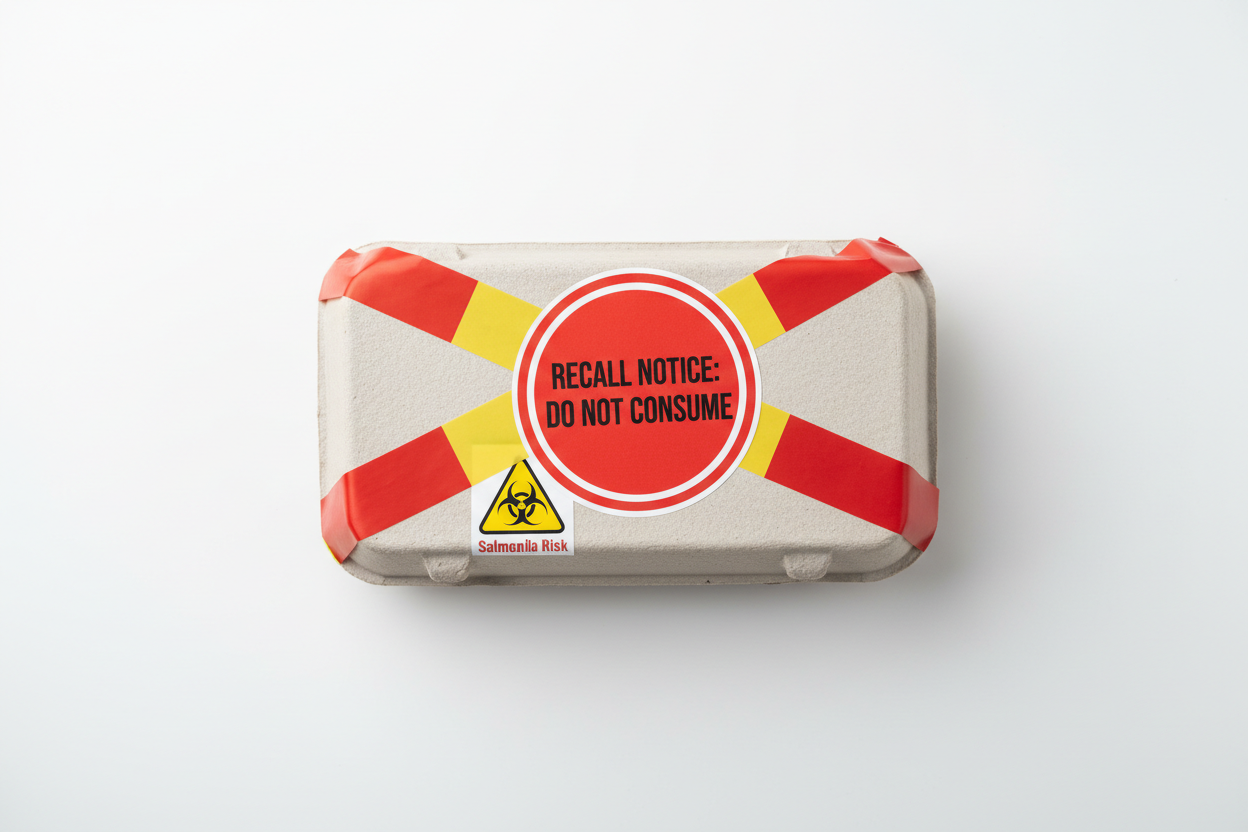
FDA published a recall notice on July 22, 2026, covering 1,589,577 dozen white shell eggs and brown cage-free shell eggs produced by Midwest Poultry Services, L.P. in Texas because they may be contaminated with Salmonella Enteritidis.
The recall covers specific Kroger, Simple Truth, Brookshire’s, Country Morning and Sunups cartons, together with several foodservice bulk formats. Affected eggs carry plant code P-1950 or 0840962, Julian dates 157 through 184, and sell-by or best-by dates from July 20 through August 17, 2026.
This is a product-specific recall. It does not mean every egg sold in the United States is recalled. Start with the carton code, not the shell color or retailer name alone.
Fast Carton Check
P-1950 or 0840962
157–184
July 20–August 17, 2026
Do not eat or compost it. Return it to the original place of purchase.
What Is the July 2026 Egg Recall?
Midwest Poultry Services voluntarily recalled more than 1.58 million dozen shell eggs because of possible Salmonella Enteritidis contamination. That equals approximately 19.1 million individual eggs.
The eggs were produced and distributed from Texas farms between June 6 and July 3, 2026. FDA says the company identified the issue through environmental monitoring and root-cause analysis. As of the announcement, no specific illnesses had been linked to these products.
Consumers should compare the brand, package size, UPC, plant code, Julian date and sell-by or best-by date. If the carton matches, do not eat the eggs, do not attempt to make them safe by cooking, and do not place them in a backyard pile, worm bin or household composter.
For the wider prevention framework, continue to the GEME Food Safety Guide.
Egg Recall 2026: Current Status
FDA Recall Date
July 22, 2026
Food recall for possible Salmonella Enteritidis contamination.
Recall Volume
1,589,577 dozen
Approximately 19.1 million eggs by calculation.
Illness Status
No specific illnesses reported by the company
This may change as public-health information is updated.
Recall Does Not Automatically Mean a Confirmed Outbreak
The FDA notice is a precautionary recall based on potential contamination. At the time this article was checked, the FDA notice stated that the company was not aware of specific illnesses linked to the recalled eggs.
A recall can occur before illnesses are identified, and an outbreak investigation can begin later if epidemiologic, traceback or laboratory evidence connects illnesses to the product.
Because recall information can expand, recheck the FDA recall page before relying on a saved screenshot, social-media post or older article.
Table of Contents
- Which Eggs Were Recalled?
- Full Retail Product List
- Foodservice Bulk Products
- States and Stores
- How to Check an Egg Carton
- What to Do With Recalled Eggs
- What If You Already Ate Them?
- Salmonella Symptoms
- Safe Egg Handling
- Can Recalled Eggs Be Composted?
- Continue Through the Food Safety Cluster
- Frequently Asked Questions
- Bottom Line
- Sources
- Related Articles
Which Eggs Were Recalled for Salmonella in July 2026?
The recall covers specific white shell eggs and brown cage-free shell eggs produced by Midwest Poultry Services at two Texas farms. The affected products include consumer cartons and bulk foodservice cases.
Plant Code
P-1950 or 0840962
Julian Date
157 through 184
Sell-By / Best-By
July 20 through August 17, 2026
No other Midwest Poultry Services products were identified in the FDA notice as part of this recall.
Full Retail Product List
Use the table below together with the plant code, Julian date and sell-by or best-by range printed on the carton.
| Brand | Product | UPC | Plant Code |
|---|---|---|---|
| Kroger | Large, 12 eggs | 011110609038 | P-1950 or 840962 |
| Kroger | Large, 18 eggs | 011110609335 | P-1950 or 840962 |
| Kroger | Large, 60 eggs | 011110609144 | P-1950 |
| Kroger | Extra Large, 12 eggs | 011110609045 | P-1950 or 840962 |
| Kroger | Medium, 12 eggs | 011110609021 | P-1950 or 840962 |
| Kroger | Medium, 30 eggs | 011110609809 | P-1950 |
| Kroger | Jumbo, 12 eggs | 011110609052 | P-1950 or 840962 |
| Simple Truth | Cage Free Medium Brown, 12 eggs | 011110870230 | P-1950 |
| Simple Truth | Cage Free Large Brown, 12 eggs | 011110797704 | P-1950 |
| Simple Truth | Cage Free Large Brown, 18 eggs | 011110893109 | P-1950 |
| Simple Truth | Cage Free Large Brown, 24 eggs | 011110150974 | P-1950 |
| Brookshire’s | Large, 6 eggs | 092825095644 | P-1950 |
| Brookshire’s | Large, 12 eggs | 092825095552 | P-1950 |
| Brookshire’s | Large, 18 eggs | 092825095569 | P-1950 |
| Brookshire’s | Large, 36 eggs | 092825109808 | P-1950 |
| Brookshire’s | Large, 60 eggs | 092825095637 | P-1950 |
| Brookshire’s | Extra Large, 18 eggs | 092825095606 | P-1950 |
| Brookshire’s | Jumbo, 12 eggs | 092825095583 | P-1950 |
| Country Morning | Large, 12 eggs | 078566200004 | P-1950 |
| Country Morning | Large, 18 eggs | 078566005036 | P-1950 |
| Country Morning | Large, 2½ dozen | 079307005162 | P-1950 |
| Country Morning | Extra Large, 12 eggs | 078566001021 | P-1950 |
| Country Morning | Medium, 12 eggs | 078566001045 | P-1950 |
| Country Morning | Jumbo, 12 eggs | 078566001014 | P-1950 |
| Sunups | Medium, 2½ dozen | 028621304987 | P-1950 |
All Rows Share the Same Date Window
The recalled Julian date range is 157–184 and the recalled sell-by or best-by range is July 20–August 17, 2026.
Foodservice and Bulk Eggs Included in the Recall
Restaurants, caterers, institutions and other foodservice operators should check bulk cases carrying plant code P-1950, Julian dates 157–184 and the same date window.
- Grade AA Large Bulk × 30 dozen
- Grade A Large Bulk × 15 dozen
- Grade A Large Bulk — TICTAC
- Grade A Large Bulk — Brown — TICTAC
- Grade A Medium Bulk × 30 dozen
- Grade A Medium Bulk × 15 dozen
- Grade A Extra Large Bulk × 15 dozen
- Grade A Jumbo Bulk, 20 eggs
Where Were the Recalled Eggs Sold?
FDA says the eggs were shipped to foodservice and retail customers in Texas, Oklahoma and Louisiana.
| Retailer / Channel | States Listed by FDA |
|---|---|
| Kroger | Texas and Louisiana |
| Brookshire Grocery stores | Texas, Oklahoma, Arkansas, Louisiana, New Mexico and Mississippi |
| Other smaller outlets | Identify the carton by code rather than relying only on retailer name. |
How to Check Whether Your Eggs Are Recalled
1. Keep the Carton
The carton contains the brand, UPC, plant code, Julian date and sell-by or best-by date.
2. Find the Plant Code
Look on the left or right side of the carton for P-1950 or 0840962. Some FDA table entries display the second code as 840962.
3. Check the Julian Date
The recalled range is 157 through 184.
4. Confirm the Date and UPC
Match the sell-by or best-by date and compare the package UPC with the product list.
5. When in Doubt, Do Not Use the Eggs
Keep the product isolated, contact the retailer or Midwest Poultry Services, and verify before cooking, serving, donating or disposing of the eggs.
What Should You Do With Recalled Eggs?
- Do not eat the eggs. Do not cook, bake, taste or serve them.
- Keep the carton for identification. Photograph the UPC, plant code, Julian date and date code if useful.
- Prevent leaks and cross-contamination. Place the carton inside a clean secondary bag or container.
- Return the product. FDA directs consumers to return recalled eggs to the original place of purchase for a full refund.
- Clean contacted surfaces. Wash hands, utensils, refrigerator shelves, containers and work surfaces with hot, soapy water.
- Do not compost the eggs or carton. Keep them together for return or follow local disposal instructions when return is impossible.
Recall Contact
Phone: 574-405-9531, Monday–Friday, 8:00 a.m.–4:30 p.m. Eastern Time
Email: recallassistance@mpseggs.com
After cleaning the refrigerator, review the Food Storage and Waste Reduction Guide.
What If You Already Ate the Recalled Eggs?
Do not panic, but stop using the remaining eggs and keep the carton information. Not every potentially contaminated egg will cause illness, and the FDA notice did not report specific linked illnesses at publication.
Monitor for symptoms during the period when Salmonella illness can develop. If symptoms appear, contact a healthcare professional and explain that you may have eaten eggs included in an FDA recall.
Do Not Continue Eating a Dish Made With Recalled Eggs
Thorough cooking is an important everyday control for non-recalled eggs, but it is not a reason to keep or consume a product that FDA says should be returned.
Salmonella Symptoms and When to Seek Medical Care
CDC says symptoms usually begin 6 hours to 6 days after infection and typically last 4 to 7 days.
Common Symptoms
- Diarrhea, sometimes bloody or with mucus
- Stomach cramps
- Fever
- Nausea or vomiting
- Headache or loss of appetite
Higher-Risk Groups
- Children younger than 5
- Adults 65 and older
- People with weakened immune systems
- People at increased risk from dehydration or invasive infection
Contact a Doctor When
- Diarrhea or vomiting lasts more than 2 days.
- There is blood in stool, diarrhea or urine.
- Fever is higher than 102°F / 38.9°C.
- There are signs of dehydration, such as little urination, very dark urine, intense thirst, dry mouth, dizziness or crying without tears.
- Symptoms are severe, worsening or affecting a high-risk person.
Safe Egg Handling After the Recall
Eggs not included in the recall still require normal controls. FDA notes that even clean, uncracked shell eggs may contain Salmonella.
| Step | Safe Practice |
|---|---|
| Buying | Buy refrigerated eggs and avoid cartons with cracked or dirty shells. |
| Refrigerating | Store promptly at 40°F / 4°C or below in the original carton. |
| Preparing | Wash hands, utensils and surfaces with hot, soapy water before and after raw-egg contact. |
| Cooking shell eggs | Cook until both yolk and white are firm. |
| Cooking egg dishes | Cook dishes such as quiche or frittata to 160°F / 71°C. |
| Raw or lightly cooked recipes | Use pasteurized shell eggs or pasteurized egg products. |
Can Recalled Eggs Be Used for Compost?
No. Do not put eggs included in this recall into a backyard compost pile, worm bin, municipal organics cart unless the local authority explicitly instructs you to do so, or a GEME household composting system.
This is a safety boundary for recalled food. FDA directs consumers to avoid consumption and return the product. Household composting should not be used as a substitute for the recall pathway.
| Material | Guidance | Reason |
|---|---|---|
| Recalled raw eggs | Do not compost. Return or follow local disposal instructions. | Potential Salmonella contamination and recall requirements. |
| Food made with recalled eggs | Do not place in home compost or GEME. | The recalled ingredient remains part of the dish. |
| Recalled carton | Keep with the eggs for identification and return. | The carton contains identifying codes and may have contacted the eggs. |
| Clean shells from non-recalled eggs | May be composted according to normal system guidance. | This is ordinary household material, not recalled food. |
Why Not Rely on a Home Compost Pile to Kill Salmonella?
A properly managed hot pile can reach temperatures that reduce germs, but home piles are uneven. Not every part reliably reaches or maintains the necessary temperature, and all material must enter the hot center.
The safer approach is to keep potentially contaminated recalled food out of compost that may later be handled or used around edible crops.
Important GEME Boundary
GEME can normally process many appropriate kitchen scraps, including eggshells and small egg residues under ordinary guidance. That does not mean a recalled product should be diverted into the machine.
For ordinary, non-recalled materials, read How to Compost Eggshells and What Can You Put in an Electric Composter?.
Continue Through the Food Safety Cluster
This recall article answers the immediate question. The following guides cover the systems that prevent future food-safety and food-waste problems.
Frequently Asked Questions
Which eggs were recalled in July 2026?
Midwest Poultry Services recalled specific Kroger, Simple Truth, Brookshire’s, Country Morning and Sunups shell eggs, plus foodservice bulk formats, because of possible Salmonella Enteritidis contamination.
What codes identify the FDA recalled eggs?
Plant code P-1950 or 0840962, Julian dates 157–184 and sell-by or best-by dates between July 20 and August 17, 2026. Also match the brand, package size and UPC.
How many eggs are in the recall?
1,589,577 dozen, equivalent to approximately 19,074,924 individual eggs.
Were illnesses linked to the recalled eggs?
The company announcement posted by FDA stated that Midwest Poultry Services was not aware of specific illnesses linked to its products at the time of the notice.
Can I cook recalled eggs thoroughly and still eat them?
No. FDA’s recall instruction is to avoid consumption and return the affected product. Cooking should not be used to override a recall.
Can recalled eggs be composted?
No. Do not put recalled eggs or foods made with them into backyard compost, vermicompost or GEME. Follow the recall return or local disposal pathway.
Can non-recalled eggshells be composted?
Yes. Clean shells from ordinary non-recalled eggs can generally be crushed and composted according to the rules of the specific system.
What are the symptoms of Salmonella?
Common symptoms include diarrhea, stomach cramps and fever. Nausea, vomiting, headache and loss of appetite may also occur. Symptoms usually begin 6 hours to 6 days after infection.
How should non-recalled eggs be cooked safely?
Cook shell eggs until both yolk and white are firm. Egg dishes should reach 160°F / 71°C, and recipes served raw or lightly cooked should use pasteurized eggs or egg products.
Bottom Line
The July 2026 egg recall covers specific cartons and foodservice cases, not every egg on the market.
Check for plant code P-1950 or 0840962, Julian dates 157–184 and dates from July 20 through August 17, 2026. Then confirm the brand, package size and UPC.
If your eggs match, do not eat, cook, donate or compost them. Return the carton, clean contacted surfaces and monitor for symptoms if exposure may already have occurred.
For non-recalled eggs, refrigerate promptly, prevent cross-contamination, cook yolks and whites until firm, and cook egg dishes to 160°F / 71°C.
Sources
- FDA — Midwest Poultry Services Shell Egg Recall
- FDA — Recalls, Market Withdrawals & Safety Alerts
- FDA — What You Need to Know About Egg Safety
- CDC — Symptoms of Salmonella Infection
- CDC — About Salmonella Infection
- CDC — Salmonella Outbreak Investigations
- FoodSafety.gov — Safe Minimum Internal Temperatures
- U.S. EPA — Composting at Home
- CalRecycle — Home Composting and Temperature Guidance


Commenta
Questo sito è protetto da hCaptcha e applica le Norme sulla privacy e i Termini di servizio di hCaptcha.