
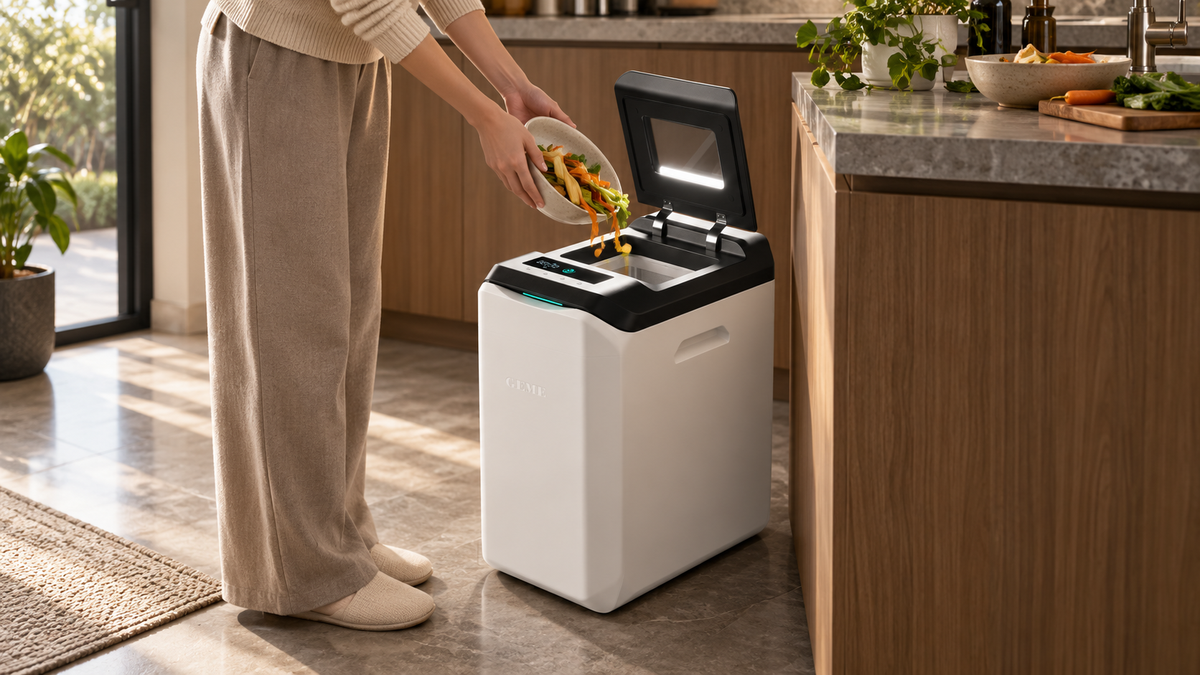
Batch Cycles · Continuous Feeding · Daily Kitchen Routine
Breakfast, lunch, and dinner scraps do not appear on a processing schedule. The question is whether your machine expects food to fit around its cycle, or whether the processing system is designed around food arriving throughout the day.
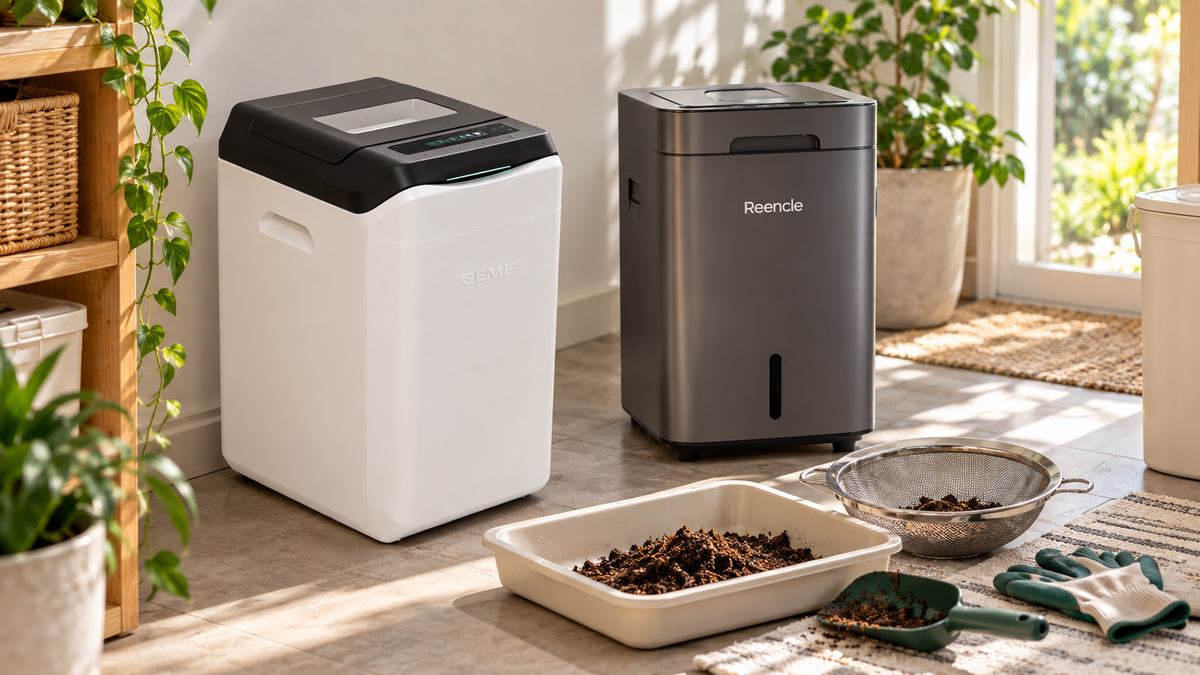
That sounds like a simple “batch versus continuous” distinction, but current machines are more nuanced. Some batch recyclers can be paused so you can add more food. Mill uses scheduled Dry & Grind cycles but allows scraps to be added mid-cycle. Reencle and GEME use ongoing microbial beds designed to receive food repeatedly without starting a new isolated batch after each meal.
The useful buying question is therefore not only “Can I physically open the lid?” It is “What happens to the process when I do?”
Quick Answer: Can I Add Scraps After Every Meal?
Yes, with a true continuous-feed microbial system such as GEME or Reencle: breakfast, lunch, and dinner scraps can join an existing living bed during normal daily operation, within the model's feeding limits.
Cycle-based machines require more nuance:
- Lomi 3: it still operates in discrete cycles, but its current manual allows you to pause a running cycle, add more food, close the lid, and resume. Adding material late or adding too much moisture may mean another cycle is needed.
- FoodCycler Eco 5: its normal workflow is load → run a 4–9 hour cycle → output, but the current manual allows additional food during phases 1–3 by opening the lid to pause. Later additions can affect the finished by-product.
- Mill: it is a scheduled Dry & Grind food recycler rather than a continuous microbial composter, yet current Mill guidance explicitly allows food to be added while a Dry & Grind cycle is running. The machine may extend the cycle to process the new material.
- Reencle: food enters an existing microbial bed continuously. Opening the lid temporarily stops the stirring rod; it resumes after the lid closes.
- GEME Terra 2 / Pro: there is no meal-by-meal batch cycle to start. Add suitable scraps progressively; opening the lid stops the stirring mechanism for safety, while the biological bed itself remains in place.
The real distinction is therefore isolated processing cycles versus an ongoing biological environment.
For a brand-by-brand look at everyday ownership, continue to our daily operation comparison of Lomi, Mill, Reencle, and GEME. For the larger buying journey, start with the Electric Composter Comparison Hub.
1. Breakfast, Lunch, and Dinner: What Happens in One Real Day?
Specifications such as chamber liters and cycle hours are useful, but they do not show the part of ownership you feel every day.
Food scraps appear repeatedly. Coffee grounds and eggshells arrive in the morning. Vegetable trimmings appear at lunch. Meat scraps, rice, peels, leftovers, and plate waste show up at dinner.
Breakfast
Coffee grounds, fruit peel, eggshells, toast scraps.
Batch logic: place scraps in the bucket and decide whether to start a cycle now or collect more first.
Continuous-bed logic: open the lid, add an appropriate amount, close it, and leave the existing biological bed working.
Lunch
Vegetable ends, rice, sandwich scraps, leftovers.
Batch logic: if a cycle is active, the exact next step depends on that model: wait, pause and add, or add mid-cycle.
Continuous-bed logic: lunch scraps join the same active microbial environment used at breakfast.
Dinner
Preparation waste, cooked leftovers, meat or dairy, and larger total volume.
Batch logic: you may need another load, more cycle time, or temporary scrap storage if the bucket is already committed.
Continuous-bed logic: add progressively within the model's daily and per-feed limits.

This is the practical reason continuous feeding matters. It is not primarily about claiming that a machine “runs all the time.” It is about whether new food can join the system without creating a new processing job for the user.
2. Do Not Reduce This to Only “Batch” and “Continuous”
Modern food-waste appliances now occupy at least three useful operating categories.
1. Cycle-Based Batch
Food is collected into a bucket, a defined process is started, and the appliance moves through stages such as drying, grinding, and cooling.
The cycle remains the organizing unit, even if the machine can technically be paused.
2. Cycle-Based but Mid-Cycle Accessible
The machine still processes food through a cycle, but current controls may allow users to pause or open the machine and add more material.
Lomi 3, FoodCycler Eco 5, and Mill each demonstrate a different version of this behavior.
3. Continuous Microbial Bed
The chamber contains a persistent living bed. New food joins partially decomposed material, microbes, moisture, and older Compost Base.
Reencle and GEME operate around this biological continuity rather than isolated meal-by-meal processing cycles.
This distinction prevents a common comparison error.
A machine can allow its lid to open during a cycle without becoming a continuous biological composter. Likewise, a continuous composter can stop its mechanical stirrer whenever the lid opens while remaining biologically continuous.
3. Batch vs Continuous Electric Composters: How Current Models Actually Behave
Here is the more accurate cross-brand comparison.
| System | Processing Logic | Can You Add During Processing? | What Opening the Lid Means | Between Meals |
|---|---|---|---|---|
| Lomi 3 | Cycle-based. Express and Grow are defined processing cycles. | Yes, with interruption. Current manual says to pause using the Start button, add scraps, then resume. | Opening during a cycle pauses the cycle. Close the lid and press Start to resume. | You can collect scraps and add them to a batch, but later additions may change moisture and can require another cycle. |
| FoodCycler Eco 5 | Cycle-based. Drying, grinding, and cooling; approximately 4–9 hours per cycle. | Conditionally. Current manual allows additions during phases 1–3. | Opening the lid pauses the cycle. Late-cycle additions can reduce by-product quality and may require another cycle. | Manufacturer guidance also suggests collecting food in the removable bucket until ready to run a cycle. |
| Mill Plus / Mill | Scheduled Dry & Grind. Normally runs at a scheduled time and adapts duration to the load. | Yes. Mill explicitly allows scraps to be added while Dry & Grind is running. | Unlock and add food. The system can extend Dry & Grind time to process the new material. | Add throughout the day; processing still follows Mill's scheduled drying-and-grinding cycle logic. |
| Reencle Prime / Gravity | Continuous microbial bed. | Yes. Add food regularly within the model's daily limits. | Magnetic safety sensing stops the stirring rod whenever a lid is open. Reencle says rotation resumes roughly 10–15 seconds after full closure. | Breakfast, lunch, and dinner can enter the same established microbial environment. |
| GEME Terra 2 / Pro | Continuous aerobic microbial bed. | Yes. Add suitable scraps during normal operation within daily and single-addition limits. | Opening the lid stops the stirring mechanism immediately for safety. Continuous feeding does not mean moving parts continue while the lid is open. | No cycle selection or meal-by-meal restart. New scraps join the active Kobold™ bed progressively. |
The table reveals why a simple checkbox reading “can add mid-cycle: yes/no” is not enough.
Lomi, FoodCycler, and Mill can all permit additional food under certain operating conditions, yet their processing logic remains fundamentally cycle-oriented. Reencle and GEME instead maintain a resident microbial environment between additions.
Current manufacturer references: Lomi 3 User Guide; FoodCycler Eco 5 User Manual; Mill Dry & Grind guidance; Reencle continuous-processing and lid guidance; GEME operating manual and FAQ.
4. What Actually Happens When You Open the Lid Mid-Process?
This is where the words continuous feed are often misunderstood.
They do not mean:
- the motor must keep turning while your hand is near the chamber;
- heaters must remain active without interruption;
- every mechanism operates every second of the day; or
- safety interlocks are bypassed.
Continuous feeding describes the workflow and biological process, not unsafe uninterrupted mechanical motion.
GEME Terra 2 and Pro
During normal daily use, opening the lid stops the stirring mechanism immediately. The user adds suitable food, closes the lid, and the appliance returns to normal operation.
The important point is that the microbial bed was not reset. Breakfast material, older Compost Base, active microorganisms, moisture, and incoming lunch scraps remain part of one continuous system.
Reencle
Reencle uses a similar lid-safety principle. Its current Prime and Gravity guidance says a magnetic sensor stops the stirring rod whenever either lid is open, with stirring resuming shortly after full closure.
Lomi 3
Lomi 3 takes a different approach because the cycle remains the organizing framework. Its current user guide says food can be added to a running cycle by pausing Lomi.
Opening the lid during a cycle pauses the process; after closing, the user presses Start to resume.
FoodCycler Eco 5
Eco 5 also pauses when its lid is opened. Its manual permits additional waste during phases 1–3, while warning that later additions can affect the by-product and may require another cycle.
Mill
Mill is the useful exception to a simplistic batch-versus-continuous chart. Its Dry & Grind process is cycle-based, but current support guidance says you can unlock the lid and add scraps while the cycle is running.
The trade-off is processing time: adding fresh material, particularly late in the cycle, can extend Dry & Grind.

5. Why an Active Microbial Bed Changes More Than Convenience
The bigger difference between continuous and batch systems is what exists inside the machine between meals.
| Concept | Cycle-Based Bucket | Continuous Microbial Bed |
|---|---|---|
| What organizes the process? | A defined cycle: load → process → finish. | A persistent biological environment operating across many additions. |
| Age of material inside | Material generally enters the active cycle as one load, although some models allow additions. | Fresh scraps, partially decomposed food, and older material coexist. |
| What happens after breakfast? | The user decides when to run or resume the next processing cycle. | The established ecosystem remains active while more scraps arrive later. |
| What happens after lunch? | Add to the waiting bucket, pause an active cycle, or extend an existing cycle, depending on the model. | Add lunch scraps to the same active bed within feeding limits. |
| What happens after dinner? | Capacity and cycle status determine whether the load can be processed immediately. | Add progressively, provided daily capacity, single-feed limits, bed moisture, and fill level remain appropriate. |
| Does opening the lid end continuity? | It can pause or interrupt the active mechanical cycle. | Mechanical stirring can stop for safety without destroying the resident microbial ecosystem. |
| Harvest logic | Output normally follows completion of one or more processing cycles. | Harvest part of the accumulated material while keeping the active bed operating. |
The GEME Advantage Between Meals
For households that cook repeatedly through the day, GEME removes three small decisions from the routine:
- No need to decide whether this meal is enough to justify a cycle.
- No need to select or restart a processing mode after every addition.
- No need to empty the chamber after each completed operating cycle.
Instead, food joins the existing Kobold™ microbial bed and GEMEBrain™ manages chamber conditions in the background.
Terra 2 accepts suitable scraps throughout normal daily use, up to 2 kg/day, with each addition kept at 1 kg or less.
GEME Pro uses the same daily logic with more headroom: up to 5 kg/day, again with individual additions kept at 1 kg or less.
Continuous feed is not permission to overload. Smaller progressive additions are exactly what make a continuous household workflow useful. Daily capacity, each-addition limits, moisture condition, and the chamber's fill level still matter.
6. When a Batch Electric Food Recycler Can Still Make Sense
Continuous feeding is useful, but it is not automatically the right answer for every household.
You Generate Small, Predictable Loads
If you cook lightly, accumulate one small bucket over a day or two, and are happy to run a processing cycle when convenient, batch operation may fit perfectly well.
You Primarily Want Volume Reduction
If the goal is to turn wet scraps into a smaller, drier material for later handling, a drying-and-grinding recycler may solve the job directly.
The U.S. EPA distinguishes these residential preprocessing appliances from biological composting: grinding and dehydrating reduce the weight and volume of food scraps, but the resulting material is not the same thing as biologically stable compost.
You Want a Small Countertop Appliance
Lomi 3 and FoodCycler occupy a different physical category from floor-standing microbial systems. A household with very little floor space may reasonably prefer a compact countertop recycler despite the cycle-based workflow.
You Are Comfortable Planning Around Cycles
A cycle is only inconvenient if it conflicts with the way you cook. Someone who routinely loads a machine after dinner and runs it overnight may not care whether the system is continuous.
The problem arises when marketing makes every operating model sound identical. They are not.
7. Continuous Does Not Mean “Add Anything, Anytime, in Any Amount”
A continuous microbial system still has operating boundaries.
During Initial Microbial Setup
A newly hydrated GEME microbial bed needs its initial stabilization window. During that startup period, follow the current setup instructions rather than treating the chamber as already established for normal continuous feeding.
When the Bed Is Too Wet
A heavily wet bed may need moisture correction and temporarily reduced feeding. Continuous does not mean ignoring the condition of the microbial environment.
When the Maximum Fill Level Is Reached
Stop treating “continuous” as unlimited storage. Harvest appropriate mature-looking material while preserving the living starter bed.
When Daily Capacity Has Already Been Reached
Terra 2's up-to-2-kg/day specification and GEME Pro's up-to-5-kg/day specification describe daily processing boundaries, not an invitation to keep adding indefinitely.
When an Individual Meal Produces a Very Large Load
Keep each addition at 1 kg or less. A household hosting a party may therefore need to divide a large food-waste load into smaller additions rather than dumping everything into the chamber at once.
“Continuous” describes the operating architecture, not infinite throughput. The best experience comes from matching the system's daily capacity to the household's real breakfast, lunch, dinner, and food-preparation workload.
8. If You Want Continuous Feeding, Choose the Right GEME Capacity
Terra 2 and GEME Pro use the same basic continuous microbial logic. The decision is mostly about how much food enters that living system each day.
| Feature | GEME Terra 2 | GEME Pro |
|---|---|---|
| Our recommendation | Best Overall | Best for Large Families |
| Household starting point | 1–3 people | 4+ people / heavier cooking |
| Chamber | 14 L | 19 L |
| Daily processing capacity | Up to 2 kg/day | Up to 5 kg/day |
| Maximum each addition | 1 kg or less | 1 kg or less |
| Meal-by-meal batch cycle? | No | No |
| Continuous microbial bed | Yes | Yes |
| Stirring while lid is open | Stops for safety | Stops for safety |
| Scheduled activated-carbon filter replacement | None | None |
| Current US Basic price | US$699.00 | US$899.99 |
Choose Terra 2 when your normal breakfast-to-dinner workload stays comfortably within 2 kg/day.
Choose GEME Pro when a larger family, frequent home cooking, food preparation, and heavier dinner cleanup create substantially more daily waste.
Pro's up-to-5-kg/day capacity is 2.5 times Terra 2's rated daily processing capacity. The benefit is not that you should add 5 kg at dinner; it is that a larger household has more total daily processing headroom while still feeding progressively.
For that specific decision, see our guide to electric composters for larger families.
US Basic prices checked September 23, 2026. Regional prices and configurations may differ.

Compost Around Your Meals, Not Around a Batch Schedule.
Breakfast scraps should not need one routine, lunch scraps another, and dinner scraps a holding container while you wait for the appliance.
GEME keeps one active microbial bed working across the day: open, add, close, and let the biological system continue.
Frequently Asked Questions
What is the difference between a batch and continuous electric composter?
A batch-style machine organizes processing around defined cycles: food is loaded, a processing sequence runs, and output is produced at the end. A continuous microbial composter keeps an established living bed operating across repeated additions, so new food can join material already being biologically processed.
Can I add breakfast, lunch, and dinner scraps to GEME as I go?
Yes. Terra 2 and GEME Pro are designed for continuous feeding during normal operation. Add suitable scraps progressively within the model's daily capacity, keep individual additions at 1 kg or less, and follow moisture and fill-level guidance.
Does continuous feeding mean the GEME mixer keeps running when the lid is open?
No. Opening the lid stops the stirring mechanism for safety. Continuous feeding refers to the ongoing biological workflow and resident microbial bed, not continuous motion of the stirring hardware.
Can I add food to Lomi 3 while a cycle is running?
Yes, according to the current Lomi 3 user guide. Pause the cycle using the start button, add the new scraps, close the lid, and resume. Depending on when the food is added and its moisture content, another cycle may be needed to obtain dry output.
Can I add food to FoodCycler Eco 5 during a cycle?
Current Eco 5 instructions permit additional food during phases 1–3 by opening the lid to pause the unit. Adding food later than Phase 3 can affect the by-product and may require another cycle.
Can I add food to Mill while it is running?
Yes. Mill's current guidance says food can be added while a Dry & Grind cycle is running. The machine may extend processing time for the newly added scraps, especially when food is added late in the cycle.
Is Mill a continuous composter?
No. Mill can accept food throughout the day and even during a Dry & Grind cycle, but Mill itself describes the appliance as a food recycler rather than a biological composting device. Its processing is based on scheduled drying and grinding, not a persistent microbial compost bed.
Is Reencle continuous feed?
Yes. Reencle's current guidance says it operates continuously rather than through a 30-day batch cycle. Users can keep adding food within the model's recommended capacity. Its stirring rod stops when a lid opens and resumes after the lid closes.
Is a batch recycler always less convenient?
No. A batch recycler can be a good fit for small, predictable food-waste loads, users who prefer countertop appliances, and households primarily interested in drying and volume reduction. Continuous feeding becomes more valuable when scraps arrive repeatedly and the household wants biological processing to remain active between meals.
Which GEME model is better for a larger family?
GEME Pro is the stronger fit for heavier household use. It has a 19 L microbial chamber and supports up to 5 kg/day, compared with Terra 2's 14 L chamber and up to 2 kg/day. Both use continuous feeding, and each individual addition should remain at 1 kg or less.
Sources and Related Guides
Product operating guidance was reviewed September 23, 2026. Firmware, manuals, cycle behavior, and model specifications can change, so owners should follow the current manual for their exact machine.
- U.S. EPA — Composting at Home and the Difference Between Composting and Residential Pre-Processing
- Lomi — Lomi 3 Current Getting Started Guide and User Manual
- Lomi — Lomi 3 User Guide: Mid-Cycle Addition and Lid-Pause Behavior
- FoodCycler — Eco 5 Product Information
- FoodCycler — Current Manuals and Support
- FoodCycler — Eco 5 User Manual: Cycle, Lid Pause, and Mid-Cycle Addition
- Mill — Dry & Grind Cycle and Scheduling Tips
- Mill — Mill Plus Lid, Lock, and Mid-Cycle Food Addition
- Mill — Food Recycling vs Home Composting Devices
- Reencle — How Its Continuous Composting Process Works
- Reencle — Prime Lid and Stirring-Rod Safety Behavior
- Reencle — Gravity / Gravity Pro Lid and Stirring Safety
- GEME Terra 2 — Continuous Feed and Product Information
- GEME — Current Operating Manual
- GEME — Continuous Feeding and Lid Safety FAQ


Commenta
Nota che i commenti devono essere approvati prima di essere pubblicati.
Questo sito è protetto da hCaptcha e applica le Norme sulla privacy e i Termini di servizio di hCaptcha.