
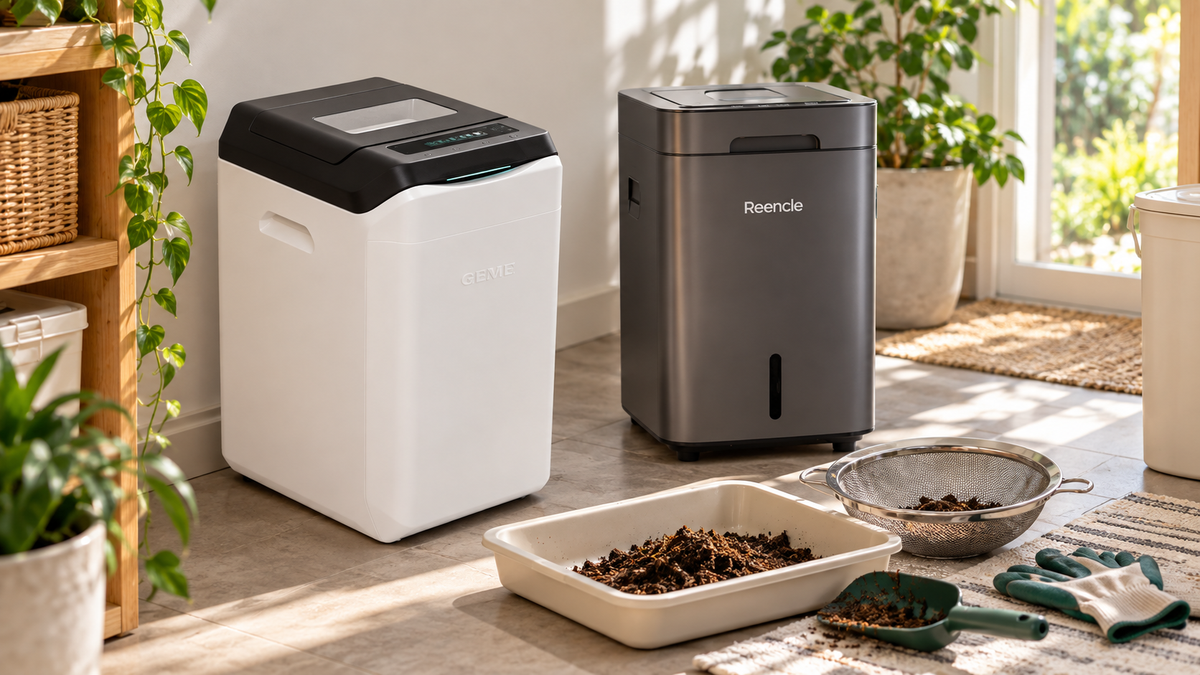
Microbial Bed · Harvesting · Screening · Curing · Soil Use
GEME and Reencle are both continuous microbial composters, so neither should normally be emptied like a batch appliance. The important difference is what you are expected to leave behind, how you decide when to harvest, and what happens to the material afterward.
Reencle uses an explicit MIN/MAX bed-level routine: harvest accumulated material while keeping the microbial bed at or above the MIN line, sift unfinished pieces back into the chamber, and use a post-harvest pathway that changes depending on whether the compost will be used as mulch or in direct root and seed contact.
GEME follows the same biological principle of preserving a living bed, but its normal routine is simpler: keep part of the Active Compost Base inside, harvest mature-looking material when needed, screen larger unfinished pieces back into the chamber, and blend the screened Compost Base with soil.
Quick Answer: How Does Harvesting Differ Between GEME and Reencle?
Both systems depend on keeping a living microbial bed, but Reencle gives users a more explicitly level-based harvesting routine, while GEME centers the routine on retaining the established bed and removing usable Compost Base as needed.
- Reencle: current guidance says harvest when the bed approaches the MAX line, scoop material out without going below the MIN line, sift unfinished food back into the unit, and preserve enough microbial material for continued mixing and decomposition.
- GEME: do not fully empty the chamber during a normal harvest. Leave part of the Active Compost Base as the starter bed, remove mature-looking material as needed, screen larger unfinished pieces back into GEME, and prepare the screened portion for soil use.
- Post-harvest is different too: Reencle's current planting/seeding pathway calls for about 3–4 weeks of curing, while its mulch pathway can use freshly harvested material. GEME normally uses a screened soil blend of approximately 1 part Compost Base to 8 parts plain soil, with additional maturation when the condition or intended use calls for it.
If you want the broader capacity, filter, input, and ownership comparison, read our existing Reencle Prime vs GEME Terra 2 comparison. This guide focuses only on harvesting and caring for the microbial bed.
For other brand and technology comparisons, start with the Electric Composter Comparison Hub.
1. GEME vs Reencle Harvesting: The Full Workflow Side by Side
The most important similarity is easy to miss: neither machine is meant to be completely emptied during a normal harvest.
Both are continuous biological systems. Part of the material inside is not simply “old compost.” It is the living environment that helps the next food scraps begin decomposing without rebuilding the system from zero.
| Step | GEME Terra 2 / Pro | Reencle | What It Means in Daily Use |
|---|---|---|---|
| Preserve the living bed | Yes. Keep part of the Active Compost Base inside during a normal harvest. | Yes. Current Reencle guidance says the microbial level should remain at or above the MIN line. | Neither should normally be emptied to a factory-clean chamber. |
| Main harvest trigger | Harvest mature-looking Compost Base when enough material has accumulated or output is needed. | The MAX line is the formal harvest reference, although Reencle also says a partial harvest can be taken earlier when enough decomposed material has accumulated. | Do not treat either system as having a universal calendar-based emptying interval. |
| How far to empty | Remove only part of the material and leave the starter bed operating. | When performing the standard MAX-line harvest, scoop material out until the bed returns to the MIN line. Do not go below MIN. | Reencle gives the user a more explicit level boundary. |
| Screening | Screen visible larger unfinished organic pieces and return suitable pieces to GEME. | Reencle recommends sieving harvested compost and returning recognizable undecomposed food. | Screening is normal in both continuous systems because material can have different residence times. |
| Material retained inside | Active Compost Base containing the established microbial ecosystem and conditioned material. | The microbial compost bed maintained at the required operating level. | The retained material supports biological continuity. |
| Immediate post-harvest route | Screen → return unfinished pieces → blend screened Compost Base with plain soil. | Sift → return unfinished pieces → choose mulch or planting/seeding pathway. | This is where ownership routines begin to diverge more clearly. |
| Standard soil ratio | Approximately 1 part Compost Base: 8 parts plain soil as the standard starting point. | Current planting/seeding guidance uses 1 part Reencle compost: 4 parts garden soil before curing. | These are brand-specific application systems, not interchangeable ratios. |
| Additional curing | Not a fixed requirement for every harvest. Additional maturation is useful when conditions, maturity, or sensitive plant use calls for it. | Current Reencle guidance specifies roughly 3–4 weeks for planting or seeding. Fresh material may be used as a properly layered mulch. | GEME generally has the shorter routine path when the goal is screened soil blending. |
| Replace microbial starter regularly? | No routine daily or harvest-by-harvest replacement. The established Kobold™ bed is retained. | Reencle says its microbes can be used semi-permanently with proper care; replacement is not on a fixed routine cycle. | Neither system should be evaluated as requiring a fresh starter pack after every harvest. |
Reencle references: When to Harvest — The MAX Line · How to Use Reencle Compost

2. The Most Important Rule: Do Not Destroy the Starter Bed
A microbial composter is fundamentally different from a bucket that simply stores waste.
The material left inside contains more than old food particles. It contains an established biological environment: microorganisms, moisture, partially transformed organic matter, enzymes, structure, and conditioned material.
Emptying everything during every harvest removes the very environment that makes continuous processing work.
How GEME Handles the Starter Bed
GEME's normal harvest guidance is to leave part of the Compost Base inside. That retained material becomes the living starter bed for incoming scraps.
This is why a normal GEME harvest is not a deep clean. You remove accumulated material when appropriate, but the active ecosystem continues operating.
Read the detailed engineering explanation in Why You Should Not Fully Empty the GEME Chamber.
How Reencle Handles the Starter Bed
Reencle expresses the same biological requirement through a more visible operating boundary: the MIN line.
Its current instructions warn that dropping below the MIN line can leave too little microbial mass for effective mixing and decomposition, increasing the risk of poor breakdown and odors.
Reencle therefore tells users performing a standard full harvest to scoop down to the MIN line, not below it.
Official reference: Reencle — When to Harvest
What this means for a buyer:
GEME and Reencle both require you to respect the living ecosystem. The practical GEME advantage is that normal harvesting can remain a simple retain → harvest → screen → return routine rather than asking the user to manage a formal MIN-to-MAX operating band as the core harvest reference.
3. When Should You Harvest GEME or Reencle?
Do not use a fixed number of days as an unconditional emptying schedule.
Continuous microbial systems do not fill at the same rate in every home. The interval changes with:
- how much food you add;
- the moisture content of that food;
- the type and particle size of the scraps;
- household cooking frequency;
- microbial-bed condition; and
- how much material you remove at each harvest.
Reencle: MAX Line Is the Main Reference
Reencle's current guidance identifies the MAX line as the point where harvesting is due. Operating persistently above that level may interfere with mixing and place additional strain on the stirring system.
Reencle also clarifies that users do not always have to wait for MAX: if enough fully broken-down material has accumulated, they may scoop out a portion earlier while preserving the active bed.
Its own 2026 support documentation describes approximately 2–4 weeks for the material to rise from MIN toward MAX under one example of regular feeding, with heavier use potentially shortening that interval. That is an operating example, not a promise that every household should harvest on that schedule.
Official reference: Reencle — How the Continuous Composting Process Works
GEME: Harvest Based on Accumulation and Need
GEME is also continuous-flow. Fresh scraps and older Compost Base can coexist, so a harvest is not the end of a batch cycle.
Harvest mature-looking Compost Base when sufficient processed material has accumulated or when you need output, while keeping the living base inside the chamber.
This matters because 6–8 hours of visible breakdown is not the same thing as saying every particle is fully mature compost. Residence time still varies in a continuous system.
For the difference between breakdown time and compost maturity, read How Long Does Compost Take?.
4. How Much Should You Remove, and How Much Should Stay?
Reencle
When the bed reaches MAX, Reencle's step-by-step guidance is straightforward:
- Open the large lid.
- Scoop out accumulated material.
- Stop when the microbial bed returns to the MIN line.
- Do not scoop below MIN.
- Sift the removed material.
- Return recognizable unfinished food to the chamber.
Reencle also states that its microbes normally do not need scheduled replacement. With proper care, the established microbes can continue operating over an extended period.
Official references: Reencle — Do I Need to Replace the Microbes?
GEME
GEME uses the same key biological rule without making a MIN/MAX line the center of routine harvesting: remove what you need while keeping an established active bed.
The retained material continues to support decomposition of new food additions. A completely stripped chamber is therefore not the target condition after normal maintenance.
Routine harvest is not the same as a full reset. If a microbial bed has suffered an unusual failure, contamination, or condition that requires a true restart, follow the product-specific recovery or reset procedure. Do not apply a routine harvesting rule to an abnormal recovery case.
5. Both Systems Need the Same Smart Habit: Screen and Return
Continuous feeding means the chamber can contain material that entered yesterday alongside material that has been there much longer.
That makes some variation normal.
A hard piece of food, dense fiber, peel, shell, or another slower item may still be recognizable even while the surrounding material looks soil-like.
Harvest
Remove an appropriate portion while keeping the active microbial bed in the appliance.
Screen
Separate larger recognizable pieces from the finer processed fraction.
Return
Put suitable unfinished organic pieces back into the microbial chamber.
Prepare for Soil
Follow the soil-use and maturation guidance specific to the system.
Reencle explicitly recommends sieving harvested material, partly because undecomposed food remaining in a curing container can attract insects.
GEME follows the same useful screen-and-return logic: larger unfinished material gets another pass through the microbial bed instead of being forced into soil before it is ready.

The U.S. EPA describes the same general principle in conventional composting: finished material is often screened, while larger pieces that did not fully break down can be returned to the next composting cycle.
Independent reference: U.S. EPA — Approaches to Composting
6. The Biggest Post-Harvest Difference: Curing and Soil Use
Once the material leaves the chamber, Reencle and GEME give users different practical pathways.
Reencle: Mulching vs Planting Are Separate Paths
Current Reencle guidance distinguishes between surface mulching and planting or seeding.
For mulch use, freshly harvested compost may be spread as a thin layer around established plants, avoiding direct contact with the stem or trunk, and then layered with soil and mulch.
For planting or seeding, Reencle currently instructs users to:
- mix approximately 1 part Reencle compost with 4 parts garden soil;
- place the mixture in a breathable container;
- cure it for approximately 3–4 weeks;
- mix it at least once every three days to maintain airflow; and
- check smell, texture, pH, moisture, and overall condition before use.
Official reference: Reencle — Mulching vs Planting
GEME: Screen, Blend, Cap, Then Mature Further When Needed
GEME's standard soil-integration workflow is:
- screen the harvested Active Compost Base;
- return larger unfinished pieces to GEME;
- blend approximately 1 part screened Compost Base with 8 parts plain soil;
- use a plain-soil cap where appropriate, especially around new or sensitive roots; and
- allow additional maturation if the material remains strongly warm, sour, ammonia-like, visibly unfinished, or is intended for a sensitive use.
The important distinction is that GEME does not treat a fixed multi-week curing period as a universal requirement for every ordinary harvest.
Instead, the soil blend provides the standard route, while further maturation is used when the material's condition or intended planting use justifies it.
For households that want a shorter harvest-to-soil routine, this is one of GEME's most practical advantages.
You still need to screen and use Compost Base correctly, but the standard routine does not automatically add a separate 3–4 week curing stage before every soil use.

For the full application method, see our Advanced GEME Compost Application Guide.
For a deeper explanation of why Active Compost Base and fully mature finished compost are related but not identical terms, read GEME Compost Base vs Finished Compost.
7. What If the Microbial Bed Is Too Low or Stops Behaving Normally?
A healthy-bed comparison is useful, but abnormal conditions need a different response.
Reencle Bed Falls Below MIN
Reencle warns that too little microbial material can reduce decomposition performance.
Current guidance says that if the microbial level is below MIN, additional Reencle Compost Starter may be required to restore sufficient bed volume.
Reencle separately notes that its microbes do not normally require routine replacement; additional starter is a recovery tool, not something users are expected to buy after every harvest.
Official reference: Reencle — What If the Microbe Level Is Too Low?
Reencle Bed Becomes Too Wet
Reencle has a separate wet-microbe recovery procedure. Its current instructions include reducing excess bed material where appropriate while still protecting the MIN level, removing visible surface moisture, and giving the system time to recover before normal feeding resumes.
That situation should not be confused with routine harvesting.
GEME Bed Needs Attention
GEME's living system also depends on balanced moisture, airflow, feeding load, and sufficient active material.
If the bed becomes unusually wet, decomposition slows, odor changes, or the machine displays an operating warning, diagnose the condition before removing large amounts of Compost Base.
The correct response may be a feeding adjustment, moisture correction, reduced load, recovery period, or support procedure rather than a harvest.
Simple rule: do not use “empty more material” as a universal fix for a microbial system that is already out of balance. First identify whether the issue is excess volume, excess moisture, insufficient bed mass, unsuitable input, or another operating condition.
8. Reencle Model Differences Matter
“Reencle” is no longer one single model. Current U.S. documentation includes Reencle Essential, Prime, Gravity, and Gravity Pro.
The general biological principle is shared, but specifications and starter packs differ.
| Model | Chamber | Recommended / Maximum Daily Input | Starter |
|---|---|---|---|
| Reencle Prime | 14 L | 700 g recommended / 1 kg max | Compost Starter 1.0 |
| Reencle Gravity | 22 L | 1 kg recommended / 1.5 kg max | Compost Starter 2.0 |
| Reencle Gravity Pro | 22 L | 1 kg recommended / 1.5 kg max | Compost Starter 2.0 |
Reencle currently publishes separate manuals for its models, so owners should use the manual matching the actual unit rather than assuming every detail from Prime applies identically to Gravity or Gravity Pro.
Official references: Reencle Model Specifications · Reencle Manuals
9. If You Prefer GEME's Harvest Routine, Choose the Capacity That Fits
Terra 2 and GEME Pro follow the same core continuous microbial principle. The main difference for this decision is active-bed volume and daily processing headroom.
| Feature | GEME Terra 2 | GEME Pro |
|---|---|---|
| Our recommendation | Best Overall | Best for Large Families |
| Household starting point | 1–3 people | 4+ people / heavier cooking |
| Microbial chamber | 14 L | 19 L |
| Daily processing capacity | Up to 2 kg/day | Up to 5 kg/day |
| Each addition | 1 kg or less | 1 kg or less |
| Normal harvest principle | Retain active bed; remove Compost Base as needed. | Retain active bed; remove Compost Base as needed. |
| Post-harvest soil route | Screen → return → approximately 1:8 soil blend | Screen → return → approximately 1:8 soil blend |
| Scheduled activated-carbon filter replacement | None | None |
| Current US Basic price | US$699.00 | US$899.99 |
For most smaller households, Terra 2 is the natural starting point. Choose GEME Pro when a larger family, heavier cooking routine, or substantially greater daily scrap volume makes more active-bed capacity useful.
See Best Electric Composter for Large Families for the capacity decision.
US Basic prices reviewed September 23, 2026. Regional pricing and configurations may differ.
Keep the Living Bed. Harvest the Part You Need.
Continuous microbial composting works best when the biological ecosystem remains continuous too.
GEME keeps that routine straightforward: retain the starter bed → harvest as needed → screen → return unfinished pieces → blend Compost Base with soil.
Frequently Asked Questions
Should I completely empty a GEME Composter when harvesting?
No. During normal harvesting, keep part of the Active Compost Base inside as the living starter bed. Remove accumulated material as needed, screen larger unfinished pieces, and return suitable unfinished organic material to the chamber.
Should I completely empty a Reencle when harvesting?
No. Reencle's current instructions say the microbial level should remain at or above the MIN line. During a standard MAX-line harvest, scoop material out until the bed returns to MIN, but do not go below it.
How often do I need to harvest Reencle?
There is no single interval that applies to every household. Reencle uses the MAX line as its main harvesting reference and also permits partial harvesting earlier when enough fully decomposed material has accumulated. Feeding rate and bed condition affect how quickly material builds up.
How often do I need to harvest GEME?
Harvest when sufficient mature-looking Compost Base has accumulated or when you need material for soil use. GEME is continuous-feed, so normal harvesting does not require stopping the process or emptying the entire chamber.
Do I need to sift compost from both GEME and Reencle?
Screening is useful for both systems. It separates larger recognizable pieces from the finer processed material. Suitable unfinished pieces can then return to the active microbial bed for additional decomposition.
Does Reencle compost need to cure?
It depends on how it will be used. Reencle's current guidance allows freshly harvested material to be used as a properly layered mulch. For planting or seeding where roots or seeds will contact the material, Reencle recommends mixing it with soil and curing for approximately 3–4 weeks.
Does GEME Compost Base always need several weeks of curing?
No fixed multi-week curing period applies to every normal harvest. The standard GEME workflow is to screen the material, return larger unfinished pieces, and blend approximately 1 part Compost Base with 8 parts plain soil. Additional maturation is appropriate when the material's condition or intended plant use calls for it.
Do Reencle microbes have to be replaced after every harvest?
No. Reencle states that its established microbes can be used semi-permanently with proper care. Additional starter may be needed if the bed becomes too low or cannot recover from an abnormal condition, but normal harvesting does not require a new pack each time.
Which GEME model is better for a large household?
GEME Pro is the larger model, with a 19 L microbial chamber and up to 5 kg/day of suitable food-scrap processing capacity. Terra 2 uses a 14 L chamber and supports up to 2 kg/day, making it the usual starting point for 1–3 person households.
Sources and Related Guides
Competitor instructions were reviewed September 23, 2026. Reencle may revise model specifications, starter products, harvesting rules, or compost-use guidance, so owners should always follow the current manual for the specific model they own.
- Reencle — When to Harvest: The MAX and MIN Lines
- Reencle — Continuous Composting and Harvest Timing
- Reencle — Using Compost for Mulching vs Planting
- Reencle — Why Cure Harvested Compost?
- Reencle — Microbe Replacement Guidance
- Reencle — Model Specifications
- Reencle — Current Model Manuals and Guides
- U.S. EPA — Approaches to Composting
- GEME Terra 2 — Product and Harvest Guidance
- GEME — Why You Should Not Fully Empty the Chamber
- GEME — Advanced Compost Base Application Guide


Commenta
Nota che i commenti devono essere approvati prima di essere pubblicati.
Questo sito è protetto da hCaptcha e applica le Norme sulla privacy e i Termini di servizio di hCaptcha.