

Strawberries · Moldy Fruit · Strawberry Tops · Home Composting
Composting Basics: Can You Compost Strawberries?
Yes, you can compost strawberries. Fresh strawberry scraps, overripe berries, ordinary moldy strawberries, strawberry tops, leaves and small stems are all organic plant material that can break down biologically.
Strawberries are soft and moisture-rich, so the main practical issue is not whether microbes can decompose them. It is how much wet fruit you add at once. A handful of berry scraps is easy to manage; a large container of collapsing, leaking strawberries needs more attention to moisture, airflow and pacing.
By Matthew Moore · Last reviewed August 21, 2026

Photo: Michael Collett / Unsplash
Quick Answer: Can Strawberries Be Composted?
Yes. Strawberries, moldy strawberries and strawberry tops can all be composted.
Strawberries are soft fruit scraps and normally break down readily. In a backyard pile, bury them beneath dry brown material to manage moisture, flies and pests. In GEME Terra 2, normal strawberry scraps can enter the microbial system directly; pace unusually large wet batches and drain excess free juice rather than pouring it into the chamber.
If the strawberries are still edible, preventing the waste is better than composting them early. See the Best Way to Store Strawberries for refrigeration, freezing and mold-prevention guidance.
For the broader food-scrap framework, continue to What Can You Compost at Home?.
Table of Contents
- Why Are Strawberries Easy to Compost?
- Can You Compost Moldy Strawberries?
- Can You Compost Strawberry Tops?
- How to Compost Strawberries in a Backyard Pile
- Can Too Many Strawberries Make Compost Too Wet?
- Can Worms Eat Strawberries?
- Can GEME Terra 2 Compost Strawberries?
- Should You Cut Strawberries Before Composting?
- When Should Strawberries Not Go Into Garden Compost?
- Store First, Compost Later
- What Happens After Strawberries Are Composted?
- Common Strawberry Composting Mistakes
- Frequently Asked Questions
- Sources
1. Why Are Strawberries Easy to Compost?
Strawberries are soft plant material made largely of water, carbohydrates and other readily degradable organic compounds.
Unlike a hard avocado pit, nutshell or woody branch, a strawberry creates very little physical resistance to microbial access.
Once the surface softens or breaks, microorganisms can reach the moist interior easily.
Strawberry scrap
↓
Soft, moist fruit tissue
↓
Large accessible microbial surface
↓
Relatively easy biological decomposition
The U.S. EPA classifies fruit and vegetable scraps as normal nitrogen-rich “green” materials for backyard composting.
That makes strawberries part of the same broad composting category as vegetable peelings, apple cores, banana scraps, grapes and tomatoes.
To understand what microbes actually do after the fruit enters the pile, read How Does Composting Work? Microbes, Heat & Oxygen.
2. Can You Compost Moldy Strawberries?
Yes. Ordinary moldy strawberries can generally be composted.
But compostability and edibility are two different questions.
Strawberries are soft, high-moisture fruit. USDA guidance for moldy soft fruit is conservative because mold growth and associated contamination can extend below the visible surface.
Do Not Eat Moldy Strawberries
If a strawberry is visibly moldy, treat it as spoiled food rather than trying to cut away the mold and eat the remaining portion. If mold appears in a container, remove the moldy berries and berries directly touching them, then inspect the rest carefully.
Once the berry has been classified as ordinary spoiled household fruit rather than food, composting is a reasonable biological pathway.
Mold itself does not make ordinary fruit biologically undecomposable. Fungi are already part of natural decomposition.
The more useful composting concerns are:
- high moisture;
- leaking juice;
- fruit flies;
- pest attraction outdoors;
- and adding too many spoiled berries as one concentrated load.
The closest existing GEME comparison is Can You Compost Moldy Grapes?. Grapes and strawberries are both soft, wet fruits whose composting challenge is mainly moisture and pest management rather than slow decomposition.
3. Can You Compost Strawberry Tops?
Yes. Strawberry tops are compostable.
The green leafy cap you remove while preparing strawberries is plant material, as is the small stem attached to it.
There is no reason to separate the top from the fruit for compostability purposes.
Strawberry tops are small enough that chopping them provides little practical benefit.
Simply remove any produce stickers, plastic film, rubber bands or packaging before the scraps enter the composting system.
This is the same “food versus packaging” rule used throughout the Complete Compostable Materials List.
4. How to Compost Strawberries in a Backyard Pile
Strawberries work well in a backyard pile when they are buried and mixed rather than left exposed on top.
EPA recommends balancing food scraps with substantially more carbon-rich brown material by volume.
Useful browns include:
- dry leaves;
- shredded plain cardboard;
- straw;
- small twigs;
- untreated wood chips;
- non-glossy shredded paper.
For a Normal Amount of Strawberry Scraps
- Remove packaging and stickers.
- Add the strawberry fruit and tops.
- Bury the scraps in the active composting area.
- Cover them with dry brown material.
- Keep the pile moist but not saturated.
- Turn the pile periodically to maintain oxygen.
For a Large Batch of Spoiled Strawberries
Do not dump several containers of collapsing berries into one wet pocket.
Instead:
- spread the berries across the active pile;
- mix in dry structural browns;
- bury the fruit rather than leaving it exposed;
- turn or aerate the pile;
- add more dry material if the pile becomes wet or sour-smelling.
Backyard rule: strawberries are easy for microbes to decompose, but sweet wet fruit is also easy for flies and animals to find. Bury, cover and balance the load.
For the entire greens/browns/moisture/airflow process, use the Complete Home Composting Guide.
5. Can Too Many Strawberries Make Compost Too Wet?
Yes.
A strawberry naturally contains a large amount of water.
That moisture is useful; microbes need water, but aerobic decomposition also depends on air moving through the composting mass.
If a large quantity of soft strawberries collapses at once, the load can become:
- wet;
- dense;
- sticky;
- low in physical structure;
- more difficult to aerate.
This is especially noticeable when spoiled berries have already released juice into their container.
A wet strawberry is food. A pool of strawberry juice is free liquid. Treat those as different inputs.
For indoor composting systems, this is part of the broader moisture boundary described in Electric Composter Salt, Oil & High-Moisture Boundaries.
The same principle is visible with other wet fruit. Our Moldy Grapes Guide recommends pacing wet fruit rather than adding a large leaking batch all at once.
6. Can Worms Eat Strawberries?
Yes. Strawberry scraps can be used in vermicomposting.
EPA guidance for worm bins accepts most fruit and vegetable scraps, but the same practical limit applies: do not overwhelm the bedding with one large mass of wet food.
Normal strawberry tops and a few berries can be mixed into the feeding routine.
For larger quantities:
- feed gradually;
- bury the fruit beneath bedding;
- wait for the existing feedstock to be processed;
- avoid waterlogging the worm bedding.
If you are comparing indoor worms with a managed microbial system, see Electric Composter vs Worm Composting.
7. Can GEME Terra 2 Compost Strawberries?
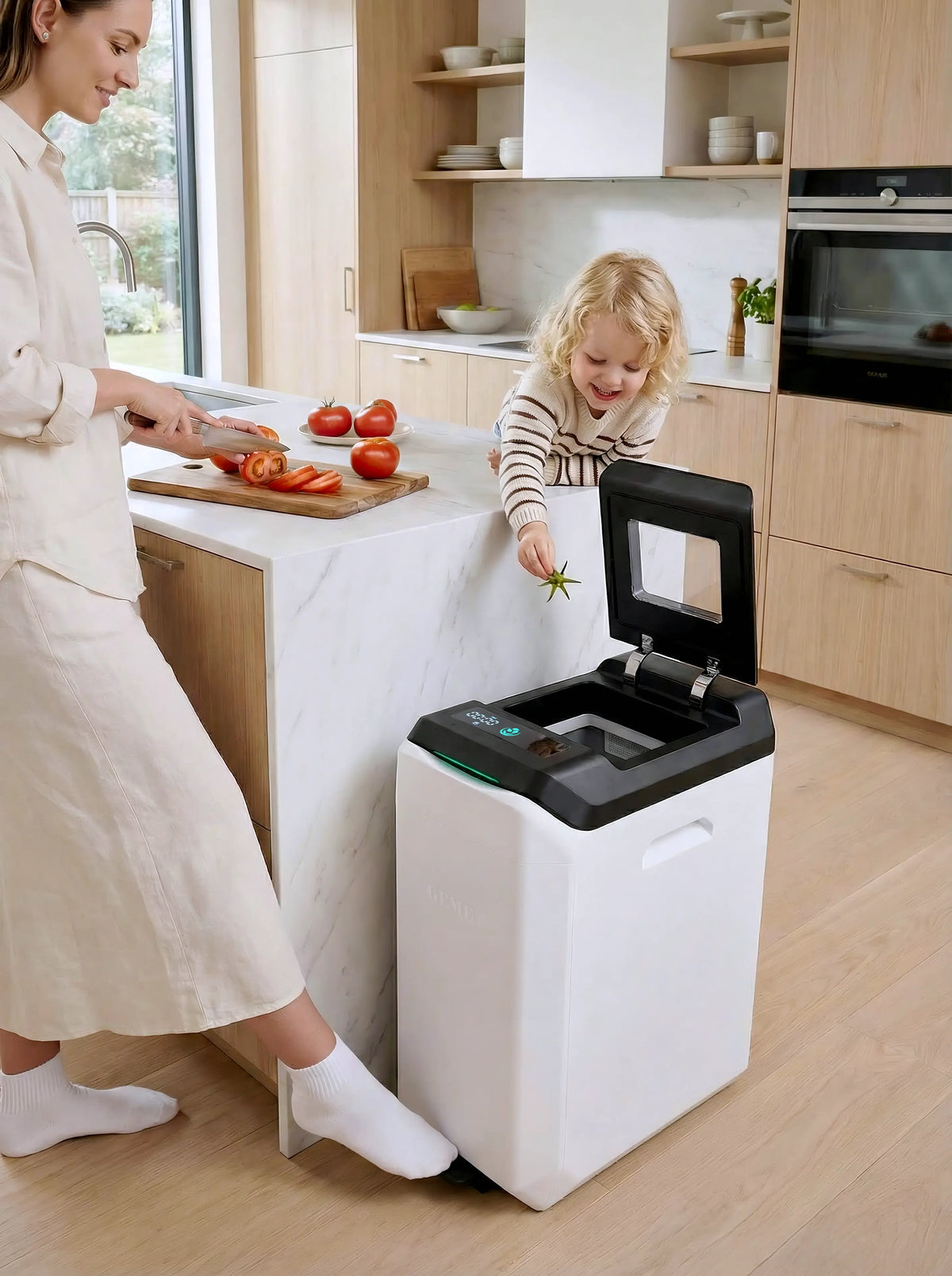
Yes. Strawberries are suitable everyday fruit scraps for GEME Terra 2.
That includes:
- fresh strawberry scraps;
- overripe strawberries;
- ordinary spoiled strawberries;
- ordinary moldy strawberries that are no longer being eaten;
- strawberry tops;
- leaves;
- small stems.
Terra 2 maintains a warm, moist and oxygen-rich microbial environment in which Kobold™ microorganisms process suitable household food waste.
GEMEBrain™ helps manage airflow, heat, moisture-related conditions and mixing while food is added continuously.
Learn more in How GEME Continuous Microbial Composting Works.
Do You Need to Cut Strawberries Before Putting Them in Terra 2?
Usually not.
Strawberries are already soft and relatively small.
A whole berry can enter the normal household food-scrap stream.
If you have unusually large, firm strawberries, splitting or crushing them can expose more internal surface area, but it is not normally necessary.
Terra 2 strawberry rule: normal berries and strawberry tops can go in directly. For an unusually large batch of soft or leaking berries, feed gradually and keep excess free juice out.
For other material-specific limits, use What Can You Put in an Electric Composter?.
From Berry Scraps to a Living Compost Base
Compost Strawberries Without Drying Them Into Flakes
Strawberries naturally contain moisture. Terra 2 does not need to dehydrate that moisture away before biological processing can begin.
Instead, suitable strawberry scraps enter an active microbial bed where food continues to break down over time.
Normal wet fruit is part of the process. The practical boundary is simply to avoid an unusually large liquid-heavy overload.
Explore GEME Terra 2 →8. Should You Cut Strawberries Before Composting?
You generally do not need to cut strawberries before composting them.
They are already small, soft and easy for microorganisms to access.
However, breaking a whole fruit does expose more internal surface.
That means:
The preparation principle is useful, but it matters much more for hard materials such as eggshells, dense stems or pits than for a soft strawberry.
9. When Should Strawberries Not Go Into Garden Compost?
Ordinary spoilage is different from known contamination.
A strawberry that became moldy because it sat too long in the refrigerator is ordinary household food waste.
A strawberry discarded because of a specific contamination event may be a different matter.
Keep Known Contamination Out of Routine Edible-Garden Compost
Do not automatically place strawberries into garden compost when they have been:
- included in a food-safety recall that gives specific disposal instructions;
- exposed to floodwater or sewage;
- contaminated with cleaners, fuel or unknown chemicals;
- treated as hazardous waste under local guidance.
Follow the applicable recall or disposal instructions instead.
This distinction is also discussed in GEME's broader food-safety and spoilage content, including Are Tomatoes Safe to Eat Now?.
10. Store Strawberries First, Compost Them Later
The fact that strawberries are compostable does not mean edible strawberries should be treated as waste.
Strawberries spoil quickly because they have:
- delicate skin;
- high moisture;
- natural sugars;
- high sensitivity to bruising;
- poor tolerance for trapped surface moisture.
Better storage can often prevent the composting question entirely.
Fresh strawberries
↓
Keep unwashed, dry, cold and breathable
↓
Eat or freeze before spoilage
↓
Compost only suitable unavoidable scraps
The full storage method is in Best Way to Store Strawberries: Fridge, Freezer & Compost Guide.
For the wider household hierarchy, plan, store, use, repurpose, freeze, then compost, see the Food Storage & Waste Reduction Hub.
11. What Happens After Strawberries Are Composted?
Strawberry scraps do not become a special “strawberry fertilizer.”
They become one component of a mixed biological feedstock.
For Terra 2, the resulting material should be understood as a moist, biologically active Compost Base.
Because Terra 2 is continuous-feed, the chamber can contain material at different stages of decomposition.
Before soil use:
- screen larger unfinished pieces;
- return those pieces to the active chamber;
- mix the screened Compost Base with soil at about 1:8;
- use a plain-soil cap where appropriate;
- observe plant response rather than over-applying concentrated output.
See the Advanced GEME Compost Application Guide for the complete process.
And if you are interested in nutrient measurements rather than assumptions, the NPK Test of Home Compost Output (N=50) shows why mixed household compost should be treated as compost, not as a standardized fertilizer bag.
12. Common Mistakes When Composting Strawberries
Mistake 1: Throwing Away Strawberry Tops
The green cap and small stem are compostable plant material. They can go into compost with the fruit scraps.
Mistake 2: Eating a Moldy Strawberry Because Only One Spot Looks Bad
Strawberries are soft, moisture-rich fruit. Do not treat visible mold like a superficial bruise that can simply be trimmed away.
Mistake 3: Leaving Sweet Fruit Exposed on an Outdoor Pile
Bury strawberry scraps and cover them with dry browns to reduce fruit flies and pest attraction.
Mistake 4: Dumping Several Containers of Spoiled Berries Into One Wet Pocket
Spread and balance a large wet batch instead of creating a dense anaerobic zone.
Mistake 5: Pouring Collected Strawberry Juice Into Terra 2
A wet berry is a normal food scrap. Free liquid that can easily be drained does not need to follow the solids into the chamber.
Mistake 6: Composting Packaging With the Strawberries
Plastic clamshells, produce stickers, absorbent pads, rubber bands and other retail packaging are separate materials.
Mistake 7: Composting Edible Strawberries Too Early
Store them properly or freeze extras first. Composting is the later pathway for suitable scraps that can no longer serve as food.
13. The Simplest Rule for Composting Strawberries
Strawberries are one of the easier fruit scraps to compost.
Remember three simple answers:
Then remember one operating rule:
Compost the berry. Manage the moisture.
Continuous Microbial Composting
From Strawberry Tops to Spoiled Berries
GEME Terra 2 processes suitable everyday fruit and vegetable scraps in a warm, aerated microbial environment. Strawberry fruit and tops can enter the normal kitchen-waste stream; just pace unusually large wet batches and keep excess free liquid out.
14. Frequently Asked Questions About Composting Strawberries
Can you compost strawberries?
Yes. Fresh strawberries, leftover strawberry pieces, overripe fruit and ordinary spoiled strawberries are compostable organic plant material.
Can you compost moldy strawberries?
Yes. Ordinary moldy strawberries can generally be composted as spoiled fruit waste. Do not eat moldy strawberries; soft fruit can be affected below the visibly moldy surface.
Can you compost strawberry tops?
Yes. Strawberry tops, including the green leafy cap and small stem, are compostable plant material and can go into a compost pile or suitable microbial composter.
Can strawberry leaves be composted?
Yes. The small leaves attached to a strawberry top are plant material and can be composted with the rest of the fruit scraps.
Can strawberry stems be composted?
Yes. Small strawberry stems are compostable. They may take slightly longer than the soft fruit but do not normally require special preparation.
Are strawberries green or brown compost material?
Strawberries are treated as nitrogen-rich green food scraps. In an outdoor pile, balance them with dry carbon-rich browns such as leaves, straw or shredded cardboard.
Do strawberries need to be cut before composting?
No. Strawberries are small and soft enough to compost whole. Halving or crushing a large firm berry exposes more internal surface but is usually unnecessary.
Can worms eat strawberries?
Yes. Strawberries can be fed to a worm bin in reasonable quantities. Avoid adding a large wet batch that saturates the bedding or reduces airflow.
Can you compost rotten strawberries?
Yes. Ordinary overripe, mushy or rotten strawberries can normally be composted as household fruit waste, provided they are not being discarded because of a specific hazardous contamination event.
Can GEME Terra 2 compost strawberries?
Yes. Fresh scraps, strawberry tops, overripe berries and ordinary spoiled strawberries are suitable fruit inputs for Terra 2 as part of a normal varied household food-waste stream.
Can moldy strawberries go into GEME Terra 2?
Yes, ordinary moldy strawberries that are no longer suitable for eating can be processed as fruit waste. Remove packaging and avoid adding an unusually large leaking batch all at once.
Can strawberry tops go into GEME Terra 2?
Yes. Strawberry tops, leaves and small stems can enter Terra 2 with normal fruit and vegetable scraps.
Should I pour strawberry juice into Terra 2?
No. Moist strawberries are normal food waste, but excess free liquid that can easily be drained should not be deliberately poured into the chamber.
What should I do with a large amount of spoiled strawberries?
For an outdoor pile, spread the berries through the active compost and mix them with dry browns. For Terra 2, feed an unusually large wet batch gradually rather than adding everything at once.
Should edible strawberries be composted?
Preventing edible food waste is preferable. Eat, cook or freeze strawberries while they are still suitable for use, and compost appropriate tops and unavoidable spoiled fruit later.
15. Authoritative Sources & Further Reading
- U.S. EPA — Composting at Home
- USDA FSIS — Molds on Food: Are They Dangerous?
- USDA FSIS — Moldy Fruit in a Container
- GEME — Best Way to Store Strawberries
- GEME — Can You Compost Moldy Grapes?
- GEME — What Can You Compost at Home?
- GEME — Complete Home Composting Guide
- GEME — How Continuous Microbial Composting Works
- GEME — Advanced Compost Application Guide
Sources reviewed August 21, 2026. Ordinary fresh, overripe and moldy strawberries are discussed here as household fruit scraps. Produce involved in a recall, sewage exposure, floodwater contamination, chemical contamination or another specific safety event should be handled according to the applicable official disposal guidance.


Commenta
Nota che i commenti devono essere approvati prima di essere pubblicati.
Questo sito è protetto da hCaptcha e applica le Norme sulla privacy e i Termini di servizio di hCaptcha.