
Soil Health · Plant Nutrition · Compost Base
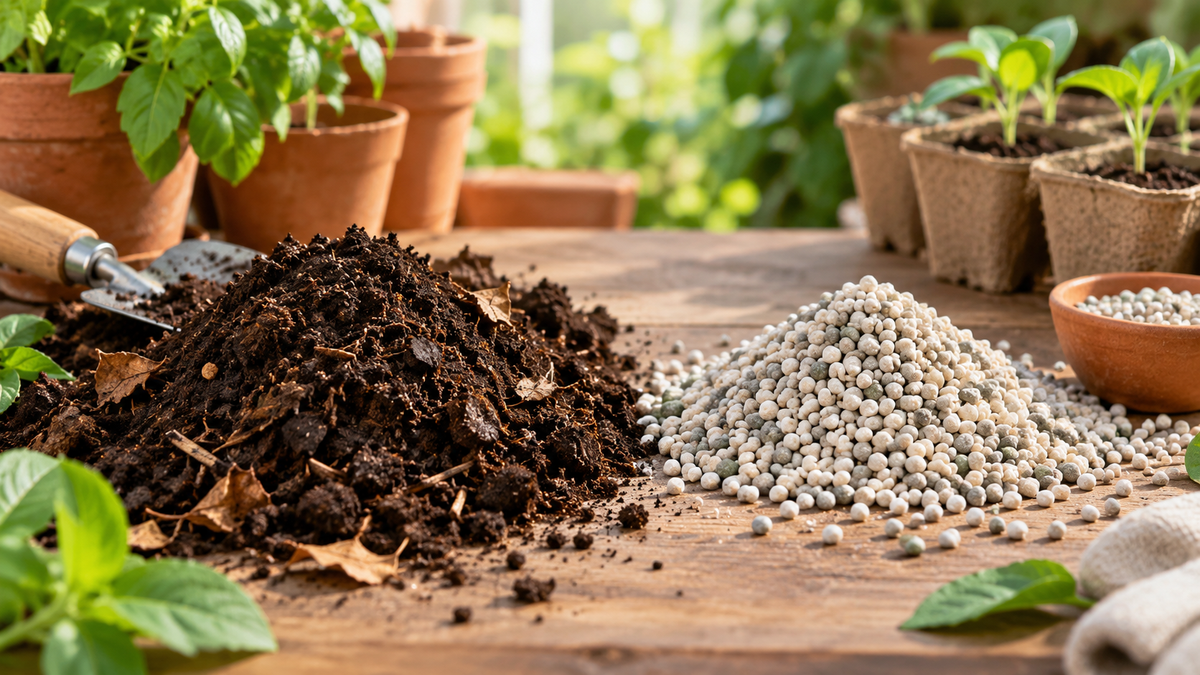
Compost and fertilizer are not substitutes for the same job. Fertilizer is primarily used to supply plant nutrients in known or targeted amounts. Compost is primarily a soil amendment: it adds organic matter, improves soil structure and water behavior, supports soil organisms, and also contributes nutrients over time.
That means the right question is usually not “Should I buy compost or fertilizer?” It is: “Is my plant struggling because the soil system needs improvement, because a specific nutrient is missing, or because it needs both?”
GEME Terra 2 and GEME Pro add another useful option to that decision. Instead of buying every bit of compost you use, suitable kitchen scraps can enter a continuous microbial system and return as Compost Base for responsible soil blending.

Quick Answer: Compost or Fertilizer?
Use compost when the soil itself needs improvement.
Compost is especially useful when you want to:
- add organic matter;
- improve soil structure;
- help sandy soil retain water and nutrients;
- improve the workability of dense soil;
- support soil organisms;
- and contribute nutrients gradually.
Use fertilizer when plants or soil need specific nutrients in a more predictable amount.
That may include a documented nitrogen, phosphorus, potassium or micronutrient deficiency—or a crop whose nutrient demand is greater than compost alone can reliably supply.
For many gardens, the best answer is both: compost to build the soil system, then targeted fertilizer only where plant needs or a soil test justify it.
1. What Is the Difference Between Compost and Fertilizer?
The simplest distinction is:
Fertilizer primarily feeds plants with nutrients. Compost improves the soil system while also contributing nutrients.
The U.S. EPA describes materials used mainly to enhance soil characteristics as soil amendments, while common fertilizers are formulated around essential plant nutrients such as nitrogen, phosphorus and potassium.
| Feature | Compost | Fertilizer |
|---|---|---|
| Primary role | Improve soil and recycle organic matter | Supply targeted plant nutrients |
| Organic matter | High-value part of its function | May be low or absent depending on product |
| NPK concentration | Variable | Usually declared on the label |
| Nutrient release | Generally slower and biologically mediated | Depends on formulation; can be rapid or controlled-release |
| Soil structure | Can improve structure, aggregation and porosity | Not normally the primary function |
| Water holding | Can improve soil moisture retention | Not normally the primary function |
| Soil biology | Organic matter can support soil organisms | Varies by fertilizer type |
| Best use | Building healthier soil over time | Correcting or supplying specific nutrient needs |
Neither category is automatically “better.” They solve different problems.
2. What Does Compost Actually Do for Your Soil?
Compost's value is much broader than its NPK number.
EPA identifies several soil benefits from compost application, including:
- higher soil organic matter;
- improved soil structure;
- lower compaction;
- better water infiltration;
- greater water-holding capacity;
- improved nutrient retention;
- more active and diverse soil biology;
- and gradual nutrient contribution.
This is why compost is especially valuable in soils that are physically poor even when the plants are not showing one obvious nutrient deficiency.
Sandy Soil
Sandy soils drain quickly and often struggle to retain water and nutrients.
Organic matter from compost helps create a more moisture- and nutrient-retentive soil environment.
Dense or Compacted Soil
Compost can improve aggregation and porosity, giving roots, water and air a more functional soil structure.
Container and Raised-Bed Soil
Compost can be part of a balanced growing medium, but it should not automatically become the entire growing medium.
For application rates and use cases, read How to Use Compost Correctly.
3. What Does Fertilizer Do That Compost Cannot Always Do?
Plants require essential mineral nutrients.
Most familiar fertilizer labels focus on three macronutrients:
| Nutrient | Symbol | Main Plant Functions |
|---|---|---|
| Nitrogen | N | Supports chlorophyll, proteins and vegetative growth. |
| Phosphorus | P | Supports energy transfer, roots, flowering and reproduction. |
| Potassium | K | Supports water regulation, enzyme activity and stress response. |
A fertilizer labeled 10-5-5, for example, provides a declared nutrient analysis. That predictability is useful when a soil test or known plant requirement shows that a particular nutrient needs supplementation.
Compost is different.
Its nutrient composition changes with:
- feedstock;
- maturity;
- moisture;
- processing conditions;
- and the materials from which it was made.
That variability is normal for compost but makes it inappropriate to treat every batch like a standardized fertilizer product.
4. Does Compost Contain Nitrogen, Phosphorus and Potassium?
Yes. Compost contains plant nutrients, including nitrogen, phosphorus and potassium.
EPA notes that these nutrients are often present in slower-release organic forms. Compost can therefore contribute meaningfully to fertility while also supplying organic matter that conventional mineral fertilizer does not provide.
But that does not mean every compost has the same NPK value.
What GEME's N=50 Output Testing Shows
GEME has tested 50 household Compost Base samples for nitrogen, phosphorus, potassium and supporting characteristics including pH, electrical conductivity, moisture and screening rate.
The central result was not a universal NPK ratio.
The output consistently contained nutrients, but nutrient values varied with household feedstock and use conditions, exactly why GEME Compost Base should be treated as compost rather than a standardized fertilizer.
This is an important difference between marketing compost responsibly and pretending that kitchen scraps automatically create a predictable bag of plant food.
Read the full evidence page: NPK Test of Home Compost Output (N=50).
5. Can Compost Replace Fertilizer?
Sometimes it can reduce fertilizer needs. It should not automatically be assumed to replace fertilizer completely.
EPA notes that compost contributes N, P, K and other nutrients and can reduce reliance on inorganic fertilizer. But nutrient concentrations in compost are not always high enough, or immediately available enough, to satisfy the needs of demanding crops.
That creates three common situations:
Compost May Be Enough
Soil already has adequate nutrients, plants have modest nutrient demands, and the main objective is maintaining soil organic matter and long-term fertility.
Compost + Fertilizer
Soil benefits from organic matter, but a soil test or crop requirement shows that one or more nutrients still need targeted supplementation.
Targeted Fertilizer May Be the Immediate Priority
A confirmed nutrient deficiency needs correction, and the soil already has adequate organic matter and structure.
Neither May Be the Real Problem
Poor drainage, root damage, incorrect pH, overwatering, disease, temperature stress or inadequate light can mimic nutrient problems.
Yellow leaves are not automatically a request for more fertilizer.
6. How to Decide What Your Plants Actually Need
Do not choose between compost and fertilizer based only on what a plant looks like.
Step 1: Look at the Soil
Ask:
- Is it compacted?
- Does water run straight through?
- Does it stay waterlogged?
- Is organic matter very low?
- Has the bed received compost repeatedly for years?
Step 2: Know the Plant
A mature ornamental, a tomato crop, a lawn, a seedling and an indoor foliage plant do not have identical nutrient needs.
Step 3: Test the Soil When the Decision Matters
A soil test can help identify:
- pH;
- phosphorus;
- potassium;
- organic matter in some tests;
- salinity or electrical conductivity;
- and other nutrients depending on the laboratory.
Testing is especially useful before repeatedly applying fertilizer or large quantities of compost.
Step 4: Match the Input to the Problem
| What You Find | Likely Starting Point | Why |
|---|---|---|
| Poor structure, low organic matter, nutrients broadly adequate | Compost | Build the soil rather than adding unnecessary concentrated nutrients. |
| Confirmed nitrogen deficiency | Targeted fertilizer, often with compost as soil support | Compost may release nitrogen too slowly or unpredictably for an immediate correction. |
| Poor soil plus nutrient deficiency | Compost + targeted fertilizer | Address both the soil system and plant nutrition. |
| Healthy soil and healthy plants | Do less | More compost or fertilizer is not automatically beneficial. |
| High phosphorus or high salts | Pause and reassess | Adding more compost or fertilizer can make the imbalance worse. |
7. Can You Use Too Much Compost or Fertilizer?
Yes—to both.
Too Much Fertilizer
Over-fertilizing can:
- damage roots;
- cause salt stress;
- produce excessive weak growth;
- create nutrient imbalances;
- and increase nutrient runoff or leaching.
Too Much Compost
Compost is gentler than many concentrated fertilizers, but “organic” does not mean unlimited.
Repeated heavy applications can:
- raise phosphorus beyond plant needs;
- increase salts;
- change soil pH;
- create nutrient imbalances;
- and make container mixes too dense or moisture-retentive.
More Is Not the Goal
The goal is healthy soil and appropriately fed plants, not the maximum possible amount of compost or fertilizer.
For detailed application guidance, see How to Use Compost Correctly.
8. Where Does GEME Compost Base Fit?
GEME Terra 2 and GEME Pro do not turn kitchen scraps into a standardized commercial fertilizer.
They support continuous aerobic microbial decomposition and produce biologically active Compost Base for a soil-return pathway.
Because GEME is continuously fed, material in the chamber can have different residence times. That means responsible harvesting matters.
The GEME Soil Workflow
- Screen harvested Compost Base.
- Return larger unfinished organic pieces to the chamber.
- Mix approximately 1 part Compost Base with 8 parts plain soil.
- Cap with plain soil where appropriate, especially around sensitive roots.
- Water and observe plant response.
- Allow further maturation when the intended use calls for more stable material.
Do not plant directly into pure fresh GEME Compost Base and do not treat it as a guaranteed NPK fertilizer.
The full application protocol is available in the GEME Compost Base Application and Storage Guide.
Why This Still Has Real Value
The fact that GEME Compost Base is not standardized fertilizer does not reduce its value. It clarifies what the material is actually for.
Its value comes from combining:
- recycled organic matter;
- biological decomposition;
- soil-building carbon;
- naturally occurring nutrients;
- microbial activity;
- and a practical route for returning unavoidable kitchen scraps toward soil.
This is fundamentally different from buying a bag of synthetic NPK, and also fundamentally different from simply drying kitchen scraps into smaller particles.
For that distinction, read How Does a Real Electric Composter Work?.
9. Terra 2 or GEME Pro If You Want Compost for Soil Use?
The compost-versus-fertilizer question does not change which GEME model you need. Choose according to household food-waste volume.
| Feature | GEME Terra 2 | GEME Pro |
|---|---|---|
| Typical household | 1–3 people | 4+ people or heavier cooking |
| Microbial chamber | 14 L | 19 L |
| Daily processing capacity | Up to ~2 kg/day | Up to ~5 kg/day |
| System | Continuous aerobic microbial processing | Continuous aerobic microbial processing |
| Output role | Compost Base for responsible soil blending | Compost Base for responsible soil blending |
| Routine activated-carbon filter replacement | Not required | Not required |
Terra 2
Terra 2 is the natural choice for smaller households that want to convert everyday food scraps into a continuous composting workflow without paying for unnecessary capacity.
GEME Pro
GEME Pro increases daily throughput substantially. For larger families, that means more unavoidable food scraps can stay within the same kitchen-to-soil system rather than being diverted to ordinary trash because the composter is undersized.
Feed the Soil First. Fertilize Only What the Plant Still Needs.
Compost and fertilizer solve different problems. GEME helps households create a soil-building pathway for suitable kitchen scraps; targeted fertilizer can still be added when plant demand or soil testing shows that specific nutrients are needed.
10. Frequently Asked Questions
What is the difference between compost and fertilizer?
Fertilizer is primarily used to supply plant nutrients in defined or targeted amounts. Compost is primarily a soil amendment that adds organic matter, improves soil characteristics and contributes nutrients more gradually.
Is compost a fertilizer?
Compost contains plant nutrients, including nitrogen, phosphorus and potassium, but it is best understood as a soil amendment rather than a standardized fertilizer. Its nutrient concentration varies with feedstock, maturity and processing conditions.
Can compost replace fertilizer?
Sometimes compost can reduce or eliminate the need for additional fertilizer, especially when soil nutrient levels are already adequate. However, nutrient-demanding plants or documented deficiencies may still require targeted fertilizer.
Should I add compost before fertilizer?
For many gardens, improving organic matter and soil condition first is a sensible foundation. A soil test can then identify whether additional nutrients are actually needed. Do not automatically add fertilizer simply because compost was applied.
Does compost contain NPK?
Yes. Compost can contain nitrogen, phosphorus and potassium, along with micronutrients. Unlike standardized fertilizer, the exact amounts and release rates vary.
What does GEME Compost Base contain?
GEME household Compost Base contains organic matter and naturally occurring plant nutrients. GEME's N=50 household-output testing found measurable N, P and K, but values varied across samples and feedstocks. The output should therefore be used as compost rather than treated as a guaranteed fertilizer formulation.
Can GEME Compost Base replace fertilizer?
Not automatically. GEME Compost Base contributes organic matter and nutrients, but whether a plant needs additional fertilizer depends on soil condition, nutrient levels, plant species and growth stage.
How should I use GEME Compost Base?
Screen larger unfinished pieces and return suitable pieces to the GEME chamber. Mix the finer Compost Base at approximately one part Compost Base to eight parts plain soil. Use a plain-soil buffer or cap where appropriate and observe plant response.
Can I plant directly in pure GEME Compost Base?
No. GEME Compost Base should not be used as the entire potting medium. It is a concentrated compost material intended for responsible soil blending.
Can too much compost hurt plants?
Yes. Heavy or repeated compost application can contribute excess nutrients, salts or changes in soil chemistry. Containers and young plants are especially sensitive, so use compost moderately and consider soil testing when applications are repeated.
Should I use compost or fertilizer for yellow leaves?
Do not diagnose yellow leaves from color alone. Nitrogen deficiency is one possibility, but overwatering, root damage, pH problems, disease, inadequate light and other nutrient issues can produce similar symptoms. Identify the cause before adding fertilizer.
What is better for soil, compost or fertilizer?
Compost provides benefits that fertilizer alone generally does not, particularly organic matter, improved structure, water management and support for soil biology. Fertilizer is more useful when the main objective is delivering specific nutrients. Healthy soil and plant nutrition often require both functions in appropriate amounts.


Commenta
Nota che i commenti devono essere approvati prima di essere pubblicati.
Questo sito è protetto da hCaptcha e applica le Norme sulla privacy e i Termini di servizio di hCaptcha.